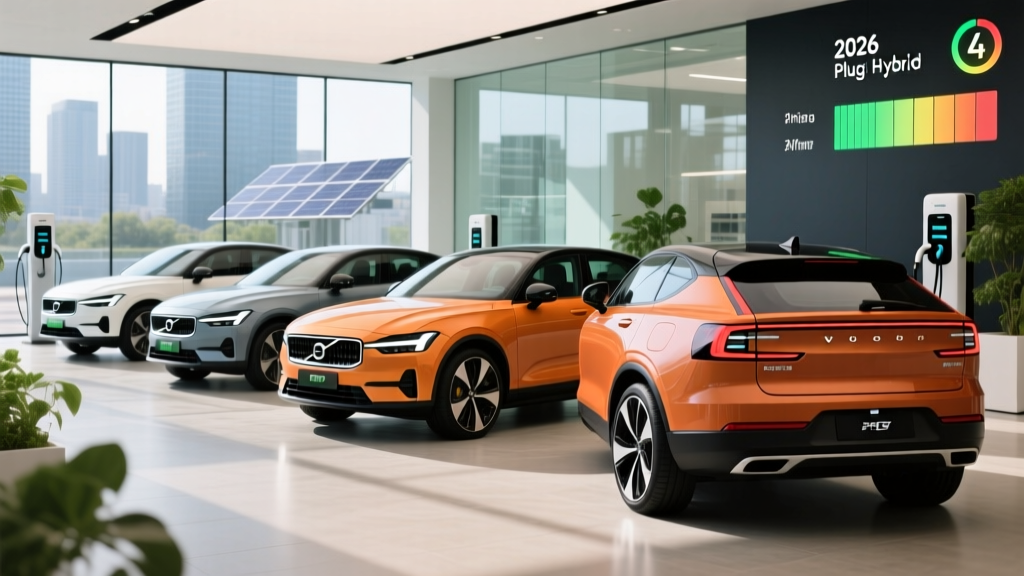
Volvo has committed its entire lineup to electrification, but the brand takes a distinct approach: rather than offering conventional self-charging hybrids (HEVs), Volvo sells only plug-in hybrids (PHEVs) under its "Recharge" badge alongside full battery-electric vehicles. If you're researching Volvo hybrid cars in 2026, you're looking at the T8 eAWD powertrain — a turbocharged and supercharged four-cylinder engine paired with an electric motor and an 18.8 kWh (usable) lithium-ion battery pack. This guide breaks down every current Volvo Recharge PHEV with the exact numbers buyers need: EPA MPG, electric-only range, charging times, pricing, and tax credit eligibility.
Volvo's Hybrid Strategy: All-In on Plug-In
Unlike Toyota or Honda, which offer both conventional hybrids and PHEVs, Volvo eliminated the conventional HEV from its U.S. lineup years ago. Every electrified Volvo you can buy today is either a Recharge PHEV (plug-in hybrid) or a fully electric Recharge model. This matters because PHEVs require access to charging — even if it's just a standard 120V household outlet — to realize their efficiency advantage.
Quick Distinction: HEV vs. PHEV
Conventional Hybrid (HEV): Small battery (1-2 kWh), recharges via regenerative braking and the engine. No plug. EPA MPG is consistent regardless of driving pattern. Examples: Toyota RAV4 Hybrid, Honda CR-V Hybrid.
Plug-In Hybrid (PHEV): Larger battery (15-25+ kWh), can be plugged in to charge. Offers 30-40+ miles of electric-only driving before the gas engine engages. If you never plug in, you get hybrid-like MPG but carry dead battery weight. All current Volvo hybrids are PHEVs.
The practical implication: a Volvo Recharge PHEV rewards drivers who charge regularly. If you have access to Level 2 charging at home or work and your daily commute falls under 35 miles, you may go weeks without visiting a gas station. If you never plug in, expect fuel economy closer to a conventional midsize luxury SUV — around 25-28 MPG combined.
2026 Volvo Recharge PHEV Lineup: Specs at a Glance
Volvo's T8 eAWD powertrain is shared across the lineup, but tuning, weight, and aerodynamics produce different EPA ratings per model. Here's the complete spec breakdown for the 2026 model year.
| Model | Body Style | Combined HP | 0-60 mph | Battery (usable) | EPA EV Range | EPA Combined MPG | Base MSRP |
|---|---|---|---|---|---|---|---|
| XC90 Recharge | 3-row SUV | 455 hp | 5.0 sec | 18.8 kWh | 32-33 mi | 27 MPG / 55 MPGe | $76,850 |
| XC60 Recharge | Compact SUV | 455 hp | 4.5 sec | 18.8 kWh | 35 mi | 28 MPG / 63 MPGe | $59,250 |
| S60 Recharge | Sedan | 455 hp | 4.1 sec | 18.8 kWh | 41 mi | 30 MPG / 69 MPGe | $53,850 |
| V60 Recharge | Wagon | 455 hp | 4.3 sec | 18.8 kWh | 38 mi | 30 MPG / 67 MPGe | $56,150 |
Source: fueleconomy.gov and Volvo Cars USA press materials. MSRP excludes destination charges. EPA figures reflect official ratings; real-world results vary.
Electric-Only Range: How Far Can You Go Without Gas?
The 18.8 kWh usable battery (gross capacity is approximately 19.7 kWh, with a software buffer to protect longevity) powers a rear-axle electric motor producing 143 hp and 228 lb-ft of torque. When the battery is depleted, the 2.0-liter turbocharged/supercharged four-cylinder engine takes over and drives all four wheels through an 8-speed automatic transmission.
The S60 Recharge sedan leads the pack with 41 miles of EPA-rated electric-only range — enough to cover the average American commute of roughly 16 miles each way (fueleconomy.gov). The heavier XC90 three-row SUV drops to 32-33 miles depending on trim and wheel size.
Real-World EV Range Expectations
EPA sticker: 32-41 miles depending on model.
Real-world warm weather (city/suburban): Expect to meet or slightly exceed EPA ratings — 35-44 miles is achievable in stop-and-go driving where regenerative braking recaptures energy efficiently.
Real-world highway (70+ mph): Electric-only range drops 20-30% due to aerodynamic drag. Expect 22-28 miles on the highway before the engine kicks in.
Cold weather (below 32°F): Battery chemistry loses efficiency and cabin heating demands energy. Expect 20-28 miles of EV range — roughly 30-35% reduction from the EPA sticker.
A key advantage of Volvo's PHEV system: when the battery depletes, you don't get range anxiety. The 15.9-gallon fuel tank gives total combined range of approximately 450-520 miles depending on the model, making these practical road-trip vehicles that happen to be electric for daily commuting.
Fuel Economy Breakdown: EPA MPG and MPGe
| Model | EV Mode (MPGe) | Gas Mode City | Gas Mode Highway | Gas Mode Combined |
|---|---|---|---|---|
| XC90 Recharge | 55 MPGe | 26 MPG | 28 MPG | 27 MPG |
| XC60 Recharge | 63 MPGe | 27 MPG | 29 MPG | 28 MPG |
| S60 Recharge | 69 MPGe | 29 MPG | 31 MPG | 30 MPG |
| V60 Recharge | 67 MPGe | 28 MPG | 32 MPG | 30 MPG |
Understanding MPGe: Miles Per Gallon Equivalent measures how far the vehicle travels on the same amount of energy as one gallon of gasoline (33.7 kWh). A 63 MPGe rating means the XC60 Recharge uses electricity roughly as efficiently as a 63 MPG gas car would — though your actual cost per mile depends on local electricity rates.
Real-world MPG note: When the battery is depleted and you're driving on gas alone, Volvo's PHEVs return fuel economy similar to a conventional luxury SUV in their class. The 27-30 MPG combined figures are competitive with the BMW X5 xDrive45e and ahead of the Porsche Cayenne E-Hybrid, but below the Lexus RX 450h+ (36 MPG combined on gas). If you charge daily and commute under 35 miles, you'll rarely use gas — many owners report using 5-10 gallons per month.
Charging the Volvo Recharge PHEV Battery
Volvo's T8 PHEVs use a relatively modest onboard charger, which keeps cost and weight down but means charging isn't as fast as a full BEV.
| Charging Level | Power (kW) | Time to Full (0-100%) | Miles of EV Range per Hour |
|---|---|---|---|
| Level 1 (120V household outlet) | ~1.4 kW | ~13-14 hours | ~3 miles/hr |
| Level 2 (240V home/public charger) | ~3.7 kW | ~5 hours | ~8 miles/hr |
| DC Fast Charging | Not supported | N/A | N/A |
Key limitation: Volvo Recharge PHEVs do not support DC fast charging (CCS, NACS, or CHAdeMO). The maximum charge rate is approximately 3.7 kW on Level 2. This is typical for PHEVs — the smaller battery makes DC fast charging less necessary — but it means you cannot top up quickly on a road trip. The practical solution: plug in at home overnight on a 240V Level 2 charger, and you'll wake up to a full battery every morning.
For home charging, a standard NEMA 14-50 outlet with a quality Level 2 EVSE (like the ChargePoint Home Flex or Emporia Vue) delivers a full charge in about 5 hours. Even a 120V outlet will replenish the battery overnight if you drive less than 30 miles daily — it adds roughly 3 miles of range per hour of charging.
Powertrain Deep Dive: 455 Horsepower, Standard AWD
Every Volvo Recharge PHEV uses the same T8 eAWD powertrain architecture:
- Engine: 2.0-liter inline-4, turbocharged and supercharged, producing 312 hp and 295 lb-ft (front axle)
- Electric motor: Rear-axle permanent-magnet motor, 143 hp and 228 lb-ft
- Combined output: 455 hp and 523 lb-ft of torque
- Transmission: 8-speed automatic (Geartronic)
- Drivetrain: eAWD — engine drives front wheels, motor drives rear wheels; no mechanical connection between axles
The eAWD system is sophisticated: in Pure mode, the car runs on electric power alone (rear-wheel drive). In Hybrid mode, the system seamlessly blends gas and electric. In Power mode, both powertrains deliver maximum output simultaneously for the quickest acceleration. The 4.1-second 0-60 time in the S60 Recharge makes it one of the quickest sedans in its price bracket.
Drive modes include Pure (EV-only), Hybrid (auto-blend), Power (maximum performance), and Off-Road (low-speed AWD with raised suspension on XC models). An AWD lock function at low speeds provides additional traction in snow and mud.
Pricing, Trims, and Tax Credit Eligibility
Volvo positions its Recharge PHEVs in the premium-to-luxury segment. Pricing reflects that positioning, but federal incentives can meaningfully reduce the effective cost.
| Model | Base MSRP | Federal Tax Credit (potential) | Effective Price (if eligible) |
|---|---|---|---|
| S60 Recharge | $53,850 | Up to $7,500 | ~$46,350 |
| V60 Recharge | $56,150 | Up to $7,500 | ~$48,650 |
| XC60 Recharge | $59,250 | Up to $7,500 | ~$51,750 |
| XC90 Recharge | $76,850 | Up to $7,500 | ~$69,350 |
Destination charges (~$1,195) not included. Higher trims (Plus, Ultimate, Polestar Engineered) add $5,000-$12,000+.
§30D Federal Tax Credit Requirements (2026)
The IRS §30D Clean Vehicle Credit provides up to $7,500 for qualifying new PHEVs. Eligibility depends on multiple factors:
- Vehicle MSRP cap: SUVs (XC60, XC90) must be under $80,000; sedans/wagons (S60, V60) must be under $55,000. Base and mid-trims qualify; loaded Ultimate or Polestar Engineered trims may exceed the cap.
- Buyer income limits: Modified AGI must not exceed $150,000 (single), $225,000 (head of household), or $300,000 (married filing jointly).
- Battery sourcing: The $7,500 credit splits into two halves — $3,750 for critical minerals sourcing and $3,750 for battery component manufacturing. Sourcing requirements tighten annually; verify current-year compliance on the IRS qualified vehicles list.
- Point-of-sale transfer: As of 2024, buyers can transfer the credit to the dealer at purchase, receiving the discount upfront rather than waiting to claim it on their tax return.
- PHEV minimum requirements: Battery capacity must be at least 7 kWh (Volvo's 18.8 kWh exceeds this), the vehicle must have a GVWR under 14,000 lbs, and it must have four wheels.
Important: Tax credit eligibility changes frequently as battery sourcing rules tighten. Always verify the specific model and trim on the IRS qualified vehicles list before purchasing. Consult a tax professional for your individual situation.
Battery Longevity, Warranty, and Reliability
Volvo PHEV Battery Warranty
Hybrid battery warranty: 8 years / 100,000 miles (whichever comes first)
Capacity retention guarantee: Volvo warrants the battery to retain at least 70% of its original capacity during the warranty period. If degradation exceeds 30%, Volvo will repair or replace the battery at no cost.
Powertrain warranty: 4 years / 50,000 miles (engine, transmission, motor)
Limited vehicle warranty: 4 years / 50,000 miles bumper-to-bumper
Real-world degradation data: Volvo's 18.8 kWh battery uses NMC (nickel-manganese-cobalt) chemistry, which offers high energy density but is more susceptible to calendar degradation than LFP. Based on owner reports from 2022-2024 T8 models (which share the same battery architecture), most drivers see 5-10% capacity loss over the first three years — well within the 70% warranty threshold. The software buffer (approximately 0.9 kWh reserved at the top and bottom of the pack) protects the cells from the deep cycling that accelerates wear.
Battery replacement cost: If the battery fails outside of warranty, replacement cost at a Volvo dealer typically ranges from $8,000 to $12,000 for the pack itself, plus labor. However, catastrophic battery failure in the T8 system is rare based on current data. Individual module replacement may be possible, reducing cost.
Reliability: Volvo's T8 powertrain has been in production since 2015 (with the current 18.8 kWh battery introduced for 2023). The system is mature, and major issues are uncommon. The most frequently reported complaints involve software glitches in the infotainment system (Google-based Android Automotive OS) rather than powertrain hardware. IIHS consistently rates Volvo models as Top Safety Pick+ recipients, and the NHTSA awards 5-star overall ratings.
Volvo Recharge vs. Full EV vs. Gas: Which Fits You?
Choose a Volvo Recharge PHEV if:
- You can charge at home (Level 2 preferred, 120V acceptable for short commutes)
- Your daily driving is under 40 miles but you take regular road trips over 200 miles
- You want electric commuting without range anxiety or public charging dependency
- You value Scandinavian design, standard AWD, and 455 hp performance
- You want a 3-row SUV option (XC90) with electric daily driving
Choose a full EV (like the Volvo EX90 or EX40) if:
- You have reliable home and/or workplace Level 2 charging
- You want zero tailpipe emissions and minimal maintenance (no oil changes, no engine)
- Your road trips are infrequent or you're comfortable planning around DC fast chargers
- You want the lowest per-mile fuel cost (electricity is cheaper than gasoline almost everywhere)
Choose a conventional hybrid (Toyota RAV4 Hybrid, Honda CR-V Hybrid) if:
- You cannot charge at home or at work (apartment, street parking, no outlet access)
- You want maximum fuel efficiency with zero behavior change — no plugging in required
- Your budget is under $40,000
- You prioritize proven long-term reliability data over luxury features
Volvo Recharge PHEV Pros
- 41 miles EV range (S60) covers most commutes gas-free
- 455 hp with standard AWD — genuinely quick in all conditions
- No range anxiety: 450+ miles total range with gas engine backup
- Up to $7,500 federal tax credit (verify eligibility per trim)
- Premium Scandinavian interior, Google-based infotainment
- Top safety ratings from IIHS and NHTSA
- Mature powertrain (T8 in production since 2015, current gen since 2023)
Volvo Recharge PHEV Cons
- No DC fast charging — Level 2 only, ~5 hours to full
- 3.7 kW onboard charger is slow for public Level 2 stations
- Gas-only MPG (27-30 combined) is merely average for the class
- Premium pricing — starts $53K-$77K before options
- MSRP cap may disqualify higher trims from federal tax credit
- NMC battery chemistry degrades faster than LFP in extreme heat
- Android Automotive infotainment has had software complaints
Frequently Asked Questions
How many MPG does a Volvo hybrid get?
On gasoline alone (battery depleted), Volvo Recharge PHEVs return 27-30 MPG combined depending on the model — 27 MPG for the XC90 Recharge, 28 MPG for the XC60, and 30 MPG for the S60 and V60. In electric mode, they achieve 55-69 MPGe. If you charge daily and drive under 35 miles, your effective fuel consumption can drop to near zero for daily driving.
How far can a Volvo PHEV go on electric only?
EPA-rated electric-only range varies by model: 41 miles for the S60 Recharge, 38 miles for the V60, 35 miles for the XC60, and 32-33 miles for the XC90. Real-world range is typically 22-28 miles on the highway and may drop 30-35% in freezing temperatures. City driving with regenerative braking often meets or exceeds EPA estimates.
Do Volvo hybrid cars need to be plugged in?
Yes — all current Volvo hybrid cars are plug-in hybrids (PHEVs). While the car will still drive on gasoline if you never plug it in, you forfeit the entire efficiency advantage. Without regular charging, you're carrying 400+ lbs of battery weight for no benefit, and your fuel economy drops to 27-30 MPG. If you cannot charge at home or work, a conventional hybrid (like the Toyota RAV4 Hybrid) is a better fit.
Is the Volvo Recharge PHEV reliable? What does battery replacement cost?
The T8 eAWD powertrain has been in production since 2015 and received a major battery upgrade for 2023 (from 11.6 to 18.8 kWh usable). Powertrain reliability is generally strong, with most complaints focused on infotainment software rather than mechanical issues. The hybrid battery is warrantied for 8 years / 100,000 miles with a 70% capacity retention guarantee. Out-of-warranty battery replacement costs approximately $8,000-$12,000, though full pack failure is rare based on current data.
Does the Volvo Recharge PHEV qualify for the $7,500 federal tax credit?
Most Volvo Recharge PHEVs qualify for up to $7,500 under the IRS §30D Clean Vehicle Credit, but eligibility depends on the specific trim's MSRP (sedans/wagons must be under $55,000; SUVs under $80,000), your income (single filers under $150K AGI; joint filers under $300K), and current battery sourcing compliance. Base and mid-level trims typically qualify; loaded Ultimate or Polestar Engineered trims may exceed MSRP caps. The credit can be transferred to the dealer at point of sale for an upfront discount. Always verify on the IRS qualified vehicles list before purchasing.
How long does it take to charge a Volvo PHEV?
On a 240V Level 2 home charger (3.7 kW), a full charge takes approximately 5 hours. On a standard 120V household outlet (Level 1, ~1.4 kW), a full charge takes 13-14 hours. Volvo Recharge PHEVs do not support DC fast charging. For most owners, overnight Level 2 charging at home is the practical solution — plug in when you get home and wake up to a full battery.
Volvo PHEV vs. full EV: which should I buy?
If you can charge at home, drive under 40 miles daily, but take road trips several times a year where charging infrastructure concerns you, the PHEV is the pragmatic choice — you get electric commuting with gas-engine flexibility. If you're ready to commit fully to electric, want the lowest operating costs, and don't mind route-planning on road trips, Volvo's full EVs (EX40, EX90) offer 250-300+ miles of range with DC fast charging. If you cannot charge at home, skip the PHEV entirely and buy a conventional hybrid instead.
All specifications reflect 2026 model year data available at time of publication. Pricing, tax credit eligibility, and EPA ratings are subject to change. Verify current figures on fueleconomy.gov and with your local Volvo dealer before purchasing.