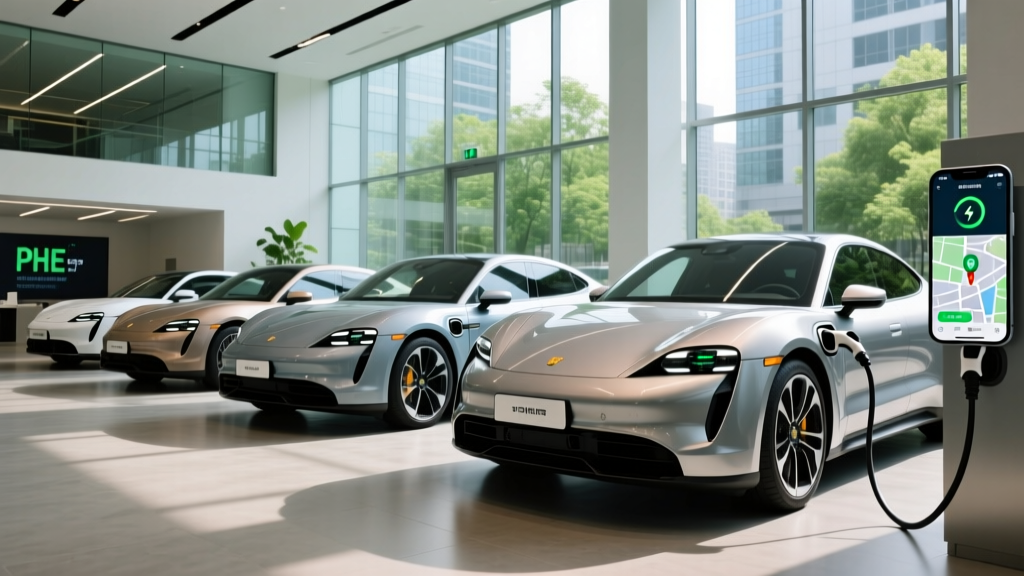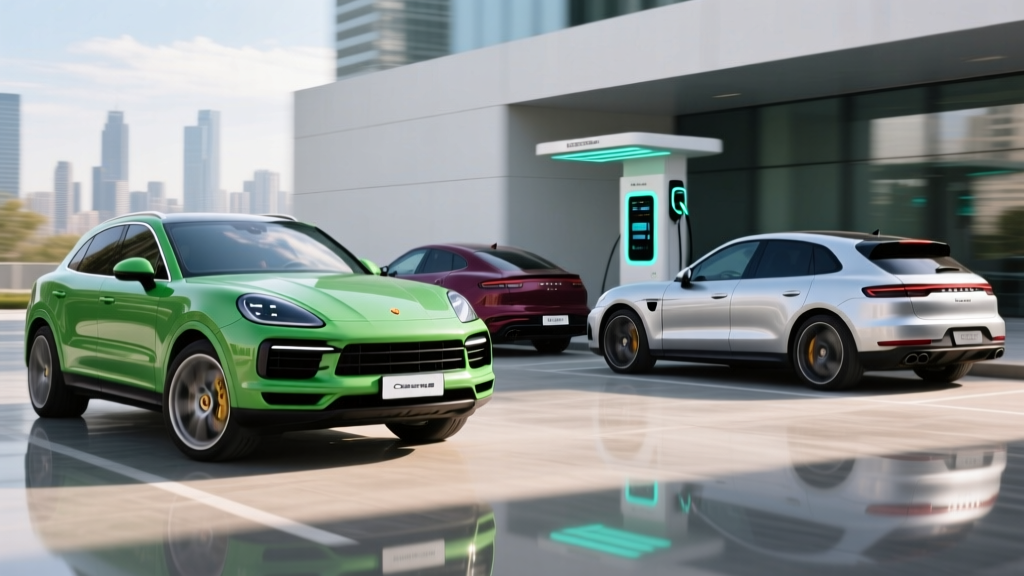
Porsche has committed to electrification harder than most legacy sports-car brands, but its hybrid lineup is easy to misread. As of the 2026 model year, Porsche sells three plug-in hybrid (PHEV) models in the United States: the Cayenne E-Hybrid, the Panamera E-Hybrid, and the all-new Macan Hybrid. There are no conventional (non-plug-in) hybrids in the current U.S. lineup. Each model pairs a turbocharged combustion engine with an electric motor and a high-voltage battery you charge from a wall outlet or public charger — and each targets a very different buyer.
This guide breaks down every Porsche hybrid by the numbers that matter: EPA fuel economy, real-world electric-only range, battery capacity in kWh, charging speed in kW, combined horsepower, MSRP, and whether any of them qualify for the federal §30D tax credit. If you're cross-shopping a BMW X5 xDrive50e, Mercedes-AMG GT 63 S E Performance, or a full EV like the Taycan, the data below will clarify which Porsche hybrid — if any — fits your daily driving.
HEV vs PHEV: What Porsche Actually Sells
Conventional Hybrid (HEV): A small battery (typically 1–2 kWh) recharged only by regenerative braking and the engine. No plug. MPG gains come from engine load-leveling and electric assist at low speeds. Examples: Toyota RAV4 Hybrid, Honda CR-V Hybrid.
Plug-in Hybrid (PHEV): A larger battery (15–30+ kWh) you charge from an external power source. Provides meaningful electric-only range (typically 20–50 miles) before the gas engine engages. All current Porsche hybrids are PHEVs.
Porsche does not offer any HEV models in the U.S. for 2026. Every hybrid badge on a Porsche showroom floor is a plug-in. This is a critical distinction because PHEVs require charging infrastructure to deliver their advertised efficiency — drive a PHEV without ever plugging in, and you'll get worse fuel economy than a comparable HEV due to the dead weight of the battery pack.
2026 Porsche Cayenne E-Hybrid: Specs, Range, and MPG
| Specification | Cayenne E-Hybrid | Cayenne S E-Hybrid | Cayenne Turbo E-Hybrid |
|---|---|---|---|
| Powertrain | 3.0L V6 turbo + electric motor | 3.0L V6 turbo + electric motor | 4.0L V8 twin-turbo + electric motor |
| Combined HP | 389 hp | 512 hp | 729 hp |
| 0–60 mph | 5.5 sec | 4.5 sec | 3.6 sec |
| Battery (usable) | 25.9 kWh | 25.9 kWh | 25.9 kWh |
| EPA Electric Range | 32 mi | 30 mi | 28 mi |
| EPA MPGe (combined) | 52 MPGe | 49 MPGe | 46 MPGe |
| EPA MPG (gas only, combined) | 21 MPG | 20 MPG | 18 MPG |
| Total Combined Range | ~430 mi | ~410 mi | ~390 mi |
| Max AC Charge Rate | 11 kW (Level 2) | 11 kW (Level 2) | 11 kW (Level 2) |
| DC Fast Charge | No | No | No |
| 10–100% L2 Charge Time | ~2 hr 45 min | ~2 hr 45 min | ~2 hr 45 min |
| Starting MSRP | $91,900 | $104,400 | $149,900 |
The Cayenne E-Hybrid is Porsche's volume hybrid for good reason: it's a practical luxury SUV with enough electric range to cover most commutes. The 25.9 kWh usable battery is one of the largest in the PHEV SUV segment, and the EPA's fueleconomy.gov listing confirms the 32-mile electric-only figure for the base E-Hybrid.
Once the battery depletes, the Cayenne operates as a parallel hybrid. The EPA combined gas-only rating of 21 MPG is respectable for a 5,000+ lb SUV, and real-world city driving often yields 22–24 MPG thanks to aggressive regenerative braking recapturing energy in stop-and-go traffic. Highway-only gas mileage drops to 18–19 MPG — heavy vehicles fight aerodynamic drag, and no hybrid system fully overcomes physics at 75 mph.
2026 Porsche Panamera E-Hybrid: The Executive PHEV
| Specification | Panamera 4 E-Hybrid | Panamera 4S E-Hybrid | Panamera Turbo S E-Hybrid |
|---|---|---|---|
| Powertrain | 2.9L V6 twin-turbo + e-motor | 2.9L V6 twin-turbo + e-motor | 4.0L V8 twin-turbo + e-motor |
| Combined HP | 463 hp | 537 hp | 717 hp |
| 0–60 mph | 4.7 sec | 4.1 sec | 3.5 sec |
| Battery (usable) | 25.9 kWh | 25.9 kWh | 25.9 kWh |
| EPA Electric Range | 35 mi | 33 mi | 30 mi |
| EPA MPGe (combined) | 55 MPGe | 52 MPGe | 48 MPGe |
| EPA MPG (gas only, combined) | 23 MPG | 22 MPG | 19 MPG |
| Total Combined Range | ~460 mi | ~440 mi | ~400 mi |
| Max AC Charge Rate | 11 kW (Level 2) | 11 kW (Level 2) | 11 kW (Level 2) |
| DC Fast Charge | No | No | No |
| Starting MSRP | $109,800 | $126,200 | $197,400 |
The Panamera sedan benefits from a lower, more aerodynamic profile than the Cayenne, which translates directly to better electric range and gas-only MPG. The 35-mile EPA electric range on the 4 E-Hybrid is enough to cover an average American commute (roughly 16 miles each way, per the U.S. Census Bureau) entirely on electricity — with margin to spare for errands.
On a Level 2 home charger at 11 kW, a full charge takes about 2 hours and 45 minutes. Porsche does not offer DC fast charging on any of its PHEVs — a notable omission compared to rivals like the BMW XM, which accepts up to 7.4 kW AC but also lacks DC capability. The absence of DC charging means road-trip top-ups are impractical; plan to charge at home or at destination Level 2 chargers.
2026 Porsche Macan Hybrid: The New Entry Point
For 2026, Porsche introduced a hybrid variant of the redesigned Macan alongside the fully electric Macan EV. The Macan Hybrid targets buyers who want the Macan's compact footprint and Porsche dynamics but aren't ready to commit to a battery-electric vehicle.
| Specification | Macan Hybrid | Macan S Hybrid |
|---|---|---|
| Powertrain | 2.0L I4 turbo + e-motor | 2.0L I4 turbo + e-motor |
| Combined HP | 335 hp | 402 hp |
| 0–60 mph | 5.8 sec | 4.9 sec |
| Battery (usable) | 17.9 kWh | 17.9 kWh |
| EPA Electric Range | 27 mi (est.) | 25 mi (est.) |
| EPA MPG (gas only, combined) | 25 MPG (est.) | 24 MPG (est.) |
| Total Combined Range | ~380 mi (est.) | ~370 mi (est.) |
| Max AC Charge Rate | 11 kW (Level 2) | 11 kW (Level 2) |
| DC Fast Charge | No | No |
| Starting MSRP | $68,900 (est.) | $79,500 (est.) |
Note: The Macan Hybrid's EPA figures are preliminary estimates based on Porsche's announced specifications. Final EPA certification was pending at the time of writing. Check fueleconomy.gov for confirmed numbers.
The Macan Hybrid's smaller 17.9 kWh battery reflects its lighter, more compact platform. The trade-off is reduced electric-only range compared to the Cayenne and Panamera, but the lower starting price makes it the most accessible Porsche PHEV. For buyers with a sub-25-mile commute and home charging, the Macan Hybrid can function as a weekday EV and a weekend gas car.
Porsche Hybrid Battery Warranty and Reliability
Porsche's hybrid system has proven robust since the Panamera S Hybrid debuted in 2011 and the Cayenne S E-Hybrid followed in 2014. The current-generation PHEV powertrain uses a permanently excited synchronous electric motor integrated into the 8-speed PDK transmission — a design with fewer failure points than belt-driven hybrid systems. The high-voltage battery uses NMC (nickel-manganese-cobalt) pouch cells with liquid thermal management, which Porsche has used since 2019 with no widespread degradation recalls.
If a battery replacement is needed out of warranty, expect a cost between $12,000 and $18,000 depending on the model and labor. This is comparable to BMW and Mercedes-Benz PHEV battery replacement pricing. However, data from long-term Porsche hybrid owners suggests most packs retain 85–92% of original capacity after 8 years of normal use, making out-of-warranty failure uncommon.
Federal Tax Credit Eligibility for Porsche PHEVs
Under current IRS §30D rules, plug-in hybrids with a battery capacity of at least 7 kWh are potentially eligible for up to $7,500 in federal tax credits — but eligibility hinges on three factors that eliminate most Porsche PHEVs:
- MSRP Cap: SUVs must be under $80,000; sedans under $55,000. The Cayenne E-Hybrid starts at $91,900, the Panamera at $109,800, and even the Macan Hybrid (est. $68,900) likely exceeds the SUV cap when equipped with typical options.
- Income Cap: Buyer AGI must not exceed $150,000 (single), $225,000 (head of household), or $300,000 (joint).
- Battery Sourcing: Critical minerals and battery components must meet escalating domestic-content thresholds. Porsche sources battery cells from suppliers that may not satisfy 2026 critical-mineral requirements.
Bottom line: As of 2026, no Porsche hybrid is expected to qualify for the full $7,500 federal credit. The Macan Hybrid's base MSRP may fall under the $80,000 SUV cap, but battery-sourcing requirements remain a barrier. Always verify eligibility on the IRS Clean Vehicle credit page and consult a tax professional before purchasing. Some states offer additional PHEV rebates (California's CVRP, for example) — check your state's energy office for current programs.
Real-World MPG: What Owners Actually See
| Model | EPA Combined (gas) | Real-World City | Real-World Highway | Notes |
|---|---|---|---|---|
| Cayenne E-Hybrid | 21 MPG | 22–24 MPG | 18–19 MPG | Regen excels in city; aero hurts on highway |
| Panamera 4 E-Hybrid | 23 MPG | 24–27 MPG | 20–22 MPG | Lower, sleeker body aids efficiency |
| Macan Hybrid | 25 MPG (est.) | 26–28 MPG (est.) | 22–24 MPG (est.) | Lightest PHEV in Porsche lineup |
Like all hybrids, Porsche PHEVs tend to exceed their EPA city ratings because regenerative braking recovers energy that would otherwise be lost as heat in the brake rotors. Highway driving tells the opposite story: at sustained speeds above 65 mph, aerodynamic drag dominates, and the engine does most of the work with minimal regen benefit. The Panamera's sedan shape gives it a measurable advantage over the bluff-fronted Cayenne at highway speeds.
Owners who charge nightly and commute under 30 miles report using gasoline only for weekend trips — effectively achieving 80–100 MPGe on an annualized basis. Owners who rarely charge report 17–20 MPG in the Cayenne and 20–23 MPG in the Panamera, which is worse than a comparably sized conventional hybrid. A PHEV rewards disciplined charging habits; neglect the plug and you're hauling 400+ pounds of battery for nothing.
Who Should Buy a Porsche Hybrid vs. a Full EV or Gas Car
Choose a Porsche PHEV if:
- Your commute is under 35 miles round-trip and you can charge at home (Level 2 strongly recommended)
- You take regular road trips exceeding 250 miles and don't want to plan around DC fast-charging stops
- You want Porsche performance (sub-5-second 0–60, sport-tuned air suspension) with reduced fuel costs on daily drives
- You live in a region with harsh winters where EV range loss is a genuine concern
Choose a full EV (e.g., Porsche Taycan) if:
- You have reliable home and/or workplace charging and rarely drive more than 250 miles in a single day
- You want zero tailpipe emissions and minimal maintenance (no oil changes, no spark plugs, no exhaust system)
- You prioritize the lowest cost per mile — electricity at $0.14/kWh costs roughly $0.04/mile in a Taycan vs. $0.15/mile in a Cayenne E-Hybrid on gas
Choose a gas-only vehicle if:
- You cannot install a home charger (apartment, street parking, no garage)
- Your annual mileage is under 8,000 miles, making the PHEV price premium hard to recoup
- You frequently tow near maximum capacity (hybrid systems add weight that reduces payload)
Porsche PHEV Pros
- 30–35 miles of electric commuting with no range anxiety on longer trips
- Porsche-level performance: 389–729 hp depending on model
- 25.9 kWh battery (Cayenne/Panamera) is among the largest in the PHEV segment
- 8-year/100,000-mile battery warranty
- Strong resale value relative to non-luxury PHEVs
Porsche PHEV Cons
- No DC fast charging on any model — road-trip charging is impractical
- MSRP well above federal tax credit caps — no $7,500 §30D credit
- Premium fuel required (91 octane minimum) increases gas-only operating cost
- PHEV price premium of $8,000–$15,000 over gas-only Porsche equivalents
- Heavy: 5,000+ lbs for Cayenne, affecting tire wear and braking distances
Frequently Asked Questions
How many MPG does a Porsche hybrid get?
On gasoline alone (battery depleted), the 2026 Cayenne E-Hybrid achieves 21 MPG combined (EPA), the Panamera 4 E-Hybrid gets 23 MPG combined, and the Macan Hybrid is estimated at 25 MPG combined. In real-world city driving with regenerative braking, owners typically see 2–4 MPG above the EPA city rating. With regular charging, annualized fuel economy can exceed 80 MPGe.
How far can a Porsche PHEV go on electric only?
The 2026 Panamera 4 E-Hybrid leads the lineup at 35 miles EPA electric-only. The Cayenne E-Hybrid delivers 32 miles, and the Macan Hybrid is estimated at 27 miles. Real-world range is typically 15–25% lower in cold weather or at sustained highway speeds above 70 mph.
Do Porsche hybrids qualify for the federal tax credit?
Under current IRS §30D rules, no Porsche PHEV is expected to qualify for the full $7,500 federal tax credit in 2026. All models exceed or approach the MSRP cap, and battery-sourcing requirements present an additional barrier. State-level incentives may apply — check your state energy office.
Can I charge a Porsche PHEV at a DC fast charger?
No. All Porsche PHEVs accept only AC charging — up to 11 kW on a Level 2 home or public charger. There is no DC fast-charge port on any Porsche plug-in hybrid. A full 0–100% Level 2 charge takes approximately 2 hours and 45 minutes for the Cayenne and Panamera.
What does a Porsche hybrid battery replacement cost?
Out-of-warranty high-voltage battery replacement for a Porsche PHEV costs between $12,000 and $18,000 including parts and labor. Porsche's battery warranty covers 8 years or 100,000 miles against defects and capacity loss below 70%. Real-world data suggests most packs retain 85–92% capacity at the 8-year mark, making replacement rare during typical ownership.
Hybrid vs PHEV vs EV — which Porsche should I buy?
Porsche doesn't sell conventional (non-plug-in) hybrids in the U.S. — every hybrid is a PHEV. If you can charge at home and want the flexibility of gas for road trips, a Porsche PHEV is the right call. If you have reliable charging and drive under 250 miles daily, the all-electric Taycan offers lower running costs and less maintenance. If you can't charge at home at all, a PHEV's advantages evaporate — consider a gas-only model or address charging access first.