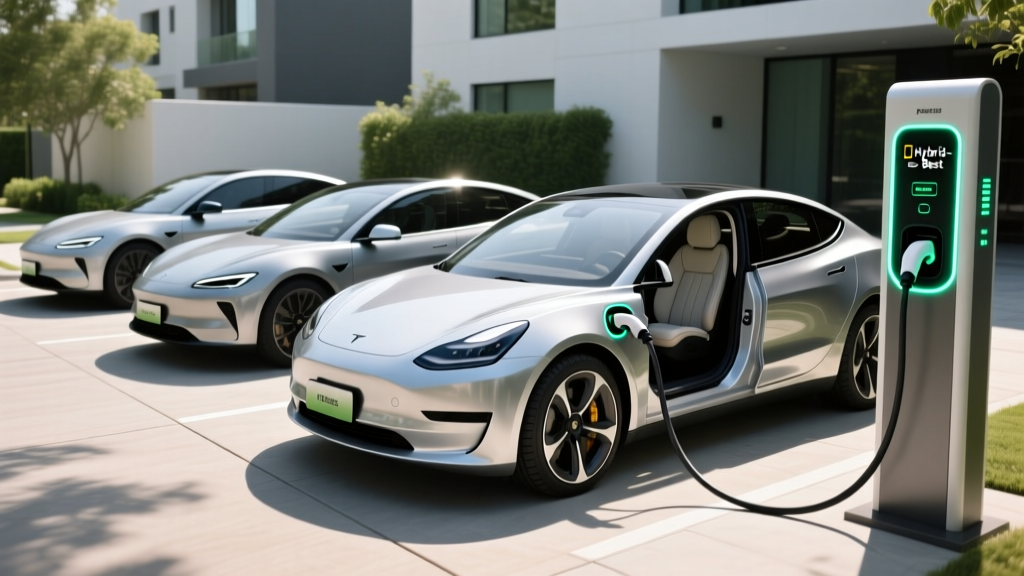
If you want electric commuting without range anxiety on road trips, a plug in hybrid EV (PHEV) may be your ideal bridge. Unlike a conventional hybrid that you never plug in, a PHEV carries a larger battery you charge at home or at public stations, delivering 25–45 miles of pure electric driving before a gasoline engine seamlessly takes over for hundreds of additional miles.
This guide breaks down the top PHEV models available in 2026, compares them against standard hybrids and full battery-electric vehicles (BEVs), and gives you the exact numbers — EPA MPG, electric-only range, battery kWh, pricing, and federal tax credit eligibility — to make an informed decision.
Plug In Hybrid EV vs. Conventional Hybrid vs. Full EV
Before comparing specific models, it's critical to understand the three electrified powertrain types. Confusion here is the number-one mistake buyers make.
| Feature | Conventional Hybrid (HEV) | Plug-In Hybrid (PHEV) | Battery Electric (BEV) |
|---|---|---|---|
| Plugs in to charge? | No — charges via regen & engine | Yes — Level 1/2 charging | Yes — Level 1/2/DC fast |
| Electric-only range | 0–2 miles (low-speed only) | 25–45 miles (typical) | 200–400+ miles |
| Gasoline engine? | Yes (primary) | Yes (backup after EV range) | No |
| Total range | 450–600 miles | 400–550+ miles combined | 200–400+ miles |
| Federal tax credit (§30D) | No | Up to $7,500 (if eligible) | Up to $7,500 (if eligible) |
| Home charging needed? | No | Recommended for full benefit | Essential |
The bottom line: A conventional hybrid (like the Toyota Prius) never plugs in and gets excellent MPG but offers no meaningful electric-only driving. A PHEV gives you a real EV commute on battery power, then unlimited gas range for road trips. A full BEV eliminates gas entirely but requires charging infrastructure.
Top Plug In Hybrid EVs for 2026: Specs Compared
Here are the standout PHEVs currently on sale, ranked by electric-only range — the single most important spec for daily commuters who want to drive on electricity.
| Model | Battery (kWh) | EV Range (mi) | Combined HP | EPA MPG (combined, gas) | MPGe (EV mode) | Base MSRP |
|---|---|---|---|---|---|---|
| 2026 Toyota RAV4 Prime | 18.1 kWh | 42 mi | 302 hp | 38 MPG | 94 MPGe | $44,985 |
| 2026 Chrysler Pacifica PHEV | 16.0 kWh | 32 mi | 260 hp | 30 MPG | 82 MPGe | $51,095 |
| 2026 Hyundai Tucson PHEV | 13.8 kWh | 33 mi | 261 hp | 35 MPG | 80 MPGe | $39,445 |
| 2026 Jeep Wrangler 4xe | 17.3 kWh | 22 mi | 375 hp | 20 MPG | 49 MPGe | $51,790 |
| 2026 Toyota Prius Prime | 13.6 kWh | 44 mi | 220 hp | 48 MPG | 114 MPGe | $34,085 |
| 2026 Kia Sportage PHEV | 13.8 kWh | 34 mi | 261 hp | 35 MPG | 84 MPGe | $39,890 |
Sources: fueleconomy.gov, manufacturer specifications. MSRP reflects base trim before destination charges.
How Many MPG Does a Plug In Hybrid EV Actually Get?
PHEV fuel economy depends entirely on how you use it. The EPA publishes two numbers for every PHEV:
- MPGe (electric mode): Miles-per-gallon-equivalent when running on battery. The Prius Prime achieves 114 MPGe — meaning it uses energy at a rate equivalent to a 114 MPG gas car.
- MPG (gas mode): Once the battery depletes, the PHEV operates as a conventional hybrid. The RAV4 Prime returns 38 MPG combined in this mode, according to EPA data.
| Model | EPA City (gas) | EPA Highway (gas) | EPA Combined (gas) | MPGe (EV mode) |
|---|---|---|---|---|
| Toyota Prius Prime | 50 MPG | 47 MPG | 48 MPG | 114 MPGe |
| Toyota RAV4 Prime | 40 MPG | 36 MPG | 38 MPG | 94 MPGe |
| Hyundai Tucson PHEV | 37 MPG | 34 MPG | 35 MPG | 80 MPGe |
| Kia Sportage PHEV | 37 MPG | 34 MPG | 35 MPG | 84 MPGe |
| Chrysler Pacifica PHEV | 30 MPG | 31 MPG | 30 MPG | 82 MPGe |
| Jeep Wrangler 4xe | 20 MPG | 20 MPG | 20 MPG | 49 MPGe |
Real-world reality check: Hybrids — including PHEVs in gas mode — often exceed their EPA city ratings in stop-and-go driving because regenerative braking recaptures energy that gas cars waste as heat. Expect real-world city MPG to run 2–5 MPG above the sticker for most models. Highway MPG tends to track closely with or slightly below the EPA estimate, particularly at speeds above 75 mph where aerodynamic drag dominates.
If your daily commute is within the PHEV's electric range and you charge nightly, you may use gasoline only a handful of times per year. A Prius Prime owner with a 20-mile round-trip commute could go months between fill-ups.
How Far Can a Plug In Hybrid EV Go on Electric Only?
Electric-only range is where PHEVs live or die. If your commute exceeds the EV range, the engine fires up and you're burning gas. Here's how the top models stack up — and what to expect in the real world:
EPA vs. Real-World EV Range
The EPA electric-range figure assumes moderate temperatures and mixed driving. In practice:
- Highway driving (70+ mph): Expect 15–25% less EV range due to aerodynamic drag. A RAV4 Prime rated at 42 miles may deliver 32–35 miles at highway speed.
- Cold weather (below 32°F): Battery chemistry slows and cabin heating draws significant power. Expect 20–40% range loss. That 44-mile Prius Prime may manage only 28–35 miles in a Minnesota January.
- Preconditioning helps: Most PHEVs let you pre-heat the cabin while plugged in, preserving battery for actual driving.
Total combined range (electric + full gas tank) is where PHEVs shine for road trips. The RAV4 Prime delivers roughly 42 miles electric + 460+ miles on gas for a total exceeding 500 miles. The Prius Prime can stretch past 550 miles combined. No range anxiety, no charging-desert worries.
Charging a PHEV: What You Need to Know
PHEV batteries are small (13–18 kWh) compared to full EVs (60–100+ kWh), so charging is faster and simpler — but there are important limitations.
| Charging Level | Power (kW) | Typical Time (0–100%) | Availability |
|---|---|---|---|
| Level 1 (120V household outlet) | 1.2–1.4 kW | 10–14 hours | Anywhere with a standard outlet |
| Level 2 (240V home/public) | 3.3–7.2 kW | 2–5 hours | Home wallbox, public stations |
| DC Fast Charge | Varies | ~25–40 min (10–80%) | Limited — only some PHEVs support it |
Critical note on DC fast charging: Most PHEVs on the market do not support DC fast charging. The Mitsubishi Outlander PHEV is a rare exception. For the Toyota RAV4 Prime, Prius Prime, Tucson PHEV, and Pacifica PHEV, Level 2 is your fastest option. Plan accordingly: a Level 2 home charger (240V) is strongly recommended to fully recharge overnight.
Level 1 charging from a standard 120V outlet works, but a full charge may take 12+ hours — fine if your car sits in the garage every night, but tight if you need a midday top-up.
Pricing and Federal Tax Credit Eligibility
PHEVs carry a price premium over their conventional hybrid siblings — typically $5,000–$10,000 more — but the federal §30D tax credit can offset a significant portion of that gap.
2026 Federal Tax Credit Rules (§30D) for PHEVs:
- Credit amount: Up to $7,500, split between critical minerals ($3,750) and battery components ($3,750) requirements
- Battery capacity: Must have at least 7 kWh — all PHEVs listed here qualify
- MSRP caps: Vans/SUVs/pickups ≤ $80,000; sedans ≤ $55,000
- Buyer income caps: AGI ≤ $150,000 (single), $225,000 (head of household), $300,000 (joint)
- Battery sourcing: Critical minerals and battery components must meet phased-in domestic/free-trade sourcing percentages — this changes annually and disqualifies some models
- Point-of-sale transfer: Eligible buyers can transfer the credit to the dealer for an immediate price reduction at purchase
Source: IRS.gov §30D Clean Vehicle Credits. Eligibility rules change frequently — verify current status before purchasing.
Which PHEVs likely qualify? The Toyota Prius Prime (MSRP under $55K sedan cap) is positioned well for the credit, though Toyota's battery sourcing compliance must be verified for the current model year. The RAV4 Prime, Tucson PHEV, and Sportage PHEV fall under the $80,000 SUV cap. The Wrangler 4xe and Pacifica PHEV also fall within SUV/van caps. However, battery-sourcing requirements have disqualified several previously eligible models — always check the latest fueleconomy.gov tax credit tool before purchasing.
Many states offer additional PHEV rebates or HOV-lane access. California's CVRP program, Colorado's state credit, and New York's Drive Clean Rebate are examples — but amounts and eligibility vary by jurisdiction. Check your state energy office for current programs.
Is a Plug In Hybrid EV Reliable? Battery Lifespan and Warranty
Hybrid and PHEV powertrains have matured over two decades of real-world use. Toyota's Hybrid Synergy Drive, now in its fourth generation, has an extensive reliability track record across millions of vehicles. Hyundai/Kia back their PHEV systems with strong warranties. The electric motors in PHEVs have fewer moving parts than conventional transmissions and tend to be extremely durable.
PHEV Battery Warranty Coverage:
- Federal minimum: All PHEV batteries carry at least 8 years / 100,000 miles of warranty coverage (mandated for emissions-related components)
- California-emissions states: Extended to 10 years / 150,000 miles in CARB states (CA, CT, ME, MD, MA, NJ, NY, OR, RI, VT, WA, and others adopting CARB standards)
- Hyundai/Kia: 10 years / 100,000 miles nationwide on hybrid/PHEV battery
- Toyota: 10 years / 150,000 miles on hybrid battery for 2020+ models
Battery replacement cost: If a PHEV battery fails out of warranty, replacement typically costs $3,000–$7,000 depending on the model. The smaller PHEV batteries are significantly cheaper to replace than full EV packs ($10,000–$20,000+). In practice, PHEV battery failures before 150,000 miles are rare — degradation is gradual, typically losing 10–15% capacity over 10 years.
Overall reliability: PHEVs from Toyota, Hyundai, and Kia consistently earn average-to-above-average reliability ratings from Consumer Reports and J.D. Power. The dual powertrain adds some complexity (both an engine and a large electric motor/battery system), but these components are well-proven. Jeep's Wrangler 4xe has drawn more mixed reliability scores, with some owners reporting electrical gremlins — worth researching on owner forums before purchasing.
PHEV vs. Hybrid vs. EV: Which Should You Choose?
Choose a plug in hybrid EV if:
- Your daily commute is under 40 miles round-trip and you can charge at home
- You take road trips of 200+ miles regularly and don't want to plan around charging stations
- You live in an apartment or area with limited public charging but have access to a home outlet or Level 2 charger
- You want to reduce gas consumption dramatically without committing to full electric
Choose a conventional hybrid (HEV) if:
- You cannot charge at home (no garage, no outlet access, apartment living without charging)
- Your budget is tighter and you want maximum MPG at the lowest purchase price
- You don't care about electric-only driving — you just want great fuel economy without plugging in
Choose a full battery-electric vehicle (BEV) if:
- You have reliable home Level 2 charging and your daily driving is under 250 miles
- You want to eliminate gasoline entirely and minimize maintenance (no oil changes, no engine)
- You want the lowest per-mile fuel cost — electricity at $0.14/kWh costs roughly $4.50 to go 100 miles vs. $12+ for a 30 MPG gas car at $3.60/gallon
- You're ready to plan road trips around DC fast-charging networks
Pros and Cons of Plug In Hybrid EVs
Pros
- 30–44 miles of zero-emission electric commuting covers most daily trips
- 400–550+ miles total range eliminates range anxiety on road trips
- Up to $7,500 federal tax credit (if eligible) offsets the price premium
- Excellent gas MPG (30–48 combined) when running in hybrid mode
- Proven reliability with 8–10 year battery warranties
- Smaller battery means lower replacement cost if needed ($3K–$7K vs $10K–$20K+ for BEVs)
Cons
- $5,000–$10,000 price premium over conventional hybrid versions
- Most PHEVs lack DC fast charging — Level 2 is the practical max
- EV range drops 20–40% in cold weather
- Maintenance burden of two powertrains (engine oil, filters, plus battery/motor system)
- Reduced cargo space in some models due to larger battery packaging
- Tax credit eligibility depends on sourcing rules that change yearly
Frequently Asked Questions
Do I have to plug in a plug in hybrid EV?
You don't have to — a PHEV will operate as a conventional hybrid if you never plug it in. But you'll miss the entire benefit of the larger battery. Without charging, you're paying a premium for battery capacity you never use and carrying dead weight. If you can't plug in at home or work, a conventional hybrid (HEV) is the smarter buy.
How long does it take to charge a PHEV at home?
On a standard 120V outlet (Level 1), expect 10–14 hours for a full charge — adequate for overnight charging. With a 240V Level 2 home charger (3.3–7.2 kW), most PHEVs charge fully in 2–5 hours. Since PHEV batteries are 13–18 kWh, they charge much faster than full EVs.
Is a PHEV better than a full EV?
Neither is universally better — they solve different problems. A PHEV is better if you need long road-trip range without charging stops, lack reliable charging access, or want a transition step. A full EV is better if you want zero gas costs, minimal maintenance, and have home charging. For a household with one EV and one gas car, a PHEV as the daily driver is often the ideal complement.
What happens when a PHEV battery runs out of electric charge?
The gasoline engine starts automatically and seamlessly. The vehicle then operates as a conventional hybrid, using regenerative braking and the engine to manage battery state of charge. You'll see no interruption in driving — just a shift from electric to hybrid mode. The transition is imperceptible in most modern PHEVs.
Can a plug in hybrid EV qualify for the $7,500 tax credit?
Yes, if it meets all IRS §30D requirements: battery capacity ≥ 7 kWh, MSRP within caps ($55K sedans, $80K SUVs/vans/pickups), buyer income within limits, and battery sourcing compliance. Not all PHEVs qualify — the critical minerals and battery component sourcing requirements disqualify some models. Always verify on fueleconomy.gov before purchasing. The credit can be transferred to the dealer at point of sale for an immediate price reduction.
How much does it cost to replace a PHEV battery?
Out-of-warranty PHEV battery replacement typically runs $3,000–$7,000 depending on the model — substantially less than full EV battery replacement. However, failures before 150,000 miles are uncommon. Most PHEV batteries lose only 10–15% capacity over a decade of use, and all carry at least 8-year/100,000-mile warranties (10 years/150,000 miles in CARB states).