If you're not ready to commit to a full battery-electric vehicle but want meaningful electric-only commuting, a plug-in hybrid electric vehicle (PHEV) splits the difference. You get 25–50 miles of zero-tailpipe-emission driving for daily errands, plus a gasoline engine that eliminates range anxiety on road trips. This 2026 plug-in hybrid cars list breaks down the top PHEVs on sale right now with exact EPA figures, real-world expectations, battery specs, charging times, and federal tax credit eligibility.
HEV vs PHEV: Know the Difference Before You Shop
Before diving into specific models, it's critical to distinguish a conventional hybrid (HEV) from a plug-in hybrid (PHEV). A conventional hybrid like the Toyota Prius LE recharges its small battery entirely through regenerative braking and the gas engine — you never plug it in, and electric-only driving is limited to brief low-speed bursts. A plug-in hybrid carries a much larger battery (typically 12–25 kWh) that you charge from a wall outlet or Level 2 charger, enabling 25–50 miles of genuine electric-only driving before the gas engine takes over.
HEV vs PHEV at a Glance
| Feature | Conventional Hybrid (HEV) | Plug-In Hybrid (PHEV) |
|---|---|---|
| Plugs in? | No | Yes (Level 1 or Level 2) |
| Electric-only range | <1 mile (low-speed only) | 25–50 miles |
| Battery size | 1–2 kWh | 12–25 kWh |
| Federal tax credit | No | Up to $7,500 (eligibility varies) |
| Best for | Drivers without home charging | Commuters with home/work charging |
If you cannot charge at home or work, a conventional hybrid like the Prius or Honda Accord Hybrid is likely the smarter choice. But if you can plug in overnight, the PHEVs below will let most commuters drive on electricity the vast majority of the time.
The 2026 Plug-In Hybrid Cars List: 8 Top PHEVs Ranked
We've selected eight PHEVs that represent the strongest options across body styles and price points for the 2026 model year. The table below gives you the essential specs side by side, followed by detailed breakdowns of each model.
| Model | EV Range | Combined MPG | Battery (kWh) | HP | L2 Charge | Base MSRP |
|---|---|---|---|---|---|---|
| Toyota RAV4 Prime | 42 mi | 94 MPGe / 38 MPG | 18.1 | 302 | 6.6 kW | $44,715 |
| Toyota Prius Prime | 44 mi | 127 MPGe / 52 MPG | 13.6 | 220 | 3.5 kW | $34,115 |
| Hyundai Tucson PHEV | 33 mi | 80 MPGe / 35 MPG | 13.8 | 261 | 7.2 kW | $39,440 |
| Kia Sportage PHEV | 34 mi | 84 MPGe / 35 MPG | 13.7 | 261 | 7.2 kW | $40,590 |
| Ford Escape PHEV | 37 mi | 105 MPGe / 40 MPG | 14.4 | 210 | 3.7 kW | $39,500 |
| Chrysler Pacifica PHEV | 32 mi | 82 MPGe / 30 MPG | 16.0 | 260 | 6.6 kW | $51,490 |
| BMW X5 xDrive50e | 38 mi | 56 MPGe / 27 MPG | 25.7 | 483 | 7.4 kW | $74,900 |
| Jeep Wrangler 4xe | 22 mi | 49 MPGe / 20 MPG | 17.3 | 375 | 7.2 kW | $51,790 |
Sources: EPA fuel economy data via fueleconomy.gov; manufacturer MSRP figures. MPG figures represent combined MPGe on electricity and combined MPG on gasoline after battery depletion.
Standout Picks: Who Each PHEV Is Best For
Toyota Prius Prime — Best Overall Efficiency
The Prius Prime leads this plug-in hybrid cars list for sheer efficiency. Its 44 miles of electric-only range covers most commutes, and when the battery depletes, the 2.0-liter four-cylinder hybrid system still delivers 52 MPG combined. That's remarkable for a plug-in. With 220 combined horsepower, the current-generation Prius Prime also sheds the sluggish reputation of its predecessors — it hits 60 mph in roughly 6.6 seconds. The trade-off: Level 2 charging tops out at just 3.5 kW, meaning a full charge takes about 4 hours on a 240-volt outlet. For overnight charging, that's fine; for midday top-ups, it's slow.
Toyota RAV4 Prime — Best PHEV SUV
With 302 horsepower and a 5.7-second 0-60 time, the RAV4 Prime is genuinely quick — the second-fastest vehicle Toyota makes behind the GR Supra. Its 42 miles of EV range is among the best in the segment, and the 6.6 kW Level 2 charger replenishes the 18.1 kWh battery in roughly 2.5 hours. Real-world fuel economy after battery depletion hovers around 35–38 MPG combined, consistent with the EPA estimate. The biggest challenge? Availability — the RAV4 Prime has faced persistent allocation constraints, so expect dealer markups in many markets.
Hyundai Tucson PHEV & Kia Sportage PHEV — Best Value Compact SUVs
These platform-mates share a 1.6-liter turbocharged four-cylinder paired with a 261-hp combined powertrain and all-wheel drive. Both deliver 33–34 miles of EV range and support 7.2 kW Level 2 charging (full charge in ~2 hours). The Tucson PHEV starts around $39,440 while the Sportage PHEV comes in at $40,590. Neither qualifies for the federal tax credit under current sourcing rules, but both remain competitively priced against non-electrified compact SUVs once you factor in fuel savings.
BMW X5 xDrive50e — Best Luxury PHEV
BMW's latest X5 PHEV packs a 25.7 kWh battery — the largest in this list — yielding 38 miles of electric range. The inline-six plus electric motor produce 483 combined horsepower, making this a 4.6-second 0-60 machine that can silently glide through school zones on electrons alone. At $74,900, it's priced firmly in luxury territory, but it competes with gas X5 models that cost nearly as much while delivering far worse fuel economy.
How Far Can a PHEV Really Go on Electric Only?
EPA electric-only range figures assume a mix of city and highway driving at moderate temperatures. In practice, PHEV electric range is highly sensitive to conditions:
- City driving at 30–45 mph: Expect to meet or slightly exceed EPA range. Regenerative braking recaptures energy at every stop, extending your miles.
- Highway driving at 70+ mph: Expect 15–25% less electric range. Aerodynamic drag scales with the square of speed, and PHEVs typically have smaller motors that lose efficiency at sustained high speeds.
- Cold weather (below 32°F): Battery chemistry slows down in the cold, and cabin heating draws heavily from the pack. Expect 20–35% range reduction depending on how aggressively you use the heater. Preconditioning while still plugged in mitigates this.
For a PHEV rated at 40 miles EPA electric, plan on roughly 30–34 miles of real-world highway range in mild weather and 25–28 miles in freezing conditions. For city commutes, you may see the full 40 miles or even a bit more.
Charging Your PHEV: What You Need to Know
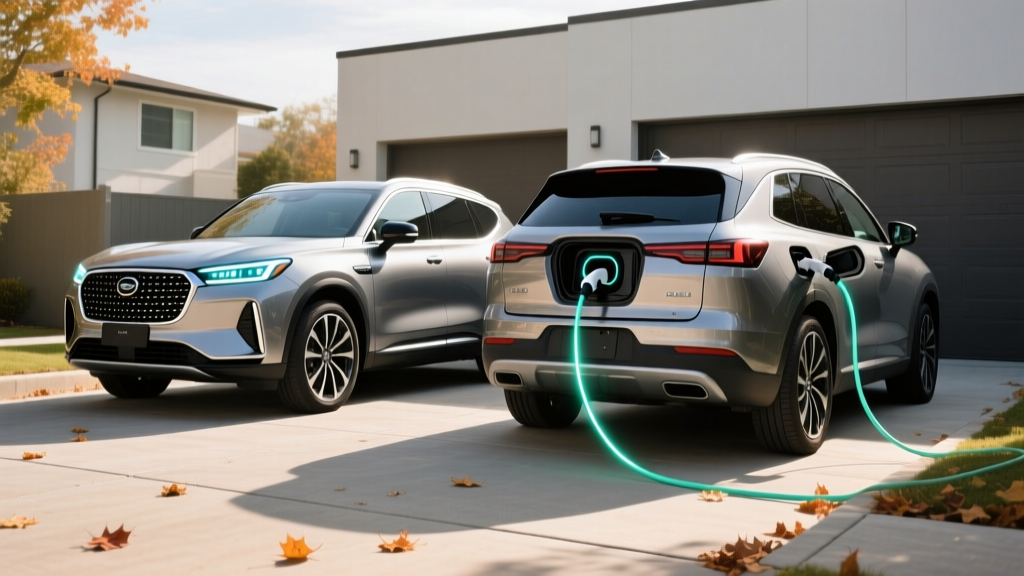
PHEV batteries are small enough that most owners charge exclusively at home using a standard 120-volt outlet (Level 1). Here's what charging looks like across the three levels:
| Level | Power | Time to Full (typical PHEV) | Best For |
|---|---|---|---|
| Level 1 (120V) | ~1.2–1.4 kW | 10–16 hours | Overnight; no install needed |
| Level 2 (240V) | 3.5–7.4 kW | 2–4.5 hours | Faster top-ups; home charger recommended |
| DC Fast Charge | N/A for most PHEVs | N/A | Most PHEVs lack DCFC capability |
Important caveat: Most PHEVs do not support DC fast charging. The Mitsubishi Outlander PHEV is a rare exception with CHAdeMO DC capability on prior generations. For 2026, virtually every PHEV on this list charges exclusively via Level 1 or Level 2 AC power. Given the small battery sizes (12–26 kWh), this is generally sufficient — a full overnight Level 1 charge covers most daily needs.
Federal Tax Credit Eligibility for PHEVs in 2026
Under IRS §30D Clean Vehicle Credit, qualifying PHEVs can receive up to $7,500 in federal tax credits. However, eligibility is far from universal. The credit depends on:
- Battery capacity: Must be at least 7 kWh (all PHEVs on this list qualify)
- Final assembly: Must occur in North America
- Critical minerals sourcing: A percentage must come from the US or free-trade-agreement partners (phases up annually)
- Battery component manufacturing: A percentage must be manufactured in North America (phases up annually)
- MSRP caps: Vans/SUVs/pickups ≤$80,000; sedans ≤$55,000
- Buyer income caps: AGI ≤$150,000 (single), ≤$225,000 (head of household), ≤$300,000 (joint)
As of 2026, the battery-component and critical-mineral sourcing requirements have tightened significantly compared to the credit's early years. Many PHEVs from Asian and European automakers have lost partial or full credit eligibility. Always verify current eligibility on the IRS Clean Vehicle Credit page or consult a tax professional before purchasing.
Point-of-sale transfer: Since 2024, qualifying buyers can transfer the credit to the dealer at purchase, receiving the benefit as an immediate price reduction rather than waiting to claim it on their tax return. This applies to eligible PHEVs just as it does to full EVs.
Hybrid Battery Reliability and Replacement Costs
Hybrid Battery Warranty & Lifespan
Federal mandate: All hybrid and PHEV batteries carry a minimum warranty of 8 years / 100,000 miles (in California Air Resources Board states, this extends to 10 years / 150,000 miles).
Real-world lifespan: Modern lithium-ion PHEV batteries routinely last 150,000–200,000+ miles before significant degradation. Toyota's hybrid battery track record is particularly strong — many Prius batteries exceed 200,000 miles with minimal capacity loss.
Replacement cost if out of warranty: $3,000–$8,000 depending on the model. Toyota and Hyundai tend to fall in the $3,000–$5,000 range; luxury models like the BMW X5 PHEV can exceed $7,000.
PHEV battery degradation is generally less of a concern than with full EVs for a simple reason: the battery is smaller, so the vehicle's thermal management system can more easily keep cells in the optimal temperature range. Additionally, PHEVs typically buffer a larger percentage of total capacity (often 15–20% at the top and bottom), meaning the cells never see true 0% or 100% state of charge — the primary driver of lithium-ion degradation.
PHEV vs HEV vs Full EV: Which Should You Choose?
Decision Framework
Choose a PHEV if: You have access to Level 1 or Level 2 charging at home or work, your daily driving is under 40 miles, and you regularly take longer road trips where you don't want to plan around charging infrastructure.
Choose a conventional HEV if: You have no access to any plug-in charging, you want maximum simplicity, or your budget is tighter (HEVs typically cost $3,000–$7,000 less than their PHEV counterparts).
Choose a full EV if: You have reliable home charging, your daily driving exceeds 40 miles (making a PHEV's small battery insufficient), you want zero tailpipe emissions and minimal maintenance, and you're comfortable planning road-trip charging stops.
The PHEV sweet spot is a commuter who drives 20–35 miles round trip and can charge overnight. In that scenario, a PHEV owner might use gasoline only 10–15 times per year on longer weekend trips, effectively running on electricity 90%+ of the time while retaining the flexibility of a gas engine when needed.
PHEV Pros
- Electric commuting with gas backup
- No range anxiety on road trips
- Smaller battery = lower replacement cost
- Level 1 outlet sufficient for overnight charging
- Works in apartments without dedicated EV charging
PHEV Cons
- Higher purchase price than HEV equivalent
- Two powertrains to maintain (engine + electric)
- Most cannot DC fast charge
- Tax credit eligibility shrinking due to sourcing rules
- Less cargo space vs non-hybrid versions (battery placement)
Real-World MPG: What PHEV Owners Actually Report
PHEV fuel economy is uniquely difficult to summarize with a single number because it depends entirely on how often you charge. The EPA reports two figures: MPGe (miles-per-gallon-equivalent when running primarily on electricity) and MPG (miles per gallon after the battery is depleted and the gas engine takes over).
Here's what to expect in practice:
| Scenario | Prius Prime | RAV4 Prime | Tucson PHEV |
|---|---|---|---|
| Daily charge + short commute | Rarely uses gas; 500+ MPGe effective | ~2 gal/week | ~2.5 gal/week |
| No charging (gas-only driving) | 48–52 MPG | 35–38 MPG | 32–35 MPG |
| Highway road trip (70 mph) | 44–48 MPG | 33–36 MPG | 30–33 MPG |
Conventional hybrids (HEVs) often exceed their EPA city estimates in real-world stop-and-go driving because regenerative braking is most effective at low speeds. PHEVs exhibit the same pattern once the battery is depleted. The Prius Prime, for instance, regularly delivers 50+ MPG in city driving after battery depletion — above its 52 MPG combined EPA rating on favorable routes.
Frequently Asked Questions
How many MPG does a plug-in hybrid get?
It depends on charging habits. When running on electricity, PHEVs achieve 80–127 MPGe. After the battery depletes, expect 20–52 MPG depending on the model — the Prius Prime leads at 52 MPG combined, while the Wrangler 4xe trails at 20 MPG combined due to its aerodynamics and weight. On fueleconomy.gov, you can compare specific models and see both MPGe and gasoline-only MPG figures.
How far can a PHEV go on electric only?
Current PHEVs deliver 22–44 miles of EPA-rated electric-only range. The Prius Prime tops this list at 44 miles; the Wrangler 4xe sits at the low end at 22 miles. Real-world highway and cold-weather driving will reduce these figures by 15–35%. For most daily commutes under 30 miles, any PHEV on this list covers the trip entirely on electricity.
Do plug-in hybrids qualify for the $7,500 federal tax credit?
Some do, but eligibility has narrowed significantly. Under IRS §30D rules, the vehicle must meet battery-sourcing and critical-mineral requirements, MSRP caps ($80,000 for SUVs, $55,000 for sedans), and buyer income limits ($150,000–$300,000 depending on filing status). Always verify current eligibility on the IRS website before purchasing, as sourcing rules tighten annually.
Is a PHEV battery reliable and what does replacement cost?
PHEV batteries are federally warranted for 8 years/100,000 miles (10 years/150,000 in CARB states). Real-world data shows most modern PHEV batteries last 150,000–200,000+ miles. Out-of-warranty replacement typically runs $3,000–$8,000 depending on the model — far less than full EV battery replacements, which can exceed $15,000.
Do I need to install a special charger for a PHEV?
No. Most PHEV owners charge on a standard 120-volt household outlet (Level 1), which fully replenishes the small battery overnight. A Level 2 (240V) home charger speeds this up to 2–4 hours, which is useful if you need midday top-ups. Unlike full EVs, PHEVs rarely justify the $500–$2,000 expense of a dedicated Level 2 installation unless you already have one for another vehicle.
What's better: a PHEV or a full EV?
For a one-car household that takes regular road trips of 200+ miles, a PHEV offers more flexibility. For a two-car household where one vehicle handles commuting and the other handles trips, a full EV is typically cheaper to operate with less maintenance. If you have reliable home charging and your commute exceeds 40 miles daily, a full EV's larger battery (250–350+ miles range) is a better fit than a PHEV's 25–44 mile electric envelope.