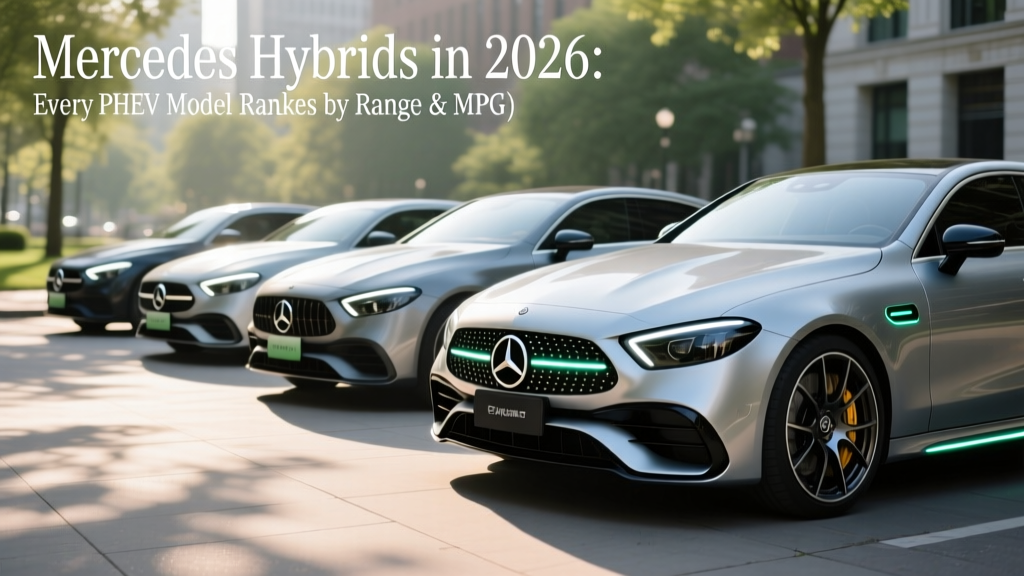
Mercedes-Benz has taken a distinct approach to electrification: while many automakers push full battery-electric vehicles, the three-pointed star has invested heavily in plug-in hybrid (PHEV) powertrains across its lineup. For 2026, Mercedes offers PHEV variants in nearly every core model — from the C-Class sedan to the GLE SUV — each packing class-leading electric-only range that blurs the line between hybrid and EV daily driving.
This guide breaks down every current Mercedes hybrid and PHEV, with exact EPA figures, battery specs, charging times, pricing, and tax-credit eligibility. Whether you're cross-shopping a C 300e against a Tesla Model 3 or weighing a GLE 580e against a BMW X5 xDrive50e, the numbers below will tell you exactly what you're getting.
HEV vs PHEV: What Mercedes Actually Sells
Before diving into the lineup, a critical distinction: Mercedes-Benz does not sell conventional hybrids (HEVs) in the United States for the 2026 model year. Unlike Toyota or Honda, which offer self-charging hybrids that never plug in, every electrified Mercedes in the U.S. is a plug-in hybrid (PHEV) — meaning it has a larger battery, a charge port, and meaningful electric-only range.
HEV vs PHEV at a Glance
| Feature | Conventional Hybrid (HEV) | Plug-in Hybrid (PHEV) |
|---|---|---|
| Plugs in? | No — self-charging via regen & engine | Yes — Level 1/Level 2 AC charging |
| Battery size | 0.5–2 kWh | 15–31 kWh (Mercedes: 25.4 kWh) |
| Electric-only range | 0.5–2 miles at low speed | 30–54 miles (Mercedes PHEVs) |
| Federal tax credit | None | Up to $3,750–$7,500 (varies) |
| Example | Toyota RAV4 Hybrid | Mercedes C 300e, GLE 580e |
Bottom line: If you see "Mercedes hybrid" in U.S. marketing, it means PHEV. You will need access to a plug — ideally a home Level 2 charger — to unlock the full benefit.
The 2026 Mercedes PHEV Lineup: Specs & Pricing
Mercedes structures its PHEV naming with an "e" suffix: C 300e (sedan), GLC 350e (SUV), S 580e (flagship sedan), and GLE 580e (midsize SUV). All share the same fourth-generation PHEV architecture introduced in 2023, built around a 25.4 kWh (total) lithium-ion battery pack mounted beneath the rear axle.
| Model | Powertrain | Combined HP | EPA EV Range | EPA Combined MPG | Battery (kWh) | 0–60 mph | Base MSRP |
|---|---|---|---|---|---|---|---|
| C 300e | 2.0L turbo I4 + e-motor | 312 hp | 54 mi | 71 MPGe / 33 MPG | 25.4 | 6.0 sec | $49,900 |
| GLC 350e 4MATIC | 2.0L turbo I4 + e-motor | 312 hp | 39 mi | 66 MPGe / 28 MPG | 25.4 | 6.5 sec | $60,550 |
| S 580e 4MATIC | 3.0L turbo I6 + e-motor | 449 hp | 38 mi | 57 MPGe / 26 MPG | 25.4 | 5.0 sec | $120,750 |
| GLE 580e 4MATIC | 3.0L turbo I6 + e-motor | 449 hp | 45 mi | 56 MPGe / 23 MPG | 25.4 | 5.5 sec | $88,350 |
Sources: EPA Fuel Economy, Mercedes-Benz USA specification sheets. MPGe reflects combined electric+gas operation; MPG reflects charge-sustaining (gas-only) mode. All prices exclude $1,150 destination.
Electric-Only Range: The Real-World Picture
The headline number across the Mercedes PHEV lineup is the C 300e's EPA-rated 54 miles of electric-only range — the longest of any luxury PHEV sedan sold in the U.S. for 2026. That's enough for most commutes without the engine ever firing.
Real-World Range Expectations
C 300e: EPA 54 mi electric → expect ~45–50 mi in mixed driving, ~35–40 mi at sustained 70+ mph highway speeds, ~30–35 mi in freezing weather with cabin heat.
GLC 350e: EPA 39 mi → expect ~32–36 mi mixed, ~25–28 mi highway.
GLE 580e: EPA 45 mi → expect ~38–42 mi mixed, ~30–34 mi highway.
S 580e: EPA 38 mi → expect ~30–35 mi mixed, ~25–28 mi highway.
Range loss in cold weather (below 32°F) typically runs 20–35% for PHEVs due to battery chemistry and cabin heating demands. Mercedes' standard heat pump on PHEV models partially mitigates this.
For context, the average American drives roughly 37 miles per day according to FHWA data. That means a C 300e owner with home charging could go weeks between fill-ups, running almost entirely on electricity for daily errands and commutes, while retaining the 370+ mile total range for road trips.
Charging: AC Only, No DC Fast Charging
Every 2026 Mercedes PHEV charges via a J1772 (AC) charge port. None of them support DC fast charging — a deliberate engineering trade-off that keeps weight and cost down while acknowledging that PHEV batteries are small enough that overnight AC charging suffices for most owners.
| Charging Level | Power | 0–100% Time | Practical Notes |
|---|---|---|---|
| Level 1 (120V household) | 1.4 kW | ~18 hours | Emergency/top-up only; won't fully refill overnight |
| Level 2 (240V, 16A) | 3.7 kW | ~7 hours | Standard home wallbox; full overnight charge |
| Level 2 (240V, 32A) | 7.4 kW | ~3.5 hours | Mercedes Wallbox Home or ChargePoint Home Flex |
| DC Fast Charge | N/A | N/A | Not supported on any 2026 Mercedes PHEV |
The onboard charger maxes out at 7.4 kW (single-phase AC). That's adequate for overnight replenishment but means you won't benefit from installing a 48A hardwired charger — the car simply won't accept more than 32A. A standard 240V / 32A Level 2 setup (roughly $500–$800 for equipment, $800–$2,000 for electrician installation depending on panel proximity) is the sweet spot for Mercedes PHEV ownership.
Fuel Economy: EPA vs Real World
Mercedes PHEVs report two efficiency figures: MPGe (miles per gallon equivalent, measuring efficiency when running on electricity) and MPG (charge-sustaining mode, when the battery is depleted and the car operates like a conventional hybrid).
| Model | MPGe (Combined) | MPG City | MPG Highway | MPG Combined | Total Range |
|---|---|---|---|---|---|
| C 300e | 71 MPGe | 35 | 32 | 33 | ~425 mi |
| GLC 350e 4MATIC | 66 MPGe | 29 | 27 | 28 | ~405 mi |
| S 580e 4MATIC | 57 MPGe | 27 | 25 | 26 | ~440 mi |
| GLE 580e 4MATIC | 56 MPGe | 24 | 22 | 23 | ~480 mi |
Real-world note: Charge-sustaining MPG in city driving often exceeds EPA estimates in PHEVs, because regenerative braking recaptures energy during stop-and-go traffic. On the highway, expect MPG to fall 2–4 points below the EPA sticker, especially at speeds above 75 mph or in mountainous terrain. Owners who charge nightly and drive under 40 miles daily may use less than a tank of gas per month.
Tax Credits and Incentives: What You Actually Qualify For
Federal tax credit eligibility for Mercedes PHEVs in 2026 is governed by IRS §30D rules, which include battery-component sourcing requirements, critical-mineral thresholds, MSRP caps, and buyer income limits. Here's where each model stands:
- C 300e ($49,900): Qualifies for up to $3,750 federal credit (meets critical-mineral requirement but not full battery-component sourcing as of 2026). MSRP is under the $55,000 sedan cap. Buyer income must not exceed $150K single / $300K joint.
- GLC 350e ($60,550): Qualifies for up to $3,750. MSRP is under the $80,000 SUV cap. Same income and sourcing limitations apply.
- GLE 580e ($88,350): MSRP exceeds the $80,000 SUV cap — not eligible for the federal credit.
- S 580e ($120,750): MSRP exceeds the $55,000 sedan cap — not eligible.
As of 2026, the §30D credit can be transferred to the dealer at point of sale, effectively reducing your purchase price at signing rather than waiting for a tax refund. Verify current eligibility on fueleconomy.gov before purchasing, as sourcing compliance can change with model-year production updates.
State incentives vary. California's CVRP, Colorado's state credit, and New York's Drive Clean rebate may stack on top of federal incentives for the C 300e and GLC 350e. Check your state's energy office or DMV for current amounts — these change frequently and often have their own income or price caps.
Battery Warranty, Longevity, and Replacement Cost
The high-voltage battery in every 2026 Mercedes PHEV is a 25.4 kWh lithium-ion pack (NMC chemistry) covered by Mercedes-Benz's hybrid battery warranty:
Mercedes PHEV Battery Warranty
- Duration: 8 years or 62,000 miles (whichever comes first)
- Capacity retention threshold: 70% of original capacity (below this triggers a warranty claim)
- Coverage: Defects, premature degradation, and cell failure
- Powertrain warranty: 4 years / 50,000 miles (standard Mercedes coverage)
Replacement cost: Out-of-warranty, a Mercedes PHEV battery replacement runs approximately $8,000–$12,000 including labor, based on current dealer pricing. However, real-world data from European-market Mercedes PHEVs (which have used this architecture since 2023) suggests degradation is modest — typically 5–8% capacity loss over 5 years / 60,000 miles with regular Level 2 charging.
Longevity tips: Avoid routinely charging to 100% and leaving the car parked at full state-of-charge in hot weather. Mercedes' battery management system includes a buffer (usable capacity is less than the 25.4 kWh total) to protect against deep discharge and overcharge, which naturally extends cycle life.
Who Should Buy a Mercedes PHEV?
✓ Choose a Mercedes PHEV If
- Your daily commute is under 40 miles and you can charge at home
- You want electric daily driving but need gas-engine range for road trips
- You live in an area with limited DC fast-charging infrastructure
- You want luxury features and brand prestige without full EV commitment
- You can benefit from the $3,750 federal credit (C 300e / GLC 350e)
✗ Look Elsewhere If
- You can't install a Level 2 charger at home (PHEV benefits collapse without regular plug-in charging)
- You want zero tailpipe emissions — consider a full BEV like the Mercedes EQE or Tesla Model S
- You want DC fast charging for road trips (PHEVs don't support it)
- You drive more than 60 miles daily and want to minimize gas use entirely
- Lowest total cost of ownership is your priority — a Toyota RAV4 Prime or Hyundai Tucson PHEV delivers similar electric range at $20K+ less
Frequently Asked Questions
How many MPG does a Mercedes hybrid get?
It depends on the model and whether the battery is charged. The C 300e achieves 71 MPGe combined when using its electric range and 33 MPG combined in charge-sustaining (gas-only) mode. The GLC 350e delivers 66 MPGe / 28 MPG combined. The larger GLE 580e and S 580e return 56 and 57 MPGe respectively, with 23 and 26 MPG in gas-only driving.
How far can a Mercedes PHEV go on electric only?
The C 300e leads the lineup with an EPA-rated 54 miles of electric-only range. The GLE 580e achieves 45 miles, the GLC 350e manages 39 miles, and the S 580e delivers 38 miles. In real-world highway driving or cold weather, subtract 20–35% from these figures.
Hybrid vs PHEV vs EV — which fits my lifestyle?
A conventional hybrid (HEV, like a Toyota Camry Hybrid) is best if you can't plug in at all. A PHEV (like the Mercedes C 300e) is ideal if you have home charging and a short commute but want gas-engine flexibility for longer trips. A full EV (like the Mercedes EQE 350) suits drivers with reliable charging access who want zero emissions and the lowest per-mile fuel cost. If you drive under 40 miles daily and charge nightly, a PHEV gives you EV-like daily operation with no range anxiety.
Is the Mercedes PHEV battery reliable, and what does replacement cost?
Mercedes covers the PHEV battery for 8 years / 62,000 miles with a 70% capacity-retention threshold. Out-of-warranty replacement costs approximately $8,000–$12,000. European fleet data on this generation's battery pack shows 5–8% degradation over 5 years with normal use, suggesting most owners will never need a replacement during typical ownership.
Does a Mercedes PHEV qualify for any tax credit?
The C 300e and GLC 350e qualify for up to $3,750 under the federal §30D credit (subject to buyer income caps of $150K single / $300K joint and battery-sourcing requirements). The GLE 580e and S 580e exceed MSRP caps and do not qualify for the federal credit. State incentives may apply separately — check your state's energy office for current programs. Always verify eligibility on IRS.gov before purchasing.
Can I DC fast charge a Mercedes PHEV?
No. No 2026 Mercedes PHEV supports DC fast charging. All models use a J1772 AC charge port and accept up to 7.4 kW on Level 2. A full charge from empty takes approximately 3.5 hours on a 32A Level 2 charger. For PHEV owners who charge overnight at home, this is rarely a practical limitation.