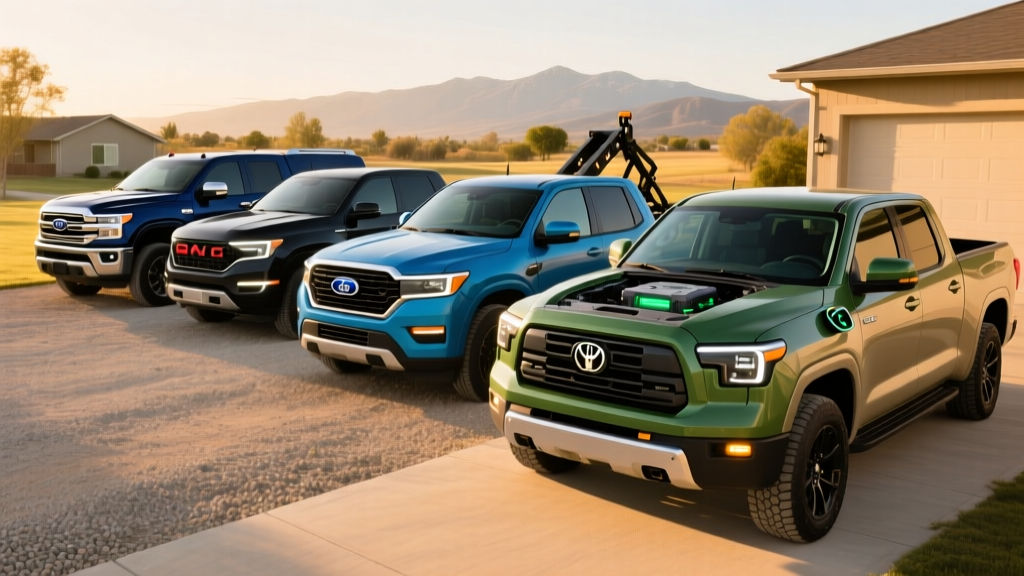
The full-size and midsize pickup segment has embraced electrification, but not every truck buyer is ready for a battery-electric vehicle. For those who need serious towing capability, long range without charging stops, and better fuel economy than a gas-only V8, hybrid trucks offer a compelling middle ground. The 2026 model year brings refined powertrains across Ford, Toyota, and Chevrolet lineups — but not all hybrids are created equal.
This guide breaks down every major hybrid truck available for 2026, separating conventional hybrids (HEVs) from plug-in hybrids (PHEVs), with exact EPA fuel economy figures, real-world efficiency observations, towing ratings, and federal tax credit eligibility under current IRS §30D rules.
HEV vs PHEV: What Hybrid Truck Buyers Need to Know
Before comparing models, it's essential to understand the two hybrid architectures available in today's trucks. The distinction affects everything from daily fuel costs to whether you need a home charger.
Conventional Hybrid (HEV)
- How it works: A small battery (typically 1.5–2.0 kWh) is charged by the engine and regenerative braking. You never plug it in.
- Electric-only driving: Minimal — usually under 1 mile at low speeds. The electric motor assists the gas engine, reducing fuel consumption.
- Best for: Buyers who want better MPG with zero lifestyle change. No charging infrastructure needed.
- Examples: Ford F-150 PowerBoost, Ford Maverick Hybrid, Toyota Tundra i-FORCE MAX.
Plug-In Hybrid (PHEV)
- How it works: A larger battery (12–20+ kWh) that charges via a plug (Level 1 or Level 2) and regenerative braking. Offers meaningful electric-only range before the gas engine engages.
- Electric-only driving: Typically 20–45 miles on battery alone, enough for most daily commutes.
- Best for: Buyers with home charging access who want EV-like daily commuting plus gas-engine range for road trips and towing.
- Examples: As of the 2026 model year, no mainstream full-size PHEV pickup is widely available in the US, though the Ram 1500 Ramcharger (an extended-range EV, not a traditional PHEV) is entering the market.
Key takeaway: Every major hybrid truck on sale in 2026 is a conventional HEV. You do not plug these trucks in. They refuel exclusively at gas stations while delivering meaningfully better MPG than their non-hybrid counterparts.
2026 Hybrid Truck Lineup: EPA MPG and Powertrain Specs
Here's how the major hybrid trucks stack up on paper and in practice. All figures reference the most current EPA data at fueleconomy.gov and manufacturer specifications for the 2026 model year.
| Truck | Powertrain | Combined HP | EPA City / Hwy / Combined MPG | Max Towing (lbs) | Starting MSRP |
|---|---|---|---|---|---|
| Ford Maverick Hybrid (FWD) | 2.5L I4 + electric motor | 191 hp | 42 / 36 / 40 MPG | 2,000 | $29,495 |
| Ford F-150 PowerBoost (4WD) | 3.5L twin-turbo V6 + electric motor | 430 hp | 23 / 24 / 23 MPG | 11,200 | $62,645 (XLT trim) |
| Toyota Tundra i-FORCE MAX (4WD) | 3.4L twin-turbo V6 + electric motor | 437 hp | 20 / 24 / 22 MPG | 11,175 | $60,705 (Limited trim) |
| Chevrolet Silverado 1500 Hybrid (2WD) | 2.7L turbo I4 + mild-hybrid assist | 310 hp | 21 / 23 / 22 MPG | 9,300 | $48,200 (WT trim) |
Note: The Silverado's mild-hybrid system provides stop/start smoothing and minor torque assist rather than the full parallel-hybrid architecture of the F-150 PowerBoost or Tundra i-FORCE MAX. It delivers more modest efficiency gains.
Real-World MPG: What Owners Actually See
EPA estimates are a starting point, but hybrid trucks behave differently than the sticker suggests — especially in city driving where regenerative braking and electric-motor assist shine.
Real-World MPG Observations
Ford Maverick Hybrid: EPA combined 40 MPG. Real-world city driving consistently yields 42–46 MPG in mixed suburban use. Highway-only trips at 75+ mph drop to 32–35 MPG. Cold weather (below 30°F) reduces city MPG by roughly 5–8%. This truck routinely exceeds its EPA city rating in stop-and-go traffic.
Ford F-150 PowerBoost: EPA combined 23 MPG. Owners report 21–24 MPG in mixed driving. Highway towing drops economy to 10–14 MPG depending on trailer weight. Unloaded highway cruising at 70 mph yields 22–25 MPG. The hybrid system's biggest advantage is city and suburban driving, where a non-hybrid 3.5L EcoBoost F-150 returns 18–20 MPG.
Toyota Tundra i-FORCE MAX: EPA combined 22 MPG. Real-world mixed driving produces 19–22 MPG. The hybrid system prioritizes performance (437 hp, 583 lb-ft torque) over maximum efficiency. Highway-only driving returns 22–24 MPG. Towing heavy trailers drops to 9–12 MPG.
The pattern is consistent across all hybrid trucks: city and suburban driving is where the hybrid premium pays off. If your truck use is primarily highway commuting or towing, the MPG advantage over a conventional gas powertrain narrows. But for contractors, suburban families, and anyone who idles or drives in stop-and-go traffic, the hybrid delivers measurable fuel savings.
Towing, Payload, and the Hybrid Powertrain Advantage
Hybrid trucks are not just about fuel economy. The electric motor in a full parallel hybrid provides instant torque at low RPM, which benefits towing launch and low-speed maneuvering with a trailer.
The Ford F-150 PowerBoost leads the segment with a maximum towing rating of 11,200 lbs when properly equipped (Max Trailer Tow Package, 3.73 axle ratio). The 430 hp and 570 lb-ft of combined torque give it passing power that rivals the 5.0L V8 while burning less fuel. The onboard 2.0 kWh lithium-ion battery also enables Ford's Pro Power Onboard — up to 7.2 kW of exportable power through bed-mounted 120V and 240V outlets. For job-site use, this is a functional differentiator: you can run power tools, a welder, or camp appliances without a separate generator.
The Toyota Tundra i-FORCE MAX produces 437 hp and 583 lb-ft — the most torque in the hybrid-truck class. Its maximum tow rating is 11,175 lbs. However, the i-FORCE MAX is only available on Limited trim and above, which pushes the entry price past $60,000. Toyota's hybrid system places the electric motor between the engine and transmission (a "motor sandwich" design), which provides seamless torque fill but adds complexity.
The Ford Maverick Hybrid is a different animal. With a 2,000-lb max tow rating (1,500 lbs with the standard configuration), it's designed for light-duty use — a small utility trailer, a pair of dirt bikes, or a lightweight camper. Its value proposition is 40+ MPG in a truck that starts under $30,000.
Battery Warranty, Lifespan, and Replacement Costs
Hybrid battery longevity remains the top concern for buyers considering a used or new hybrid truck. Here's what the data shows for 2026 models.
Hybrid Battery Warranty Coverage (2026 Models)
| Truck | Battery Warranty | Battery Chemistry | Estimated Replacement Cost |
|---|---|---|---|
| Ford F-150 PowerBoost | 8 years / 100,000 miles | Lithium-ion (NMC) | $4,000–$6,500 |
| Ford Maverick Hybrid | 8 years / 100,000 miles | Lithium-ion (NMC) | $3,000–$4,500 |
| Toyota Tundra i-FORCE MAX | 10 years / 150,000 miles | Lithium-ion (NMC) | $4,500–$7,000 |
| Chevrolet Silverado Hybrid | 8 years / 100,000 miles | Lithium-ion (mild-hybrid) | $2,500–$4,000 |
Sources: Manufacturer warranty documentation; replacement cost estimates from dealer service departments and independent hybrid repair shops. Actual costs vary by region and model year.
Toyota's 10-year/150,000-mile hybrid battery warranty is the strongest in the segment, and it reflects the brand's two decades of hybrid powertrain experience. Ford's 8-year/100,000-mile coverage meets the industry standard and is also the minimum required by the EPA for hybrid/emissions components in many states.
In practice, modern hybrid truck batteries rarely require full replacement within the warranty period. The battery packs are relatively small (1.5–2.0 kWh) compared to full EV batteries (75–130+ kWh), meaning they experience fewer deep charge/discharge cycles. Data from Toyota's long-running hybrid lineup (Prius, Highlander Hybrid) shows typical capacity retention above 85% at 150,000 miles. Ford's PowerBoost system has been on the road since the 2021 model year, and large-scale failure reports remain rare as of early 2026.
Do Hybrid Trucks Qualify for Federal Tax Credits?
This is where buyer expectations often diverge from reality. Under current IRS §30D rules, the federal clean vehicle credit of up to $7,500 is structured around battery capacity, critical-mineral sourcing, and MSRP/income caps — and it heavily favors plug-in vehicles.
- Conventional hybrids (HEVs): The Ford F-150 PowerBoost, Maverick Hybrid, Toyota Tundra i-FORCE MAX, and Chevrolet Silverado Hybrid do not qualify for the §30D federal tax credit. Their battery packs are too small (under 7 kWh) to meet the minimum plug-in vehicle requirement.
- Plug-in hybrid (PHEV) trucks: If a PHEV truck with at least 7 kWh of battery capacity becomes available and meets critical-mineral and battery-component sourcing requirements, it could qualify for up to $7,500. As of 2026, no mainstream PHEV pickup meets all current requirements.
- MSRP cap: For any qualifying truck, the MSRP must not exceed $80,000 for pickups/vans/SUVs.
- Income cap: Buyer AGI must not exceed $150,000 (single), $225,000 (head of household), or $300,000 (joint filing).
- Point-of-sale transfer: Qualifying credits can be transferred to the dealer at purchase, reducing the upfront price rather than waiting for a tax refund.
Bottom line: Do not buy a 2026 conventional hybrid truck expecting a federal tax credit. The fuel savings alone must justify any price premium over a gas-only model. For the Maverick Hybrid, that math works easily — the hybrid trim costs roughly $1,500–$2,000 more than the gas EcoBoost variant and pays back within 1–2 years of average driving. For the F-150 PowerBoost, the premium over a 3.5L EcoBoost is $3,000–$4,500 depending on trim, with a payback period of 3–5 years depending on fuel prices and annual mileage.
Hybrid Truck vs Full EV Truck vs Gas Truck: Which Fits You?
Choose a Hybrid Truck If:
- You tow regularly and cannot afford to plan routes around DC fast chargers.
- You drive 15,000+ miles per year in mixed city/highway conditions and want lower fuel costs without plugging in.
- You want onboard exported power (e.g., F-150 PowerBoost's 7.2 kW Pro Power Onboard) for job-site or camping use.
- You live in an apartment or lack access to home charging, making a full EV impractical.
Choose a Full EV Truck If:
- You have reliable Level 2 home charging and your daily driving is under 250 miles.
- You want the lowest per-mile fuel cost (electricity at $0.12–$0.16/kWh vs. gasoline at $3.00–$4.00/gal).
- You prioritize instant torque, quiet operation, and minimal drivetrain maintenance (no oil changes, fewer moving parts).
- You qualify for the full $7,500 federal tax credit, which can offset the higher purchase price of trucks like the Ford F-150 Lightning or Rivian R1T.
Choose a Gas-Only Truck If:
- Your budget is tight and the hybrid trim premium doesn't pencil out for your annual mileage.
- You primarily drive highway miles at steady speeds, where the hybrid advantage is smallest.
- You plan to keep the truck for 3 years or fewer, meaning you won't recoup the hybrid premium through fuel savings.
Pros and Cons of 2026 Hybrid Trucks
Pros
- 15–30% better city MPG vs. gas-only equivalents
- No charging infrastructure required — refuel at any gas station
- Instant electric torque improves towing launch and low-speed control
- Onboard power export (F-150 PowerBoost) replaces a portable generator
- Hybrid batteries covered by 8–10 year warranties with strong real-world longevity
- No range anxiety — total range often exceeds 600+ miles on a tank
Cons
- No federal tax credit eligibility (battery too small for §30D)
- $1,500–$4,500 price premium over equivalent gas powertrain
- Highway MPG gains are modest compared to city driving
- Added powertrain complexity (two power sources, more components)
- Full-electric driving is negligible — you still burn gas on every trip
- Resale value advantage over gas models is modest vs. the premium paid
Frequently Asked Questions
How many MPG does the best hybrid truck get?
The 2026 Ford Maverick Hybrid leads all trucks with an EPA rating of 42 city / 36 highway / 40 combined MPG. In real-world suburban driving, owners regularly report 42–46 MPG. Among full-size trucks, the Ford F-150 PowerBoost achieves 23 MPG combined — roughly 3–5 MPG better than the non-hybrid 3.5L EcoBoost in mixed driving.
Do hybrid trucks need to be plugged in?
No. Every mainstream hybrid truck available in 2026 (F-150 PowerBoost, Maverick Hybrid, Tundra i-FORCE MAX, Silverado Hybrid) is a conventional HEV. The battery charges through regenerative braking and the gasoline engine. You never plug them in. Only plug-in hybrid (PHEV) trucks — which are not yet widely available in the US pickup segment — require charging.
How long do hybrid truck batteries last and what does replacement cost?
Modern hybrid truck batteries are designed to last the life of the vehicle under normal use. Toyota covers the Tundra i-FORCE MAX battery for 10 years / 150,000 miles; Ford covers its hybrid batteries for 8 years / 100,000 miles. If replacement is needed out of warranty, expect to pay $3,000–$7,000 depending on the model — significantly less than a full EV battery replacement ($10,000–$20,000+) because hybrid battery packs are much smaller (1.5–2.0 kWh vs. 75–130+ kWh).
Can a hybrid truck tow as much as a gas truck?
Yes, and in some cases more. The Ford F-150 PowerBoost's 11,200-lb max tow rating matches or exceeds many gas-only F-150 configurations. The Toyota Tundra i-FORCE MAX tows up to 11,175 lbs. The hybrid system's electric motor provides strong low-RPM torque, which actually benefits trailer launch and hill climbing. However, towing at capacity will reduce fuel economy to 10–14 MPG regardless of the hybrid system.
Is a hybrid truck worth it over a gas model?
It depends on your driving pattern. If you drive 15,000+ miles per year with significant city/suburban driving, the hybrid premium ($1,500–$4,500) typically pays back in fuel savings within 2–5 years. The Maverick Hybrid, with its modest $1,500–$2,000 premium and 40 MPG combined, offers the fastest payback. If you primarily drive highway miles or keep trucks for under 3 years, the payback is harder to justify.
Does any hybrid truck qualify for the $7,500 federal tax credit?
No. Under current IRS §30D rules, the federal clean vehicle credit requires a minimum battery capacity of 7 kWh and plug-in capability. Conventional hybrid trucks have batteries of 1.5–2.0 kWh and cannot be plugged in, so they do not qualify. Some states offer separate hybrid incentives — check your state's energy office or Alternative Fuels Data Center for local programs.
The 2026 hybrid truck market gives buyers genuine choices: a sub-$30K compact that returns 40 MPG, a full-size work truck that tows over 11,000 lbs while beating its gas counterpart by 3–5 MPG, and a performance-oriented Toyota with best-in-class torque. None of them require a charger, none of them qualify for the federal credit, and all of them prove that electrification doesn't have to mean going all-in on a battery-electric vehicle.