Why Hybrid Truck Tires Matter More Than You Think
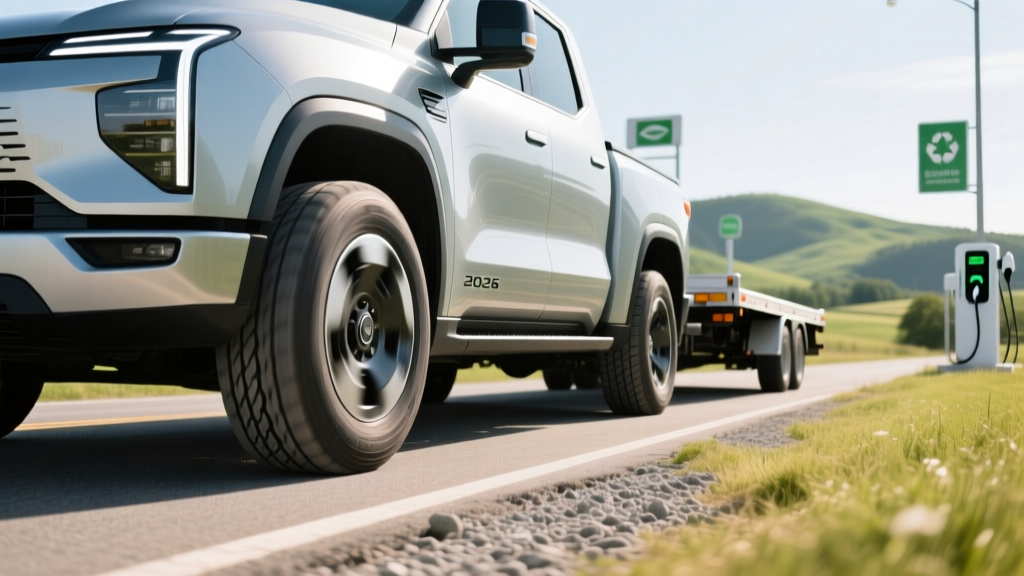
Hybrid pickups like the Ford F-150 PowerBoost, Toyota Tacoma i-FORCE MAX, and Chevrolet Silverado 1500 Hybrid carry extra weight from battery packs and electric motors while demanding efficiency gains that standard all-terrain tires can undermine. The right hybrid truck tires reduce rolling resistance to preserve MPG, maintain load capacity for towing, and handle the instant torque delivered by electric motors at low speeds.
Rolling resistance accounts for roughly 20-30% of a vehicle's energy consumption at highway speeds, according to the U.S. Department of Energy. For a hybrid truck that relies on regenerative braking and electric assist to squeeze out 22-26 MPG combined, switching from aggressive off-road rubber to a low rolling resistance (LRR) highway tire can recover 1-3 MPG — a meaningful gain over 15,000 annual miles.
This guide covers what makes a tire suited to hybrid truck duty, the top picks for 2026 model-year hybrid pickups, and how tire selection interacts with the powertrain characteristics of HEV (conventional hybrid) trucks.
2026 Hybrid Truck Lineup: Specs That Affect Tire Choice
Before selecting tires, understand the platform you're fitting. Hybrid trucks differ from their gas-only counterparts in weight distribution, torque delivery, and efficiency targets — all of which influence tire requirements.
| Model | Type | Combined HP | Curb Weight (lbs) | Max Tow (lbs) | Stock Tire Size | EPA Combined MPG |
|---|---|---|---|---|---|---|
| Ford F-150 PowerBoost | HEV | 430 hp | ~5,200-5,600 | 12,700 | 275/65R18, 275/60R20 | 25 MPG |
| Toyota Tacoma i-FORCE MAX | HEV | 326 hp | ~4,700-5,100 | 6,000 | 265/70R17, 265/65R18 | 23-25 MPG |
| Chevrolet Silverado 1500 Hybrid | HEV | ~400 hp (est.) | ~5,100-5,400 | 9,500 | 265/70R17, 275/60R20 | 22-24 MPG (est.) |
| Toyota Tundra i-FORCE MAX | HEV | 437 hp | ~5,800-6,100 | 12,000 | 275/65R18, 275/60R20 | 20-22 MPG |
All four models above are conventional hybrids (HEV), meaning they do not plug in. The battery charges through regenerative braking and engine operation. This distinction matters for tire buyers: there's no heavier PHEV battery pack adding 300-500 lbs to these trucks, but the hybrid system still adds roughly 200-350 lbs compared to gas-only equivalents.
HEV vs PHEV: What This Means for Tires
Conventional Hybrid (HEV): Self-charging via regen braking and engine. Lighter battery (1-2 kWh). Tire priority: low rolling resistance, standard load ratings.
Plug-in Hybrid (PHEV): Charges via plug, larger battery (10-20+ kWh), heavier. Tire priority: higher load capacity, reinforced sidewalls. As of 2026, no mainstream PHEV pickup is sold in the U.S. — the Chrysler Pacifica PHEV and Jeep Wrangler 4xe remain the primary PHEV options, neither being a truck.
What Makes a Tire Suited for Hybrid Trucks
Hybrid truck tires must balance three competing demands that don't always align:
Low Rolling Resistance (LRR)
LRR tires use specialized rubber compounds and tread patterns that deform less as they roll. The result: less energy wasted as heat, more energy moving the truck forward. For a hybrid truck operating in electric-assist mode at low speeds, reduced rolling resistance directly translates to more regenerative energy captured and less fuel burned during engine operation.
Look for tires marketed as "eco," "fuel-efficient," or carrying the manufacturer's LRR designation. Michelin's e.Primacy line, Continental's EcoContact, and Bridgestone's Ecopia series all offer truck-sized LRR options.
Load Rating and Towing Capacity
Hybrid trucks tow serious loads — the F-150 PowerBoost pulls up to 12,700 lbs. Your replacement tires must match or exceed the OEM load index. Check the door jamb placard for the original equipment load rating, and never downsize. A tire with an insufficient load index can overheat under heavy tow loads, risking blowout.
Most half-ton hybrid trucks require Load Range E (10-ply equivalent) or at minimum Load Range D tires when towing near capacity. For daily driving without heavy loads, standard load (SL) tires in the correct size and load index are acceptable.
Torque Handling and Tread Wear
Hybrid powertrains deliver electric motor torque instantly from 0 RPM. The F-150 PowerBoost produces 570 lb-ft combined, with a significant portion available immediately. This torque characteristic accelerates tread wear on drive-axle tires compared to a conventional gas engine that builds torque gradually with RPM.
Tires with harder tread compounds resist this wear better, but harder compounds can increase rolling resistance and reduce wet grip. The best hybrid truck tires strike a balance — look for UTQG treadwear ratings of 600 or higher for longevity.
Top Hybrid Truck Tire Picks for 2026
Best Overall Efficiency: Michelin Defender LTX M/S2
The Defender LTX M/S2 is Michelin's highway all-season tire designed for light trucks and SUVs. It carries a 70,000-mile treadwear warranty and delivers among the lowest rolling resistance in the highway-terrain category.
- Sizes available: 17"-20" (covers most hybrid truck fitments)
- Load range: SL and XL options
- UTQG treadwear: 720
- Estimated MPG gain vs A/T tire: 1.5-2.5 MPG
- Price: ~$240-$310 per tire
Best for: F-150 PowerBoost and Tacoma i-FORCE MAX owners who drive primarily on pavement and want to maximize the hybrid efficiency advantage.
Best All-Terrain Hybrid Option: Goodyear Wrangler Duratrac
For hybrid truck owners who need genuine off-road capability without completely sacrificing efficiency, the Duratrac offers a reasonable compromise. It's not an LRR tire, but its rolling resistance is competitive within the all-terrain category.
- Sizes available: 16"-20"
- Load range: SL, C, D, E
- UTQG treadwear: 520
- Estimated MPG loss vs highway tire: 1-2 MPG
- Price: ~$220-$290 per tire
Best for: Tundra i-FORCE MAX and Tacoma owners who split time between pavement and trails and accept a modest MPG penalty for all-terrain grip.
Best for Heavy Towing: Bridgestone Dueler H/T 684 II
When your F-150 PowerBoost regularly pulls a 10,000+ lb trailer, you need a tire built for sustained load. The Dueler H/T 684 II is OEM on many heavy-duty truck packages and handles high inflation pressures under load.
- Sizes available: 17"-20"
- Load range: D, E
- UTQG treadwear: 640
- Price: ~$250-$320 per tire
Best for: Hybrid truck owners who tow frequently and need Load Range E confidence.
Real-World MPG Impact: Tire Swap Data
EPA fuel economy figures are measured with OEM tires. When you replace them, your real-world MPG will shift based on tire selection. Here's what hybrid truck owners typically observe:
| Tire Category | Rolling Resistance | Est. Combined MPG | Change vs OEM |
|---|---|---|---|
| OEM Highway (H/T) | Low | 24-26 | Baseline |
| Aftermarket LRR Highway | Very Low | 25-27 | +1 to +2 |
| Standard All-Season (H/T) | Medium | 23-25 | -1 to 0 |
| All-Terrain (A/T) | High | 21-23 | -2 to -4 |
| Mud-Terrain (M/T) | Very High | 18-20 | -5 to -7 |
These estimates assume proper tire inflation (check monthly — underinflated tires increase rolling resistance by up to 10%), moderate driving habits, and no other vehicle modifications. Cold weather reduces MPG across all tire types by 5-15% due to increased air density, colder lubricants, and winter fuel blends.
For a hybrid truck owner driving 15,000 miles per year at $3.50/gallon, a 2 MPG loss from aggressive all-terrain tires costs roughly $340 annually in extra fuel. Over a 50,000-mile tire lifespan, that's $1,133 — often more than the price difference between tire categories.
Hybrid Truck Ownership: Battery, Warranty & Reliability
Hybrid Battery Warranty Coverage
Federal law mandates that hybrid battery packs carry a minimum warranty of 8 years or 100,000 miles (10 years/150,000 miles in California and states adopting CARB standards). Here's what the major manufacturers offer for 2026:
- Ford F-150 PowerBoost: 8 years / 100,000 miles hybrid components
- Toyota (Tacoma/Tundra i-FORCE MAX): 10 years / 150,000 miles hybrid battery
- Chevrolet Silverado Hybrid: 8 years / 100,000 miles hybrid components
Hybrid battery replacement costs range from $2,000-$4,500 depending on the model, though most hybrid batteries last well beyond warranty. Toyota's hybrid systems in particular have demonstrated 200,000+ mile longevity in fleet data.
From a reliability standpoint, hybrid trucks have proven robust. The electric motor adds a component but eliminates traditional starter motor wear, and regenerative braking extends brake pad life significantly — many hybrid truck owners report 80,000+ miles on original brake pads.
The hybrid battery itself is a nickel-metal hydride (NiMH) or lithium-ion pack sized at 1.5-2.0 kWh for these HEV trucks — far smaller than a full EV's 80-130 kWh pack. This smaller size means lower replacement cost and less degradation concern, since the battery management system keeps state of charge within a narrow, longevity-preserving window (typically 40-80% SoC).
Does a Hybrid Truck Qualify for Tax Credits?
For 2026, conventional hybrid trucks (HEV) like the F-150 PowerBoost, Tacoma i-FORCE MAX, and Tundra i-FORCE MAX do not qualify for the federal §30D new clean vehicle tax credit. That credit is reserved for plug-in electric vehicles — battery-electric vehicles (BEVs) and plug-in hybrids (PHEVs) with at least 7 kWh of battery capacity.
Since no mainstream PHEV pickup is currently available in the U.S. market, buyers seeking a tax-credited truck must look to full EVs like the Ford F-150 Lightning, Rivian R1T, or Chevrolet Silverado EV. The §30D credit offers up to $7,500 for qualifying new EVs, subject to:
- MSRP caps: $80,000 for trucks/vans/SUVs; $55,000 for sedans
- Buyer income limits: $150,000 single / $300,000 joint AGI
- Battery critical mineral and component sourcing requirements (per IRS §30D guidelines)
- Point-of-sale transfer option available at participating dealers
Some states offer their own incentives for hybrid purchases. Check your state's energy office or department of revenue for current programs, as these vary widely and change frequently.
Who Should Buy Hybrid Truck Tires — and Who Shouldn't
✓ Choose LRR Hybrid Truck Tires If:
- You drive primarily on paved roads and highways
- Maximizing MPG is a priority (you bought a hybrid for efficiency)
- You tow occasionally, not daily
- You want longer tread life (60,000-70,000+ miles)
- You commute in stop-and-go traffic where regen braking shines
✗ Skip LRR Tires If:
- You regularly drive off-road or on unpaved surfaces
- You tow near max capacity in all weather conditions
- You need severe snow traction (3PMSF rating) year-round
- You prioritize aggressive looks over efficiency
- You operate in extreme heat with heavy loads (need max load range)
Decision Framework: Hybrid Truck vs Full EV vs Gas
Choosing tires is secondary to choosing the right powertrain. Here's how hybrid trucks stack up:
- Choose a hybrid truck (HEV) if: You need truck capability, want better MPG than gas without range anxiety or charging infrastructure dependency, and don't qualify for or want to rely on EV tax credits.
- Choose a full EV truck if: You have reliable home Level 2 charging, drive under 300 miles daily, qualify for the $7,500 federal credit, and want minimal maintenance (no oil changes, fewer brake replacements).
- Choose a gas truck if: Your budget is tight upfront, you drive low annual miles (under 8,000/year where MPG savings don't offset hybrid premium), or you need a specific configuration unavailable in hybrid.
Frequently Asked Questions
How many MPG does a hybrid truck get with LRR tires?
The 2026 Ford F-150 PowerBoost achieves an EPA-estimated 25 MPG combined (24 city / 26 highway) with stock tires, per fueleconomy.gov. With aftermarket low rolling resistance tires and proper inflation, real-world owners report 26-27 MPG combined in mixed driving. The Toyota Tacoma i-FORCE MAX returns 23-25 MPG combined depending on trim and tire configuration.
Do hybrid trucks need special tires?
No tire is marketed exclusively as a "hybrid truck tire," but hybrid trucks benefit most from tires optimized for low rolling resistance, high load capacity, and durable tread compounds that withstand electric motor torque. Any tire matching your truck's OEM size, load index, and speed rating will fit — but LRR highway-terrain tires maximize the efficiency advantage you paid for with the hybrid powertrain.
Will all-terrain tires ruin my hybrid truck's MPG?
"Ruin" is strong, but A/T tires typically reduce combined MPG by 2-4 miles per gallon compared to highway-terrain tires. On an F-150 PowerBoost, that means dropping from ~25 to ~21-22 MPG combined. If efficiency was your reason for choosing a hybrid, aggressive A/T or M/T tires work against that goal. Consider a mild A/T like the Falken Wildpeak A/T3W if you need some off-road capability without maximum MPG sacrifice.
How does hybrid truck tire wear compare to gas trucks?
Hybrid trucks can wear drive-axle tires slightly faster due to instant electric motor torque at low speeds, which increases micro-slip on the tread surface. Expect 5-10% faster wear on rear tires (or front, depending on drivetrain bias) compared to an equivalent gas truck. Regular rotation every 5,000-7,500 miles mitigates this. The regenerative braking system reduces brake pad wear dramatically but does not significantly affect tire wear.
Is the hybrid truck battery reliable long-term?
Yes. Toyota's i-FORCE MAX hybrid system carries a 10-year/150,000-mile battery warranty, and Toyota's hybrid technology has accumulated billions of real-world miles across millions of vehicles with excellent longevity data. Ford's PowerBoost system is newer but uses proven hybrid architecture. Replacement cost, if ever needed out of warranty, runs $2,000-$4,500 — far less than a full EV battery replacement. Most hybrid truck batteries will outlast the truck's useful life under normal use.
What tire pressure should I run on my hybrid truck?
Always follow the door jamb placard for recommended cold tire pressure — typically 35-40 PSI for half-ton hybrid trucks. Never use the max pressure printed on the tire sidewall. Check pressure monthly and before towing, as underinflated tires increase rolling resistance (hurting MPG) and generate excess heat (risking failure under load). Hybrid trucks are not exempt from basic tire maintenance.