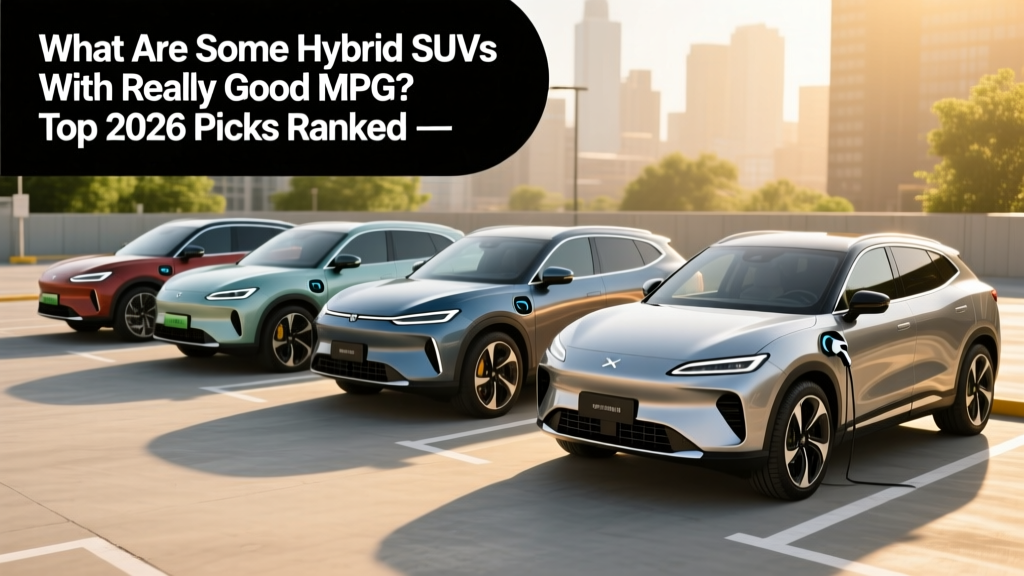
If you're asking "what are some hybrid SUVs with really good MPG," you're not alone. With gasoline prices still volatile and full EVs requiring a charging commitment, hybrid SUVs occupy the sweet spot for millions of buyers: no plug required for conventional hybrids, and for plug-in hybrids, short electric commutes paired with gas-engine road-trip freedom. Below, we rank the best-performing hybrid and plug-in hybrid SUVs on the market for the 2026 model year, with exact EPA figures, real-world fuel economy expectations, powertrain specs, and tax credit eligibility.
HEV vs. PHEV: Know the Difference Before You Shop
The single most important distinction when shopping hybrid SUVs is whether you're looking at a conventional hybrid (HEV) or a plug-in hybrid (PHEV). Conventional hybrids like the Toyota RAV4 Hybrid generate all their electricity internally — through regenerative braking and the gasoline engine. You never plug them in. Plug-in hybrids like the Toyota RAV4 Prime have a larger battery (typically 13–20 kWh) that you charge from a wall outlet or public charger, giving you 30–42 miles of pure electric driving before the gas engine kicks in.
HEVs cost less upfront and deliver consistent 35–41 MPG combined. PHEVs cost more but can eliminate gasoline entirely for short commutes if you charge regularly. If you have home charging and a commute under 40 miles, a PHEV will save more fuel. If you lack charging access or take frequent long road trips, an HEV is simpler and more cost-effective.
Top Hybrid SUVs With the Best MPG for 2026
1. Toyota RAV4 Hybrid — 41 MPG Combined
The RAV4 Hybrid remains the benchmark for compact hybrid SUVs. Its 2.5-liter four-cylinder engine paired with Toyota's fourth-generation hybrid transaxle produces a combined 219 horsepower and delivers an EPA-estimated 41 MPG city / 38 MPG highway / 41 MPG combined on the LE trim (fueleconomy.gov). In real-world driving, owners frequently report exceeding EPA city estimates — hybrids benefit from regenerative braking in stop-and-go traffic, and it's common to see 43–45 MPG in urban conditions. Highway driving at sustained 75+ MPH typically drops to 34–36 MPG due to aerodynamic drag, which affects all hybrid SUVs.
| Spec | 2026 RAV4 Hybrid LE |
|---|---|
| Powertrain | 2.5L I4 + 2 electric motors (219 hp combined) |
| EPA MPG (City/Hwy/Combined) | 41 / 38 / 41 |
| 0–60 MPH | 7.4 seconds |
| Drivetrain | AWD (electronic rear motor) |
| Cargo Volume | 37.5 cu ft (rear seats up) |
| Base MSRP | ~$33,500 |
| Tax Credit | None (HEV — no federal credit) |
2. Honda CR-V Hybrid — 40 MPG Combined
Honda's two-motor hybrid system in the CR-V Hybrid pairs a 2.0-liter Atkinson-cycle engine with twin electric motors for a combined 204 horsepower. The EPA rates the FWD Sport Hybrid at 43 MPG city / 36 MPG highway / 40 MPG combined. The city-heavy advantage is typical of Honda's series-hybrid architecture, which runs primarily on electric motors at lower speeds. Expect real-world combined figures of 36–40 MPG, with highway-heavy commutes closer to 33–35 MPG. Base pricing starts around $36,000 for the Sport Hybrid trim.
3. Toyota RAV4 Prime (PHEV) — 94 MPGe + 42 Miles Electric
For buyers with home charging, the RAV4 Prime is arguably the most capable plug-in hybrid SUV available. Its 18.1 kWh lithium-ion battery delivers an EPA-estimated 42 miles of electric-only range, enough to cover most daily commutes without burning a drop of gasoline. Once the battery depletes, the hybrid powertrain — a turbocharged 2.5L engine with front and rear electric motors producing a combined 302 horsepower — delivers an EPA-estimated 38 MPG combined as a conventional hybrid. Total system range exceeds 600 miles.
| Spec | 2026 RAV4 Prime SE |
|---|---|
| Powertrain | 2.5L I4 + 2 electric motors (302 hp combined) |
| Battery | 18.1 kWh lithium-ion |
| Electric-Only Range | 42 miles (EPA) |
| MPGe (Electric Mode) | 94 MPGe combined |
| Gas-Only MPG | 38 combined (as HEV) |
| Level 2 Charge Time (0–100%) | ~2.5 hours (6.6 kW onboard charger) |
| DC Fast Charge | Not supported |
| 0–60 MPH | 5.7 seconds |
| Base MSRP | ~$44,500 |
| Federal Tax Credit (§30D) | Up to $7,500 (subject to income/MSRP/sourcing rules) |
The RAV4 Prime qualifies for the IRS §30D federal tax credit, potentially worth up to $7,500 — but eligibility depends on your adjusted gross income (caps at $150K single / $300K joint), the vehicle's MSRP (must be under $80,000 for SUVs), and battery component and critical mineral sourcing requirements that have tightened significantly since 2024. The credit can now be transferred to the dealer at point of sale, reducing your purchase price directly. Always verify current-year eligibility with your tax professional before committing.
4. Hyundai Tucson Hybrid — 38 MPG Combined
The Tucson Hybrid uses a 1.6-liter turbocharged four-cylinder paired with a 64 kW electric motor and a 6-speed automatic transmission (rather than a CVT), producing a combined 226 horsepower. The EPA rates the Blue trim at 38 MPG city / 38 MPG highway / 38 combined. The more conventional automatic appeals to drivers who dislike the rubber-band feel of CVTs. Real-world mixed driving tends to land at 35–38 MPG. Starting MSRP is approximately $34,000.
5. Hyundai Tucson PHEV — 33 Miles Electric, 80 MPGe
The Tucson Plug-In Hybrid steps up with a 13.8 kWh battery, providing 33 miles of EPA electric-only range and an 80 MPGe rating in electric mode. A 7.2 kW onboard charger replenishes the battery in about 2 hours on a Level 2 home charger. Once the battery is depleted, it operates as a conventional hybrid at approximately 35 MPG combined. The combined powertrain output is 261 horsepower. Base MSRP starts around $39,500, and it may qualify for partial §30D credits depending on current battery sourcing rules — check the IRS clean vehicle credit list for the latest.
6. Kia Sportage Hybrid — 38 MPG Combined
Sharing its powertrain with the Tucson Hybrid, the Sportage Hybrid offers 226 horsepower and an EPA-estimated 38 MPG combined (38 city / 38 highway) on the LX trim. It distinguishes itself with a slightly more rugged design and competitive cargo space at 39.5 cu ft behind the rear seats. Starting MSRP is approximately $32,500, making it one of the most affordable hybrid SUVs in this list.
Side-by-Side MPG Comparison
| Model | Type | City MPG | Hwy MPG | Combined MPG/MPGe | EV Range | Combined HP | Base MSRP |
|---|---|---|---|---|---|---|---|
| Toyota RAV4 Hybrid | HEV | 41 | 38 | 41 MPG | — | 219 | $33,500 |
| Honda CR-V Hybrid | HEV | 43 | 36 | 40 MPG | — | 204 | $36,000 |
| Toyota RAV4 Prime | PHEV | — | — | 94 MPGe / 38 MPG | 42 mi | 302 | $44,500 |
| Hyundai Tucson Hybrid | HEV | 38 | 38 | 38 MPG | — | 226 | $34,000 |
| Hyundai Tucson PHEV | PHEV | — | — | 80 MPGe / 35 MPG | 33 mi | 261 | $39,500 |
| Kia Sportage Hybrid | HEV | 38 | 38 | 38 MPG | — | 226 | $32,500 |
Real-World MPG vs. EPA Estimates: What to Actually Expect
EPA hybrid ratings are among the most optimistic sticker numbers in the auto industry for city driving — and that's a good thing. Because hybrids recapture energy during braking, they genuinely excel in stop-and-go traffic. Many RAV4 Hybrid and CR-V Hybrid owners report beating the EPA city estimate by 2–4 MPG in dense urban driving.
However, highway driving tells a different story. At sustained speeds above 70 MPH, the aerodynamic drag of an SUV body overwhelms the hybrid system's efficiency advantage. Expect highway fuel economy to drop 4–7 MPG below the EPA highway sticker for most of these vehicles. Cold weather further reduces efficiency by 10–15% due to engine warm-up cycles and reduced battery performance. If your commute is primarily highway miles, a conventional hybrid's advantage over a fuel-efficient gas car narrows — but for mixed and city-heavy driving, the 38–41 MPG these SUVs deliver is genuine and repeatable.
Hybrid Battery Longevity, Warranty, and Replacement Cost
Hybrid battery anxiety is the most common concern we hear from first-time hybrid buyers. Here's what the data actually shows: modern hybrid batteries are engineered for the life of the vehicle. Toyota, Honda, and Hyundai/Kia all provide a hybrid battery warranty of 10 years / 150,000 miles (in CARB states) or 8 years / 100,000 miles (federal). Toyota has been building hybrid powertrains since 1997, and it's common to see Prius and RAV4 Hybrid batteries lasting 200,000+ miles with minimal degradation.
If a hybrid battery does need replacement out of warranty, costs range from $2,000 to $4,500 depending on the model — significantly less than an EV traction battery. Refurbished and third-party replacement options have also expanded, often bringing the cost below $2,000. For PHEVs, the larger battery carries the same warranty coverage, and replacement costs are higher ($4,000–$7,000) but still far below full EV battery replacements. The bottom line: hybrid battery failure before 150,000 miles is statistically rare, and the warranty has you covered regardless.
Tax Credits: Which Hybrid SUVs Qualify?
This is where the HEV vs. PHEV distinction matters enormously. Conventional hybrids (HEVs) do not qualify for the federal §30D clean vehicle tax credit. The credit is available only for plug-in vehicles — battery electric vehicles (BEVs) and plug-in hybrids (PHEVs) with at least 7 kWh of battery capacity.
Among PHEV SUVs, the RAV4 Prime and Tucson PHEV may qualify for up to $7,500 under §30D, but the actual amount depends on several factors:
- Income caps: Modified AGI must not exceed $150,000 (single), $225,000 (head of household), or $300,000 (joint filers)
- MSRP cap: The vehicle's MSRP must be under $80,000 for SUVs
- Battery sourcing: A percentage of critical minerals and battery components must be sourced from the U.S. or free-trade-agreement countries — these thresholds increase annually and can reduce or eliminate the credit for some models
- Point-of-sale transfer: You can now transfer the credit to the dealer, reducing your purchase price at the dealership rather than waiting for a tax refund
Always verify current eligibility on the IRS clean vehicle credit page before purchasing, as sourcing requirements change and can shift a model from full credit to partial or zero credit between model years.
Hybrid vs. PHEV vs. EV: Which Is Right for You?
Choose a Conventional Hybrid (HEV) If:
- You don't have access to home or workplace charging
- You want maximum simplicity — no cables, no charging apps, no planning
- Your budget is under $38,000
- You drive 12,000+ miles per year with mixed city/highway
- You want proven long-term reliability with minimal new technology risk
Choose a Plug-In Hybrid (PHEV) If:
- You have Level 2 charging at home or work
- Your daily commute is under 40 miles round-trip
- You want to drive mostly on electricity but need gas flexibility for road trips
- You want to reduce (not eliminate) gasoline spending
- You want access to the federal tax credit (up to $7,500)
A full battery electric vehicle (BEV) makes the most sense if you have reliable home charging, drive under 300 miles per day, want zero tailpipe emissions, and are ready to commit fully to electric. For buyers who aren't ready for that commitment — or who take regular 400+ mile road trips through areas with sparse charging infrastructure — a hybrid or PHEV SUV is the pragmatic choice that still delivers meaningful fuel savings.
Frequently Asked Questions
How many MPG does a hybrid SUV actually get?
The best hybrid SUVs for 2026 deliver 38–41 MPG combined (EPA). The Toyota RAV4 Hybrid leads at 41 MPG combined, followed by the Honda CR-V Hybrid at 40 MPG. Real-world city driving often exceeds EPA estimates by 2–4 MPG, while highway-heavy driving typically falls 4–7 MPG below the EPA highway number.
How far can a PHEV SUV go on electric only?
The Toyota RAV4 Prime offers the longest electric-only range among PHEV SUVs at 42 miles (EPA). The Hyundai Tucson PHEV delivers 33 miles. For most commuters with home charging, this covers daily driving entirely on electricity, with the gas engine available for longer trips.
Do hybrid SUVs need to be plugged in?
No. Conventional hybrids (HEVs) like the RAV4 Hybrid and CR-V Hybrid never need to be plugged in. They charge their small battery through regenerative braking and the gasoline engine. Only plug-in hybrids (PHEVs) benefit from being plugged in — and even PHEVs will function perfectly fine as regular hybrids if you never charge them.
Is a hybrid SUV reliable, and what does battery replacement cost?
Hybrid SUVs from Toyota, Honda, and Hyundai/Kia have excellent reliability records backed by 8–10 year / 100,000–150,000 mile battery warranties. Out-of-warranty hybrid battery replacement costs $2,000–$4,500 depending on the model. In practice, hybrid batteries routinely last 200,000+ miles.
Does a hybrid SUV qualify for a tax credit?
Conventional hybrids (HEVs) do not qualify for any federal tax credit. Plug-in hybrids (PHEVs) may qualify for up to $7,500 under IRS §30D, subject to income caps, MSRP limits, and battery sourcing requirements. Always check current IRS rules and consult a tax professional before purchasing.
What's better for road trips — a hybrid or a full EV?
For road trips through areas with limited DC fast-charging infrastructure, a hybrid or PHEV SUV is more convenient — you refuel in 5 minutes at any gas station. A full EV requires route planning around chargers and 20–40 minute charging stops. If your road trips are primarily along well-served corridors (Interstates with Electrify America or Tesla Supercharger stations), a BEV is viable. For remote or rural road trips, a hybrid eliminates range planning entirely.