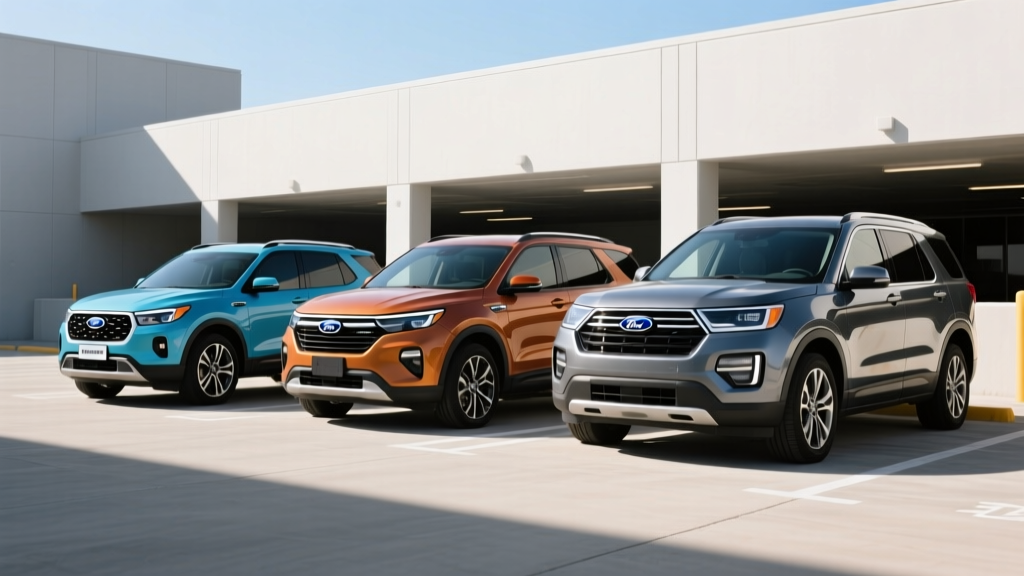
Ford's hybrid lineup has matured into one of the most practical in the mainstream market. If you're searching for a hybrid Ford SUV, you have four strong contenders for 2026: the Escape Hybrid, the Escape Plug-In Hybrid (PHEV), the Explorer Hybrid, and the Maverick Hybrid (technically a compact pickup, but priced and shopped like a small crossover). Each fills a different niche — from budget-friendly efficiency to three-row family hauling — and the right choice depends on whether you want a conventional hybrid you never plug in, or a PHEV with genuine electric-only commuting range.
This guide breaks down every 2026 hybrid Ford SUV with exact EPA numbers, real-world expectations, powertrain specs, pricing, tax-credit eligibility, and a decision framework so you can pick the right one without cross-referencing a dozen tabs.
Hybrid vs. Plug-In Hybrid: Know the Difference Before You Shop
Conventional Hybrid (HEV)
The Escape Hybrid, Explorer Hybrid, and Maverick Hybrid are self-charging hybrids. You never plug them in. A small battery (typically 1.1–1.5 kWh) captures energy from regenerative braking and the gasoline engine, then deploys it for electric-assist acceleration and low-speed driving. The result: dramatically better MPG than a gas-only equivalent, with zero lifestyle change. You fuel up at gas stations exactly as before.
Plug-In Hybrid (PHEV)
The Escape PHEV pairs a larger battery (14.4 kWh usable) with a charging port. Plug in at home (Level 2) or on the go, and you get up to 37 miles of electric-only driving before the gasoline engine engages. Once the battery depletes, it operates as a conventional hybrid. This is the sweet spot for commuters who can charge at home: most daily driving is electric, but road trips use gasoline with no range anxiety.
2026 Ford Escape Hybrid: The Efficiency Benchmark
The Escape Hybrid remains Ford's volume hybrid SUV and one of the most efficient compact crossovers on the market. For 2026, the 2.5-liter Atkinson-cycle four-cylinder paired with an electric motor delivers 210 combined horsepower through an eCVT (planetary gearset, not a belt-driven CVT). Front-wheel drive is standard; AWD is available and costs roughly 2 MPG combined.
| Configuration | City MPG | Highway MPG | Combined MPG |
|---|---|---|---|
| Escape Hybrid FWD | 42 | 36 | 39 |
| Escape Hybrid AWD | 42 | 36 | 37 |
Real-world MPG note: Toyota RAV4 Hybrid and Honda CR-V Hybrid owners frequently report beating EPA city estimates in stop-and-go traffic, and the Escape Hybrid behaves similarly. Expect 40–44 MPG in urban driving where regenerative braking shines. Highway cruising at 75+ MPH will dip toward 32–34 MPG — hybrids lose their advantage at sustained high speed because the engine runs continuously. Source: fueleconomy.gov.
2026 Escape Hybrid Quick Specs
| Powertrain | 2.5L I4 + electric motor, 210 hp combined |
| Transmission | eCVT (planetary gearset) |
| Hybrid Battery | ~1.1 kWh lithium-ion |
| 0–60 MPH | ~7.5 seconds |
| Cargo Volume | 34.4 cu ft (rear seats up) |
| Base MSRP | ~$33,000 (ST-Line Hybrid) |
2026 Ford Escape PHEV: 37 Miles of Electric Commuting
The Escape PHEV is where Ford's hybrid lineup gets genuinely interesting for commuters. Its 14.4 kWh lithium-ion battery delivers an EPA-rated 37 miles of electric-only range — enough to cover most daily commutes and errands without burning a drop of gasoline. When the battery depletes, the 2.5L engine and motor continue as a conventional hybrid, returning a respectable 40 MPG combined in hybrid mode.
| Mode | Rating |
|---|---|
| Electric-Only Range | 37 miles (EPA) |
| Combined MPGe (electric + gas) | 105 MPGe |
| Hybrid-Only MPG (after depletion) | 40 combined (42 city / 37 hwy) |
| Total Range (gas + electric) | ~520 miles |
Charging the Escape PHEV
The Escape PHEV uses a standard J1772 connector for Level 1 (120V) and Level 2 (240V) AC charging. It does not support DC fast charging — a deliberate engineering choice to save cost and weight, and typical for PHEVs in this class.
| Charging Level | Power | 0–100% Time | Practical Notes |
|---|---|---|---|
| Level 1 (120V outlet) | ~1.4 kW | ~10–11 hours | Overnight from a standard household outlet |
| Level 2 (240V home charger) | ~3.3 kW (onboard limit) | ~3.5 hours | Full charge during workday or overnight easily |
Key insight: The 3.3 kW onboard charger is the bottleneck, not your home charger. Even if you install a 48-amp Level 2 station, the Escape PHEV will only draw 3.3 kW. That's fine for a 14.4 kWh battery — 3.5 hours is plenty — but it means there's no benefit to overspec'ing your home charging equipment for this vehicle alone.
Base MSRP for the 2026 Escape PHEV starts around $40,000, roughly $7,000 above the conventional Escape Hybrid. The math works if your commute is under 37 miles round-trip and you can charge at home: you'll use gasoline only for weekend road trips.
2026 Ford Explorer Hybrid: Three-Row Efficiency
The Explorer Hybrid fills a niche no other Ford hybrid occupies: three-row family hauling with meaningful fuel savings. Its 3.3L V6 hybrid powertrain produces 318 combined horsepower — substantially more than the turbocharged 2.3L EcoBoost in the gas-only Explorer — while returning markedly better fuel economy.
| Configuration | City MPG | Highway MPG | Combined MPG |
|---|---|---|---|
| Explorer Hybrid RWD | 21 | 28 | 24 |
| Explorer Hybrid AWD | 20 | 27 | 23 |
| Gas Explorer 2.3L EcoBoost AWD (baseline) | 20 | 25 | 22 |
The MPG improvement over the gas Explorer is modest in the city (1 MPG), but the hybrid's electric torque fill makes the V6 feel more responsive off the line, and the combined 318 hp gives confident highway merging. Towing capacity remains 5,000 lbs with the Class III tow package — matching the EcoBoost.
Base MSRP for the 2026 Explorer Hybrid (Limited trim) starts around $55,000. That's a significant premium over the base gas Explorer (~$39,000), but the hybrid powertrain is bundled with the higher trim's content, so the effective upcharge for the hybrid system alone is closer to $3,000–$4,000 when comparing similarly equipped models.
2026 Ford Maverick Hybrid: The Budget Efficiency King
The Maverick Hybrid isn't an SUV — it's a compact pickup — but it's priced like a subcompact crossover and cross-shopped against vehicles like the RAV4 and CR-V by budget-conscious buyers. For 2026, the 2.5L hybrid powertrain produces 191 combined horsepower and achieves an EPA-rated 42 MPG city / 33 highway / 38 combined (FWD only; AWD is not available on the hybrid).
Starting MSRP is approximately $28,000, making the Maverick Hybrid the most affordable new hybrid vehicle Ford sells and one of the cheapest hybrids on the market, period. For urban drivers who need occasional cargo flexibility (the 4.5-foot bed handles furniture runs and garden supplies), it's a compelling alternative to a compact crossover.
Battery Warranty, Reliability, and Replacement Costs
Ford Hybrid Battery Warranty Coverage
Ford covers the high-voltage hybrid battery in all its hybrid and PHEV models with an 8-year / 100,000-mile warranty (10 years / 150,000 miles in California and states that follow CARB emissions rules). The warranty guarantees the battery will retain sufficient capacity to function as designed — typically defined as above 60–70% of original capacity.
Real-world reliability data: Ford's hybrid system, particularly the eCVT planetary gearset, has proven robust. Unlike conventional automatic transmissions, the eCVT has no belts, clutches, or friction bands to wear — it's a simple set of gears connecting the engine and two motor-generators. Toyota pioneered this architecture (the Hybrid Synergy Drive), and Ford licensed a compatible design. Failures are rare; high-mileage Escape Hybrids used as taxis and fleet vehicles regularly exceed 200,000 miles on the original hybrid battery.
Battery replacement cost if out of warranty: A replacement hybrid battery pack for the Escape Hybrid runs approximately $2,000–$3,500 (parts only, remanufactured units available). The Escape PHEV's larger 14.4 kWh pack costs more — expect $5,000–$8,000 for a replacement. The Explorer Hybrid's battery falls in the $3,000–$5,000 range. These are parts-only estimates; labor adds $500–$1,500 depending on the dealer.
Tax Credits and Incentives for Ford Hybrids
Under current IRS §30D rules, the Escape PHEV may qualify for up to $3,750 in federal tax credit, depending on battery mineral sourcing compliance. The exact credit amount varies by model year and production batch — Ford's battery sourcing has shifted as supply chains evolve, and some build dates qualify for the full $7,500 while others receive $3,750 or none. Always verify current eligibility on the IRS clean vehicle credits page before purchasing.
The conventional Escape Hybrid, Explorer Hybrid, and Maverick Hybrid do not qualify for the §30D new clean vehicle credit — this credit is reserved for plug-in vehicles (BEVs and PHEVs) with batteries above 7 kWh.
- MSRP cap: SUVs must be under $80,000 MSRP (all Ford hybrids qualify)
- Income cap: AGI must not exceed $150,000 (single) / $300,000 (joint) / $225,000 (head of household)
- Battery sourcing: Critical minerals and battery components must meet phased-in domestic/free-trade requirements
- Point-of-sale transfer: You can transfer the credit to the dealer for an immediate price reduction (effective 2024+)
- Verification: Check the IRS source and the dealer's point-of-sale confirmation before signing
Some states offer additional rebates for PHEVs (California's CVRP, for example, has offered $1,000–$1,750 for eligible PHEVs, though funding availability varies). Check your state energy office for current programs.
Hybrid vs. PHEV vs. Full EV: Which Ford Fits Your Life?
Choose a Conventional Hybrid (Escape Hybrid, Explorer Hybrid, Maverick Hybrid) if:
- You cannot charge at home (apartment, street parking, no garage)
- You want maximum MPG with zero lifestyle change
- Your budget is under $35,000 (Maverick or Escape Hybrid)
- You drive more than 20,000 miles per year and want proven, low-maintenance efficiency
Choose the Escape PHEV if:
- You can install a Level 2 charger at home (garage or driveway with 240V access)
- Your daily commute is under 37 miles round-trip
- You want to drive on electricity most days but need gasoline flexibility for road trips
- You want to reduce (but not eliminate) gasoline spending
Choose a Full EV (like the Ford Mustang Mach-E) if:
- You can charge at home and want zero gasoline expenses
- Your daily driving is under 250 miles and you're comfortable planning DC fast-charge stops on road trips
- You want the lowest per-mile "fuel" cost and minimal drivetrain maintenance
- You qualify for the full $7,500 federal tax credit on a BEV
Ford Hybrid SUVs — Pros
- Escape Hybrid: 39 MPG combined, no plug needed, ~$33K starting price
- Escape PHEV: 37 miles electric, 520+ total range, commuter-friendly
- Explorer Hybrid: 318 hp, three rows, 5,000-lb towing, 24 MPG combined
- Maverick Hybrid: 38 MPG combined, ~$28K, most affordable hybrid Ford
- eCVT reliability: proven architecture, no belts or clutches to fail
- 8-year/100K-mile hybrid battery warranty (10/150K in CARB states)
Ford Hybrid SUVs — Cons
- Explorer Hybrid MPG gain over gas model is modest (~2 MPG combined)
- Escape PHEV: no DC fast charging, 3.3 kW onboard charger is slow for public Level 2
- AWD not available on Maverick Hybrid
- Escape PHEV's ~$7,000 premium over conventional hybrid takes years to recoup at current gas prices
- Tax credit for PHEV is uncertain ($0–$7,500 depending on sourcing compliance)
- Conventional hybrids don't qualify for any federal purchase incentive
Frequently Asked Questions
How many MPG does the Ford Escape Hybrid get?
The 2026 Escape Hybrid FWD is EPA-rated at 42 city / 36 highway / 39 combined MPG. AWD drops the combined figure to 37 MPG. In real-world city driving with frequent stops, many owners report 40–44 MPG. Highway driving at 75+ MPH typically yields 32–34 MPG.
How far can the Escape PHEV go on electric only?
The 2026 Escape PHEV has an EPA-rated 37 miles of electric-only range. Real-world range varies with temperature and driving style: expect 30–33 miles in cold weather (below 40°F) and 35–38 miles in mild conditions with moderate acceleration. Once the battery depletes, the vehicle continues as a hybrid at 40 MPG combined.
Is the Ford hybrid system reliable?
Ford's eCVT-based hybrid system has a strong reliability record. The planetary gearset design has no wearable friction components (no belts, clutches, or torque converters). Fleet Escape Hybrids have documented 200,000+ miles on original hybrid batteries and transmissions. The 8-year/100,000-mile battery warranty provides additional protection.
What does a Ford hybrid battery replacement cost?
Out-of-warranty replacement costs vary by model: Escape Hybrid ~$2,000–$3,500 (remanufactured), Escape PHEV ~$5,000–$8,000, Explorer Hybrid ~$3,000–$5,000. Labor adds $500–$1,500. However, widespread battery failure before 150,000 miles is uncommon based on fleet and owner data.
Does the Ford Escape PHEV qualify for a tax credit?
The Escape PHEV may qualify for up to $3,750 under the IRS §30D credit, depending on battery mineral and component sourcing for the specific build date. Conventional Ford hybrids (Escape Hybrid, Explorer Hybrid, Maverick Hybrid) do not qualify for any federal purchase credit. Always verify current eligibility on irs.gov before purchase.
Do I need to plug in the Escape Hybrid or Explorer Hybrid?
No. The Escape Hybrid, Explorer Hybrid, and Maverick Hybrid are conventional (self-charging) hybrids. They generate all their electricity internally through regenerative braking and the gasoline engine. You fuel them at a gas station like any other vehicle. Only the Escape PHEV requires plugging in to access its electric-only range.
Can the Escape PHEV use DC fast charging?
No. The Escape PHEV supports Level 1 (120V, ~1.4 kW) and Level 2 (240V, up to 3.3 kW) AC charging only. A full Level 2 charge takes about 3.5 hours. DC fast charging is not available — this is standard for most PHEVs in this price class, as the smaller battery doesn't justify the added cost and weight of DC hardware.