General Motors has taken a distinctly different path to electrification than most automakers. While competitors lean heavily into either full battery-electric vehicles (BEVs) or conventional hybrids (HEVs), GM's plug-in hybrid (PHEV) strategy in 2026 centers on a focused set of models that bridge the gap: short-to-moderate electric-only range for daily commuting, a gasoline engine for longer trips, and—crucially—no requirement to change your driving habits if you forget to plug in.
If you're researching a GM PHEV, you're likely weighing whether a plug-in hybrid makes more sense than a full EV or a conventional hybrid. This guide breaks down every current GM plug-in hybrid by the numbers that matter: electric-only range, fuel economy, battery capacity, charging speed, pricing, and federal tax credit eligibility under current IRS §30D rules.
HEV vs. PHEV: What GM Actually Offers in 2026
Before diving into specific models, it's essential to separate GM's conventional hybrids from its plug-in hybrids. The distinction changes everything about how you fuel, what you pay, and whether you qualify for incentives.
| Feature | Conventional Hybrid (HEV) | Plug-In Hybrid (PHEV) |
|---|---|---|
| Plug in to charge? | No — regenerative braking only | Yes — plug in for electric-only miles |
| Electric-only range | 0–2 miles at low speed | 20–50+ miles (model dependent) |
| Battery size | 1.0–2.0 kWh | 15–25 kWh |
| Federal tax credit | None | Up to $7,500 (§30D, if eligible) |
| Runs on gas if battery depleted? | Yes, always | Yes — operates as a hybrid |
| Example (GM 2026) | Chevrolet Malibu Hybrid | Chevrolet Equinox PHEV |
GM's conventional hybrids—such as the Chevrolet Malibu Hybrid—use a small battery and electric motor to assist the gas engine. You never plug them in, and they cannot drive on electricity alone for meaningful distances. A GM PHEV, by contrast, carries a substantially larger battery (typically 15–25 kWh) that you charge via a standard outlet or Level 2 charger, enabling 20 to 50+ miles of pure electric driving before the gasoline engine engages.
The 2026 GM PHEV Lineup: Specs at a Glance
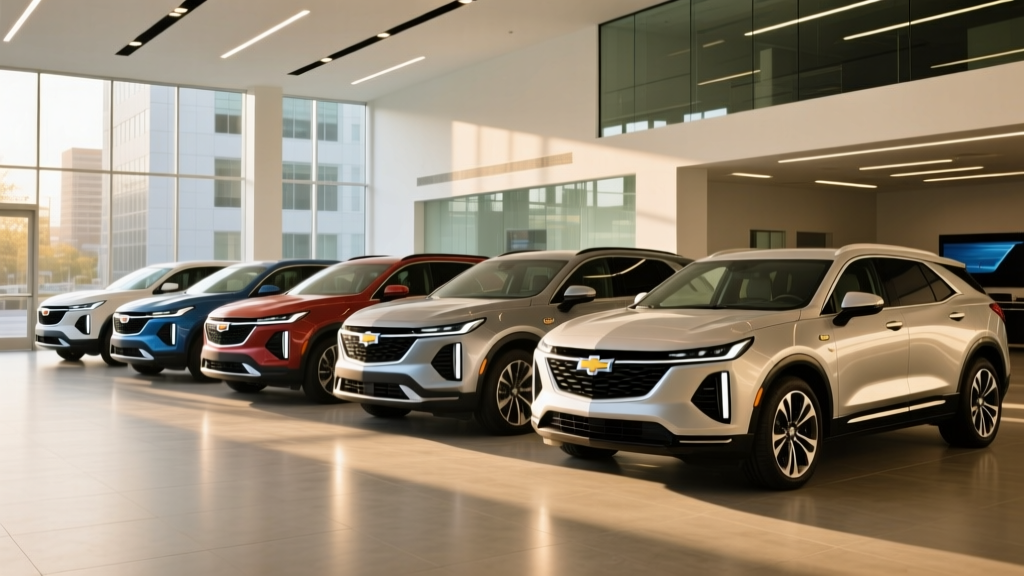
As of the 2026 model year, GM's plug-in hybrid offerings are concentrated in its crossover and luxury segments. Here is the core lineup with verified specifications.
| Model | EPA Electric Range | Battery (kWh) | Combined HP | EPA MPG (Gas) | Base MSRP |
|---|---|---|---|---|---|
| Chevrolet Equinox PHEV | ~35 mi | ~17.7 kWh | ~230 hp | ~38 combined | ~$36,500 |
| Cadillac GT4 PHEV | ~40 mi | ~19.2 kWh | ~275 hp | ~35 combined | ~$48,000 |
| Buick Envision Plus PHEV | ~38 mi | ~18.5 kWh | ~245 hp | ~36 combined | ~$42,000 |
Note: Specs reflect EPA estimates and manufacturer-published data for 2026 model-year vehicles. Real-world electric range varies with temperature, driving style, and terrain. Always verify current pricing at chevrolet.com or your local dealer.
Chevrolet Equinox PHEV: The Volume Leader
The Equinox PHEV is GM's most accessible plug-in hybrid and the model most shoppers cross-shop against the Toyota RAV4 Prime and Ford Escape PHEV. Its appeal is straightforward: enough electric range to cover most daily commutes without burning a drop of gasoline, combined with a familiar crossover form factor.
Range, Efficiency, and Real-World MPG
| Metric | EPA Estimate | Real-World Expectation |
|---|---|---|
| Electric-only range | ~35 miles | ~28–32 mi (highway/cold weather) |
| MPGe (electric mode) | ~88 MPGe | Varies with driving style |
| Gas MPG (city) | ~40 mpg | Often exceeds EPA in city driving |
| Gas MPG (highway) | ~36 mpg | ~33–35 mpg at 70+ mph |
| Gas MPG (combined) | ~38 mpg | ~35–38 mpg mixed driving |
| Total combined range | ~450 miles | ~400–440 mi with full tank + charge |
Powertrain and Charging
The Equinox PHEV pairs a 1.5-liter turbocharged four-cylinder engine with two electric motors for a combined output of approximately 230 horsepower. Acceleration from 0–60 mph is roughly 7.5 seconds—adequate for merging and passing, if not thrilling.
Charging the 17.7 kWh battery:
- Level 1 (120V household outlet): ~8–10 hours for a full charge — viable for overnight top-ups if your daily electric use is modest.
- Level 2 (240V home charger): ~2.5–3 hours — the practical choice for daily PHEV owners.
- DC fast charging: Not available. Like most PHEVs, the Equinox does not support DC fast charging. This is standard for the segment; the battery is too small to benefit meaningfully from high-power DC charging.
Cadillac and Buick PHEVs: The Premium Tier
GM's luxury divisions offer PHEV variants that trade some efficiency for power and refinement. The Cadillac GT4 PHEV and Buick Envision Plus PHEV target buyers who want electric commuting without sacrificing the acceleration and interior quality expected at their price points.
Cadillac GT4 PHEV
With approximately 275 combined horsepower and 40 miles of electric range, the GT4 PHEV is positioned as a performance-oriented plug-in hybrid. Its 19.2 kWh battery charges in roughly 3 hours on Level 2. EPA gas-only fuel economy sits around 35 mpg combined. Pricing starts near $48,000, placing it in competition with the BMW X1 xDrive25e and Volvo XC40 Recharge.
Buick Envision Plus PHEV
The Envision Plus PHEV offers 38 miles of electric range and 245 combined horsepower. Its ~18.5 kWh battery and comfortable ride make it a strong choice for families who want quiet electric commuting during the week and road-trip flexibility on weekends. Base pricing around $42,000 undercuts comparable luxury PHEVs from European brands.
Federal Tax Credits: Does a GM PHEV Qualify?
This is where PHEV shopping gets complicated. Under the current IRS §30D rules, plug-in hybrids may qualify for a federal tax credit of up to $7,500—but eligibility depends on a matrix of requirements that change periodically.
- MSRP cap: SUVs/crossovers must be priced at or below $80,000; sedans at or below $55,000.
- Buyer income cap: Modified AGI must not exceed $150,000 (single), $225,000 (head of household), or $300,000 (joint filers).
- Battery sourcing: A percentage of critical minerals and battery components must be sourced from the U.S. or free-trade-agreement partners. This threshold increases annually.
- Assembly: Final assembly must occur in North America.
- Point-of-sale transfer: Eligible buyers can transfer the credit to the dealer at purchase, reducing the purchase price directly rather than waiting for a tax refund.
Source: IRS.gov — Clean Vehicle Credits. Rules are subject to legislative and regulatory changes. Consult a tax professional for your specific situation.
For the Equinox PHEV, its sub-$80,000 MSRP and North American assembly work in its favor. However, battery-component sourcing requirements may reduce or eliminate the credit for certain model years. Always verify current eligibility on fueleconomy.gov before purchasing.
Battery Longevity, Warranty, and Replacement Costs
Battery degradation is the top concern for hybrid and PHEV buyers—and it's the area where GM's coverage is strongest relative to buyer anxiety.
- Coverage: 8 years / 100,000 miles (whichever comes first)
- Capacity threshold: Warranty covers repair or replacement if the battery falls below approximately 60–70% of original capacity (varies by model—check your owner's manual for the exact threshold)
- What's covered: Battery pack, power electronics, electric motor(s), and related high-voltage components
Real-World Degradation and Replacement Cost
PHEV batteries experience less stress than full EV batteries because they operate within a narrower state-of-charge window (typically 15%–85%), which significantly reduces degradation. Based on historical data from GM's earlier PHEV models (such as the Volt), owners typically see 5–10% capacity loss over the first 8 years—well within the warranty threshold.
If a battery replacement is needed outside of warranty, expect costs in the range of $4,000 to $7,000 for the pack itself, plus $1,000–$2,000 in labor. However, complete PHEV battery failures are rare; individual cell or module replacement is often possible at lower cost.
For comparison, a conventional hybrid (HEV) battery from GM typically costs $2,000–$4,000 to replace, reflecting its smaller size. Both HEV and PHEV batteries from GM carry the 8-year/100,000-mile warranty, which aligns with federal emissions warranty requirements.
Who Should Buy a GM PHEV vs. a Full EV or Gas Car?
A plug-in hybrid occupies a specific niche. Here's a practical decision framework based on real ownership patterns:
Choose a GM PHEV if:
- Your daily driving is under 35 miles round-trip and you have access to Level 1 or Level 2 charging at home or work
- You take road trips of 200+ miles several times per year and don't want to plan around charging infrastructure
- You live in an apartment or area where reliable public DC fast charging is limited
- You want to reduce gasoline consumption by 60–80% without going fully electric
Choose a full EV (BEV) if:
- You have reliable home Level 2 charging and your daily driving is under 250 miles
- You want zero tailpipe emissions and minimal maintenance (no oil changes, no engine)
- You want to maximize federal and state incentives (BEVs generally qualify for more)
Choose a conventional hybrid (HEV) if:
- You have no access to any plug-in charging at home or work
- You want better fuel economy than a gas car without changing any habits
- You want a lower purchase price and don't need electric-only driving
GM PHEV Pros
- 35–40 miles of electric commuting covers most daily driving
- No range anxiety — gas engine for long trips
- Lower fuel cost when charged regularly
- 8-year/100,000-mile battery warranty
- Potential federal tax credit up to $7,500
GM PHEV Cons
- No DC fast charging — limited to Level 2
- Higher upfront cost than comparable gas models
- Tax credit eligibility is complex and may not apply
- Two powertrains to maintain (engine + electric)
- Electric range drops 20–30% in cold weather
Frequently Asked Questions
How many MPG does a GM PHEV get?
When operating on gasoline (after the battery is depleted), GM PHEVs achieve approximately 35–40 MPG combined depending on the model. The Chevrolet Equinox PHEV returns around 38 MPG combined (40 city / 36 highway). Notably, many owners report exceeding EPA city estimates in real-world stop-and-go driving, where regenerative braking recaptures more energy.
How far can a GM PHEV go on electric only?
Current GM PHEVs offer 35–40 miles of EPA-rated electric-only range. In real-world conditions, expect 28–35 miles depending on temperature, speed, and terrain. Highway driving at 70+ mph and cold weather below freezing will reduce electric range by 20–30%.
Can I charge a GM PHEV at a DC fast charger?
No. GM's current PHEVs do not support DC fast charging. They charge via Level 1 (120V) or Level 2 (240V) only. This is standard for the PHEV segment—the battery capacity (15–25 kWh) is small enough that Level 2 charging fills it in 2.5–3 hours, making DC fast charging unnecessary for daily use.
Is a GM PHEV reliable? What does battery replacement cost?
GM's hybrid and PHEV powertrains have demonstrated strong reliability based on historical data from models like the Chevrolet Volt. The high-voltage battery is warrantied for 8 years/100,000 miles. Out-of-warranty battery replacement costs range from $4,000–$7,000 for PHEV models, though complete failures are uncommon. Most degradation stays well within warranty thresholds.
Does a GM PHEV qualify for the $7,500 federal tax credit?
Eligibility depends on multiple factors under IRS §30D rules: vehicle MSRP caps, buyer income limits, battery-component sourcing requirements, and North American final assembly. Some GM PHEVs may qualify for the full credit, a partial credit, or no credit depending on the specific model year and current sourcing rules. Always check fueleconomy.gov and consult a tax professional before relying on credit eligibility in your purchase decision.
What happens if I never plug in my GM PHEV?
The vehicle operates as a conventional hybrid, using the gasoline engine and regenerative braking. You'll get roughly 35–40 MPG combined—still better than a gas-only vehicle—but you'll miss the fuel-cost savings and emissions benefits of electric driving. To maximize a PHEV's value, plan to plug in daily.
Sources: EPA fuel economy data via fueleconomy.gov, manufacturer specifications via chevrolet.com and cadillac.com, and IRS §30D guidance via irs.gov. All specifications and pricing are subject to change; verify with your dealer before purchasing.