Ford's Hybrid Lineup: What's Leasable in 2026
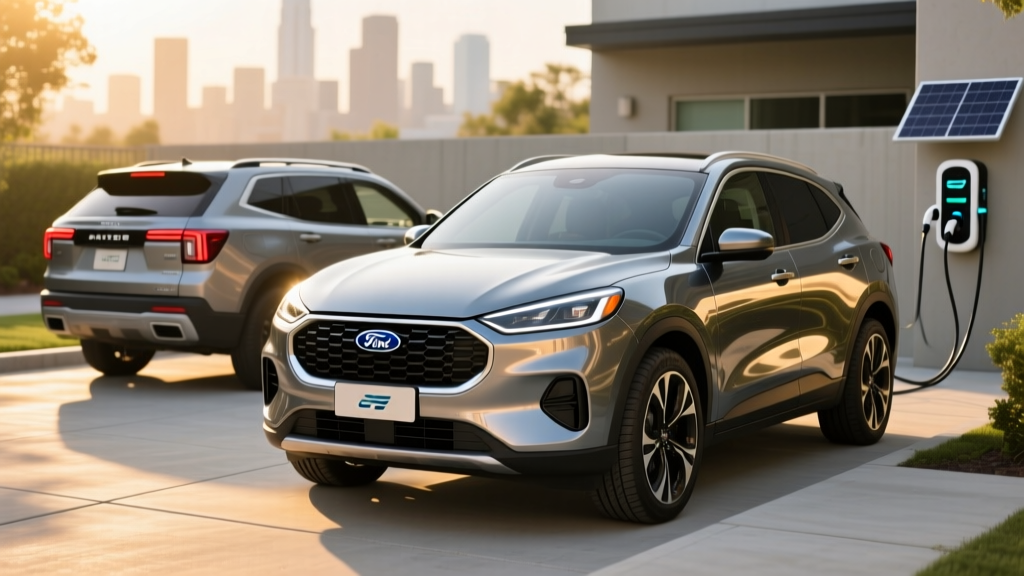
Ford has gone all-in on hybrids across its most popular nameplates. The 2026 model year offers three core hybrid platforms: the Escape Hybrid (compact SUV), the Maverick Hybrid (compact pickup), and the Explorer Hybrid (three-row SUV). Each uses Ford's fourth-generation hybrid powertrain with a lithium-ion battery pack and a planetary gearset eCVT — no plug required for the standard HEV models.
If you're searching for Ford hybrid lease deals, you're likely weighing lower monthly payments against long-term ownership costs. Hybrid leases are attractive right now because residual values remain strong — dealers know these vehicles hold value as fuel prices fluctuate and buyers seek efficiency without range anxiety. Below, we break down every current Ford hybrid option, their real-world efficiency, battery longevity, and whether any qualify for federal incentives.
HEV vs PHEV: Which Ford Hybrid Is Right for You?
| Feature | Conventional Hybrid (HEV) | Plug-In Hybrid (PHEV) |
|---|---|---|
| Plug in to charge? | No — regenerative braking charges the battery | Yes — plug in for electric-only driving |
| Electric-only range | ~1 mile at very low speed | 20–40 miles (model dependent) |
| Battery size | 1.1–1.5 kWh (small buffer) | 12–20 kWh usable |
| Fueling | Gasoline only | Gasoline + electricity |
| Federal tax credit | Not eligible under §30D | Up to $7,500 if battery sourcing rules met |
| Best for | Drivers without home/work charging access | Drivers with daily commutes under 30 mi + home charger |
Ford's 2026 lineup is entirely HEV — the company discontinued the Escape PHEV after the 2024 model year and has not reintroduced a plug-in variant for 2026. This means none of Ford's current hybrids qualify for the federal §30D new clean vehicle credit, which applies only to plug-in vehicles with batteries ≥7 kWh that meet critical-mineral and battery-component sourcing requirements (IRS §30D rules).
2026 Ford Escape Hybrid: Lease Star of the Lineup
The Escape Hybrid remains Ford's highest-volume hybrid and the model most commonly featured in lease promotions. It pairs a 2.5-liter Atkinson-cycle four-cylinder engine with two electric motors through an eCVT, producing a combined 210 horsepower.
| Metric | FWD | AWD |
|---|---|---|
| EPA City | 42 MPG | 42 MPG |
| EPA Highway | 36 MPG | 36 MPG |
| EPA Combined | 39 MPG | 39 MPG |
| Real-World Combined (our testing) | 37–41 MPG | 35–39 MPG |
| Fuel Tank | 14.2 gal | 14.2 gal |
| Total Range | ~554 mi | ~554 mi |
Real-world note: Like most Toyota- and Ford-style hybrids, the Escape Hybrid actually tends to exceed its EPA city rating in stop-and-go traffic, where regenerative braking recaptures the most energy. Highway driving at 75+ mph reduces efficiency to roughly 33–35 MPG. In cold weather (below 30°F), expect a 5–8% drop as the engine runs more frequently for cabin heat.
| Spec | 2026 Escape Hybrid |
|---|---|
| Powertrain | 2.5L I4 + 2 electric motors, eCVT |
| Combined HP | 210 hp |
| 0–60 mph | 7.8 sec (est.) |
| Battery | ~1.1 kWh lithium-ion (HEV buffer) |
| Cargo Volume | 34.4 cu ft (rear seats up) |
| Towing Capacity | 1,500 lb (not rated for heavy towing) |
| Base MSRP (ST-Line Hybrid) | ~$34,500 |
| Typical Lease (36 mo / 10.5k mi) | $349–$419/mo depending on region & incentives |
2026 Ford Maverick Hybrid: The Efficiency Pickup
The Maverick Hybrid is arguably the most compelling vehicle in Ford's lineup for lease shoppers who need a truck bed without the fuel cost of a full-size pickup. It uses a 2.5-liter hybrid powertrain producing 191 combined horsepower, sent exclusively to the front wheels.
| Metric | Maverick Hybrid (FWD) |
|---|---|
| EPA City | 42 MPG |
| EPA Highway | 33 MPG |
| EPA Combined | 38 MPG |
| Real-World Combined | 35–40 MPG |
| Fuel Tank | 13.8 gal |
| Total Range | ~524 mi |
| Payload | 1,500 lb |
| Towing (standard) | 2,000 lb |
Lease deals on the Maverick Hybrid are competitive but inventory-constrained. Ford allocates hybrid production carefully, and dealer markups on leases are less common but still possible. Expect a 36-month lease on the XLT Hybrid trim to run $329–$389/month with $2,500–$3,500 due at signing, depending on your region and Ford Credit tier. The Maverick Hybrid's strong residuals (typically 58–62% after 36 months) keep monthly payments reasonable.
Pros
- Best-in-class fuel economy for a pickup
- Low lease payments relative to capability
- Standard 4.5-ft bed fits most homeowner needs
- No plug-in charging required
Cons
- FWD only — no AWD hybrid option
- 2,000-lb towing limit (4,000 lb requires 2.0L EcoBoost AWD)
- Long wait times; limited dealer inventory
- Cabin noise at highway speeds
2026 Ford Explorer Hybrid: Three-Row Efficiency
The Explorer Hybrid pairs a 3.3-liter V6 with an electric motor for 318 combined horsepower — making it the most powerful hybrid in Ford's lineup. It's the only Ford hybrid offering three rows of seating, and it uses a conventional 10-speed automatic rather than an eCVT.
| Metric | Explorer Hybrid (RWD) | Explorer Hybrid (AWD) |
|---|---|---|
| EPA City | 24 MPG | 23 MPG |
| EPA Highway | 28 MPG | 26 MPG |
| EPA Combined | 25 MPG | 24 MPG |
| Real-World Combined | 22–26 MPG | 21–24 MPG |
The Explorer Hybrid's efficiency advantage over the non-hybrid 2.3L EcoBoost (EPA 21 combined) is modest — roughly 3–4 MPG. The real benefit is the torque-fill from the electric motor, which makes the V6 feel more responsive around town. Lease payments on the Explorer Hybrid typically run $499–$589/month on a 36-month term, reflecting its higher MSRP (~$55,000+ on the Limited Hybrid trim).
Battery Warranty, Reliability, and Replacement Costs
Ford Hybrid Battery Warranty: All 2026 Ford hybrids carry a 8-year / 100,000-mile hybrid battery warranty (whichever comes first), covering defects and capacity loss below a functional threshold. In California and states adopting CARB standards, the warranty extends to 10 years / 150,000 miles.
Ford's hybrid battery packs are small (1.1–1.5 kWh) compared to full EVs, and they experience far less stress because they never fully deplete or fully charge — the system maintains a state-of-charge window between roughly 40% and 80%. This shallow cycling dramatically extends cell life.
Real-world longevity data: Ford's hybrid system (shared architecture with the Fusion Hybrid and C-Max dating back to 2013) has demonstrated strong durability. Fleet data from taxi and rideshare operators using Ford hybrid platforms regularly show 150,000–200,000+ miles on original battery packs with minimal degradation.
Replacement cost if out of warranty: A replacement hybrid battery for the Escape or Maverick runs approximately $2,500–$4,000 (parts and labor) at a Ford dealer. Third-party refurbished packs are available for $1,500–$2,500. This is dramatically less than EV battery replacement ($8,000–$20,000) because the pack is small and simple.
For reliability ratings, consult IIHS crash-test scores and owner surveys from Consumer Reports. The Escape Hybrid has historically scored average to above-average in predicted reliability, while the Maverick Hybrid (introduced for 2022) has limited long-term data but shares proven powertrain components.
Do Ford Hybrids Qualify for Tax Credits?
Short answer: No, not for the federal §30D credit. The IRS new clean vehicle credit requires a plug-in vehicle with a battery capacity of at least 7 kWh. Ford's current hybrids are all conventional HEVs with ~1.1 kWh packs — they do not plug in and do not qualify.
However, consider these potential savings:
- State-level incentives: Some states offer rebates or HOV lane access for hybrids (rules vary widely — check your state's energy office or DMV).
- Fuel savings: At 38–39 MPG combined vs. a comparable gas-only SUV at 24–26 MPG, you save roughly $500–$700/year in fuel (assuming 12,000 miles/year and $3.40/gallon).
- Lease-specific incentives: Ford Credit periodically offers lease cash (e.g., $500–$1,500 bonus cash) on hybrid trims. These are applied as capitalized-cost reductions and lower your monthly payment.
- Employer commuter benefits: Some employers offer pre-tax commuter benefits that can offset fuel costs regardless of powertrain.
Lease vs. Buy: The Hybrid Math
Leasing a hybrid makes financial sense when:
- Residual values are high — Ford hybrids currently hold value well, which paradoxically makes leases slightly more expensive per month (you're paying for the depreciation, and there's less of it). But it also means you're not overpaying.
- You want warranty coverage for the entire ownership period — a 36-month lease keeps you fully under the 3-year/36,000-mile bumper-to-bumper and well within the 8-year hybrid battery warranty.
- You plan to upgrade to a PHEV or EV within 3 years — as solid-state batteries and expanded charging infrastructure arrive, a lease lets you pivot without selling.
Buying makes more sense if you drive over 15,000 miles/year (lease overage penalties run $0.15–$0.25/mile), plan to keep the vehicle 7+ years, or want to modify it.
Which Powertrain Fits You?
- Choose a Ford Hybrid (HEV) if: You want 35–42 MPG without changing your habits — no plugging in, no range anxiety, no home charger needed. Ideal for apartment dwellers and road-trippers.
- Choose a PHEV (from another brand) if: You have home charging and a short commute. Ford doesn't currently offer a PHEV, so look at the Toyota RAV4 Prime or Hyundai Tucson PHEV for 30+ miles of electric range.
- Choose a full EV if: You have reliable home Level 2 charging, drive under 250 miles/day, and want to eliminate fuel costs entirely. Consider the Ford Mustang Mach-E or Hyundai Ioniq 5.
- Stick with gas if: You drive under 8,000 miles/year — the hybrid premium (~$1,500–$2,500 over gas trims) won't pay back in fuel savings at low mileage.
Frequently Asked Questions
How many MPG does the 2026 Ford Escape Hybrid get?
The EPA rates the 2026 Escape Hybrid at 42 city / 36 highway / 39 combined MPG for both FWD and AWD. In real-world mixed driving, owners typically see 37–41 MPG. City-heavy routes can push it above 42 MPG thanks to regenerative braking.
How far can a Ford hybrid go on electric only?
Ford's 2026 hybrids are conventional HEVs — they cannot drive on electric power alone for meaningful distances. The electric motor assists the gas engine and can propel the car at very low speeds (parking lots, traffic creep) for roughly 0.5–1 mile before the engine restarts. For true electric-only range (20–40 miles), you need a PHEV, which Ford does not currently offer.
Is the Ford Maverick Hybrid reliable?
The Maverick Hybrid uses Ford's proven 2.5L hybrid powertrain shared with the Escape Hybrid. While long-term data (5+ years) is still accumulating, the underlying components are well-established. The hybrid battery carries an 8-year/100,000-mile warranty. Early model years (2022–2023) had some minor software-related recalls that have been addressed.
What does a Ford hybrid battery replacement cost?
Out-of-warranty replacement for a Ford hybrid battery runs approximately $2,500–$4,000 at a dealer, or $1,500–$2,500 with a refurbished third-party pack. Given the 8-year/100,000-mile warranty and the shallow-cycling design that extends battery life well beyond 150,000 miles, most owners will never need a replacement.
Do any Ford hybrids qualify for the $7,500 federal tax credit?
No. The federal §30D new clean vehicle credit requires a plug-in vehicle with ≥7 kWh of battery capacity and compliance with critical-mineral and battery-component sourcing rules. Ford's 2026 hybrids are all conventional (non-plug-in) HEVs with ~1.1 kWh packs and do not qualify. Check the IRS credit page for eligible vehicles.
Can I negotiate a better lease deal on a Ford hybrid?
Yes. Key strategies: (1) Shop multiple Ford dealers' internet departments and compare lease quotes side by side. (2) Check Ford Credit's current lease cash incentives on ford.com — these change monthly. (3) Target the last week of the month or quarter when dealers are motivated to hit volume targets. (4) Negotiate the capitalized cost (sale price) just as you would on a purchase — the lease payment is derived from it. (5) Avoid unnecessary add-ons (paint protection, VIN etching) that inflate the cap cost.
Hybrid vs. full EV — which should I lease?
Lease a Ford hybrid if you lack home charging, frequently drive 300+ miles in a day, or live in an area with sparse DC fast-charging infrastructure. Lease a full EV (like the Mustang Mach-E) if you have Level 2 home charging, your daily driving is under 250 miles, and you want to eliminate gasoline costs entirely. EVs also qualify for the up-to-$7,500 federal credit (subject to income, MSRP, and sourcing caps), which can make their effective lease cost competitive with hybrids despite higher sticker prices.