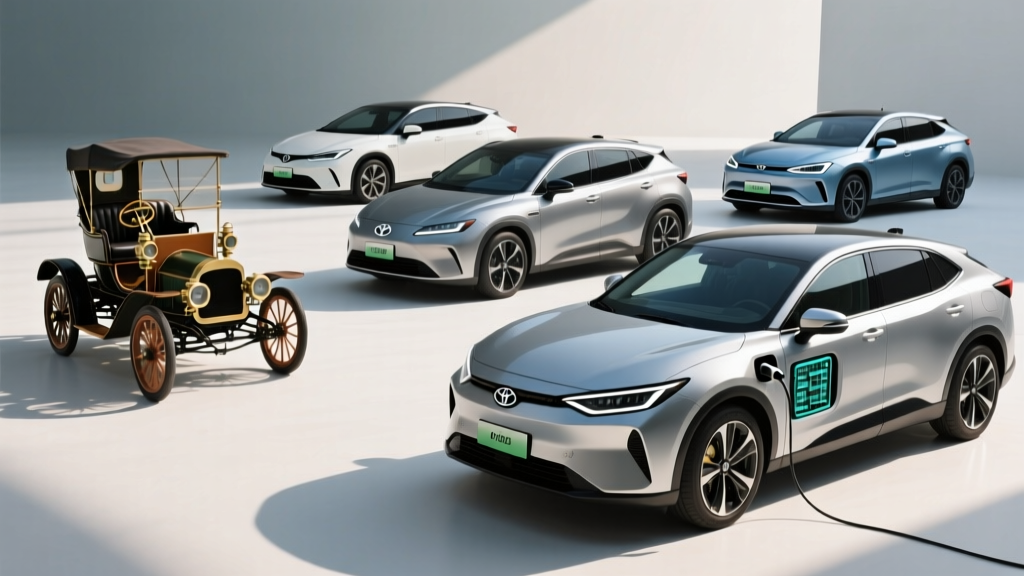
When most people think of the first hybrid vehicle, they picture the Toyota Prius arriving in America in 2000. But the true origin of the hybrid car stretches back over a century earlier — to a young engineer named Ferdinand Porsche who, in 1900, built a vehicle that combined a gasoline engine with electric motors. Understanding where hybrid technology started helps explain why today's hybrids and plug-in hybrids (PHEVs) are engineered the way they are, and more importantly, which one belongs in your driveway right now.
This guide traces the hybrid lineage from the Lohner-Porsche Mixte to the 2026 lineup of high-efficiency HEVs and PHEVs, then gives you the exact specs, MPG figures, pricing, and tax-credit data you need to choose the right electrified vehicle today.
The First Hybrid Vehicle: The 1900 Lohner-Porsche Mixte
At the 1900 Paris World's Fair, Ferdinand Porsche — then just 25 years old and working for coachbuilder Ludwig Lohner — unveiled the Lohner-Porsche Mixte Hybrid. It used a gasoline internal-combustion engine to spin a generator, which produced electricity to drive hub-mounted electric motors in the front wheels. This series-hybrid architecture is remarkably similar to the powertrain layout used in the 2026 BMW i3 REx and, conceptually, to range-extended EVs being developed today.
The Mixte produced roughly 5.6 horsepower from its Daimler gasoline engine and could travel about 40 miles on its battery alone before the engine needed to recharge the cells. It was heavy, expensive, and ultimately impractical for mass production — only about 300 units were built. But it proved that combining an electric motor with a gasoline engine could solve the range limitations that plagued early pure-electric vehicles.
Key insight: The first hybrid vehicle wasn't born from environmental concern — it was an engineering solution to the same problem modern EV owners still face: limited battery range and slow refueling infrastructure.
How Hybrid Technology Evolved: A Century of Milestones
After the Mixte, hybrid technology largely disappeared for decades. Cheap gasoline and improving internal-combustion engines made pure gas cars dominant. But several pivotal moments brought hybrids back:
- 1966 — AMC Rambler concept: American Motors experimented with a hybrid drivetrain, but it never reached production.
- 1997 — Toyota Prius (Japan): The first mass-produced modern hybrid. Used Toyota's Hybrid Synergy Drive (a power-split device combining a 1.5L engine with an electric motor and a 1.3 kWh NiMH battery). Achieved roughly 52 MPG on the Japanese test cycle.
- 2000 — Toyota Prius (US launch): Rated at 42 MPG combined by the EPA. Americans finally had a production hybrid option.
- 2010 — Chevrolet Volt: The first mass-market plug-in hybrid (PHEV) in the US, offering 35 miles of electric-only range before a gasoline engine kicked in as a generator.
- 2016 — Hyundai Ioniq: Offered HEV, PHEV, and BEV variants simultaneously — a first for a single nameplate.
- 2023–2026 — PHEV mainstreaming: Models like the Toyota RAV4 Prime, Jeep Wrangler 4xe, and Ford Escape PHEV pushed electric-only ranges past 35–45 miles, making PHEVs viable as daily EVs with gas-car road-trip freedom.
HEV vs PHEV: The Distinction That Matters
Before evaluating any specific hybrid, you need to understand the two categories. This distinction determines how you fuel the vehicle, whether you need home charging, and which tax credits apply.
Conventional Hybrid (HEV)
- No plug required. The battery recharges via regenerative braking and the gasoline engine.
- Battery size: Typically 1.0–2.0 kWh (nickel-metal hydride or small lithium-ion).
- Electric-only driving: Minimal — usually under 1 mile at very low speeds.
- Fuel economy advantage: 30–50% better MPG than a comparable gas-only car, especially in city driving.
- Tax credits: No federal §30D tax credit. Some states offer minor rebates.
Plug-In Hybrid (PHEV)
- Plugs in to charge. Uses Level 1 (120V) or Level 2 (240V) charging. Cannot DC fast charge (with rare exceptions).
- Battery size: Typically 11–22 kWh (lithium-ion, increasingly LFP chemistry).
- Electric-only range: 25–50 miles EPA, enough for most daily commutes.
- After battery depletes: Operates as a conventional hybrid using the gasoline engine.
- Tax credits: Eligible for up to $7,500 federal §30D credit if battery sourcing, MSRP caps, and buyer income limits are met (see IRS guidelines).
Today's Best Hybrid Vehicles: Specs, MPG, and Pricing
The lineage from the Lohner-Porsche Mixte culminates in a 2026 market full of refined, efficient hybrids. Here are the standout models across both HEV and PHEV categories, with exact figures.
| Model | Type | EPA MPG (City/Hwy/Combined) | Electric Range (mi) | Battery | Combined HP | Base MSRP |
|---|---|---|---|---|---|---|
| Toyota Prius | HEV | 57 / 56 / 57 | N/A | 1.3 kWh Li-ion | 196 hp | $29,450 |
| Toyota Prius Prime | PHEV | 52 combined (hybrid mode) | 44 mi | 13.6 kWh Li-ion | 220 hp | $34,170 |
| Toyota RAV4 Hybrid | HEV | 41 / 38 / 40 | N/A | 1.6 kWh NiMH | 219 hp | $33,575 |
| Toyota RAV4 Prime | PHEV | 38 combined (hybrid mode) | 42 mi | 18.1 kWh Li-ion | 302 hp | $44,590 |
| Honda Accord Hybrid | HEV | 51 / 44 / 48 | N/A | 1.3 kWh Li-ion | 204 hp | $34,095 |
| Ford Escape PHEV | PHEV | 40 combined (hybrid mode) | 37 mi | 14.4 kWh Li-ion | 210 hp | $40,500 |
| Hyundai Tucson PHEV | PHEV | 35 combined (hybrid mode) | 33 mi | 13.8 kWh Li-ion | 261 hp | $39,900 |
Sources: fueleconomy.gov, manufacturer spec sheets. MSRP reflects base trim before destination charges. Verify current pricing with your dealer.
Real-World MPG: What the EPA Sticker Doesn't Tell You
Hybrids have a unique characteristic that surprises many first-time owners: they often exceed their EPA city rating in real-world stop-and-go driving. This is because city driving maximizes regenerative braking, which recaptures energy normally lost as heat and feeds it back into the battery. The engine shuts off at stops, and the electric motor handles low-speed acceleration.
On the highway, the advantage narrows. At sustained speeds above 65 mph, the gasoline engine does most of the work, and aerodynamic drag dominates. Expect real-world highway MPG to land at or slightly below the EPA estimate for most hybrids.
Real-world MPG expectations (Toyota Prius HEV, EPA 57 combined):
- City / suburban with stops: 55–62 MPG (often beats EPA)
- Highway at 70 mph: 48–54 MPG
- Cold weather (below 30°F): 45–52 MPG (engine runs more for cabin heat)
- Combined mixed driving: 52–58 MPG
For PHEVs, real-world electric range also varies. The EPA-rated 44 miles on the Prius Prime may drop to 35–38 miles in winter due to battery chemistry limitations and cabin heating demands. In summer with moderate speeds, some owners report exceeding the EPA electric range by 2–4 miles.
Charging a PHEV: What You Need to Know
If you choose a PHEV, charging logistics are simpler than with a full EV but still require planning.
| Charging Level | Power | Time (0–100%) | Notes |
|---|---|---|---|
| Level 1 (120V outlet) | ~1.4 kW | 8–12 hours | Sufficient for most PHEVs overnight |
| Level 2 (240V) | 3.3–7.2 kW | 2–4 hours | Recommended for daily top-ups |
| DC Fast Charge | N/A for most PHEVs | N/A | Most PHEVs lack DC fast-charge capability. The Mitsubishi Outlander PHEV is a rare exception. |
A critical point: conventional hybrids (HEVs) never need to be plugged in. They charge their small batteries entirely through regenerative braking and the gasoline engine. If you don't have access to any charging — no garage outlet, no workplace charger — a conventional HEV is the correct choice.
Battery Reliability, Warranty, and Replacement Cost
Battery longevity is the number-one concern for hybrid buyers, and the data is reassuring. Toyota's hybrid battery packs have demonstrated exceptional durability, with many Prius taxis surpassing 300,000 miles on the original battery. Honda, Hyundai, and Ford hybrid systems have similarly strong track records.
Hybrid Battery Warranty Coverage
Federal law mandates that hybrid and PHEV battery packs carry a minimum warranty of 8 years / 100,000 miles. In California Air Resources Board (CARB) states, that extends to 10 years / 150,000 miles.
- Toyota: 10 years / 150,000 miles (all states, from 2020 model year onward)
- Honda: 8 years / 100,000 miles (10/150k in CARB states)
- Hyundai/Kia: 10 years / 100,000 miles
- Ford: 8 years / 100,000 miles
Out-of-warranty replacement cost: $2,000–$4,500 for most hybrid battery packs (HEV). PHEV packs are larger and cost $4,000–$8,000. Refurbished and third-party replacement options can reduce this by 30–50%.
Modern hybrid batteries use sophisticated thermal management and state-of-charge buffers (the system never lets the battery fully charge or fully deplete) to minimize degradation. Real-world capacity loss is typically 10–15% over 10 years — noticeable but not debilitating.
Tax Credits and Incentives for Hybrids and PHEVs
The federal §30D New Clean Vehicle Credit applies only to plug-in hybrids and full EVs, not to conventional hybrids. Here's how eligibility works for PHEVs under current IRS rules:
- Maximum credit: Up to $7,500 (split between $3,750 for battery components manufactured in North America and $3,750 for critical minerals sourced from the US or free-trade-agreement partners)
- MSRP cap: Vans, SUVs, and pickups ≤ $80,000; sedans ≤ $55,000
- Buyer income cap: Modified AGI ≤ $300,000 (joint), $225,000 (head of household), $150,000 (single)
- Point-of-sale transfer: You can transfer the credit to the dealer at purchase, reducing your out-of-pocket cost immediately rather than waiting for tax filing
- Battery sourcing: Vehicles must meet escalating domestic-content requirements for battery components and critical minerals — check the latest DOE eligible-vehicle list before purchasing
Conventional hybrids like the standard Prius or RAV4 Hybrid do not qualify for §30D. However, some states and utilities offer rebates for HEVs — check your state energy office or local utility for current programs.
Who Should Choose a Hybrid, PHEV, or Full EV?
Choose a Conventional Hybrid (HEV) If:
- You have no access to home or workplace charging
- You want maximum MPG with zero behavior change
- Your budget is under $35,000
- You drive mostly city and suburban routes
- Example: Toyota Prius HEV at 57 MPG combined, $29,450
Choose a Plug-In Hybrid (PHEV) If:
- You can charge at home (even a standard 120V outlet works overnight)
- Your daily commute is under 40 miles round-trip
- You take road trips where EV charging infrastructure is sparse
- You want EV-like daily driving without range anxiety
- Example: Toyota RAV4 Prime — 42 miles electric, 302 hp, $44,590
Choose a Full Battery EV (BEV) If:
- You have reliable Level 2 home charging
- Your daily driving is under 250 miles
- You want zero tailpipe emissions and minimal maintenance
- You want the maximum $7,500 federal tax credit on qualifying models
- Example: Tesla Model Y Long Range — 320 miles EPA, from ~$46,000
Frequently Asked Questions
How many MPG does a modern hybrid get?
The most efficient conventional hybrid, the 2026 Toyota Prius, achieves an EPA-rated 57 MPG combined (57 city / 56 highway). Real-world city driving often yields 55–62 MPG due to regenerative braking. Highway driving at 70 mph typically returns 48–54 MPG. Compact SUV hybrids like the RAV4 Hybrid deliver 40 MPG combined.
How far can a PHEV go on electric only?
Current PHEVs offer 25–50 miles of EPA-rated electric-only range. The Toyota Prius Prime leads at 44 miles, followed by the RAV4 Prime at 42 miles. This covers the average American's daily round-trip commute (approximately 32 miles, per FHWA data). Once the battery depletes, the vehicle operates as a conventional hybrid — you're never stranded.
Is a hybrid reliable, and what does battery replacement cost?
Hybrid powertrains from Toyota, Honda, and Hyundai are among the most reliable in the industry. Battery packs are warranted for 8–10 years / 100,000–150,000 miles. Out-of-warranty replacement costs $2,000–$4,500 for HEVs and $4,000–$8,000 for PHEVs. Many hybrids reach 200,000+ miles on the original battery.
Does a hybrid qualify for a tax credit?
Conventional hybrids (HEVs) do not qualify for the federal §30D tax credit. Plug-in hybrids (PHEVs) may qualify for up to $7,500, subject to MSRP caps ($55,000 for sedans, $80,000 for SUVs/trucks), buyer income limits, and battery-sourcing requirements. Always verify current eligibility on irs.gov before purchasing.
Do I need to plug in a conventional hybrid?
No. Conventional hybrids (HEVs) charge their batteries entirely through regenerative braking and the gasoline engine. You fuel them like a normal gas car — just less often. Only plug-in hybrids (PHEVs) require or benefit from external charging.
What was the first hybrid vehicle ever made?
The first hybrid vehicle was the Lohner-Porsche Mixte, built in 1900 by Ferdinand Porsche. It used a gasoline engine to generate electricity that powered hub-mounted electric motors. While only about 300 were built, it established the series-hybrid concept that influences vehicles like today's range-extended EVs.
Hybrid & PHEV Advantages
- 40–57 MPG combined (HEV) or 33–44 mi electric + hybrid backup (PHEV)
- No range anxiety — gas stations everywhere
- Proven reliability with 8–10 year battery warranties
- PHEVs eligible for up to $7,500 federal credit
- Lower maintenance than gas cars (less brake wear from regen, no engine idling)
Hybrid & PHEV Limitations
- HEVs don't qualify for federal tax credit
- PHEVs add $3,000–$8,000 to base price vs gas equivalents
- Most PHEVs cannot DC fast charge
- Two powertrains mean more components (though failure rates remain low)
- Electric-only range drops 15–25% in cold weather