The 2026 Hybrid and PHEV SUV Landscape at a Glance
Shoppers evaluating electric and hybrid SUVs in 2026 face a wider field than ever — and a more confusing one. The Toyota RAV4 Hybrid still dominates sales volume, the RAV4 Prime (PHEV) remains on perpetual allocation, Hyundai's Tucson Plug-In Hybrid undercuts rivals on price, and the Ford Escape PHEV offers class-leading electric-only range. Meanwhile, three-row options like the Toyota Grand Highlander Hybrid and Mazda CX-90 PHEV address family-hauling needs without range anxiety.
This guide cuts through the marketing to answer what actually matters: real-world MPG versus EPA stickers, whether a PHEV's electric-only range covers your commute, what battery replacement costs look like at year 10, and which models qualify for federal tax credits under current IRS §30D rules. Every figure below is sourced from EPA data, manufacturer spec sheets, or IRS guidance — no rounded-up brochure numbers.
HEV vs PHEV — The Fundamental Split
Conventional Hybrid (HEV): Uses a small battery (typically 1–2 kWh) recharged by regenerative braking and the engine. You never plug it in. Best for drivers who want better MPG without changing habits.
Plug-In Hybrid (PHEV): Carries a larger battery (12–25 kWh) you charge via a wall outlet or Level 2 charger. Delivers 25–45 miles of electric-only driving before the gas engine engages. Best for commuters with home charging who take occasional long road trips.
Top Hybrid (HEV) SUVs: EPA MPG and Real-World Results
Conventional hybrids don't require any plug-in infrastructure. Their advantage is simplicity: fill up with gas and drive, while the hybrid system recovers energy during braking and optimizes engine load. In real-world driving, HEVs frequently exceed their EPA combined rating in city driving (where regen braking shines) but fall 2–4 MPG short on sustained highway runs.
| Model (2026) | EPA City | EPA Hwy | EPA Combined | Real-World Note |
|---|---|---|---|---|
| Toyota RAV4 Hybrid AWD | 41 MPG | 38 MPG | 40 MPG | Expect 42–44 city; 35–37 sustained highway |
| Honda CR-V Hybrid AWD | 40 MPG | 34 MPG | 37 MPG | Strong city regen; highway drops to ~32 MPG at 75 mph |
| Toyota Grand Highlander Hybrid | 36 MPG | 32 MPG | 34 MPG | Three-row efficiency leader; real-world aligns closely with EPA |
| Hyundai Tucson Hybrid AWD | 38 MPG | 38 MPG | 38 MPG | Balanced city/highway; ~36 MPG mixed real-world |
| Ford Escape Hybrid AWD | 42 MPG | 36 MPG | 39 MPG | City-heavy drivers see 43+ MPG consistently |
Source: fueleconomy.gov (EPA). Real-world notes based on owner-reported data and independent testing at sustained highway speeds.
Top Plug-In Hybrid (PHEV) SUVs: Electric Range, Charging, and Specs
PHEVs bridge the gap between a full EV and a conventional hybrid. On a full charge, they operate as battery-electric vehicles for a defined range — typically 25 to 45 miles — before seamlessly transitioning to hybrid mode. The critical specs to compare are electric-only range, battery capacity (kWh), Level 2 charging time, and whether DC fast charging is supported (most PHEVs are not).
| Model (2026) | EV Range | Battery (kWh) | L2 Charge Time | DC Fast Charge | Combined HP | Total Range |
|---|---|---|---|---|---|---|
| Toyota RAV4 Prime | 42 mi | 18.1 kWh | ~2.5 hr (240V) | No | 302 HP | ~600 mi |
| Ford Escape PHEV | 37 mi | 14.4 kWh | ~2.0 hr (240V) | No | 210 HP | ~520 mi |
| Hyundai Tucson PHEV | 33 mi | 13.8 kWh | ~2.0 hr (240V) | No | 261 HP | ~440 mi |
| Mazda CX-90 PHEV | 26 mi | 17.8 kWh | ~2.5 hr (240V) | No | 323 HP | ~490 mi |
| Jeep Grand Cherokee 4xe | 25 mi | 17.3 kWh | ~2.5 hr (240V) | No | 375 HP | ~460 mi |
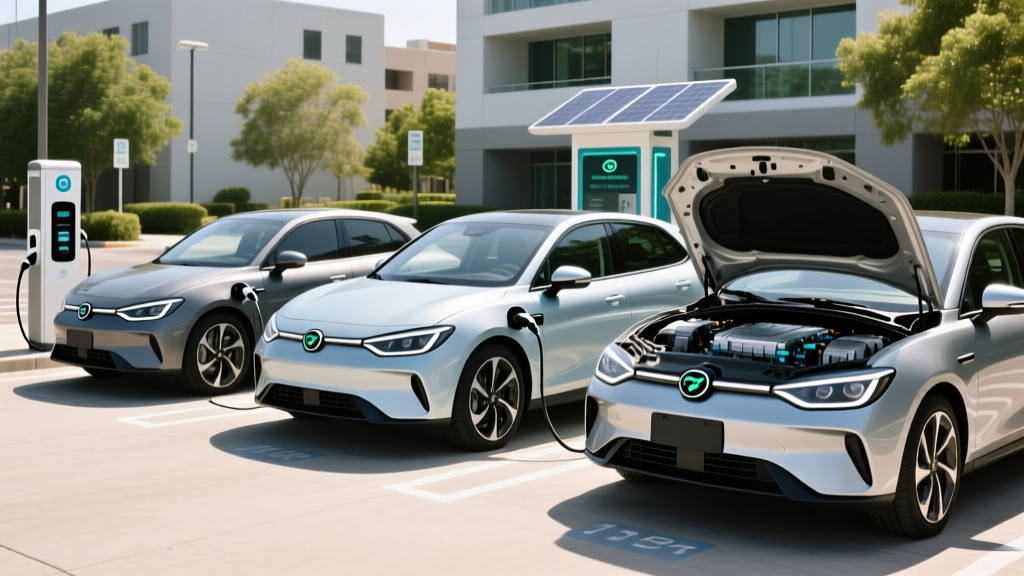
Charging reality check: None of the mainstream PHEV SUVs support DC fast charging. All charge on Level 1 (120V household outlet) in roughly 8–12 hours or Level 2 (240V) in 2–2.5 hours. If your commute is under 35 miles round-trip and you charge at home overnight, you may go weeks without burning gas.
Hybrid vs PHEV vs Full EV: Which Powertrain Fits You?
The decision isn't about which technology is "best" — it's about which matches your driving pattern, charging access, and budget. Here's a concrete decision framework:
Choose a Conventional Hybrid (HEV) If:
- You lack home or workplace charging access
- Your commute varies wildly — some days 10 miles, some days 200
- You want maximum simplicity with no plug-in routine
- Your budget is under $40,000 and you need cargo versatility
- You frequently take long road trips through rural areas with sparse charging
Choose a Plug-In Hybrid (PHEV) If:
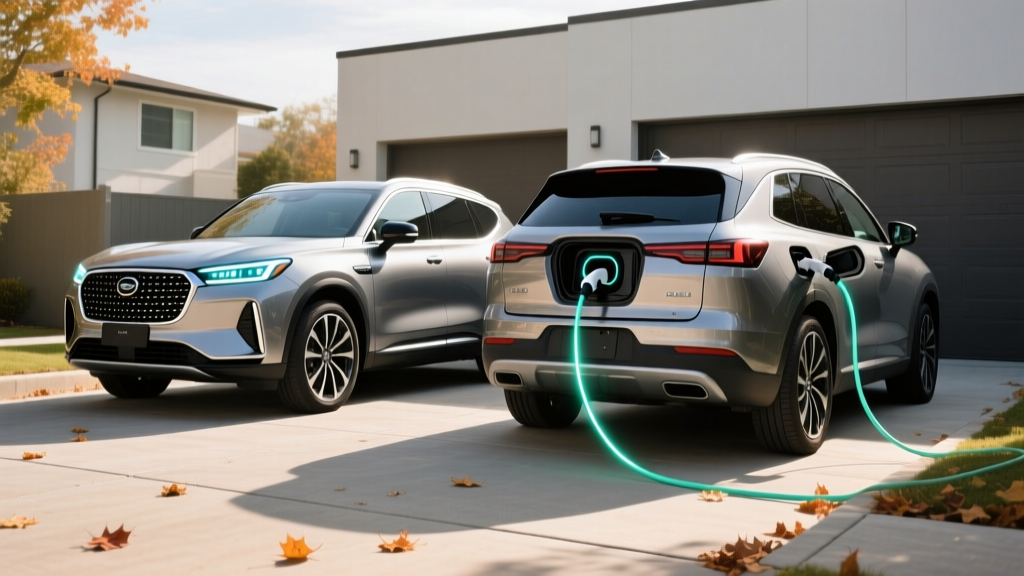
- You have reliable home Level 2 charging (garage or driveway)
- Your daily commute is under 40 miles round-trip (covering EV range)
- You take 4+ road trips per year where EV charging infrastructure is uncertain
- You want EV-like daily driving without committing to a full BEV
- You qualify for the §30D federal tax credit (up to $7,500 on eligible PHEVs)
Choose a Full EV (BEV) If:
- You have home charging and your daily driving is under 250 miles
- You want zero tailpipe emissions and minimal maintenance (no oil changes, fewer moving parts)
- You're ready to plan road trips around DC fast-charging stops
- Local electricity rates make per-mile fuel cost significantly cheaper than gas
- You want maximum performance and instant torque
Pricing and Federal Tax Credit Eligibility for 2026
Pricing for hybrid and PHEV SUVs spans a wide range. Conventional hybrids start in the low $30,000s, while three-row PHEVs push past $55,000. The federal §30D tax credit can offset up to $7,500 for eligible new PHEVs — but conventional HEVs do not qualify. The used-EV credit (§25E) offers up to $4,000 on qualifying pre-owned PHEVs.
| Model | Base MSRP (2026) | §30D Credit Eligible? | Est. After-Credit Price |
|---|---|---|---|
| Toyota RAV4 Hybrid | $33,575 | No (HEV) | $33,575 |
| Toyota RAV4 Prime | $44,900 | Likely — verify battery sourcing | ~$37,400 |
| Ford Escape PHEV | $40,500 | Likely — verify battery sourcing | ~$33,000 |
| Hyundai Tucson Hybrid | $34,250 | No (HEV) | $34,250 |
| Hyundai Tucson PHEV | $39,400 | Check current sourcing rules | ~$31,900–$39,400 |
| Mazda CX-90 PHEV | $51,400 | Check MSRP cap & sourcing | ~$43,900–$51,400 |
| Jeep Grand Cherokee 4xe | $56,145 | MSRP cap may disqualify (SUV cap: $80K — qualifies) | ~$48,645–$56,145 |
§30D Federal Tax Credit Requirements (2026)
To qualify for up to $7,500 on a new PHEV, all of the following must apply (per IRS.gov):
- Income cap: AGI ≤ $150,000 (single) / $225,000 (head of household) / $300,000 (joint)
- MSRP cap: ≤ $80,000 for SUVs, vans, and pickups; ≤ $55,000 for sedans
- Battery sourcing: Critical minerals and battery components must meet escalating domestic/free-trade-content thresholds — these tighten annually
- Point-of-sale transfer: You can transfer the credit to the dealer at purchase for an immediate price reduction (new for 2024+)
- Filing: You must file IRS Form 8936 with your tax return
Important: Conventional hybrids (HEVs) are NOT eligible for §30D. Battery-sourcing rules change frequently — always verify eligibility at fueleconomy.gov and consult a tax professional before purchase.
Battery Reliability, Warranty Coverage, and Replacement Costs
Hybrid battery longevity is the single most common concern among first-time hybrid buyers. The data is reassuring: modern nickel-metal-hydride (NiMH) and lithium-ion hybrid batteries routinely last 150,000–200,000+ miles with minimal degradation. Toyota's hybrid synergy drive system, in particular, has a proven track record spanning two decades of Prius and RAV4 Hybrid service.
Hybrid Battery Warranty: What's Covered
| Manufacturer | Hybrid Battery Warranty | Capacity Threshold |
|---|---|---|
| Toyota | 10 years / 150,000 miles | Below ~60% capacity triggers coverage |
| Honda | 8 years / 100,000 miles (10yr/150k in CARB states) | Defect or significant capacity loss |
| Hyundai / Kia | 10 years / 100,000 miles | Defect or capacity below threshold |
| Ford | 8 years / 100,000 miles | Hybrid system component failure |
| Mazda | 8 years / 100,000 miles | High-voltage battery defect coverage |
Federal emissions law mandates that hybrid batteries carry at minimum an 8-year/80,000-mile warranty. Most automakers exceed this. In CARB-adopting states (CA, CO, CT, ME, MD, MA, NJ, NY, OR, RI, VT, WA), coverage often extends to 10 years / 150,000 miles.
Replacement cost reality: If a hybrid battery fails outside warranty, expect $2,000–$4,000 for an HEV battery pack and $6,000–$10,000 for a PHEV pack (larger capacity). Third-party refurbishers offer remanufactured packs for $1,200–$2,500 (HEV). Toyota RAV4 Hybrid battery replacements typically run $2,500–$3,500 at a dealer. PHEV batteries cost more due to higher kWh capacity, but failures within the warranty period are handled at no charge.
Real-world longevity data: Toyota's hybrid taxi fleets have logged 300,000+ miles on original batteries. Consumer Reports reliability surveys consistently rank Toyota and Lexus hybrids at the top. The hybrid system itself (power control unit, motor-generators) rarely fails — it's the battery cells that degrade slowly over time and high heat cycles.
Powertrain Deep Dive: How These Systems Actually Work
Understanding the powertrain helps set realistic expectations for performance and efficiency.
Toyota RAV4 Hybrid / Prime
The HEV pairs a 2.5L four-cylinder engine (176 HP) with front and rear electric motors for a combined 219 HP (AWD). The Prime uses the same engine but adds a more powerful front motor and larger 18.1 kWh battery for 302 combined HP and a 5.7-second 0–60 time — making it one of the quickest compact SUVs in its class. The series-parallel hybrid system can run on engine only, motor only, or both simultaneously.
Ford Escape Hybrid / PHEV
Ford's 2.5L Atkinson-cycle four-cylinder pairs with an electric motor through a planetary gearset (eCVT). The HEV produces 210 combined HP; the PHEV uses a 14.4 kWh battery for 37 miles of electric-only range. The PHEV operates as a pure EV until the battery depletes, then transitions to hybrid mode seamlessly.
Hyundai Tucson Hybrid / PHEV
Hyundai uses a turbocharged 1.6L four-cylinder with a 6-speed automatic (not an eCVT), which gives it a more conventional driving feel. The HEV delivers 226 combined HP; the PHEV bumps to 261 HP with a 13.8 kWh battery. The conventional transmission means slightly less seamless stop-start behavior than Toyota's planetary system, but highway passing feel is more natural.
Real-World Ownership: What MPG Stickers Don't Tell You
EPA ratings are measured under controlled laboratory conditions. Your actual fuel economy depends on driving style, climate, terrain, and trip length. Here's what hybrid SUV owners should expect:
- City driving advantage: Hybrids shine in stop-and-go traffic where regenerative braking recovers energy. Expect to meet or exceed EPA city ratings by 2–5 MPG in urban commuting.
- Highway penalty: At sustained 70–80 mph speeds, the engine runs continuously and aerodynamic drag dominates. Expect 2–5 MPG below EPA highway ratings on long interstate runs.
- Cold weather impact: Below freezing, hybrid batteries are less efficient and the engine runs more often for cabin heat. Expect a 10–20% MPG reduction in winter. PHEV electric-only range drops 20–30% in cold weather due to battery chemistry and cabin heating demands.
- Short trips hurt: Engines are least efficient during warm-up. Multiple cold-start short trips (under 3 miles) will reduce MPG significantly, even in a hybrid.
- Towing: Hybrid SUVs with towing capacity (RAV4: 1,500–3,500 lbs depending on trim; Grand Highlander Hybrid: 5,000 lbs) will see MPG drop to the mid-20s or lower when towing near capacity.
Frequently Asked Questions
How many MPG does a hybrid SUV actually get in real driving?
Most compact hybrid SUVs deliver 35–44 MPG in real-world mixed driving. The Toyota RAV4 Hybrid averages around 40 MPG combined, with city driving often reaching 42–44 MPG and highway cruising dropping to 35–37 MPG. Three-row options like the Grand Highlander Hybrid return a realistic 32–35 MPG combined.
How far can a PHEV SUV go on electric only?
The class leader is the Toyota RAV4 Prime at 42 EPA-rated electric-only miles. The Ford Escape PHEV manages 37 miles, and the Hyundai Tucson PHEV covers 33 miles. In cold weather (below 32°F), expect these figures to drop by 20–30% — so a 42-mile rated PHEV may deliver 28–32 miles of electric range in winter. For commutes under 30 miles round-trip with home charging, most PHEV owners report using little to no gasoline on weekdays.
Do I need to plug in a conventional hybrid (HEV)?
No. Conventional hybrids recharge their small battery entirely through regenerative braking and the gasoline engine. You fuel them exactly like a gas car. Only PHEVs require (or benefit from) plugging in. If you never plug in a PHEV, it still functions as a conventional hybrid — you just miss the electric-only range benefit.
Are hybrid SUVs reliable long-term?
Yes. Toyota's hybrid system has a two-decade track record with millions of units on the road. Hybrid batteries are warrantied for 8–10 years / 100,000–150,000 miles and frequently outlast those periods. The electric motor-generators have fewer wear components than a conventional transmission. Consumer Reports and J.D. Power data consistently show Toyota, Lexus, and Honda hybrids ranking at or near the top for long-term reliability.
What does a hybrid battery replacement cost?
For a conventional hybrid (HEV), dealer replacement runs $2,000–$4,000 depending on the model. Third-party refurbished packs cost $1,200–$2,500 installed. PHEV battery replacements are more expensive at $6,000–$10,000 due to larger capacity. However, most hybrid batteries last 150,000+ miles, and failures within the warranty period are covered at no cost.
Do hybrid SUVs qualify for a federal tax credit?
Only plug-in hybrids (PHEVs) are potentially eligible for the §30D federal tax credit of up to $7,500 — conventional hybrids (HEVs) do not qualify. PHEV eligibility depends on your income (AGI caps apply), the vehicle's MSRP (≤$80,000 for SUVs), and battery component/critical mineral sourcing requirements that tighten annually. Check current eligibility at IRS.gov and verify specific model qualification at fueleconomy.gov before purchasing. The credit can now be transferred to the dealer at point of sale for an immediate price reduction.
Hybrid vs PHEV vs EV — which should I buy?
Choose a conventional hybrid if you lack home charging, drive unpredictable distances, or want zero lifestyle change. Choose a PHEV if you have home charging, commute under 40 miles daily, and take occasional long road trips. Choose a full EV if you have reliable charging, want minimal maintenance, and are comfortable planning road trips around DC fast-charger stops. There is no universally "best" option — only the one that matches your infrastructure and driving pattern.
Final Recommendation: Match the Powertrain to Your Life
The best electric and hybrid SUV for you depends on three variables: charging access, daily mileage, and trip patterns. If you can install a Level 2 charger at home and your commute falls within 35 miles, a PHEV like the RAV4 Prime or Escape PHEV delivers EV-like daily driving with gas-engine road-trip security — and potential §30D credit savings. If charging isn't feasible or your mileage is unpredictable, the RAV4 Hybrid or CR-V Hybrid deliver 40 MPG with zero behavior change and proven long-term reliability. Either path dramatically reduces fuel cost versus a conventional gas SUV, without the range-planning demands of a full BEV.