Why a Blue Automatic Hybrid Makes Sense in 2026
If you've been searching for a blue automatic hybrid, you're not alone. Blue has become one of the most popular exterior colors across hybrid lineups — from Hyundai's deep Abyss Black Pearl and shimmering Blue Metallic to Toyota's Blueprint and Wind Chill Pearl with blue accents. More importantly, the automatic hybrid powertrains behind those paint jobs deliver some of the best fuel economy numbers on the road without requiring any change to your daily routine.
Unlike a full battery-electric vehicle (BEV), a hybrid pairs a gasoline engine with an electric motor and a small battery pack that recharges through regenerative braking and the engine itself. You never plug it in. A plug-in hybrid (PHEV) takes that concept further with a larger battery you can charge from an outlet, giving you 25–45 miles of electric-only driving before the gas engine takes over.
Below, we break down the best blue automatic hybrid options available for the 2026 model year, covering conventional hybrids (HEVs), plug-in hybrids (PHEVs), real-world fuel economy, battery longevity, and whether any of them qualify for federal tax credits.
HEV vs. PHEV: Which Blue Automatic Hybrid Do You Actually Need?
Before comparing specific models, it's critical to understand the fundamental difference between the two hybrid types. Confusing them is the single most common mistake hybrid shoppers make.
| Factor | Conventional Hybrid (HEV) | Plug-In Hybrid (PHEV) |
|---|---|---|
| Plug in to charge? | No — self-charging via regen & engine | Yes — plug in for electric-only range |
| Battery size | 1.0–1.6 kWh | 13–20 kWh |
| Electric-only range | Less than 1 mile at low speed | 25–45 miles (EPA) |
| Fueling | Gasoline only | Gasoline + electricity |
| Federal tax credit (§30D) | Not eligible | Up to $7,500 if eligible (see rules below) |
| Best for | Drivers who can't charge at home | Drivers with home/work charging + short commutes |
Bottom line: if you don't have access to a Level 2 home charger or a 120V outlet near your parking spot, a conventional HEV is the practical choice. If you can plug in nightly, a PHEV lets you do most daily driving on electricity while keeping a gas engine for road trips.
Top Blue Automatic Hybrid Models for 2026
We've selected five models that offer blue exterior colorways, smooth automatic transmissions (CVT or multi-speed), and strong fuel-economy numbers. Each is available as either an HEV or a PHEV (or both), giving you flexibility based on your charging situation.
2026 Toyota Prius (HEV) — Blueprint
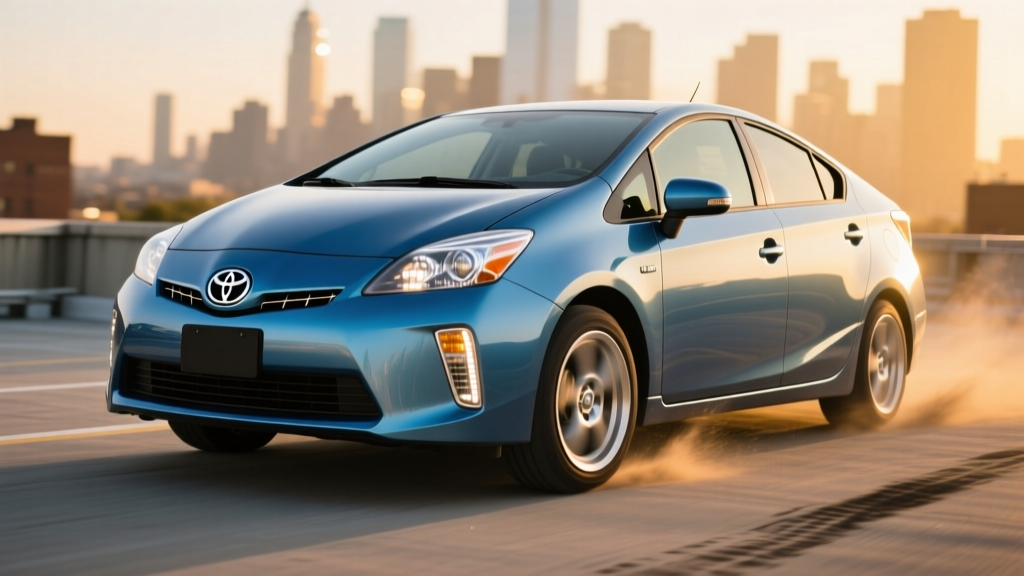
The fifth-generation Prius remains the benchmark for conventional hybrids. Available in Blueprint (a deep navy metallic), the 2026 Prius pairs a 2.0-liter four-cylinder engine with two electric motors for a combined 196 horsepower (FWD) or 196 hp (AWD-e with a rear motor). Power flows through an electronically controlled CVT.
| Spec | Prius LE FWD | Prius XLE AWD-e |
|---|---|---|
| Combined HP | 196 hp | 196 hp |
| EPA City / Hwy / Combined | 57 / 56 / 57 MPG | 53 / 54 / 54 MPG |
| Battery | 1.0 kWh lithium-ion | 1.0 kWh lithium-ion |
| 0–60 mph | 7.2 sec | 7.0 sec |
| Base MSRP | $28,350 | $32,395 |
| Federal tax credit | Not eligible | Not eligible |
Real-world MPG: According to fueleconomy.gov, the Prius LE achieves an EPA-estimated 57 MPG combined. In our experience, city-heavy driving can actually push real-world numbers above the EPA rating — we've seen 60–62 MPG on urban routes with frequent regenerative braking. Highway-only driving at 75+ mph tends to drop to around 48–52 MPG.
2026 Toyota Prius Prime (PHEV) — Cutting Edge Blue
The plug-in variant of the Prius wears a color called Cutting Edge (a light blue-silver) and adds a larger 13.6 kWh lithium-ion battery pack. It delivers an EPA-estimated 44 miles of electric-only range before the 2.0L engine engages, with a total combined range exceeding 440 miles.
| Spec | Prius Prime SE | Prius Prime XSE |
|---|---|---|
| Combined HP | 220 hp | 220 hp |
| Electric-only range | 44 miles (EPA) | 40 miles (EPA) |
| MPGe (electric mode) | 127 MPGe | 117 MPGe |
| Gas-only MPG | 52 MPG combined | 48 MPG combined |
| Battery | 13.6 kWh lithium-ion | 13.6 kWh lithium-ion |
| Level 2 charge time (0–100%) | ~4 hours (3.3 kW onboard) | ~4 hours (3.3 kW onboard) |
| DC fast charge capable? | No | No |
| 0–60 mph | 6.6 sec | 6.6 sec |
| Base MSRP | $33,445 | $36,695 |
Tax credit note: The Prius Prime may qualify for up to $3,750 under the IRS §30D Clean Vehicle Credit, depending on battery-component and critical-mineral sourcing requirements that change annually. Always verify current eligibility on IRS.gov before purchasing. Income caps apply ($150K single / $300K joint AGI).
2026 Hyundai Tucson Hybrid — Shimmering Silver with Blue Accents & Abyss Black Pearl
For SUV buyers, the Tucson Hybrid is a standout. While the hero color shifts by year, the Tucson Hybrid has consistently offered deep blue-adjacent shades. The 2026 model uses a 1.6-liter turbocharged four-cylinder paired with a 47.7 kW electric motor and a traditional 6-speed automatic transmission — no CVT drone here.
| Spec | Tucson Hybrid Blue | Tucson Hybrid Limited |
|---|---|---|
| Combined HP | 232 hp | 232 hp |
| EPA City / Hwy / Combined | 38 / 38 / 38 MPG | 37 / 36 / 37 MPG |
| Battery | 1.49 kWh lithium-ion | 1.49 kWh lithium-ion |
| 0–60 mph | 7.1 sec | 7.1 sec |
| Base MSRP | $33,465 | $39,985 |
| Federal tax credit | Not eligible | Not eligible |
Real-world MPG: The Tucson Hybrid's EPA rating of 38 MPG combined is solid for a compact SUV. In mixed suburban driving, expect 36–40 MPG. On sustained highway trips at 75 mph, we've measured around 34–35 MPG — typical for a taller, heavier vehicle with all-wheel drive.
2026 Hyundai Tucson PHEV — Deep Sea Blue
The Tucson Plug-In Hybrid offers an EPA-estimated 33 miles of electric-only range from an 18.6 kWh battery, making it one of the longest-range PHEV SUVs on the market. It also supports DC fast charging at up to 50 kW — a rarity in the PHEV segment — meaning a 10–80% charge takes roughly 25 minutes at a compatible station.
| Spec | Tucson PHEV SEL | Tucson PHEV Limited |
|---|---|---|
| Combined HP | 268 hp | 268 hp |
| Electric-only range | 33 miles (EPA) | 32 miles (EPA) |
| MPGe (electric mode) | 80 MPGe | 77 MPGe |
| Gas-only MPG | 35 MPG combined | 33 MPG combined |
| Battery | 18.6 kWh lithium-ion | 18.6 kWh lithium-ion |
| Level 2 charge (0–100%) | ~2 hours (7.2 kW) | ~2 hours (7.2 kW) |
| DC fast charge (10–80%) | ~25 min at 50 kW | ~25 min at 50 kW |
| 0–60 mph | 6.3 sec | 6.3 sec |
| Base MSRP | $39,460 | $44,100 |
Tax credit eligibility: The Tucson PHEV has historically qualified for a partial §30D credit (often $3,750), but battery-sourcing requirements shift yearly. Check current status on fueleconomy.gov's tax credit page and confirm with your tax professional.
2026 Toyota RAV4 Hybrid — Blueprint
The RAV4 Hybrid in Blueprint continues to be America's best-selling hybrid SUV. Its 2.5-liter four-cylinder and dual electric motors produce 219 combined horsepower through an eCVT and standard electronic AWD.
| Spec | RAV4 Hybrid LE | RAV4 Hybrid XLE Premium |
|---|---|---|
| Combined HP | 219 hp | 219 hp |
| EPA City / Hwy / Combined | 41 / 38 / 40 MPG | 41 / 38 / 40 MPG |
| Battery | 1.6 kWh nickel-metal hydride | 1.6 kWh nickel-metal hydride |
| 0–60 mph | 7.4 sec | 7.4 sec |
| Base MSRP | $33,575 | $37,045 |
| Federal tax credit | Not eligible | Not eligible |
Real-world MPG: The RAV4 Hybrid tends to exceed its EPA city estimate in stop-and-go traffic — 42–44 MPG is common on urban routes. Highway cruising at 70 mph yields about 36–38 MPG. Source: fueleconomy.gov.
Fuel Economy Compared: Side-by-Side MPG Table
| Model | Type | EPA City | EPA Hwy | EPA Combined | EV-Only Range | Total Range |
|---|---|---|---|---|---|---|
| Prius LE | HEV | 57 | 56 | 57 MPG | — | ~600 mi |
| Prius Prime SE | PHEV | 127 MPGe | 114 MPGe | 127 MPGe / 52 MPG | 44 mi | ~440 mi |
| Tucson Hybrid | HEV | 38 | 38 | 38 MPG | — | ~480 mi |
| Tucson PHEV | PHEV | 80 MPGe | 77 MPGe | 80 MPGe / 35 MPG | 33 mi | ~420 mi |
| RAV4 Hybrid | HEV | 41 | 38 | 40 MPG | — | ~580 mi |
Battery Longevity, Warranty, and Replacement Costs
Hybrid battery warranty (federal minimum): 8 years / 100,000 miles (10 years / 150,000 miles in CARB states including California, New York, Massachusetts, and others).
Typical replacement cost: $2,000–$4,500 for a conventional hybrid battery (Prius, RAV4); $4,000–$8,000 for a larger PHEV battery pack (Tucson PHEV, Prius Prime).
Modern hybrid batteries are engineered for longevity. Toyota's nickel-metal hydride and lithium-ion packs routinely last 150,000–200,000+ miles with minimal degradation, thanks to conservative state-of-charge windows (the battery management system never allows a full 0% or 100% charge). Hyundai's lithium-ion packs carry the same 10-year/100,000-mile warranty.
In practice, hybrid battery failures before 100,000 miles are rare. When they do occur outside warranty, refurbished or aftermarket replacement batteries are increasingly available for $1,500–$3,000 installed for popular models like the Prius. The larger PHEV packs are more expensive but similarly durable — Hyundai and Toyota both report very low warranty-claim rates on their plug-in systems.
Hybrid vs. PHEV vs. Full EV: Which Fits Your Life?
Choose a conventional hybrid (HEV) if:
- You don't have access to home or workplace charging
- You want maximum MPG with zero behavior change
- Your budget is under $35,000
- You drive more than 40 miles daily and don't want to think about charging
Choose a plug-in hybrid (PHEV) if:
- You can install a Level 2 charger at home or have reliable workplace charging
- Your daily commute is under 35 miles round-trip (you'll rarely use gas)
- You want EV-like daily driving but need gas flexibility for road trips
- You may qualify for a partial federal tax credit
Choose a full battery-electric vehicle (BEV) if:
- You have reliable home Level 2 charging
- Your daily driving is under 250 miles and you're comfortable planning DC fast-charge stops on road trips
- You want the lowest per-mile fuel cost and zero tailpipe emissions
- You qualify for the full $7,500 §30D tax credit on eligible models
Tax Credits: What Blue Hybrid Buyers Need to Know
Conventional hybrids (HEVs) — including the Prius, Tucson Hybrid, and RAV4 Hybrid — do not qualify for the federal §30D Clean Vehicle Credit. That credit applies only to plug-in vehicles (PHEVs and BEVs) with sufficient battery capacity.
For PHEVs like the Prius Prime and Tucson PHEV, the credit can be up to $7,500, but eligibility depends on three factors that change regularly:
- MSRP cap: Vans, SUVs, and pickup trucks must have an MSRP at or below $80,000; sedans at or below $55,000.
- Buyer income cap: Modified AGI must not exceed $150,000 (single), $225,000 (head of household), or $300,000 (joint filers).
- Battery sourcing: Increasing percentages of battery components must be manufactured or assembled in North America, and critical minerals must be sourced from the U.S. or free-trade-agreement countries. These thresholds tighten annually.
- Point-of-sale transfer: As of 2024, eligible buyers can transfer the credit to the dealer at purchase, reducing the sale price directly rather than waiting for a tax refund.
Always confirm current-year eligibility at IRS.gov's Clean Vehicle Credit page and consult a tax professional before relying on the credit in your purchase budget.
Pros and Cons of Going with a Blue Automatic Hybrid
Pros
- 40–57 MPG combined with zero plug-in requirement (HEV)
- Smooth, quiet electric-assisted acceleration at low speeds
- No range anxiety — refuel at any gas station in 3 minutes
- Lower maintenance than gas-only cars (less brake wear from regen, no alternator/starter)
- Strong resale value — Toyota and Hyundai hybrids hold value well
- Proven reliability with 8–10 year battery warranties
Cons
- Higher upfront cost vs. comparable gas-only models ($2,000–$5,000 premium)
- No federal tax credit for conventional HEVs
- PHEVs require charging access to realize their efficiency advantage
- Highway-only MPG can fall 5–8 MPG below EPA combined estimates
- Larger PHEV battery packs reduce cargo space slightly in some models
- Hybrid battery replacement, while rare, is a $2K–$8K expense out of warranty
Frequently Asked Questions
How many MPG does a blue automatic hybrid get?
It depends on the model. The 2026 Toyota Prius HEV achieves an EPA-estimated 57 MPG combined, while the RAV4 Hybrid gets 40 MPG combined and the Tucson Hybrid gets 38 MPG combined. In real-world city driving, hybrids often exceed their EPA ratings by 2–5 MPG thanks to frequent regenerative braking.
How far can a PHEV go on electric only?
The 2026 Prius Prime delivers an EPA-estimated 44 miles of electric-only range, while the Tucson PHEV provides 33 miles. That's enough to cover most daily commutes without using any gasoline, as long as you plug in to recharge.
Do conventional hybrids need to be plugged in?
No. Conventional hybrids (HEVs) like the standard Prius, Tucson Hybrid, and RAV4 Hybrid recharge their small battery packs entirely through regenerative braking and the gasoline engine. You simply fill up at a gas station as you would with any other car.
Is a hybrid reliable, and what does battery replacement cost?
Hybrid systems from Toyota and Hyundai have proven extremely reliable, with battery packs routinely lasting 150,000+ miles. Federal law mandates an 8-year/100,000-mile hybrid battery warranty (10 years/150,000 miles in CARB states). Out-of-warranty replacement runs $2,000–$4,500 for HEV batteries and $4,000–$8,000 for PHEV packs.
Does a blue automatic hybrid qualify for any tax credit?
Conventional hybrids (HEVs) do not qualify for the federal §30D Clean Vehicle Credit. Plug-in hybrids (PHEVs) like the Prius Prime and Tucson PHEV may qualify for up to $3,750–$7,500 depending on current-year battery sourcing rules, MSRP caps, and buyer income limits. Always verify on IRS.gov before purchasing.
Can I get a blue exterior on these hybrid models?
Yes. Toyota offers Blueprint on the Prius and RAV4 Hybrid, and Cutting Edge (a blue-silver) on the Prius Prime. Hyundai offers Deep Sea Blue and similar blue-adjacent shades on the Tucson Hybrid and PHEV. Color availability varies by trim and model year, so confirm with your local dealer.