The Plug-In Hybrid SUV Case: Why Buyers Are Choosing PHEV Over Full EV
If you want electric commuting without range anxiety on road trips, a plug-in hybrid SUV occupies a practical middle ground. Unlike a conventional hybrid (HEV) that generates electricity solely from its gasoline engine and regenerative braking, a plug-in hybrid (PHEV) carries a larger battery you can charge from a wall outlet or public charger — giving you 25 to 40 miles of pure electric driving before the gas engine kicks in. For the 70% of American drivers whose daily round-trip commute is under 40 miles, a PHEV can function as an EV most weekdays and a hybrid on weekends.
For 2026, the plug-in hybrid SUV segment has matured significantly. Battery packs have grown, electric ranges have stretched, and several models now offer DC fast charging — eliminating the overnight-only charging limitation that frustrated early PHEV adopters. Let's examine the top contenders with exact EPA data, real-world observations, and ownership economics.
HEV vs. PHEV — The Critical Difference
| Attribute | Conventional Hybrid (HEV) | Plug-In Hybrid (PHEV) |
|---|---|---|
| Battery size | 1–2 kWh | 13–28 kWh |
| Electric-only range | 0–1 mile (low speed) | 25–40 miles |
| Plug in to charge? | No — self-charging | Yes — Level 1, Level 2, some DC |
| Federal tax credit | No | Up to $7,500 (§30D, with caveats) |
| Best for | No home charging access | Home charging + short commute |
Top Plug-In Hybrid SUV Contenders: 2026 Spec Breakdown
Below is a side-by-side look at the highest-volume PHEV SUVs available in the US market for the 2026 model year. All figures reflect EPA-published data and manufacturer specifications.
| Model | Battery (kWh) | EV Range (mi) | Combined MPG (gas) | MPGe | Total HP | 0-60 mph | Base MSRP |
|---|---|---|---|---|---|---|---|
| Toyota RAV4 Prime | 18.1 | 42 | 38 | 94 | 302 | 5.7s | $44,500 |
| Hyundai Tucson PHEV | 13.8 | 33 | 35 | 80 | 261 | 6.9s | $39,400 |
| Kia Sportage PHEV | 13.8 | 34 | 35 | 84 | 261 | 7.0s | $39,990 |
| Ford Escape PHEV | 14.4 | 37 | 40 | 105 | 210 | 7.8s | $38,500 |
| Jeep Grand Cherokee 4xe | 17.3 | 26 | 23 | 56 | 375 | 6.0s | $60,495 |
| BMW X5 xDrive50e | 25.7 | 38 | 27 | 50 | 483 | 4.6s | $72,500 |
Sources: EPA / fueleconomy.gov, manufacturer press sites. Prices exclude destination charges.
Real-World MPG: What the EPA Sticker Doesn't Tell You
EPA combined MPG numbers assume a mix of city and highway driving with the battery depleted. In practice, PHEV fuel economy depends entirely on your charging habits and driving profile.
City driving, charged battery: Most PHEV SUVs will exceed their EPA gas-only MPG in stop-and-go traffic because regenerative braking recaptures energy aggressively. The Toyota RAV4 Prime, rated at 38 MPG combined on gas, routinely delivers 42–45 MPG in real-world city driving when the battery is depleted, thanks to Toyota's series-parallel hybrid system that prioritizes electric motor assist at low speeds.
Highway driving, depleted battery: Expect 5–15% below EPA combined figures at sustained 70–80 mph speeds. Aerodynamic drag dominates, regen opportunities are minimal, and the gasoline engine carries the full load. The Ford Escape PHEV, EPA-rated at 40 MPG combined, typically returns 34–37 MPG on a flat highway at 75 mph. The Tucson and Sportage PHEVs land around 30–33 MPG highway.
The commute scenario: If your daily round trip is 30 miles and you charge at home overnight, you may burn zero gasoline for months. The RAV4 Prime's 42-mile EV range covers most commutes entirely on electricity. The gasoline engine might only fire during winter warmup or on longer weekend trips. Owners who charge daily report annual fuel consumption equivalent to 80–120+ MPGe in practice.
Real-World Range Reality Check
EPA EV range vs. what you'll actually see: PHEV electric range drops 20–30% in winter (below 40°F) due to cabin heating demands and reduced battery chemistry efficiency. A RAV4 Prime rated for 42 electric miles may deliver 28–34 miles in January in Minneapolis. Highway speeds above 65 mph also reduce EV range — expect roughly 85% of sticker at 75 mph. Preconditioning while plugged in helps mitigate cold-weather losses.
Charging a Plug-In Hybrid SUV: Speeds, Connectors, and Home Setup
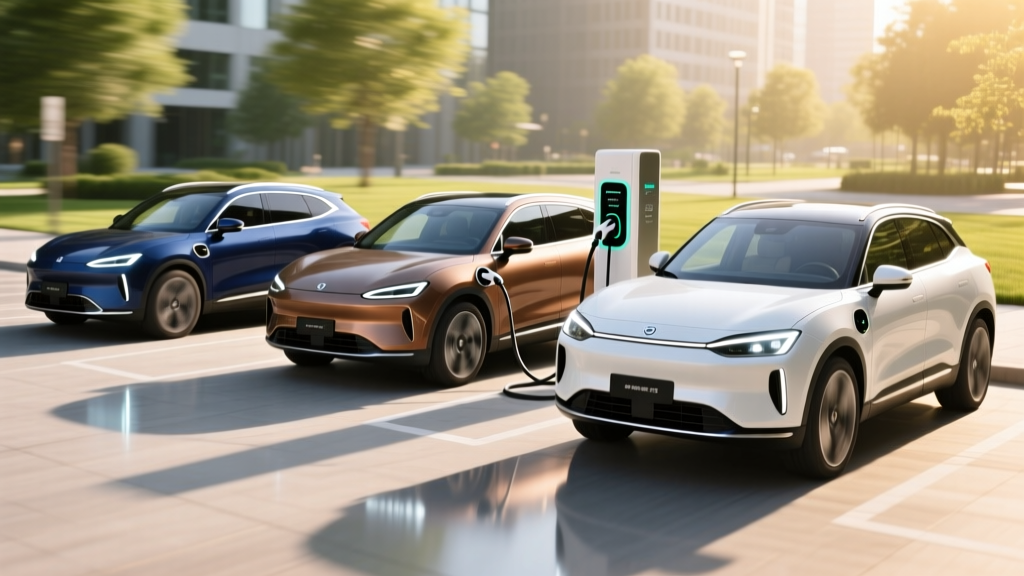
PHEV batteries are small enough that home charging is straightforward — and for most owners, a standard 120V outlet is sufficient.
| Charging Level | Power (kW) | Time to Full (13–18 kWh) | Availability |
|---|---|---|---|
| Level 1 (120V household) | 1.2–1.4 kW | 10–15 hours | Any standard outlet |
| Level 2 (240V home/public) | 3.3–7.2 kW | 2–5 hours | Home wallbox, public stations |
| DC Fast Charge (select models) | 25–50 kW | 25–40 min (10–80%) | Public DC stations |
DC fast charging is rare in PHEVs — the BMW X5 xDrive50e supports DC charging at up to 7.4 kW (not true DCFC speeds), and the Jeep Grand Cherokee 4xe does not support DC fast charging at all. The Toyota RAV4 Prime charges at a maximum of 6.6 kW on Level 2, reaching a full charge in roughly 2.5 hours. For most PHEV owners, overnight Level 2 charging at home is the primary routine, and Level 1 works if your daily EV range needs are modest.
Connector note: All current PHEV SUVs use the J1772 connector for AC charging. None have adopted NACS for AC, though future models may transition. Adapters are available if you need to use a Tesla destination charger.
Powertrain Deep Dive: Where the Power Comes From
Plug-in hybrid SUVs combine a gasoline engine with one or more electric motors. The combined output often exceeds what either power source could deliver alone.
The Toyota RAV4 Prime pairs a 2.5-liter four-cylinder Atkinson-cycle engine (177 hp) with front and rear electric motors for a combined 302 hp and standard electronic all-wheel drive. The rear motor provides AWD without a mechanical driveshaft, reducing weight and drivetrain losses.
The Hyundai Tucson PHEV and Kia Sportage PHEV share a 1.6-liter turbocharged four-cylinder (178 hp) with a 66.9 kW electric motor integrated into the six-speed automatic transmission, producing 261 hp combined. Both use a conventional AWD system with a mechanical rear driveshaft.
The Jeep Grand Cherokee 4xe takes a different approach: a 2.0-liter turbo four (270 hp) plus two electric motors for 375 hp and 470 lb-ft of torque. It's the most powerful PHEV SUV in this group but also the heaviest, which explains its 23 MPG combined on gas — the lowest here.
The BMW X5 xDrive50e uses a 3.0-liter inline-six turbo (307 hp) with an electric motor (181 hp) integrated into the transmission for 483 hp total. It's the quickest in this group at 4.6 seconds to 60 mph and delivers a refined driving experience, though at a premium price that exceeds §30D MSRP caps.
Pricing, Tax Credits, and Total Ownership Cost
PHEV SUVs carry a price premium over their conventional hybrid and gas-only siblings — typically $4,000 to $8,000 more. The question is whether fuel savings and tax incentives close that gap.
Federal Tax Credit Eligibility (§30D)
Under current IRS rules for 2026, qualifying new PHEVs may receive up to $7,500 in federal tax credit, split into two halves:
- $3,750 — Battery components: Battery components must be manufactured or assembled in North America (percentage thresholds increase annually).
- $3,750 — Critical minerals: Critical minerals must be sourced from the US or a free-trade-agreement partner country.
- MSRP cap: SUVs must have an MSRP at or below $80,000.
- Income cap: Buyer AGI must not exceed $150,000 (single), $225,000 (head of household), or $300,000 (joint).
- Point-of-sale transfer: You can transfer the credit to the dealer for an immediate price reduction at purchase.
- Battery capacity: Minimum 7 kWh battery (all PHEV SUVs here qualify).
Credit status by model (2026): The RAV4 Prime, Tucson PHEV, Sportage PHEV, and Escape PHEV are on the fueleconomy.gov qualifying list, but the exact credit amount ($0, $3,750, or $7,500) depends on current battery-sourcing compliance, which manufacturers update periodically. The Grand Cherokee 4xe and BMW X5 xDrive50e have historically qualified for partial or full credit, but always verify on fueleconomy.gov before purchase. Tax credit rules are subject to change — consult a tax professional and check IRS.gov §30D guidance for the latest.
| Cost Factor | RAV4 Prime | Tucson PHEV | Escape PHEV | Gas-Only RAV4 (baseline) |
|---|---|---|---|---|
| Base MSRP | $44,500 | $39,400 | $38,500 | $33,500 |
| Est. tax credit | $3,750–$7,500 | $3,750–$7,500 | $3,750–$7,500 | $0 |
| 5-yr fuel cost (15k mi/yr) | $3,200 | $4,100 | $3,500 | $8,800 |
| 5-yr maintenance (est.) | $2,800 | $3,200 | $3,000 | $3,800 |
| 5-yr total (excl. insurance) | $46,750–$50,500 | $46,700–$50,450 | $45,000–$48,750 | $46,100 |
Fuel cost assumes 60% electric driving at $0.14/kWh and 40% gas driving at $3.50/gal. Actual costs vary by electricity rate, driving habits, and charging frequency.
Battery Longevity, Warranty, and Replacement Costs
PHEV Battery Warranty Coverage
Federal law mandates that hybrid and PHEV battery packs carry a minimum warranty of 8 years / 100,000 miles. In California Air Resources Board (CARB) states, that extends to 10 years / 150,000 miles. Here's what major manufacturers offer:
- Toyota: 10 years / 150,000 miles (all states, for 2020+ models)
- Hyundai / Kia: 10 years / 100,000 miles
- Ford: 8 years / 100,000 miles
- BMW: 8 years / 80,000 miles (capacity retention guarantee to 70%)
- Jeep (Stellantis): 8 years / 100,000 miles
Will you need a replacement? PHEV battery degradation is generally less severe than full EV degradation because the battery is smaller and the system avoids deep discharge cycles — the car's software maintains a buffer (typically 15–20% of total capacity is unusable by design). Real-world data from earlier-generation Toyota and Hyundai PHEVs shows capacity retention of 88–95% after 100,000 miles.
Replacement cost if out of warranty: PHEV battery packs currently cost between $4,000 and $8,000 for parts, plus $500–$1,200 in labor, depending on the model. The RAV4 Prime's 18.1 kWh pack runs approximately $5,500–$7,000 installed. This is significantly less than a full EV battery replacement ($10,000–$20,000+) because the pack is smaller.
Reliability data from Consumer Reports and J.D. Power consistently ranks Toyota and Lexus hybrid systems among the most dependable powertrains on the market. Hyundai and Kia PHEV systems have also performed well, though some early-model-year Tucson PHEVs had software-related recalls for the hybrid control unit — always verify open recalls on any specific VIN via NHTSA.gov.
PHEV vs. Full EV vs. Gas: Which SUV Fits Your Life?
Choose a Plug-In Hybrid SUV If:
- Your daily commute is under 35 miles round-trip and you can charge at home
- You take road trips of 300+ miles multiple times per year
- You live in an apartment or area with unreliable public charging infrastructure
- You want EV-like commuting without committing to full-electric range planning
- You want AWD capability without the range penalty of a full EV in cold climates
Choose a Full EV If:
- You have reliable home Level 2 charging
- Your typical trips are under 250 miles, or you're willing to plan DC fast-charge stops
- You want to eliminate oil changes, spark plugs, and transmission maintenance entirely
- You want maximum fuel cost savings (electricity at $0.14/kWh ≈ $1.20/gallon equivalent)
Choose a Conventional Hybrid (HEV) If:
- You have no access to home or workplace charging
- You want better fuel economy than a gas car with zero behavior change
- You want the lowest purchase price in an electrified vehicle
PHEV SUV Advantages
- 25–42 miles of zero-emission daily driving
- No range anxiety — gas engine covers any trip length
- Lower upfront cost than comparable full EVs
- Regenerative braking extends brake pad life
- Federal tax credit up to $7,500 (with eligibility caveats)
- Standard AWD on most models
PHEV SUV Trade-Offs
- Must charge daily to maximize EV range benefit
- Heavier than gas-only equivalents (battery + engine + motor)
- Two powertrains to maintain long-term
- DC fast charging is rare or unavailable
- EV range drops significantly in cold weather
- Cargo space slightly reduced vs. gas models (battery placement)
Frequently Asked Questions
How many MPG does a plug-in hybrid SUV get?
On gasoline alone (battery depleted), 2026 PHEV SUVs range from 23 MPG combined (Jeep Grand Cherokee 4xe) to 40 MPG combined (Ford Escape PHEV). The Toyota RAV4 Prime delivers 38 MPG combined on gas, and the Hyundai Tucson PHEV returns 35 MPG combined. When factoring in electric-only driving, MPGe ratings range from 50 MPGe (BMW X5 xDrive50e) to 105 MPGe (Escape PHEV). Your real-world MPG depends entirely on how often you charge and the ratio of electric to gas miles driven.
How far can a plug-in hybrid SUV drive on electric only?
Current PHEV SUVs offer 26 to 42 miles of EPA-rated electric-only range. The Toyota RAV4 Prime leads at 42 miles, followed by the BMW X5 xDrive50e and Ford Escape PHEV at 37–38 miles. In real-world conditions, expect 20–30% less range in cold weather and at sustained highway speeds. For most commutes under 35 miles, a charged PHEV covers the trip entirely on electricity.
Is a plug-in hybrid SUV reliable? What about battery replacement cost?
Yes — PHEV powertrains from Toyota, Hyundai, and Ford have demonstrated strong reliability. All PHEV batteries carry a minimum 8-year/100,000-mile warranty, with Toyota extending to 10 years/150,000 miles. Battery degradation is typically mild (5–12% over 100,000 miles) due to built-in charge buffers. Out-of-warranty replacement costs range from $4,500 to $8,000 including labor — far less than a full EV battery replacement.
Does a plug-in hybrid SUV qualify for a tax credit?
Several 2026 PHEV SUVs qualify for up to $7,500 under the federal §30D clean vehicle credit, subject to battery-sourcing requirements, buyer income limits ($150K single / $300K joint), and an $80,000 MSRP cap for SUVs. The credit can be transferred to the dealer at point of sale for an immediate price reduction. Eligibility changes as manufacturers adjust supply chains — always verify current status on fueleconomy.gov and consult a tax professional. State-level incentives may also apply; check your state's energy office or DSIRE (dsireusa.org) for details.
Do I have to plug in a plug-in hybrid?
No — a PHEV will operate as a conventional hybrid if you never plug it in. However, you'll forfeit the electric-only range that makes a PHEV worthwhile, and you'll have paid a premium for battery capacity you never use. If you cannot charge at home or work, a conventional hybrid (HEV) like the standard RAV4 Hybrid is a more cost-effective choice.
Can a plug-in hybrid SUV tow?
Towing capacity varies significantly. The Jeep Grand Cherokee 4xe is rated for up to 6,000 lbs — the strongest tow rating in this segment. The Toyota RAV4 Prime tows up to 2,500 lbs. The Tucson and Sportage PHEVs are rated for 2,000 lbs. Note that towing almost always engages the gasoline engine, so expect fuel economy to drop to 18–25 MPG while towing depending on trailer weight and terrain.