Why Plug In Hybrid Cars Deserve a Second Look in 2026
Full battery-electric vehicles dominate headlines, but plug in hybrid cars (PHEVs) quietly solve the two problems that still stall EV adoption: range anxiety and charging-desert risk. A 2026 PHEV gives you 25–44 miles of electric-only commuting, then a gasoline engine that extends total range past 400 miles. You plug in at home overnight, drive most weekdays without burning a drop of gas, and take road trips without mapping DC fast chargers.
The trade-off is mechanical complexity — two powertrains, two fuel systems, and a battery large enough to matter but small enough to keep weight and cost down. This guide breaks down what PHEVs actually deliver in 2026, how they compare to conventional hybrids and full EVs, and which models lead the pack on real-world efficiency, pricing, and tax-credit eligibility.
HEV vs PHEV vs BEV: Which Powertrain Fits Your Life?
Conventional Hybrid (HEV)
How it works: A small battery (typically 1–2 kWh) recharges through regenerative braking and the engine. You never plug it in. The electric motor assists the gas engine at low speeds and during acceleration, boosting fuel economy.
Best for: Drivers who lack home-charging access, apartment dwellers, high-mileage commuters who want set-and-forget efficiency.
Example: 2026 Toyota Prius — EPA 57 MPG combined, zero plug-in required.
Plug-In Hybrid (PHEV)
How it works: A larger battery (10–25 kWh) provides 25–44 miles of pure electric range. You plug in to recharge (Level 1 or Level 2). Once the battery depletes, the vehicle operates as a conventional hybrid.
Best for: Homeowners with a garage or driveway outlet, commuters with round trips under 40 miles, one-car households that also take road trips.
Example: 2026 Toyota RAV4 Prime — 42 miles electric-only, then 38 MPG as a hybrid.
Battery Electric (BEV)
How it works: A large battery (60–100+ kWh) powers one or more electric motors. No gasoline engine. You recharge at home or at public DC fast chargers.
Best for: Two-car households, drivers with reliable home and workplace charging, those who want minimal maintenance and zero tailpipe emissions.
Example: 2026 Hyundai Ioniq 5 — EPA 303 miles range, 10–80% DC charge in ~18 minutes.
Choose a PHEV if: You can charge at home, your commute is under 40 miles round-trip, and you regularly take trips beyond 200 miles where charging infrastructure is sparse.
Choose a HEV if: You cannot plug in at home or work, and you want maximum fuel economy with zero behavior change.
Choose a BEV if: You have reliable Level 2 home charging, rarely drive beyond 250 miles in a day, and want the lowest per-mile fuel cost and maintenance burden.
Top Plug In Hybrid Cars for 2026: Specs at a Glance
| Model | EV Range (mi) | Battery (kWh) | Combined HP | Hybrid MPG | 0–60 mph | Base MSRP |
|---|---|---|---|---|---|---|
| Toyota RAV4 Prime | 42 | 18.1 | 302 | 38 | 5.7s | $44,500 |
| Jeep Wrangler 4xe | 22 | 17.3 | 375 | 20 | 6.0s | $51,795 |
| Hyundai Tucson PHEV | 33 | 13.8 | 261 | 35 | 7.1s | $39,250 |
| Chrysler Pacifica PHEV | 32 | 16.0 | 260 | 30 | 7.5s | $50,095 |
| BMW X5 xDrive50e | 38 | 25.7 | 483 | 24 | 4.6s | $74,200 |
| Toyota Prius Prime | 44 | 13.6 | 220 | 52 | 6.6s | $33,450 |
Sources: EPA fueleconomy.gov, manufacturer press sites. MSRP reflects base trims before destination charges. Hybrid MPG is the combined figure once the battery is depleted.
Real-World MPG: What the EPA Sticker Doesn't Tell You
The EPA publishes two numbers for every PHEV: electric-mode MPGe (miles-per-gallon-equivalent) and charge-sustaining hybrid MPG. The real-world picture depends on how you drive and charge.
| Model | EPA Combined MPGe | EPA Hybrid MPG (Combined) | Real-World Hybrid MPG (Observed) |
|---|---|---|---|
| Toyota RAV4 Prime | 94 MPGe | 38 | 35–40 (city-biased driving can exceed 40) |
| Toyota Prius Prime | 127 MPGe | 52 | 48–56 (city driving often beats EPA) |
| Hyundai Tucson PHEV | 80 MPGe | 35 | 32–37 |
| Jeep Wrangler 4xe | 49 MPGe | 20 | 17–22 |
| BMW X5 xDrive50e | 56 MPGe | 24 | 22–26 |
Cold-weather reality check: PHEV electric range drops 15–30% in freezing temperatures. The RAV4 Prime's 42-mile EPA rating may deliver 28–34 miles at 20°F before the engine kicks on. Cabin heating is a major draw — some PHEVs use engine waste heat, which preserves battery but ends pure-electric mode sooner.
Hybrids and PHEVs tend to exceed their EPA city ratings because regenerative braking recaptures more energy in stop-and-go traffic than the test cycle assumes. Highway MPG typically runs 3–5 MPG below the combined sticker due to aerodynamic drag and the engine running at sustained load.
Charging Your PHEV: Speeds, Connectors, and Home Setup
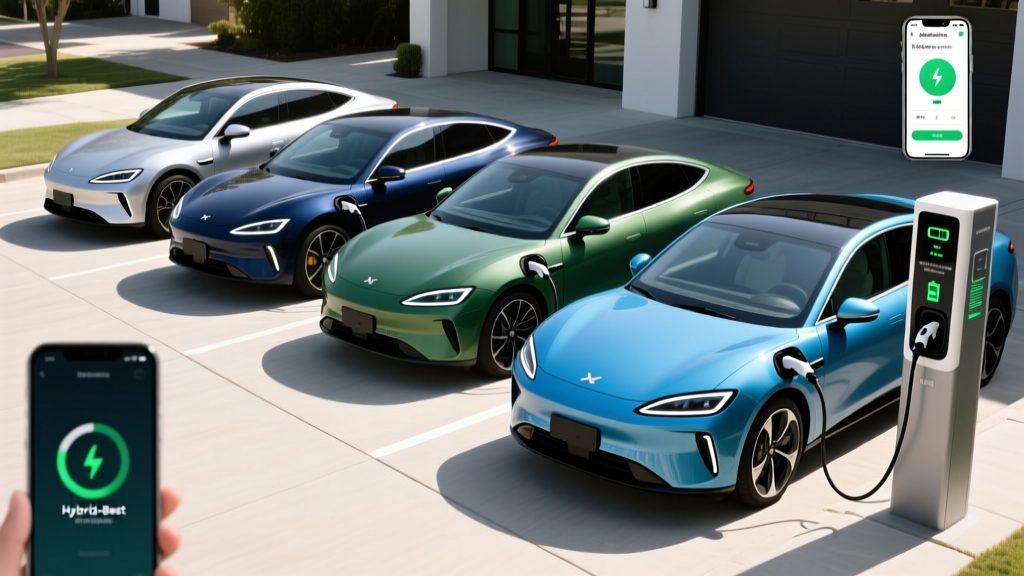
PHEV batteries are small enough that Level 1 charging (120V household outlet) is practical for overnight top-ups — something full EVs can't claim. Here's what to expect:
| Charging Level | Power (kW) | Time to Full (typical PHEV) | Notes |
|---|---|---|---|
| Level 1 (120V) | 1.2–1.4 kW | 8–14 hours | Sufficient for daily replenishment of 25–44 mi range |
| Level 2 (240V) | 3.3–7.2 kW | 2–5 hours | Most PHEVs accept 3.3–6.6 kW onboard |
| DC Fast Charge | Varies | N/A for most | Very few PHEVs support DC fast charging |
DC fast-charging caveat: Most PHEVs — including the RAV4 Prime, Tucson PHEV, and Prius Prime — do not support DC fast charging. The Mitsubishi Outlander PHEV is a rare exception, accepting up to 22 kW DC via CHAdeMO. If you rely on public fast chargers, a PHEV's small battery makes DC charging impractical anyway; you'd gain only 15–20 miles in a session that costs more than the gasoline equivalent.
Home setup: A standard 120V outlet in your garage is enough for most PHEV owners. If you want faster Level 2 charging, expect $500–$1,500 for a 240V circuit installation (equipment + electrician), assuming your panel has capacity. Most PHEVs charge fully overnight on Level 1, so a Level 2 upgrade is optional rather than essential.
Federal Tax Credits: What PHEVs Qualify for in 2026
Under IRS §30D, qualifying new plug-in hybrids can receive up to $7,500 in federal tax credits — but the rules are strict and vehicle-specific. The credit depends on battery capacity (minimum 7 kWh for full credit), critical-mineral sourcing, and battery-component manufacturing origin.
- Battery capacity: Must be at least 7 kWh (most 2026 PHEVs meet this)
- MSRP cap: Vans/SUVs/pickups ≤ $80,000; sedans ≤ $55,000
- Buyer income cap: AGI ≤ $150,000 (single), $225,000 (head of household), $300,000 (joint)
- Critical minerals: Must meet annual percentage thresholds for US/FTA-country sourcing
- Battery components: Must meet annual percentage thresholds for North American manufacturing
- FEOC restriction: No battery components from a "foreign entity of concern" (primarily Chinese firms)
- Point-of-sale transfer: Eligible buyers can transfer the credit to the dealer for an upfront price reduction
As of 2026, the Toyota RAV4 Prime and Toyota Prius Prime do not qualify for the full $7,500 credit due to battery-sourcing requirements. The Chrysler Pacifica PHEV and Jeep Wrangler 4xe (Stellantis, assembled in North America) have historically qualified for partial or full credits depending on the model year's sourcing rules. The Ford Escape PHEV has also qualified for partial credit.
Critical: Credit eligibility changes as manufacturers adjust supply chains. Always verify current status on IRS.gov's clean vehicle credit page or ask your dealer for the IRS-qualified-vehicle list before purchase. State incentives (California, Colorado, New York, and others) may stack on top — check your state's energy office.
Battery Longevity, Warranty, and Replacement Costs
Federal mandate: All PHEV batteries sold in the US carry a minimum warranty of 8 years / 100,000 miles (whichever comes first) for capacity retention and defect coverage. California Air Resources Board (CARB) states require 10 years / 150,000 miles.
Capacity threshold: Most warranties guarantee the battery will retain at least 60–70% of original capacity. If your 42-mile EV range drops below ~25 miles within the warranty window, the manufacturer must repair or replace the pack.
Real-world degradation: PHEV batteries are smaller and experience shallower charge cycles than BEV batteries, which generally means slower degradation. Toyota's nickel-metal-hydride and lithium-ion hybrid packs have an extensive track record — 15-year-old Prius packs routinely retain 80%+ capacity. Lithium-ion PHEV packs from Hyundai, BMW, and Stellantis show 5–10% degradation over the first 5 years based on owner-reported data.
Replacement cost: Out-of-warranty PHEV battery replacement ranges from $4,000 to $8,000 depending on the model and whether individual modules can be serviced versus a full pack swap. The RAV4 Prime pack replacement runs approximately $6,000–$7,500 at a dealership. The Prius Prime is closer to $3,500–$5,000. Aftermarket and refurbished packs are emerging at 30–50% lower cost for older models.
Reliability: PHEV powertrains are inherently more complex than either a pure BEV (fewer moving parts) or a conventional HEV (smaller, less-stressed battery). However, Toyota's PHEV systems have proven highly reliable in long-term ownership surveys. Hyundai/Kia's turbocharged PHEV powertrains have had isolated reports of transmission-related issues. BMW's xDrive50e is too new for long-term data but benefits from BMW's proven B58 inline-six engine.
Who Should Buy a Plug In Hybrid — and Who Shouldn't
PHEV Pros
- Electric commuting eliminates daily gasoline use for short-trip drivers
- No range anxiety — gas engine covers any distance
- Level 1 (120V) charging is sufficient; no expensive home install required
- Lower battery replacement cost than a BEV (smaller pack)
- Some models qualify for federal/state tax credits
- Regenerative braking extends brake-pad life
PHEV Cons
- Two powertrains mean more maintenance (oil changes + electric drivetrain service)
- Heavier than a comparable HEV or gas car, slightly reducing highway efficiency
- Electric range drops significantly in cold weather (15–30% loss)
- Most PHEVs lack DC fast charging
- Cargo space may be reduced by battery placement
- If you never plug in, you're carrying dead weight — worse MPG than a regular hybrid
Buy a PHEV if: You have access to a plug (even a 120V outlet), your daily driving is under 40 miles, and you take road trips where charging infrastructure is unreliable. The PHEV is the best "one-car solution" for households that can't yet commit to a full EV.
Skip the PHEV if: You have no access to any plug — you'll never use the electric range and will pay a premium for a battery you don't exploit. In that case, a conventional HEV like the Prius or Honda Accord Hybrid delivers better value. If you have reliable home Level 2 charging and rarely drive beyond 250 miles, a BEV offers lower running costs and less maintenance.
Frequently Asked Questions
How many MPG does a plug-in hybrid get?
Once the battery is depleted, PHEVs operate as conventional hybrids. Combined hybrid MPG ranges from 20 (Jeep Wrangler 4xe) to 52 (Toyota Prius Prime). While the battery has charge, efficiency is measured in MPGe — the Prius Prime achieves 127 MPGe in electric mode. Real-world hybrid MPG often exceeds the EPA city rating due to regenerative braking in stop-and-go traffic.
How far can a PHEV go on electric only?
Current 2026 PHEVs deliver 22–44 miles of EPA-rated electric-only range. The Toyota Prius Prime leads at 44 miles; the RAV4 Prime delivers 42 miles. In cold weather (below freezing), expect 15–30% less range — roughly 30 miles from a 42-mile-rated pack. Highway-speed driving also reduces EV range compared to city driving.
Do I have to plug in a PHEV, or does it charge itself?
You must plug in to get the electric-only range. The gas engine and regenerative braking will maintain a small charge buffer, but you won't access the full EV range without plugging in. If you never plug in, a PHEV functions as a heavier, less efficient conventional hybrid. If you can't plug in at home or work, buy a conventional HEV instead.
Is a PHEV reliable, and what does battery replacement cost?
PHEVs carry more mechanical complexity than BEVs or HEVs, but Toyota's PHEV systems have demonstrated strong long-term reliability. Federal law mandates an 8-year/100,000-mile battery warranty (10/150,000 in CARB states). Out-of-warranty battery replacement typically costs $4,000–$8,000 depending on the model. Most PHEV batteries show only 5–10% degradation over 5 years.
Does a plug-in hybrid qualify for the $7,500 federal tax credit?
Some PHEVs qualify for partial or full credits under IRS §30D, but eligibility depends on battery sourcing, MSRP caps, and buyer income limits. As of 2026, Stellantis PHEVs (Wrangler 4xe, Pacifica) and the Ford Escape PHEV have qualified for varying credit amounts. Toyota PHEVs have not qualified for the full credit due to battery-component sourcing. Always verify on IRS.gov before purchasing, as eligibility changes with supply-chain updates.
Can I DC fast-charge a plug-in hybrid?
Most PHEVs do not support DC fast charging. The Mitsubishi Outlander PHEV is a rare exception with CHAdeMO DC capability. Given the small battery size (13–26 kWh), DC fast charging adds minimal range in a session and is generally not cost-effective compared to Level 1 or Level 2 home charging.