The Beginner's Guide to Choosing a Family Hybrid SUV
Welcome to the ultimate beginner's guide to navigating the world of family-friendly hybrid SUVs. When you are starting a family, expanding your current one, or simply preparing for the chaotic beauty of school runs, grocery hauls, and weekend road trips, the vehicle you choose becomes your mobile command center. You need space for strollers, car seats, sports equipment, and the inevitable mountain of luggage. But you also want to keep your fuel costs manageable and reduce your environmental footprint. This is where the modern hybrid SUV shines.
Unlike the early days of hybrid vehicles, which often sacrificed cargo space to accommodate bulky battery packs, today's best family hybrid SUVs are built on dedicated platforms that maximize interior volume. Whether you are looking at a traditional Hybrid Electric Vehicle (HEV) that never needs to be plugged in, or a Plug-In Hybrid Electric Vehicle (PHEV) that offers a buffer of pure electric range for your daily commute, there is a spacious option for your needs. In this guide, we will rank the top contenders based strictly on passenger comfort, cargo versatility, and real-world family usability.
Why Hybrid SUVs Make Sense for Growing Families
Families do a lot of stop-and-go driving. From idling in school pickup lines to navigating crowded suburban shopping centers, traditional gas engines waste fuel in these low-speed scenarios. Hybrids, however, thrive here. They use regenerative braking to capture energy and rely on their electric motors at low speeds, resulting in massive fuel savings. According to the EPA's official hybrid comparison guide, modern hybrid SUVs can achieve combined fuel economy ratings upwards of 35 to 40 MPG, saving families thousands of dollars over the lifespan of the vehicle compared to their gas-only counterparts.
Furthermore, PHEVs offer an incredible advantage for school runs and local errands. With 30 to 40 miles of pure electric range, many families can complete their entire weekly local driving without using a single drop of gasoline, all while retaining the gas engine for long road trips where public charging infrastructure might be sparse.
How We Measure Space: Passenger Volume vs. Cargo Capacity
When evaluating the best family hybrid SUVs, we look beyond the brochure numbers. The EPA measures passenger volume in cubic feet, which gives a good baseline for headroom and legroom. However, for families, cargo space is often the true bottleneck. We evaluate cargo capacity in three stages: behind the third row (for 3-row SUVs), behind the second row, and maximum cargo with all rear seats folded flat.
We also consider the 'hybrid battery tax.' In some older or retrofitted designs, the hybrid battery was placed under the cargo floor, raising the load height and eating into vertical space for tall items like dog crates or large coolers. The models ranked below utilize modern architectures that package batteries low and flat, preserving the cargo room families desperately need.
The Top 5 Family Hybrid SUVs Ranked by Space
1. Toyota Grand Highlander Hybrid (The 3-Row Space King)
When it comes to maximum passenger and cargo volume in a midsize hybrid package, the Toyota Grand Highlander Hybrid is currently unmatched. Unlike the standard Highlander, which has a notoriously cramped third row, the Grand Highlander offers a third row that comfortably fits adults on long trips. More importantly for families, it leaves a generous 14.9 cubic feet of cargo space behind that third row—enough for a double stroller and several bags of groceries.
With the third row folded, cargo space expands to a massive 57.9 cubic feet, and folding both rear rows yields an SUV-like 97.5 cubic feet. The hybrid powertrain delivers an impressive 36 MPG combined, making it the ultimate road-trip warrior for large families who refuse to compromise on space or fuel economy.
2. Kia Sorento Plug-In Hybrid (The Commuter-Friendly 3-Row)
The Kia Sorento PHEV is a masterclass in packaging. It is one of the few vehicles in its class to offer three rows of seating alongside a plug-in hybrid powertrain. While the third row is best reserved for small children or occasional use, the passenger volume in the first two rows is exceptional. The Sorento PHEV offers 32 miles of pure electric range, which is perfect for dropping the kids off at school and commuting to work without engaging the gas engine.
Cargo space behind the third row is tight at 12.6 cubic feet, but dropping the third row opens up a highly usable 45 cubic feet. The flat load floor and low liftover height make it incredibly easy for kids to load their own backpacks and sports gear.
3. Hyundai Santa Fe Hybrid (The Boxy 2-Row Cargo Hauler)
Hyundai completely redesigned the Santa Fe for the 2024 model year, adopting a bold, boxy aesthetic that is not just for show—it drastically improves interior volume. While it is strictly a 2-row SUV, the passenger cabin feels cavernous, and the cargo area is exceptionally tall and wide. The hybrid version maintains the same 40.5 cubic feet of space behind the second row as the gas model, thanks to clever battery packaging.
The wide, square hatch opening is a dream for loading bulky items like bicycles or large furniture boxes. With an estimated 36 MPG combined, the Santa Fe Hybrid is the ideal choice for families of four who prioritize maximum cargo versatility over a third row.
4. Honda CR-V Hybrid (The Compact Family Gold Standard)
For families who do not need the sheer footprint of a midsize SUV, the Honda CR-V Hybrid remains the gold standard of the compact segment. Honda's 'man maximum, machine minimum' philosophy shines here. The rear doors open nearly 90 degrees, making it incredibly easy to load rear-facing car seats—a common pain point in tighter SUVs. Passenger volume is a class-leading 106 cubic feet.
Cargo space is equally impressive, offering 39.3 cubic feet behind the second row. The cargo floor is low, and the hybrid battery does not intrude into the cabin space. Combined with its stellar reliability and 40 MPG city rating, the CR-V Hybrid is the default recommendation for young families.
5. Toyota RAV4 Prime (The PHEV Efficiency Leader)
The Toyota RAV4 Prime offers an astonishing 42 miles of electric range and standard all-wheel drive, making it a powerhouse for efficiency. However, it lands at number five on our space list because the larger battery pack required for that 42-mile range does slightly raise the cargo floor compared to the standard RAV4 Hybrid. You lose a bit of vertical space, but you gain immense fuel savings.
Passenger room is comfortable for a family of four, and the 37.6 cubic feet of cargo space behind the second row is still plenty for a week's worth of luggage or a large dog crate. It is the perfect choice for eco-conscious families who want PHEV benefits without stepping up to a larger, more expensive midsize SUV.
Comprehensive Space & Efficiency Comparison Table
| Model | Type | Passenger Vol (cu ft) | Cargo (Behind 2nd/3rd Row) | Max Cargo (cu ft) | MPG / MPGe |
|---|---|---|---|---|---|
| Toyota Grand Highlander Hybrid | HEV | 143.2 | 14.9 (behind 3rd) | 97.5 | 36 MPG |
| Kia Sorento PHEV | PHEV | 135.1 | 12.6 (behind 3rd) | 75.7 | 84 MPGe |
| Hyundai Santa Fe Hybrid | HEV | 111.5 | 40.5 (behind 2nd) | 79.6 | 36 MPG |
| Honda CR-V Hybrid | HEV | 106.0 | 39.3 (behind 2nd) | 76.5 | 40 City MPG |
| Toyota RAV4 Prime | PHEV | 98.9 | 37.6 (behind 2nd) | 69.8 | 94 MPGe |
Beginner Tips for Evaluating Family Cargo Space
When shopping for your family hybrid SUV, do not rely solely on the spec sheet. Here are practical, actionable tips to test the space yourself:
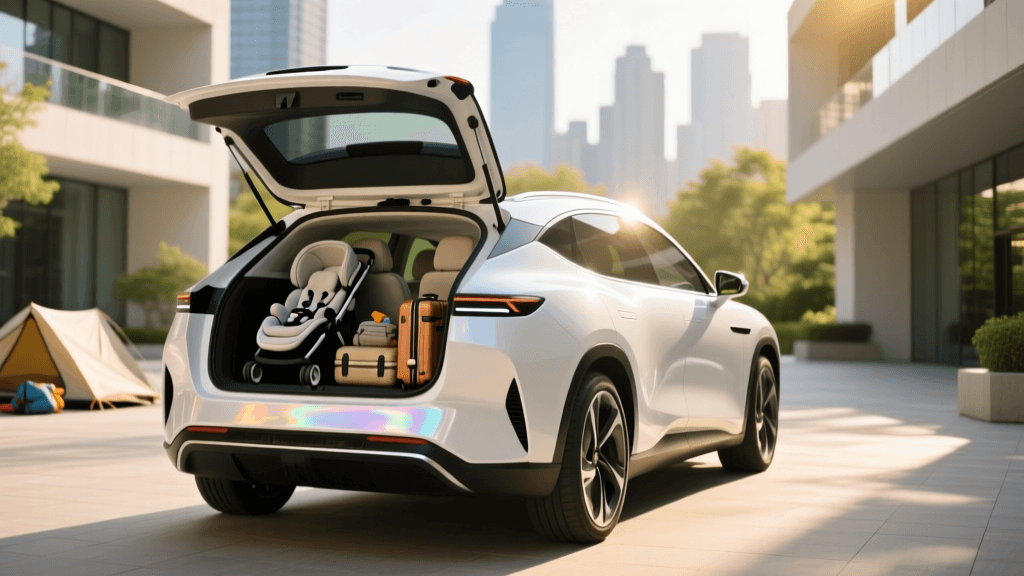
- The Stroller Test: Bring your exact stroller to the dealership. Some strollers fold compactly, while others require you to remove the wheels. Ensure the cargo opening is wide enough and the load floor is low enough that you will not strain your back lifting it in and out daily.
- Check the LATCH Anchors: According to NHTSA's car seat safety guidelines, proper installation is critical. Hybrid SUVs generally maintain standard LATCH anchor placements, but thicker hybrid seat cushions can sometimes make the lower anchors harder to find. Test your car seats in the vehicle before purchasing.
- PHEV Home Charging Logistics: If you opt for a PHEV like the Sorento or RAV4 Prime, remember that you will need a Level 2 (240V) home charger to make the most of the battery. Factor the $500 to $1,500 installation cost into your budget, and ensure your garage has enough physical space to accommodate the vehicle plus a wall-mounted charging unit without blocking your cargo access.
- Cargo Tie-Downs and Grocery Hooks: Look for integrated grocery bag hooks and sturdy tie-down points. Hybrid SUVs often have smoother cargo floors to accommodate battery placement, making it easier for loose items to slide around during cornering.
Safety First: Checking the Ratings
Space means nothing without safety. When selecting a family vehicle, always cross-reference your favorites with the IIHS Top Safety Pick awards. The vehicles on our list, particularly the Honda CR-V and Toyota models, consistently perform exceptionally well in crashworthiness and crash avoidance tests. Ensure the hybrid trim you select includes the full suite of advanced driver assistance systems (ADAS), such as automatic emergency braking with pedestrian detection and blind-spot monitoring, which are vital when navigating crowded school zones and parking lots.
Final Thoughts
Choosing the best family hybrid SUV is all about balancing your specific spatial needs with your daily driving habits. If you regularly transport more than five people or need maximum cargo volume for large gear, the Toyota Grand Highlander Hybrid is the undisputed champion. If your family is smaller and your commute is short, a PHEV like the Toyota RAV4 Prime or Kia Sorento PHEV will drastically cut your fuel costs while providing ample room for the essentials. By understanding how hybrid packaging affects interior space and testing the vehicles with your own family gear, you will find the perfect, efficient command center for your family's adventures.