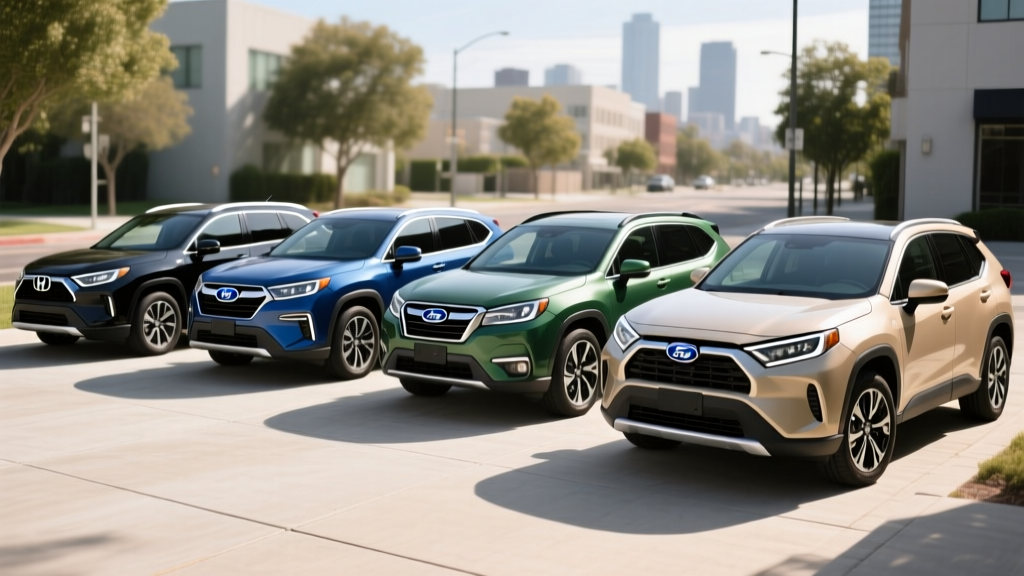
If you live where winter brings snow, ice, and slush — or you simply want the traction security of all-wheel drive without the fuel penalty of a traditional AWD gas vehicle — AWD hybrid cars deserve a hard look. Modern hybrid and plug-in hybrid systems now pair electric motors with internal combustion engines in ways that deliver all-weather capability and exceptional efficiency. Some AWD hybrids now exceed 40 MPG combined, and several AWD plug-in hybrids can cover 30+ miles on electricity alone before the gas engine ever fires.
This guide breaks down the most compelling AWD hybrid cars and SUVs available for the 2026 model year, covering both conventional hybrids (HEVs) and plug-in hybrids (PHEVs). We'll give you exact EPA fuel economy figures, electric-only range for PHEVs, powertrain specs, real-world efficiency expectations, pricing, tax credit eligibility, and battery warranty details — everything you need to decide which AWD hybrid fits your driving life.
HEV vs. PHEV: Which Type of AWD Hybrid Do You Need?
Before comparing models, it's essential to understand the two hybrid architectures available with AWD. Conflating them is the most common mistake buyers make.
Conventional Hybrid (HEV)
How it works: A small battery (typically 1–2 kWh) and electric motor(s) assist a gasoline engine. The battery recharges through regenerative braking and the engine — you never plug it in.
AWD method: Most AWD HEVs use a dedicated rear electric motor (e-AXLE) that powers the rear wheels when traction is needed, eliminating the mechanical driveshaft found in gas-only AWD systems.
Best for: Drivers without access to home or workplace charging who want maximum MPG with zero behavior change.
Plug-In Hybrid (PHEV)
How it works: A larger battery (typically 13–20 kWh) provides meaningful electric-only range (usually 25–42 miles). You plug in to recharge — on a standard 120V outlet overnight or a Level 2 charger in 2–3 hours. Once the battery depletes, the vehicle operates as a conventional hybrid.
AWD method: Similar e-AXLE rear motor setups, though some PHEVs use more powerful electric motors that drive AWD in EV mode as well.
Best for: Drivers with home charging access who want EV-like commuting most days but need gas-engine range for road trips and the security of AWD in bad weather.
Top AWD Hybrid Cars and SUVs for 2026
The following models represent the strongest AWD hybrid options across sedans, crossovers, and SUVs. We've selected them based on efficiency, AWD system capability, interior practicality, and value. All pricing reflects 2026 model-year MSRP before any incentives.
| Model | Type | Combined HP | EPA Combined MPG / MPGe | EV Range (PHEV) | Starting MSRP |
|---|---|---|---|---|---|
| Toyota Prius AWD | HEV | 196 hp | 49 MPG | N/A | $29,950 |
| Toyota RAV4 Hybrid AWD | HEV | 219 hp | 39 MPG | N/A | $34,450 |
| Toyota RAV4 Prime AWD | PHEV | 302 hp | 94 MPGe / 38 MPG (hybrid) | 42 miles | $44,900 |
| Honda CR-V Hybrid AWD | HEV | 204 hp | 37 MPG | N/A | $36,350 |
| Hyundai Tucson Hybrid AWD | HEV | 226 hp | 38 MPG | N/A | $36,550 |
| Hyundai Tucson PHEV AWD | PHEV | 261 hp | 80 MPGe / 35 MPG (hybrid) | 33 miles | $40,250 |
| Ford Escape PHEV (FWD only noted*) | PHEV | 210 hp | 105 MPGe / 40 MPG (hybrid) | 37 miles | $39,900 |
| Toyota Crown AWD | HEV | 236 hp | 41 MPG | N/A | $42,350 |
| Volvo XC60 Recharge AWD | PHEV | 455 hp | 63 MPGe / 28 MPG (hybrid) | 35 miles | $58,950 |
*The Ford Escape PHEV is FWD only — included here as an efficiency benchmark. For AWD in the Ford lineup, the hybrid (non-PHEV) Escape offers AWD but with lower MPG. All other models listed above come with AWD as standard or available.
Sources: fueleconomy.gov (EPA), manufacturer press sites. Verify current-year specs at purchase time, as trims and pricing shift annually.
Fuel Economy Deep Dive: Real-World MPG vs. EPA Stickers
The EPA's hybrid fuel economy testing tends to be more conservative than what many owners experience — particularly in city driving, where regenerative braking recaptures energy at every stop. Here's what to actually expect:
| Model | EPA City | EPA Highway | EPA Combined | Real-World Expectation |
|---|---|---|---|---|
| Prius AWD | 53 | 54 | 49 | 48–55 MPG (city-favoring drivers often exceed EPA) |
| RAV4 Hybrid AWD | 41 | 38 | 39 | 36–42 MPG |
| CR-V Hybrid AWD | 40 | 34 | 37 | 34–40 MPG |
| Tucson Hybrid AWD | 38 | 38 | 38 | 35–40 MPG |
| Crown AWD | 42 | 41 | 41 | 38–44 MPG |
Real-world note on highway driving: Hybrids lose their city advantage at sustained highway speeds (70–80 mph), where the gasoline engine does most of the work and aerodynamic drag dominates. Expect highway MPG to land at or slightly below the EPA highway figure. In cold weather (below 30°F), hybrid fuel economy drops 10–15% due to engine warm-up cycles, cabin heating demands, and reduced battery efficiency. This is less severe than EV cold-weather range loss (20–30%) but still meaningful.
AWD PHEV Range: How Far on Electric Alone?
For plug-in hybrid buyers, electric-only range is the number that determines whether your daily commute can be completed without burning a drop of gasoline. Here's how the top AWD PHEVs compare:
| AWD PHEV Model | Battery (kWh) | EPA EV Range | Total Range | Level 2 Charge Time | DC Fast Charge |
|---|---|---|---|---|---|
| RAV4 Prime AWD | 18.1 kWh | 42 miles | ~600 miles | ~2.5 hours | No |
| Tucson PHEV AWD | 13.8 kWh | 33 miles | ~430 miles | ~2 hours | No |
| Volvo XC60 Recharge AWD | 18.8 kWh | 35 miles | ~470 miles | ~3 hours | No |
Key insight for PHEV buyers: Most current AWD PHEVs do not support DC fast charging. You'll recharge via Level 1 (standard 120V household outlet — 8–12 hours for a full charge) or Level 2 (240V — 2–3 hours). For most owners, plugging in at home overnight on Level 1 or Level 2 is sufficient to start each morning with a full battery. If you need rapid mid-day top-ups, a full BEV with DC fast charging capability is the better fit.
Real-world EV range caveat: EPA EV-range figures for PHEVs assume moderate temperatures and mixed driving. In cold weather (below freezing), expect 20–30% less electric-only range due to cabin heating demands and reduced battery performance. The RAV4 Prime's 42-mile EPA EV range may shrink to 28–33 miles in a Minnesota January. Highway-speed driving at 75+ mph also reduces EV range.
Powertrain and AWD System Details
Understanding how AWD hybrids generate and distribute power helps explain why these vehicles are both efficient and capable in low-traction conditions.
Toyota's AWD Hybrid System (Prius, RAV4, Crown)
Toyota pairs its proven hybrid transaxle (front wheels driven by a 2.0L or 2.5L four-cylinder engine plus one or two motor-generators) with a separate rear-mounted electric motor (e-AXLE) producing 40–54 hp. This rear motor activates automatically during acceleration from a stop, on slippery surfaces, and during hard cornering. There is no mechanical driveshaft connecting front and rear axles — the rear wheels are driven purely by electricity. This reduces weight and drivetrain losses compared to traditional AWD, which is a key reason these hybrids achieve such high MPG.
Hyundai/Kia's AWD Hybrid System
Hyundai uses a 1.6L turbocharged four-cylinder paired with a 6-speed automatic transmission (not a CVT like Toyota) and an integrated electric motor. AWD models add a rear e-AXLE motor. The Tucson Hybrid's combined output of 226 hp makes it one of the more powerful compact hybrid crossovers, and the conventional transmission gives it a more familiar driving feel compared to Toyota's CVT-based system.
Honda's Two-Motor Hybrid AWD
Honda's system in the CR-V Hybrid uses two electric motors — one for propulsion, one for generation — paired with a 2.0L Atkinson-cycle engine. The AWD system uses a rear electric motor that engages as needed. Honda's hybrid system operates primarily as an EV at low and moderate speeds, with the engine acting as a generator; it only mechanically connects to the wheels at highway cruising speeds via a lock-up clutch. This gives it a notably smooth, EV-like feel around town.
Battery Warranty, Reliability, and Replacement Costs
Hybrid Battery Warranty Coverage
Federal emissions regulations require hybrid battery warranties of at least 8 years / 100,000 miles in most states, and 10 years / 150,000 miles in California Air Resources Board (CARB) states (CA, CO, CT, ME, MA, NJ, NY, OR, RI, VT, WA, and others adopting CARB standards).
Toyota: 10 years / 150,000 miles on hybrid battery (all 50 states for 2026 models).
Honda: 8 years / 100,000 miles (10 years / 150,000 miles in CARB states).
Hyundai: 10 years / 100,000 miles on hybrid/PHEV battery (all states).
Volvo: 8 years / 100,000 miles on PHEV battery.
How long do hybrid batteries actually last? Real-world data is encouraging. Toyota's hybrid battery packs — particularly the nickel-metal hydride (NiMH) units used in earlier generations and the lithium-ion packs in current models — routinely exceed 150,000–200,000 miles before significant degradation. The Prius, now in its third decade, has the longest reliability track record of any hybrid. Hybrid batteries experience far less stress than full EV batteries because they operate within a narrow state-of-charge window (typically 40–80%), avoiding the deep cycles that accelerate degradation in BEVs.
Replacement cost if out of warranty: A hybrid battery replacement runs $2,000–$4,000 for most models (parts and labor), with Prius replacements on the lower end (~$2,000–$2,500) and larger SUVs or PHEVs on the higher end ($3,500–$5,500 for a RAV4 Prime's larger pack). PHEV batteries cost more to replace because they contain significantly more kWh capacity. Refurbished and aftermarket replacement packs are increasingly available at 30–50% less than OEM pricing.
Overall reliability: According to long-term dependability data from sources like Consumer Reports and J.D. Power, Toyota and Lexus hybrids consistently rank among the most reliable vehicles on the road — often more reliable than their gas-only counterparts, because the hybrid system reduces strain on the engine and the regenerative braking system extends brake pad life significantly.
Pricing, Tax Credits, and Total Cost of Ownership
AWD hybrids carry a price premium over their gas-only AWD equivalents — typically $1,500–$3,000 — but the fuel savings often pay back that premium within 3–5 years depending on annual mileage and local gas prices.
Federal Tax Credits (§30D) for PHEVs
Conventional hybrids (HEVs) do not qualify for the federal §30D clean vehicle tax credit. Only plug-in hybrids and full EVs are eligible, and even then, eligibility depends on several requirements that change frequently:
- Battery capacity: Must be at least 7 kWh (all PHEVs listed here qualify).
- MSRP caps: Vans/SUVs/pickups must be under $80,000 MSRP; sedans under $55,000. The RAV4 Prime and Tucson PHEV qualify; the Volvo XC60 Recharge may exceed the cap depending on trim.
- Buyer income limits: Adjusted gross income must not exceed $300,000 (joint filers), $225,000 (head of household), or $150,000 (single filers).
- Battery sourcing: Critical minerals and battery components must meet phased-in domestic/free-trade sourcing requirements that tighten each year. Check current IRS rules at irs.gov, as a vehicle's eligibility can change based on supply chain shifts.
- Point-of-sale transfer: As of 2024+, buyers can transfer the credit to the dealer for an immediate price reduction at purchase, rather than waiting to claim it on their tax return.
The maximum credit is $7,500, but many PHEVs qualify for a partial credit of $3,750 depending on whether they meet the critical minerals requirement, the battery component requirement, or both. For the most current eligibility status of any specific model, consult the fueleconomy.gov tax credit lookup.
Total Cost of Ownership: Hybrid vs. Gas vs. Full EV
Consider a 5-year ownership scenario at 15,000 miles/year with gas at $3.50/gallon and electricity at $0.14/kWh:
| Cost Factor | AWD Gas SUV (25 MPG) | AWD Hybrid SUV (39 MPG) | AWD PHEV SUV (33 mi EV + 35 MPG) |
|---|---|---|---|
| Fuel cost (5 yr) | $10,500 | $6,731 | $4,500 (est.)* |
| Maintenance (5 yr) | $3,500 | $2,800 | $2,800 |
| Upfront premium vs. gas | Baseline | +$2,000 | +$7,000 (before credit) |
| 5-yr total (fuel + maint. + premium) | $14,000 | $9,531 | $7,300 (or ~$3,550 after $3,750 credit) |
*PHEV fuel cost assumes 60% of daily driving is within EV range and home charging is available. Actual savings depend heavily on commute distance and charging habits.
AWD Hybrid vs. PHEV vs. Full EV: Which Fits Your Life?
Choose a Conventional AWD Hybrid (HEV) If:
- You don't have reliable access to home or workplace charging.
- You want maximum MPG with zero change to your fueling habits.
- Your budget is under $40,000 and you want AWD standard.
- You drive 12,000–20,000 miles/year and want to minimize fuel spend without a large upfront premium.
Choose an AWD Plug-In Hybrid (PHEV) If:
- You can charge at home (even a standard 120V outlet works).
- Your daily round-trip commute is under 35–40 miles (covering most US commutes).
- You want EV-like daily driving but still take road trips where charging infrastructure is sparse.
- You qualify for the federal tax credit, which can reduce the PHEV premium by $3,750–$7,500.
Choose a Full EV (BEV) With AWD If:
- You have Level 2 home charging and are comfortable with public DC fast charging for road trips.
- You want the lowest per-mile fuel cost ($0.04–$0.06/mile on electricity vs. $0.10–$0.14/mile in a hybrid).
- You want zero tailpipe emissions and minimal maintenance (no oil changes, fewer moving parts).
- Your household has a second vehicle for the rare long trip, or you're comfortable planning charging stops.
AWD Hybrid Pros
- 30–55 MPG combined depending on model
- No charging required (HEV); just fill up with gas
- Proven long-term reliability (especially Toyota)
- AWD without major fuel economy penalty
- Lower purchase price than full EVs
- Excellent resale value (RAV4 Hybrid, Prius)
AWD Hybrid Cons
- Still burns gasoline; not zero-emission
- Less power than EV equivalents in most models
- HEVs don't qualify for federal tax credits
- Higher maintenance than EVs (oil changes, filters)
- AWD e-AXLE systems less capable off-road than mechanical AWD
- PHEVs have limited EV range vs. full BEVs (30–42 mi vs. 250–350 mi)
Frequently Asked Questions
How many MPG do AWD hybrid cars get?
AWD hybrids range from about 37 MPG combined (Honda CR-V Hybrid AWD, Hyundai Tucson Hybrid AWD) up to 49 MPG combined (Toyota Prius AWD). The Toyota Crown AWD achieves 41 MPG combined, and the RAV4 Hybrid AWD delivers 39 MPG. Real-world results vary: city-heavy drivers often exceed EPA figures thanks to regenerative braking, while sustained highway driving and cold weather reduce efficiency by 10–15%.
How far can an AWD PHEV go on electric only?
Current AWD PHEVs offer 33–42 miles of EPA-rated electric-only range. The Toyota RAV4 Prime leads at 42 miles, followed by the Volvo XC60 Recharge at 35 miles and the Hyundai Tucson PHEV at 33 miles. In cold weather (below freezing), expect 20–30% less EV range. For context, the average US one-way commute is about 16 miles, meaning most PHEV owners can complete daily commuting entirely on electricity.
Are AWD hybrids reliable? What does battery replacement cost?
AWD hybrids, particularly from Toyota, are among the most reliable vehicles on the road. Toyota's hybrid system has been refined over 25+ years and hundreds of billions of miles of real-world use. Hybrid batteries are warrantied for 8–10 years / 100,000–150,000 miles depending on the manufacturer and state. Out-of-warranty replacement costs range from $2,000–$4,000 for most HEVs and $3,500–$5,500 for PHEVs with larger battery packs. Many hybrid batteries last well beyond 200,000 miles.
Do AWD hybrid cars qualify for any tax credits?
Conventional hybrids (HEVs) do not qualify for the federal §30D clean vehicle tax credit. Only plug-in hybrids (PHEVs) and full EVs are eligible. PHEV credit eligibility depends on MSRP caps ($80,000 for SUVs, $55,000 for sedans), buyer income limits, and battery sourcing requirements. The credit can be up to $7,500, though many PHEVs currently qualify for $3,750 depending on sourcing compliance. Always verify current eligibility at irs.gov before purchasing. Some states offer additional rebates for PHEVs — check your state's energy office or AFDC for local incentives.
Is an AWD hybrid better than an AWD gas car?
For most buyers, yes. An AWD hybrid delivers 30–50% better fuel economy than a comparable gas-only AWD vehicle while providing equivalent or better acceleration (electric motors deliver instant torque). The upfront premium of $1,500–$3,000 typically pays back within 3–5 years through fuel savings. Hybrids also benefit from reduced brake wear (regenerative braking handles much of the deceleration) and, in Toyota's case, exceptional long-term reliability. The main reason to choose a gas AWD vehicle over a hybrid is a very tight purchase budget where the hybrid premium is prohibitive.
Can I get AWD in a hybrid sedan, or only SUVs?
AWD hybrid sedans are available but less common than AWD hybrid SUVs. The Toyota Prius AWD (49 MPG combined, starting at $29,950) and the Toyota Crown AWD (41 MPG, starting at $42,350) are the standout options. Most other AWD hybrids are crossovers and SUVs (RAV4, CR-V, Tucson, etc.) because the AWD hybrid powertrain's packaging works naturally in taller vehicles. If you prefer a sedan with AWD and maximum efficiency, the Prius AWD is the clear segment leader.