The All-Weather Hybrid Dilemma: Traction vs. Efficiency
For years, automotive enthusiasts and daily commuters faced a frustrating compromise: if you wanted the all-weather security of all-wheel drive (AWD), you had to accept a significant penalty in fuel economy. Traditional mechanical AWD systems add weight, rotational mass, and drivetrain friction, all of which drag down miles per gallon (MPG). However, the modern hybrid era has completely rewritten this rulebook. By utilizing electric motors to power the rear axle, automakers can now offer exceptional traction in rain, snow, and mud without sacrificing the stellar fuel efficiency that hybrid buyers demand.
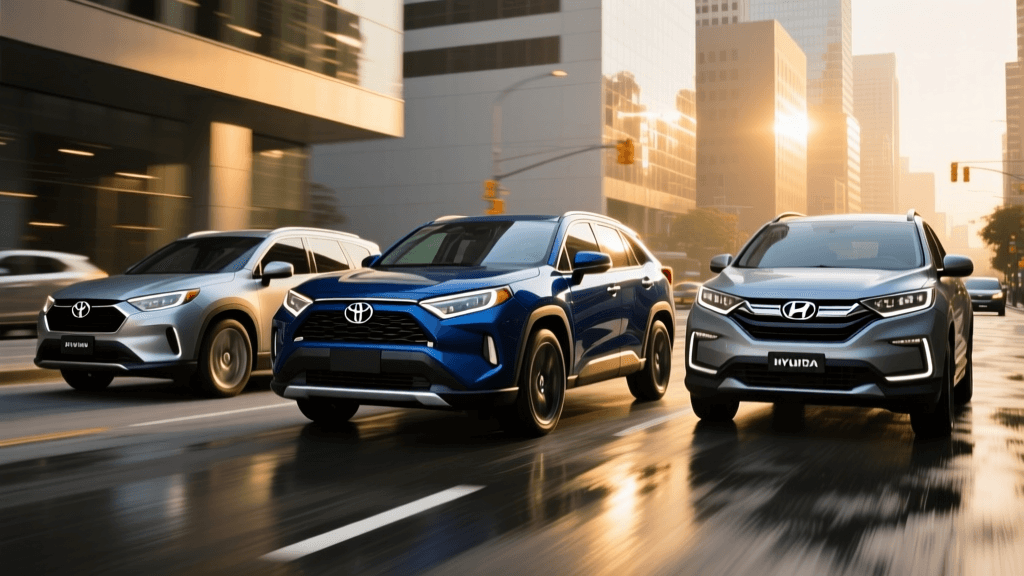
But not all hybrid AWD systems are created equal. Some rely on independent rear electric motors (e-AWD), while others utilize traditional mechanical driveshafts linked to the hybrid transmission. In this head-to-head product showdown, we are ranking the top three compact hybrid SUVs on the market—Toyota RAV4 Hybrid AWD, Honda CR-V Hybrid AWD, and Hyundai Tucson Hybrid AWD—to determine which offers the ultimate balance of traction, efficiency, and real-world utility.
The Contenders at a Glance
Before diving into the deep technical analysis, let us look at the raw numbers. The following table outlines the core specifications that dictate how these vehicles perform on the pavement and at the pump.
| Vehicle | AWD System Type | Combined MPG (EPA) | 0-60 MPH | Starting MSRP (AWD) |
|---|---|---|---|---|
| Toyota RAV4 Hybrid | Electronic On-Demand (e-AWD) | 39 MPG | 7.4 sec | $33,550 |
| Honda CR-V Hybrid | Real-Time Mechanical AWD | 37 MPG | 7.6 sec | $36,350 |
| Hyundai Tucson Hybrid | HTRAC Mechanical AWD | 38 MPG | 7.1 sec | $34,460 |
Contender 1: Toyota RAV4 Hybrid AWD (The Efficiency King)
The Toyota RAV4 Hybrid has long been the benchmark for the compact crossover segment. Its AWD system is entirely electronic, meaning there is no physical driveshaft connecting the front and rear axles. Instead, a dedicated 40-kilowatt electric motor sits on the rear axle, powering the back wheels when the front wheels slip or when extra acceleration is needed.
Traction Profile
Because the rear motor provides instant torque, the RAV4 Hybrid is incredibly adept at launching from a stop on wet pavement or light snow. However, because it is an e-AWD system, it is designed primarily for on-road slip correction. In sustained, deep-snow scenarios or severe off-road crawling, the system may limit power to the rear motor to prevent overheating.
Efficiency Profile
By eliminating the heavy mechanical driveshaft, Toyota saves weight and reduces parasitic drivetrain loss. This engineering choice allows the RAV4 Hybrid to achieve an EPA-estimated 41 MPG in the city and 38 MPG on the highway, making it the undisputed fuel-economy champion of this trio.
Contender 2: Honda CR-V Hybrid AWD (The Traction Champion)
Honda took a fundamentally different approach with the latest CR-V Hybrid. Rather than using a separate rear electric motor, Honda utilizes its Real-Time AWD system, which features a physical mechanical driveshaft connected to the hybrid powertrain's transmission.
Traction Profile
This mechanical linkage allows the CR-V to send up to 50% of the engine and hybrid motor's combined torque to the rear wheels continuously. According to the EPA's guidelines on hybrid powertrains, integrating mechanical drivetrains with hybrid systems requires complex tuning, but Honda has nailed it. The result is superior traction in deep snow, muddy trails, and sustained low-grip environments where an electronic e-AWD system might time out or overheat.
Efficiency Profile
The trade-off for this robust mechanical traction is a slight drop in fuel economy. Spinning a physical driveshaft requires energy, dropping the CR-V Hybrid's EPA rating to 40 MPG city and 34 MPG highway. However, its aerodynamic tuning and excellent highway cruising manners make it a highly efficient road-trip companion.
Contender 3: Hyundai Tucson Hybrid AWD (The Value & Tech Underdog)
The Hyundai Tucson Hybrid bridges the gap between the Toyota and the Honda. It utilizes the HTRAC AWD system, which is a mechanical setup featuring an electro-hydraulic clutch pack that can actively vector torque between the front and rear axles.
Traction Profile
Hyundai's HTRAC system is highly responsive and features dedicated terrain modes (Snow, Mud, Sand) that alter the torque distribution mapping. It feels more aggressive and sporty than the Toyota's e-AWD, offering excellent cornering grip by sending power rearward during hard acceleration out of turns.
Efficiency Profile
The Tucson Hybrid utilizes a traditional 1.6-liter turbocharged engine paired with a 6-speed automatic transmission (rather than the e-CVTs found in the Toyota and Honda). This gives it a more natural, engaging driving feel and a very competitive 38 MPG combined rating, though it lacks the seamless city-crawling efficiency of the CVT-equipped rivals.
Deep Dive: Electronic vs. Mechanical AWD Systems
When ranking these vehicles by traction, it is vital to understand the physics of their drivetrains. The Department of Energy's Alternative Fuels Data Center notes that hybrid systems recover kinetic energy through regenerative braking, but the method of deploying that energy to the wheels varies wildly.
- Electronic e-AWD (Toyota): Best for sudden weather changes, rain, and light snow. It operates silently, adds minimal weight, and maximizes interior cabin space since there is no driveshaft tunnel. It is the ultimate "set-it-and-forget-it" system for suburban commuters.
- Mechanical AWD (Honda & Hyundai): Best for mountain passes, deep winter conditions, and light towing. The physical connection ensures that torque is available to the rear wheels exactly when needed, without relying on battery state-of-charge or thermal limits of a secondary electric motor.
Safety and All-Weather Handling
Traction is only half the battle; vehicle stability and crash safety are paramount for family haulers. According to IIHS data on hybrid vehicle safety, the battery placement in modern hybrids actually lowers the center of gravity, improving rollover resistance and evasive handling metrics. All three vehicles in this showdown boast top-tier safety ratings, but the Honda CR-V and Toyota RAV4 consistently earn the highest accolades for their standard active safety suites and structural rigidity during small-overlap crash tests. The Hyundai Tucson is no slouch, but its slightly firmer ride quality can make it feel a bit more unsettled on washboard dirt roads compared to the compliant Honda.
The Final Rankings and Verdict
After analyzing traction capabilities, fuel efficiency metrics, and real-world packaging, here is our final head-to-head ranking for the best AWD hybrid SUVs.
Rank #1: Toyota RAV4 Hybrid AWD (Best Overall for 90% of Buyers)
If your primary goal is maximizing fuel savings while retaining enough traction to handle rainy highways and snowy driveways, the Toyota RAV4 Hybrid is the undisputed winner. The electronic e-AWD system is perfectly calibrated for daily life, and the 39 MPG combined rating will save you hundreds of dollars annually at the pump compared to the competition. It is the smartest financial and practical choice for the average commuter.
Rank #2: Honda CR-V Hybrid AWD (Best for Severe Weather & Road Trips)
The Honda CR-V Hybrid takes second place, but it is actually the first choice for buyers living in regions with harsh, prolonged winters or those who frequently travel to mountain ski resorts. The mechanical Real-Time AWD system provides a level of sustained, deep-snow traction that the Toyota simply cannot match. Furthermore, the CR-V's interior volume and highway ride comfort make it a superior long-distance cruiser, justifying the slight 2-MPG penalty.
Rank #3: Hyundai Tucson Hybrid AWD (Best for Tech & Driving Dynamics)
The Hyundai Tucson Hybrid rounds out the podium. It offers the most aggressive styling, the longest standard warranty (10-year/100,000-mile powertrain), and the most engaging driving dynamics thanks to its turbocharged engine and traditional automatic transmission. While its HTRAC AWD system is highly capable and its 38 MPG rating is excellent, it falls just short of the Toyota's efficiency and the Honda's ultimate traction refinement.
Ultimately, the "best" AWD hybrid depends entirely on your local climate and driving habits. Choose the Toyota for unmatched city efficiency, the Honda for uncompromising winter traction, and the Hyundai for value and sporty handling. Whichever you select, you will no longer have to sacrifice fuel economy to conquer the elements.