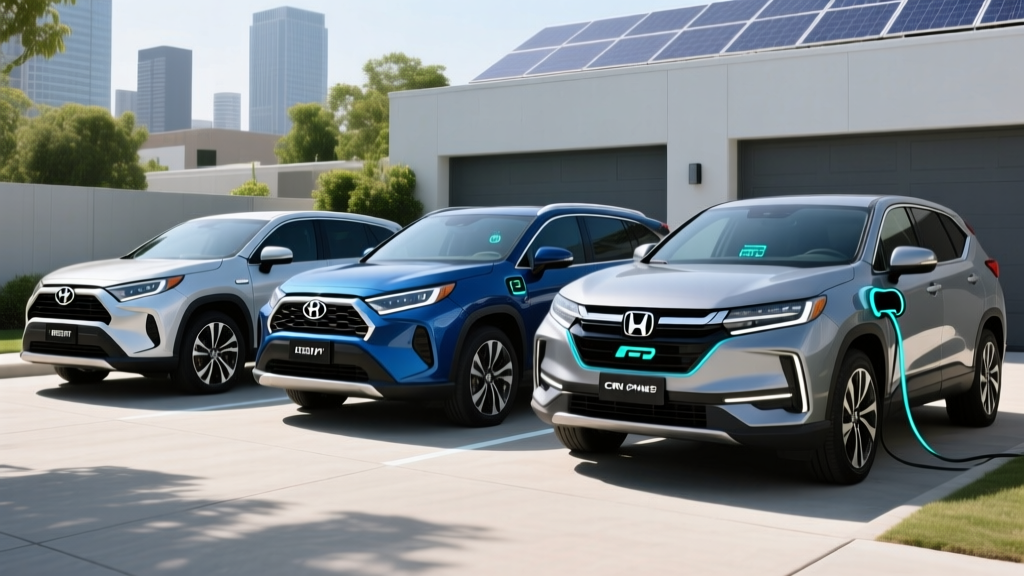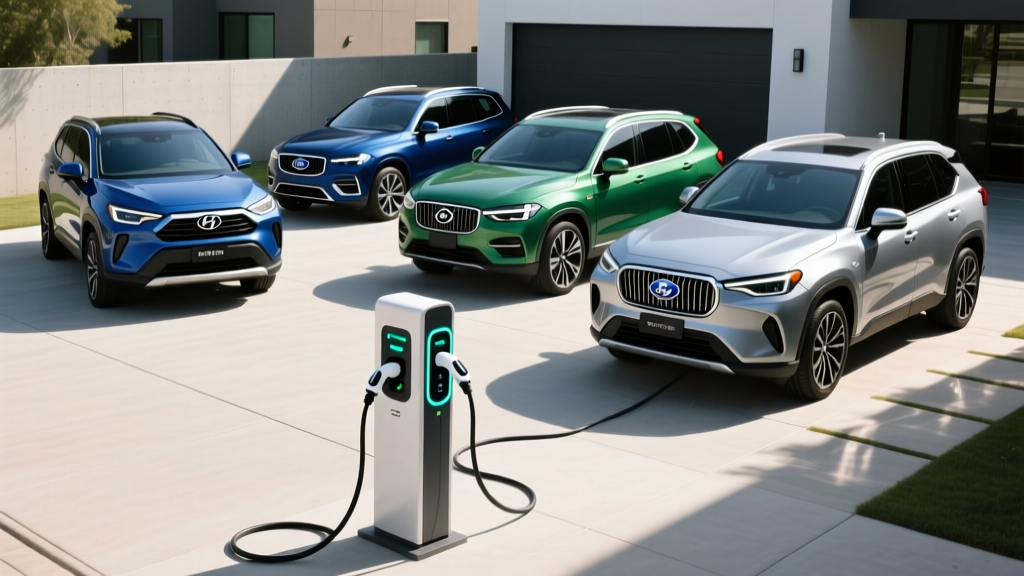
Not every driveway has room for a dedicated charger, and not every road trip stays within 300 miles of home. For buyers who need the traction of all-wheel drive, the efficiency of electrification, and the flexibility to drive cross-country without route-planning apps, an all wheel drive plug in hybrid (AWD PHEV) occupies a compelling middle ground. These vehicles pair a gasoline engine with a larger battery and electric motors—delivering 25 to 40+ miles of electric-only commuting, then seamless gas-hybrid operation when the battery depletes.
This guide breaks down the leading AWD PHEV SUVs available for the 2026 model year, with exact EPA figures, battery specs, charging times, pricing, and current federal tax credit eligibility under IRS §30D. We'll also clarify where a PHEV makes sense versus a conventional hybrid (HEV) or a full battery-electric vehicle (BEV).
HEV vs. PHEV vs. BEV: Which Electrified AWD Fits You?
Before comparing specific models, it's critical to understand what each powertrain actually delivers. Automakers use the word "hybrid" loosely, and the differences in daily operation—and cost—are substantial.
| Feature | HEV (Conventional Hybrid) | PHEV (Plug-In Hybrid) | BEV (Full Electric) |
|---|---|---|---|
| Plugs in? | No — self-charges via engine & regen | Yes — plugs in to charge battery | Yes — sole energy source |
| Electric-only range | ~1 mile or less at low speed | 25–42 miles (typical 2026 AWD SUVs) | 250–350+ miles |
| Total range | 450–600+ miles | 450–600+ miles (gas + electric) | 250–350+ miles |
| Battery size | 1–2 kWh | 13–20 kWh usable | 70–100+ kWh |
| Home charging needed? | No | Recommended (Level 2 ideal) | Essential |
| Federal tax credit (§30D) | Not eligible | Up to $7,500 (if eligible) | Up to $7,500 (if eligible) |
| Best for | No charging access; want better MPG | Home charging + road trip flexibility | Home charging + mostly under 300 mi/day |
The key takeaway: a conventional hybrid does not plug in. If you see "hybrid" without "plug-in," the vehicle generates all its electricity internally. A PHEV requires access to an outlet (at minimum a 120V household plug) to realize its electric-range advantage. If you can't charge at home or work, a PHEV functions as a slightly heavier, slightly less efficient HEV—defeating the purpose of the premium you paid.
Top All Wheel Drive Plug In Hybrid SUVs Compared
The following table compares the most competitive AWD PHEV SUVs for the 2026 model year. All figures are EPA-published or manufacturer-confirmed unless noted.
| Spec | Toyota RAV4 Prime | Ford Escape PHEV AWD | Hyundai Tucson PHEV AWD | Kia Sportage PHEV AWD | Mitsubishi Outlander PHEV |
|---|---|---|---|---|---|
| EPA Electric Range | 42 mi | 37 mi | 33 mi | 34 mi | 38 mi |
| Battery (usable kWh) | 14.9 kWh | 14.4 kWh | 13.8 kWh | 13.8 kWh | 17.0 kWh |
| Combined HP | 302 hp | 210 hp | 261 hp | 261 hp | 248 hp |
| EPA Combined MPGe | 94 MPGe | 105 MPGe | 80 MPGe | 84 MPGe | 74 MPGe |
| Gas-only Combined MPG | 38 MPG | 40 MPG | 35 MPG | 36 MPG | 26 MPG |
| Total Range (gas+elec) | ~600 mi | ~520 mi | ~430 mi | ~440 mi | ~420 mi |
| Level 2 Charge (0–100%) | ~2.5 hrs (6.6 kW) | ~3.5 hrs (3.7 kW) | ~2 hrs (7.2 kW) | ~2 hrs (7.2 kW) | ~3.5 hrs (6.6 kW) |
| DC Fast Charge? | No | No | No | No | Yes (CHAdeMO, ~38 min 0–80%) |
| 0–60 mph | 5.7 sec | 7.8 sec (est.) | 7.4 sec | 7.4 sec | 7.0 sec (est.) |
| Base MSRP (AWD PHEV) | $45,875 | $41,500 (est.) | $39,590 | $39,490 | $42,395 |
| Battery Warranty | 10 yr / 150,000 mi | 8 yr / 100,000 mi | 10 yr / 100,000 mi | 10 yr / 100,000 mi | 10 yr / 100,000 mi |
Sources: fueleconomy.gov (EPA), manufacturer U.S. press sites. MPGe reflects electric+gas blended operation during the charge-depleting phase. MSRP reflects base AWD PHEV trim before destination; actual dealer pricing may vary.
Fuel Economy Breakdown: Real-World MPG vs. EPA Stickers
PHEV fuel economy is split into two phases: charge-depleting (battery has energy, measured in MPGe) and charge-sustaining (battery depleted, operates as a conventional hybrid, measured in MPG). The number that matters most depends on your driving pattern.
| Model | MPGe (Electric Phase) | City MPG (Gas) | Highway MPG (Gas) | Combined MPG (Gas) |
|---|---|---|---|---|
| Toyota RAV4 Prime | 94 MPGe | 40 | 36 | 38 |
| Ford Escape PHEV AWD | 105 MPGe | 42 | 37 | 40 |
| Hyundai Tucson PHEV AWD | 80 MPGe | 37 | 33 | 35 |
| Kia Sportage PHEV AWD | 84 MPGe | 38 | 34 | 36 |
| Mitsubishi Outlander PHEV | 74 MPGe | 26 | 26 | 26 |
Real-world expectation: Hybrids—especially Toyota's series-parallel system—tend to exceed EPA city MPG because regenerative braking recaptures more energy in stop-and-go traffic. Expect the RAV4 Prime to deliver 40–44 MPG in city driving once the battery depletes. Highway figures are typically 2–4 MPG below EPA, especially at sustained speeds above 70 mph or in cold weather (below 35°F), where engine efficiency drops and cabin heating draws additional load.
The Mitsubishi Outlander PHEV's lower gas-phase MPG (26 combined) reflects its larger, heavier body-on-frame-adjacent platform and older engine architecture. If most of your driving exceeds the 38-mile electric range, this model is the least efficient of the group once the battery runs out.
Electric-Only Range and Charging: What 30–42 Miles Actually Means
Thirty to forty-two miles of electric range covers a significant share of American commutes. According to FHWA data, the average one-way commute is roughly 16 miles, meaning most of these AWD PHEVs can handle a full round-trip commute on electricity alone—provided you charge at home overnight.
However, real-world electric range varies:
- Mild weather (55–75°F), city driving: You may match or slightly exceed EPA electric range thanks to regenerative braking.
- Highway driving (70+ mph): Expect 15–25% less electric range. Aerodynamic drag scales with the square of speed, and the electric motor works harder without regen recovery.
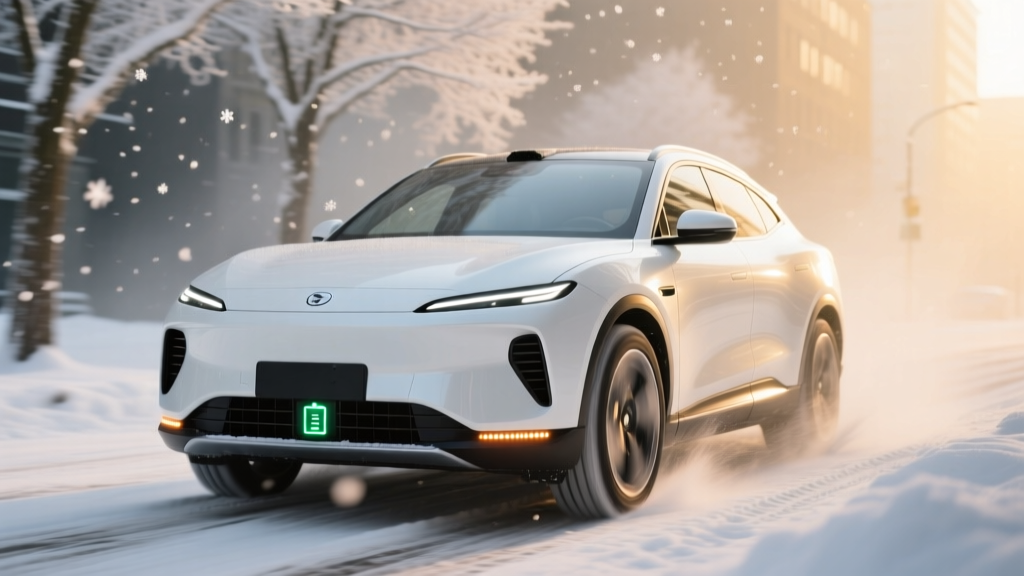
- Cold weather (below 32°F): Expect 20–35% range reduction. Battery chemistry slows, and resistive cabin heating draws 2–4 kW continuously. The RAV4 Prime's 42-mile EPA range may shrink to 27–33 miles on a 20°F morning.
- Hilly terrain: Ascending grades drain the battery faster; descending grades can partially recover energy through regen.
Charging note — kW vs. kWh: Battery capacity is measured in kWh (kilowatt-hours — total energy stored). Charging speed is measured in kW (kilowatts — power delivered at a given moment). A 14.9 kWh battery charging at 6.6 kW takes roughly 2.5 hours from empty. None of these PHEVs (except the Outlander) support DC fast charging, so public fast-charger networks are irrelevant for daily use. A Level 2 home charger (240V) is the practical charging solution.
Level 2 home charging costs: Installing a 240V outlet (NEMA 14-50) typically costs $500–$1,500 depending on panel proximity and local permitting. A quality Level 2 EVSE (charger) runs $300–$600. For a PHEV with a 14–17 kWh battery, overnight charging adds roughly $0.50–$1.50 per day at the national average electricity rate of ~$0.16/kWh—compared to $4–$7 in gasoline for the same 35 miles.
Powertrain Performance: More Than Just Efficiency
AWD PHEVs don't just save fuel—they often deliver more power than their gas-only siblings because the electric motor(s) add instant torque. Here's how the powertrains break down:
- Toyota RAV4 Prime (302 hp): A 2.5L four-cylinder Atkinson-cycle engine (177 hp) paired with front and rear electric motors. The rear motor provides AWD without a mechanical driveshaft (eAWD). At 5.7 seconds to 60 mph, it's the quickest compact PHEV SUV in this group—and one of the quickest RAV4 variants ever sold.
- Hyundai Tucson / Kia Sportage PHEV (261 hp): A 1.6L turbocharged four-cylinder (178 hp) combined with a 98 hp front electric motor and a rear motor for AWD. The turbo provides strong mid-range passing power.
- Mitsubishi Outlander PHEV (248 hp): A 2.4L Atkinson-cycle engine with twin electric motors. The Outlander is the only PHEV in this class with standard DC fast charging (CHAdeMO connector), though CHAdeMO infrastructure is declining in the U.S.
- Ford Escape PHEV AWD (210 hp): A 2.5L Atkinson-cycle four with electric assist. It prioritizes efficiency over acceleration, and the AWD variant was reintroduced for recent model years after initial FWD-only availability.
Pricing and Federal Tax Credit Eligibility (§30D)
PHEV pricing starts in the high $30,000s and climbs past $50,000 for loaded trims. The federal §30D Clean Vehicle Credit can reduce effective cost by up to $7,500—but eligibility is far from automatic. Current IRS rules (as of 2026) impose multiple hurdles:
§30D Credit Requirements for PHEVs (2026 tax year):
- Battery capacity: Must have at least 7 kWh — all models above qualify.
- MSRP cap: SUVs/vans/pickups must be under $80,000 MSRP; sedans under $55,000. All models here qualify.
- Buyer income cap: Modified AGI must not exceed $150,000 (single), $225,000 (head of household), or $300,000 (joint).
- Battery component sourcing: A percentage of battery components must be manufactured or assembled in North America (threshold increases annually; 100% for 2025+). This rule has disqualified several PHEVs from the full credit.
- Critical minerals: A percentage of critical minerals must be sourced from the U.S. or FTA partners (80% for 2025+).
- Point-of-sale transfer: Eligible buyers can transfer the credit to the dealer at purchase, reducing the sale price directly rather than waiting for a tax refund.
- FEOC exclusion: Vehicles with battery components from a "foreign entity of concern" (primarily Chinese supply chain) are disqualified entirely.
Always verify current eligibility on IRS.gov before purchasing. Rules and qualifying vehicle lists change frequently.
Practical impact: As of early 2026, the sourcing and FEOC rules have narrowed the qualifying PHEV list significantly. Check the IRS qualifying vehicle list and confirm with your dealer before assuming credit eligibility. The credit is non-refundable (unless transferred at point of sale), meaning it can only reduce your tax liability to zero—not generate a refund beyond that.
Reliability, Battery Longevity, and Replacement Costs
Hybrid and PHEV battery reliability is a top buyer concern, but the data is reassuring. Modern lithium-ion hybrid batteries are engineered with conservative charge windows (they never fully charge or fully discharge), active thermal management, and robust warranty coverage.
PHEV Battery Warranties (2026 models):
- Toyota: 10 years / 150,000 miles (best in class — transferable to subsequent owners)
- Hyundai / Kia: 10 years / 100,000 miles (original owner; may reduce to 5/60,000 for second owner)
- Mitsubishi: 10 years / 100,000 miles
- Ford: 8 years / 100,000 miles
Warranties cover battery capacity falling below a specified threshold (typically 60–70% of original capacity). Under normal use, PHEV batteries are projected to retain 80–90% capacity after 10 years.
Replacement costs if out of warranty: A PHEV traction battery replacement typically ranges from $3,500 to $7,500 including labor, depending on the model. This is significantly less than a full BEV battery replacement ($10,000–$20,000+) because PHEV packs are much smaller. For context, Consumer Reports and J.D. Power data indicate that hybrid battery failure rates within the first 150,000 miles are well below 5% for Toyota and Hyundai/Kia systems.
The conventional hybrid components (engine, transmission, motor-generators) have proven extremely durable. Toyota's hybrid synergy drive, now in its fifth generation, has accumulated billions of real-world miles. The PHEV variant adds complexity (larger battery, onboard charger, plug port) but shares the core powertrain architecture.
Who Should Buy an AWD PHEV — and Who Shouldn't?
AWD PHEV Is Right for You If:
- You can charge at home (garage, driveway, or dedicated outlet) and want to commute mostly on electricity
- You regularly take road trips exceeding 300 miles and don't want to plan around DC fast chargers
- You live in a region with snow, ice, or rain and need AWD traction
- You want to reduce fuel consumption without range anxiety or charging-infrastructure dependence
- Your daily driving is under 40 miles but you occasionally need 500+ mile range
Look Elsewhere If:
- You have no access to home or workplace charging — without plugging in, you're paying a premium for a heavy hybrid
- Your daily driving consistently exceeds 60 miles — a long-range BEV or efficient diesel may save more
- You want zero tailpipe emissions — PHEVs still burn gasoline in charge-sustaining mode
- You want the lowest possible maintenance — PHEVs have both an engine (oil changes, spark plugs) AND a high-voltage system
- You want DC fast charging for apartment/condo living — only the Outlander PHEV offers it, via the declining CHAdeMO standard
Decision Framework:
- Choose an AWD PHEV if you can charge at home, commute under 40 miles daily, and take road trips 3+ times per year.
- Choose an AWD HEV (conventional hybrid) if you cannot plug in at home but want better MPG and AWD without a price premium.
- Choose an AWD BEV (full EV) if you can charge at home, drive under 300 miles daily, and want the lowest per-mile fuel cost and zero tailpipe emissions.
Frequently Asked Questions
How many MPG does an all wheel drive plug in hybrid get?
It depends on whether the battery is charged. In electric mode, AWD PHEVs achieve 74–105 MPGe (miles per gallon equivalent). Once the battery depletes, they operate as conventional hybrids delivering 26–40 MPG combined depending on the model. The Ford Escape PHEV AWD leads in gas-phase efficiency at 40 MPG combined; the RAV4 Prime leads in electric-mode efficiency at 94 MPGe with a far longer 42-mile electric range.
How far can these PHEVs go on electric only?
EPA-rated electric-only ranges span 33 to 42 miles for current AWD PHEV SUVs. In real-world driving, expect 25–35 miles on the highway and 35–45 miles in city conditions with regenerative braking. Cold weather (below freezing) can reduce electric range by 20–35%.
Do I need to plug in a plug-in hybrid?
Yes — to benefit from the electric-only range and lower fuel costs, you should plug in regularly. If you never plug in, a PHEV functions as a conventional hybrid but carries extra battery weight, slightly reducing gas-phase efficiency compared to a dedicated HEV. A standard 120V household outlet can fully charge most PHEVs overnight (8–12 hours); a 240V Level 2 charger cuts that to 2–3.5 hours.
Is a plug-in hybrid reliable, and what does battery replacement cost?
PHEV powertrains from Toyota, Hyundai, and Kia have demonstrated strong reliability, with battery failure rates under 5% within the warranty period. All major manufacturers cover the traction battery for 8–10 years and 100,000–150,000 miles. Out-of-warranty battery replacement typically costs $3,500–$7,500 depending on the model.
Does an AWD PHEV qualify for the federal tax credit?
Some do, but eligibility under the §30D Clean Vehicle Credit depends on MSRP caps (under $80,000 for SUVs), buyer income limits (up to $300,000 joint), and strict battery-sourcing requirements that change annually. As of 2026, the FEOC and critical-mineral rules have disqualified several models. Always check the current IRS qualifying vehicle list before purchasing and consult a tax professional regarding your specific situation.
Can an AWD PHEV tow?
Yes, but capacity varies. The RAV4 Prime is rated for up to 1,500 lbs. The Mitsubishi Outlander PHEV can tow up to 1,500 lbs. The Tucson and Sportage PHEVs are rated for approximately 2,000 lbs. Towing significantly reduces both electric range and gas-phase MPG—expect a 30–50% efficiency penalty when towing near maximum capacity.
AWD PHEV vs. full EV — which saves more money over 5 years?
It depends on your driving pattern. If you can charge at home and your daily driving stays under the PHEV's electric range (30–42 mi), fuel costs are comparable to a BEV. But a BEV eliminates oil changes, spark plugs, and transmission fluid—saving roughly $400–$800/year in maintenance. A PHEV wins on purchase price (typically $5,000–$15,000 less than a comparable AWD BEV) and eliminates road-trip charging logistics. Use the DOE side-by-side comparison tool to model your specific commute and fuel costs.