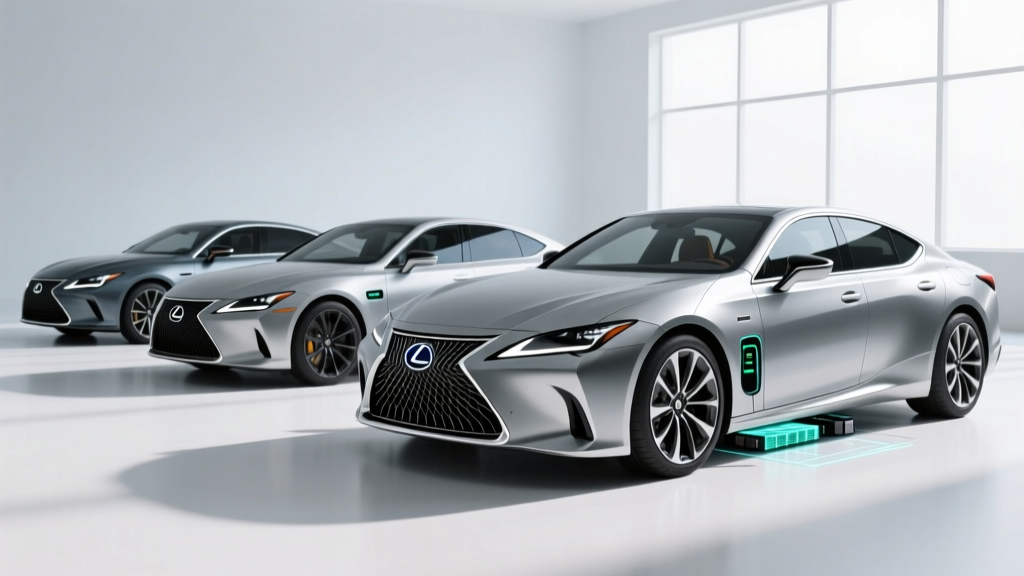
Lexus has gone all-in on electrification without abandoning the hybrid formula that built its reputation. For the 2026 model year, every single Lexus nameplate offers a hybrid variant — conventional hybrid electric vehicles (HEVs) that need no plug, plus plug-in hybrid electric vehicles (PHEVs) that deliver meaningful electric-only driving. But with nine hybrid models spanning $39,000 to over $90,000, figuring out which 2026 Lexus hybrid fits your commute, budget, and charging situation requires sorting through a lot of spec sheets.
This guide breaks down every 2026 Lexus hybrid — HEV and PHEV — with exact EPA fuel economy figures, electric-only range, powertrain output, pricing, battery warranty coverage, and current federal tax credit eligibility. No marketing fluff, just the numbers you need to decide.
HEV vs PHEV: What's the Difference in the Lexus Lineup?
Before diving into individual models, it's essential to understand the two distinct hybrid architectures Lexus uses. Confusing them is the most common mistake buyers make.
Conventional Hybrid (HEV)
A Lexus HEV like the RX 350h or ES 300h pairs a gasoline engine with one or more electric motors and a small battery (typically 1.0–2.0 kWh). You never plug it in. The battery charges through regenerative braking and the engine. The electric motor assists during acceleration and enables brief low-speed electric driving, but the engine is always the primary power source. You simply fuel up at a gas station as normal.
Plug-In Hybrid (PHEV)
A Lexus PHEV like the NX 450h+ or RX 450h+ carries a much larger battery (18.1 kWh usable in current Lexus PHEVs) that you plug in to charge — at home on a 240V Level 2 outlet or at a public charger. This delivers 37–38 miles of pure electric driving before the gasoline engine engages. After the battery depletes, it operates exactly like a conventional hybrid. Think of it as an EV for your daily commute and a hybrid for road trips.
The practical implication: if you can charge at home and your daily round-trip commute is under 35 miles, a Lexus PHEV lets you drive almost entirely on electricity day-to-day while keeping the gas engine for longer trips. If you lack home charging access or regularly drive more than 40 miles one-way, a conventional HEV is simpler and still delivers excellent fuel economy.
2026 Lexus Hybrid Fuel Economy: Every Model Ranked
Here's the complete 2026 Lexus hybrid lineup sorted by EPA combined fuel economy. All figures are from fueleconomy.gov and represent the latest EPA estimates.
| Model | Type | City MPG | Highway MPG | Combined MPG | Combined HP | Starting MSRP |
|---|---|---|---|---|---|---|
| UX 300h | HEV | 43 | 41 | 42 | 198 | $39,990 |
| ES 300h | HEV | 43 | 44 | 44 | 215 | $46,450 |
| NX 350h | HEV | 41 | 37 | 39 | 244 | $44,150 |
| RX 350h | HEV | 37 | 34 | 36 | 250 | $53,400 |
| TX 500h | HEV | 27 | 28 | 27 | 371 | $65,500 |
| LC 500h | HEV | 26 | 33 | 29 | 354 | $103,500 |
| LS 500h | HEV | 22 | 29 | 25 | 354 | $84,000 |
| NX 450h+ | PHEV | 38 (hybrid) | 37 (hybrid) | 37 (hybrid) / 84 MPGe | 304 | $52,300 |
| RX 450h+ | PHEV | 36 (hybrid) | 34 (hybrid) | 35 (hybrid) / 65 MPGe | 304 | $63,350 |
Real-world MPG note: Lexus hybrids — particularly the HEV models — tend to meet or slightly exceed their EPA city estimates in real-world driving, thanks to Toyota's Hybrid System optimizing regenerative braking in stop-and-go traffic. Highway figures, however, often run 2–4 MPG below the EPA sticker at sustained 75+ mph speeds, especially in the heavier RX and TX models. Expect the UX 300h to deliver 40–44 MPG combined in mixed driving and closer to 38–40 MPG on a highway road trip.
Lexus PHEVs: Electric-Only Range and Charging Details
For the two plug-in models in the 2026 lineup — the NX 450h+ and RX 450h+ — electric-only range is the headline figure. Here's what the data shows:
| Specification | NX 450h+ | RX 450h+ |
|---|---|---|
| EV Range (EPA) | 38 miles | 37 miles |
| Total Range (EV + Gas) | ~470 miles | ~460 miles |
| Battery Capacity (usable) | 18.1 kWh (lithium-ion) | 18.1 kWh (lithium-ion) |
| Level 1 Charging (120V) | ~12 hours (0–100%) | ~12 hours (0–100%) |
| Level 2 Charging (240V, 3.3 kW) | ~5.5 hours (0–100%) | ~5.5 hours (0–100%) |
| DC Fast Charging | Not supported | Not supported |
| Charge Port | J1772 | J1772 |
Real-world electric range: The EPA's 37–38 mile EV estimate assumes moderate temperatures and mixed driving. In warm weather at city speeds, you can stretch it to 40–42 miles. In cold weather (below 35°F) or at sustained highway speeds, expect 28–32 miles before the engine kicks in. This is typical for PHEVs in this class — the battery's thermal management is passive, so extreme temperatures reduce usable capacity.
No DC fast charging: This is a deliberate engineering choice by Lexus (and parent company Toyota). The 3.3 kW onboard charger means a full charge takes about 5.5 hours on a home Level 2 circuit. For PHEVs with 37-mile batteries, this is adequate — you plug in when you get home and wake up fully charged. But if you were hoping to top up at a public DC fast charger during a road trip, that's not an option. The gasoline engine handles long-distance driving anyway.
Powertrain Deep Dive: How Lexus Hybrids Make Their Power
Every 2026 Lexus hybrid uses a variant of Toyota's Hybrid Synergy Drive, but the configurations differ meaningfully across the lineup.
4-Cylinder Hybrids (UX 300h, ES 300h, NX 350h)
These models pair a 2.5-liter Atkinson-cycle four-cylinder engine with front and rear electric motors for standard all-wheel drive (AWD). The UX 300h produces 198 combined horsepower, the ES 300h delivers 215 hp (front-wheel drive only), and the NX 350h makes 244 hp. The electric motors provide instant torque from a stop, which makes these feel peppier than their horsepower figures suggest in city driving. The NX 350h's 0–60 mph time is approximately 7.2 seconds — brisk for a compact luxury SUV returning 39 MPG.
6-Cylinder and Turbo Hybrids (RX 350h, TX 500h, LC 500h, LS 500h)
The RX 350h uses the same 2.5L four-cylinder hybrid system as the NX 350h but tuned for 250 hp to move its larger frame. The TX 500h, LC 500h, and LS 500h step up to more complex powertrains: the TX 500h pairs a turbocharged 2.4-liter four with a hybrid system for 371 hp and DIRECT4 AWD; the LC 500h and LS 500h use a 3.5-liter V6 with a Multi Stage Hybrid System that includes a 4-speed automatic transmission in addition to the e-CVT, yielding 354 hp with more natural-feeling acceleration.
PHEV Powertrains (NX 450h+, RX 450h+)
Both PHEV models use a 2.5-liter four-cylinder engine paired with more powerful electric motors and the 18.1 kWh battery. Combined output is 304 hp with standard AWD. The NX 450h+ hits 60 mph in about 6.0 seconds — genuinely quick — while the heavier RX 450h+ does it in roughly 6.5 seconds. When the battery depletes, both seamlessly transition to hybrid mode with no driver intervention required.
Pricing and Federal Tax Credit Eligibility for 2026
Here's where the math gets interesting — and where many buyers get confused. Under current IRS §30D rules, the federal clean vehicle credit applies to PHEVs with at least 7 kWh of battery capacity, but eligibility depends on several factors:
- MSRP cap: SUVs, vans, and trucks must have an MSRP under $80,000; sedans under $55,000
- Buyer income cap: Modified adjusted gross income must not exceed $300,000 (joint), $225,000 (head of household), or $150,000 (single)
- Battery sourcing: Critical minerals and battery components must meet escalating domestic-content thresholds that tighten each year through 2029
- Point-of-sale transfer: The credit can be applied at the dealer as a down payment reduction, or claimed on your tax return
For 2026 Lexus PHEVs: The NX 450h+ (SUV, starting ~$52,300) and RX 450h+ (SUV, starting ~$63,350) both fall under the $80,000 SUV MSRP cap. Whether they qualify for the full $7,500 credit depends on the battery's critical-mineral and component sourcing at time of purchase, which has been a moving target. Lexus has not publicly confirmed full compliance for all 2026 builds. Always verify current eligibility on fueleconomy.gov or consult a tax professional before counting on the credit.
For conventional HEVs: No Lexus HEV qualifies for the §30D federal clean vehicle credit. These vehicles do not have sufficient battery capacity or plug-in capability. Some states offer separate hybrid incentives — check your state's energy office for details.
Battery Warranty, Reliability, and Replacement Costs
Battery longevity is consistently the top concern among first-time hybrid buyers. Here's what Lexus provides:
Lexus Hybrid Battery Warranty
Coverage: 10 years or 150,000 miles (whichever comes first) on the hybrid battery pack, from the date of first use.
What's covered: Defects in materials or workmanship, and capacity loss below a functional threshold (typically around 60–70% of original capacity).
Transferability: The hybrid battery warranty transfers to subsequent owners, which supports resale value.
Real-world reliability: Toyota/Lexus hybrid systems have over two decades of field data. The Hybrid Synergy Drive is one of the most proven electrified powertrains in existence, with millions of units on the road. The e-CVT transmission has no traditional clutch packs or torque converters to wear out. Independent reliability surveys consistently rank Lexus hybrids among the most dependable vehicles in any segment.
Replacement cost if out of warranty: A Lexus hybrid battery replacement runs approximately $3,000–$5,000 for HEV models (the batteries are small, 1–2 kWh) and $8,000–$12,000 for the PHEV models with their larger 18.1 kWh packs. However, catastrophic battery failure before 200,000+ miles is rare based on historical data. More commonly, individual cells may degrade unevenly, and some independent shops offer cell-level repair for $1,500–$2,500.
Lexus also covers the broader hybrid system — including the inverter, electric motors, and e-CVT — under the same 10-year/150,000-mile warranty. The conventional powertrain warranty is 6 years/70,000 miles.
2026 Lexus Hybrids: Pros and Cons at a Glance
Pros
- Class-leading fuel economy in most segments (ES 300h at 44 MPG combined is exceptional for a midsize luxury sedan)
- Standard AWD on most models without the fuel-economy penalty of mechanical AWD systems
- Proven, battle-tested hybrid powertrain with 10-year battery warranty
- No range anxiety — HEVs refuel in 3 minutes at any gas station; PHEVs switch seamlessly to hybrid mode
- Strong resale value driven by Lexus reliability reputation and hybrid demand
- PHEV models offer genuine daily EV commuting with road-trip flexibility
Cons
- PHEV models do not support DC fast charging — Level 2 only at 3.3 kW
- PHEV electric range (37–38 miles) trails some competitors (e.g., Chrysler Pacifica PHEV at 32 mi but larger; Toyota RAV4 Prime at 42 mi)
- Conventional HEVs receive no federal tax credit under current §30D rules
- Hybrid premium over non-hybrid trims adds $2,000–$5,000 to purchase price (partially offset by fuel savings)
- e-CVT acceleration character lacks the stepped-gear feel some drivers prefer (mitigated by Multi Stage system in LC/LS)
- PHEV cargo space is slightly reduced due to larger battery placement under the rear seats
Who Should Buy a Lexus Hybrid vs a Full EV or Gas Car?
Choose a Lexus HEV if:
- You cannot charge at home or work (apartment, street parking, no outlet access)
- You want maximum simplicity — no charging cables, no apps, no plug-in routine
- Your daily driving exceeds 50 miles, making a PHEV's electric range less impactful
- You prioritize lowest total cost of ownership without behavioral change
- You drive a Lexus ES, UX, or NX and want 37–44 MPG without compromise
Choose a Lexus PHEV if:
- You have reliable home Level 2 charging (or can install it)
- Your daily round-trip commute is under 35 miles — you'll rarely use gas on weekdays
- You want EV-like daily driving but need gas-engine flexibility for weekend road trips
- You want to potentially claim the $7,500 federal tax credit (verify sourcing eligibility)
- You're choosing between the NX or RX and want the most powerful, quickest variant
Choose a full EV (BEV) instead if:
- You have home charging and rarely drive more than 250 miles in a single day
- You want zero tailpipe emissions and the lowest per-mile fuel cost
- You want the strongest federal and state incentives (full BEVs have broader credit eligibility)
- You prefer instant torque, one-pedal driving, and minimal maintenance (no oil changes, no engine)
- You're considering models like the Tesla Model Y, BMW iX, or Hyundai Ioniq 5 and have charging figured out
Frequently Asked Questions
How many MPG does the most efficient 2026 Lexus hybrid get?
The 2026 Lexus ES 300h leads the lineup at 44 MPG combined (43 city / 44 highway). The subcompact UX 300h follows closely at 42 MPG combined (43 city / 41 highway). In real-world city driving with frequent stops, both models often meet or slightly exceed their EPA city estimates because regenerative braking works hardest in stop-and-go traffic.
How far can a Lexus PHEV drive on electric power alone?
The 2026 NX 450h+ delivers 38 miles of EPA-rated electric-only range, and the RX 450h+ provides 37 miles. In warm weather at moderate speeds, real-world range can stretch to 40–42 miles. In cold weather or at highway speeds, expect 28–32 miles before the gasoline engine engages. After the battery depletes, both vehicles operate as conventional hybrids with 35–37 MPG.
Do Lexus conventional hybrids need to be plugged in?
No. Lexus HEVs (like the UX 300h, ES 300h, NX 350h, RX 350h, TX 500h, LC 500h, and LS 500h) charge their batteries entirely through regenerative braking and the gasoline engine. You never plug them in. You simply refuel at a gas station like any other car. Only the PHEV models (NX 450h+ and RX 450h+) require plugging in to access their electric-only range.
Is the Lexus hybrid battery reliable, and what does replacement cost?
Lexus hybrid batteries carry a 10-year/150,000-mile warranty, and real-world data from two decades of Toyota Hybrid Synergy Drive vehicles shows that catastrophic battery failure before 200,000 miles is uncommon. If replacement is needed out of warranty, HEV battery packs cost approximately $3,000–$5,000, while the larger PHEV battery runs $8,000–$12,000. Cell-level repair at independent shops can reduce this to $1,500–$2,500.
Does any 2026 Lexus hybrid qualify for the federal tax credit?
The two PHEV models — NX 450h+ and RX 450h+ — are potentially eligible for up to $7,500 under the IRS §30D clean vehicle credit, as both have batteries exceeding 7 kWh and MSRPs under the $80,000 SUV cap. However, eligibility depends on the buyer's income (under $300,000 joint / $150,000 single) and the battery's critical-mineral and component sourcing, which changes yearly. Conventional HEVs do not qualify. Always verify on irs.gov or with a tax professional before purchasing.
Can I DC fast charge a Lexus PHEV?
No. Neither the NX 450h+ nor the RX 450h+ supports DC fast charging. The onboard charger is rated at 3.3 kW, meaning a full charge from empty takes about 5.5 hours on a 240V Level 2 home charger, or roughly 12 hours on a standard 120V household outlet. For PHEVs with ~38 miles of range, overnight Level 2 charging is the intended use case.
How does a Lexus hybrid compare to a full EV for total cost of ownership?
Over five years and 75,000 miles, a Lexus HEV like the ES 300h will cost roughly $7,500–$9,000 in fuel (at $3.50/gallon and 44 MPG). A comparable EV charged at home at $0.15/kWh would cost $2,500–$3,500 in electricity. However, the EV may carry a higher purchase price, potentially higher insurance premiums, and depreciation uncertainty. The Lexus hybrid wins on simplicity and proven reliability; the EV wins on fuel cost and emissions. Your break-even point depends on local electricity rates, gas prices, and available incentives.
The 2026 Lexus hybrid lineup covers nearly every luxury-hybrid use case, from the 44-MPG ES 300h sedan for commuters to the 371-hp TX 500h for families who need three rows. The PHEV models add electric commuting capability without sacrificing road-trip flexibility. The right choice depends on your charging access, commute length, and whether the potential $7,500 tax credit tips the financial equation in the PHEV's favor. Whichever you choose, the 10-year battery warranty and two decades of hybrid system refinement provide genuine peace of mind.