Hybrid SUVs occupy a pragmatic middle ground in 2026: no range anxiety, no charging infrastructure dependency (for conventional hybrids), and fuel economy that routinely doubles what a comparable gas-only SUV delivers. The 2026 model year brings refreshed powertrains, larger PHEV batteries, and a reshuffling of federal tax credit eligibility that favors certain plug-in hybrids over others.
This guide breaks down the strongest 2026 hybrid SUV models across both conventional hybrid (HEV) and plug-in hybrid (PHEV) categories. We lead with exact EPA figures, real-world adjustments, battery specs, and pricing — the data points that actually matter at the dealership.
HEV vs PHEV: The Core Distinction
Conventional Hybrid (HEV): Charges its small battery (~1–2 kWh) exclusively through regenerative braking and the gasoline engine. You never plug it in. It optimizes city driving by using the electric motor at low speeds and supplementing with the engine under load. Think Toyota RAV4 Hybrid.
Plug-In Hybrid (PHEV): Carries a larger battery (~14–22 kWh) that you charge via a wall outlet, Level 2 charger, or occasionally a DC fast charger. It delivers 25–45 miles of pure electric driving before the gasoline engine engages, functioning as a conventional hybrid afterward. Think Toyota RAV4 Prime.
Top 2026 Hybrid SUV Models: Side-by-Side Specs
| Model | Type | Combined HP | EPA Combined MPG | EV Range (mi) | Battery (kWh) | Base MSRP |
|---|---|---|---|---|---|---|
| Toyota RAV4 Hybrid | HEV | 219 | 39 MPG | — | ~1.6 | $33,500 |
| Toyota RAV4 Plug-In Hybrid | PHEV | 302 | 38 MPG + 94 MPGe | 42 | 18.1 | $44,500 |
| Honda CR-V Hybrid | HEV | 204 | 40 MPG | — | ~1.1 | $35,700 |
| Hyundai Tucson Plug-In Hybrid | PHEV | 261 | 35 MPG + 80 MPGe | 33 | 13.8 | $39,900 |
| Kia Sportage Plug-In Hybrid | PHEV | 261 | 35 MPG + 84 MPGe | 34 | 13.8 | $39,490 |
| Ford Escape Plug-In Hybrid | PHEV | 210 | 40 MPG + 105 MPGe | 37 | 14.4 | $38,500 |
| Toyota Highlander Hybrid | HEV | 243 | 35 MPG | — | ~1.9 | $42,100 |
Sources: EPA fueleconomy.gov, manufacturer spec sheets. MPG figures are EPA combined estimates; real-world results vary by driving style, terrain, and climate.
How Many MPG Do These Hybrids Actually Get?
The EPA sticker is a starting point, not a guarantee. Conventional hybrids consistently exceed their EPA city ratings in stop-and-go traffic because regenerative braking recovers energy that a gas car wastes as heat. Highway driving is where hybrids lose their advantage — the engine does most of the work at sustained speed.
| Model | EPA City | EPA Highway | EPA Combined | Real-World Expectation |
|---|---|---|---|---|
| Toyota RAV4 Hybrid | 41 | 38 | 39 | 37–43 (city-biased drivers see higher) |
| Honda CR-V Hybrid | 43 | 36 | 40 | 38–45 (strong city regen advantage) |
| Toyota Highlander Hybrid | 36 | 35 | 35 | 33–37 (heavy vehicle, less city upside) |
| Ford Escape PHEV (hybrid mode) | 42 | 37 | 40 | 38–44 after battery depleted |
For PHEVs, the MPG picture splits into two modes. While battery charge remains, you burn zero gasoline and consume electricity measured in MPGe. Once the battery depletes to its buffer threshold (typically ~15% state of charge), the powertrain operates as a conventional hybrid with the MPG figures shown above. The combined total range for a fully fueled and charged RAV4 Prime, for example, exceeds 520 miles.
PHEV Electric-Only Range and Charging Details
Electric-only range is the PHEV's headline feature. If your daily commute falls within the EV range, you may go weeks without visiting a gas station — provided you charge at home overnight.
PHEV Charging: What You Need to Know
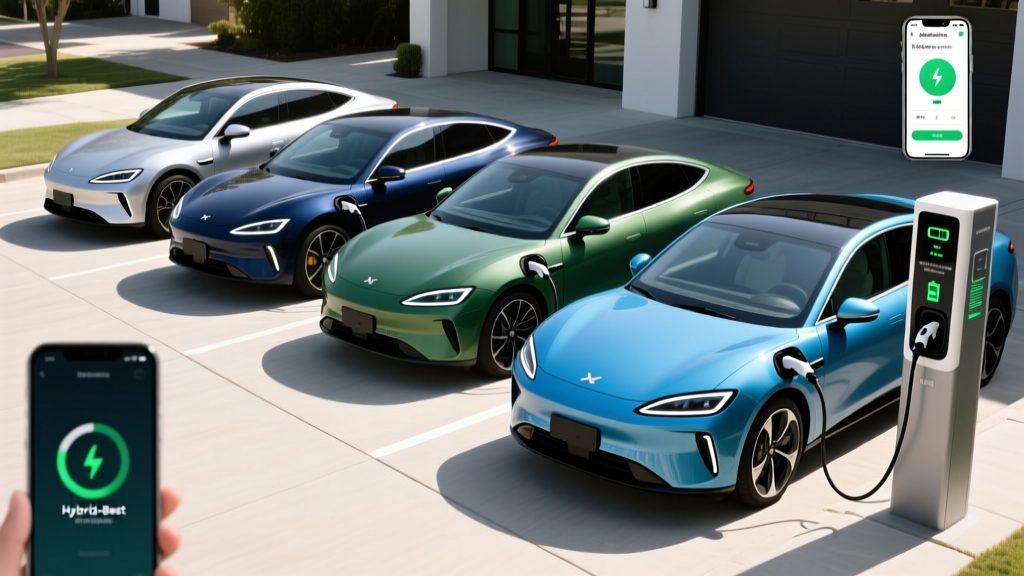
Level 1 (120V household outlet): Adds roughly 4–5 miles of range per hour. A full charge from empty takes 8–12 hours depending on battery size. Sufficient for overnight charging if your daily EV-range use is under 30 miles.
Level 2 (240V): Adds 15–25 miles per hour. Full charge in 2–4 hours. Most PHEVs accept 3.3–7.2 kW on Level 2. Recommended if you want midday top-ups or have a shorter overnight window.
DC Fast Charging: Most PHEVs do not support DC fast charging. The Mitsubishi Outlander PHEV is a notable exception, accepting up to 22 kW DC (still far slower than a full BEV). For the PHEVs in our table above, plan on Level 1 or Level 2 only.
For the 2026 Tucson and Sportage PHEVs, the 13.8 kWh battery delivers 33–34 EPA-rated electric miles. At a 3.3 kW onboard charger, expect roughly 4.5 hours from empty on Level 2. The RAV4 Plug-In Hybrid's larger 18.1 kWh battery extends to 42 EV miles but requires ~5.5 hours on Level 2 at its 3.3 kW onboard rate — or ~2.5 hours if equipped with the optional 6.6 kW charger.
Cold weather reduces EV range by 15–30% in PHEVs, just as it does in full battery-electric vehicles. A 34-mile rated PHEV may deliver only 24–28 miles of electric driving at 20°F before the engine intervenes.
Hybrid vs PHEV vs Full EV: Which Fits Your Situation?
Decision Framework
Choose a conventional hybrid (HEV) if:
- You cannot charge at home (apartment, street parking, no garage)
- You want zero behavioral change — just drive it like a gas car
- Your budget is under $40,000 and you want maximum fuel savings per dollar spent
- You regularly take long road trips and don't want to plan around charging
Choose a plug-in hybrid (PHEV) if:
- You can charge at home overnight (even a standard 120V outlet works)
- Your daily commute is under 35 miles round-trip (fits within EV range)
- You want electric daily driving but need gasoline flexibility for weekend trips
- You're not ready to commit to a full BEV due to charging-desert concerns or towing needs
Choose a full battery-electric vehicle (BEV) if:
- You have reliable home Level 2 charging and your daily drive is under 250 miles
- You want to eliminate gasoline entirely and minimize moving parts
- You qualify for the full $7,500 federal EV tax credit (which PHEVs may also qualify for, but most conventional hybrids do not)
- You're prepared for route planning on road trips and understand DC fast-charging logistics
Pricing, Tax Credits, and the §30D PHEV Advantage
Under current IRS rules for the §30D Clean Vehicle Credit, qualifying plug-in hybrids can receive up to $7,500 — the same maximum as full BEVs — provided they meet battery capacity, critical mineral sourcing, and battery component requirements. The vehicle must also satisfy MSRP caps ($80,000 for SUVs) and buyer income limits ($300,000 joint / $150,000 single modified AGI).
- MSRP cap: SUVs must be priced at or below $80,000. All PHEVs in our table qualify.
- Buyer income cap: $300,000 joint filers, $225,000 head of household, $150,000 single.
- Battery sourcing: Critical minerals and battery components must meet phased-in percentages from US or FTA-partner countries. This requirement tightens annually — check the fueleconomy.gov credit tracker for current eligibility by model.
- Point-of-sale transfer: As of 2024, buyers can transfer the credit to the dealer for an immediate price reduction at purchase rather than waiting to claim it on their tax return.
Conventional hybrids (HEVs) do not qualify for the §30D federal credit. Their lower purchase price partially offsets this — a RAV4 Hybrid at $33,500 vs. the RAV4 Plug-In at $44,500 is an $11,000 gap that even a $7,500 credit doesn't fully close. The breakeven math depends on your annual mileage, electricity cost, and how often you drive within EV range.
Battery Reliability, Warranty, and Replacement Costs
Hybrid Battery Warranty: What's Covered
Federal law mandates that hybrid and PHEV battery packs carry a minimum warranty of 8 years / 100,000 miles. In California Air Resources Board (CARB) states, that extends to 10 years / 150,000 miles. Toyota, Honda, Hyundai, and Kia all meet or exceed these thresholds.
The warranty covers battery capacity loss below a specified threshold — typically 60–70% of original capacity — and outright failure. Normal gradual degradation above the threshold is not covered.
Hybrid battery replacement cost outside of warranty varies by model. For the RAV4 Hybrid, expect $3,000–$5,000 for a new OEM battery pack. The larger PHEV batteries run higher: $5,000–$8,000 for the RAV4 Plug-In Hybrid. Third-party refurbished packs are emerging at 40–60% of OEM pricing, though availability is model-dependent.
Real-world failure rates are low. Toyota's hybrid Synergy Drive system has accumulated over two decades of field data, with many original Prius batteries lasting 150,000–200,000 miles before significant degradation. PHEV batteries undergo deeper daily cycling, which accelerates wear slightly — but the larger buffer (you never use 100% of the pack) and active thermal management in modern designs mitigate this. Plan on 10–15 years of service life before a replacement becomes likely.
Pros and Cons: 2026 Hybrid SUVs at a Glance
✓ Advantages
- 35–43 MPG combined cuts fuel costs by 40–55% vs. gas-only equivalents
- No range anxiety — gasoline backup is always available
- HEVs require zero charging infrastructure
- PHEVs deliver silent, zero-tailpipe-emission daily commutes under 35 miles
- Lower maintenance than gas vehicles (regen braking reduces pad wear, no alternator/starter)
- PHEVs eligible for up to $7,500 federal tax credit
- Strong resale values — hybrid SUVs retain demand in the used market
✗ Limitations
- PHEV premium: $6,000–$11,000 more than the HEV or gas equivalent
- PHEV EV range (33–42 mi) is insufficient for drivers with long commutes
- Most PHEVs lack DC fast charging — Level 2 is the practical ceiling
- HEVs do not qualify for federal purchase tax credits
- Cargo space slightly reduced in some models due to battery placement
- Highway-only drivers see less MPG benefit than city-dominant drivers
- Battery replacement cost ($3,000–$8,000) is a long-tail ownership risk
Who Should Buy a 2026 Hybrid SUV — and Who Shouldn't
The ideal hybrid SUV buyer drives 10,000–18,000 miles annually with a mix of city and highway routes, lacks reliable access to DC fast charging, and wants to reduce fuel spending without altering their driving routine. The Honda CR-V Hybrid and Toyota RAV4 Hybrid are the default picks here — proven powertrains, strong reliability records, and sub-$36,000 pricing.
The ideal PHEV buyer has a garage or driveway with at least a 120V outlet, commutes under 35 miles daily, and takes 3–6 road trips per year where BEV charging logistics would be inconvenient. The RAV4 Plug-In Hybrid leads this segment with 42 miles of EV range and 302 combined horsepower, though its $44,500 starting price demands the tax credit to pencil out against the HEV variant.
If you drive over 20,000 highway miles per year, a diesel or efficient gas vehicle may rival hybrid economics — hybrids shine in stop-and-go, not at steady 75 mph. And if you have home Level 2 charging, drive under 250 miles daily, and want the lowest per-mile energy cost, a full BEV like the Hyundai Ioniq 5 or Tesla Model Y will undercut any hybrid on operating expense over a 5-year ownership horizon.
Frequently Asked Questions
Do conventional hybrids need to be plugged in?
No. Conventional hybrids (HEVs) charge their battery entirely through regenerative braking and the gasoline engine. You fuel them like any other car. Only plug-in hybrids (PHEVs) benefit from being connected to an external power source.
How long do hybrid batteries last before needing replacement?
Most hybrid batteries last 150,000–200,000 miles or 10–15 years under normal use. Federal warranty coverage is 8 years/100,000 miles minimum (10 years/150,000 miles in CARB states). Outright failure before 100,000 miles is statistically uncommon in Toyota and Honda systems.
Is a PHEV worth the extra cost over a regular hybrid?
It depends on your commute and charging access. If you drive under 35 miles daily and charge at home, the PHEV eliminates nearly all gasoline use on weekdays. The $6,000–$11,000 price premium is offset by fuel savings and the potential $7,500 tax credit. If you can't charge at home, the PHEV premium buys little benefit — choose the HEV.
Which 2026 hybrid SUV gets the best MPG?
The Honda CR-V Hybrid leads the compact segment at 40 MPG combined (43 city / 36 highway). The Ford Escape PHEV achieves 40 MPG combined in hybrid mode after battery depletion, plus 105 MPGe when operating on battery charge.
Can a hybrid SUV tow?
Yes, but with reduced capacity compared to gas-only variants. The Toyota RAV4 Hybrid tows up to 1,750 lbs; the Highlander Hybrid tows up to 3,500 lbs. Towing significantly reduces MPG — expect a 25–40% drop from rated fuel economy when pulling a loaded trailer.
Do hybrids cost more to insure?
Moderately. Hybrid insurance premiums run 5–15% higher than gas equivalents due to higher repair costs for battery and powertrain electronics. The gap has narrowed as hybrid adoption has increased and repair networks have expanded.