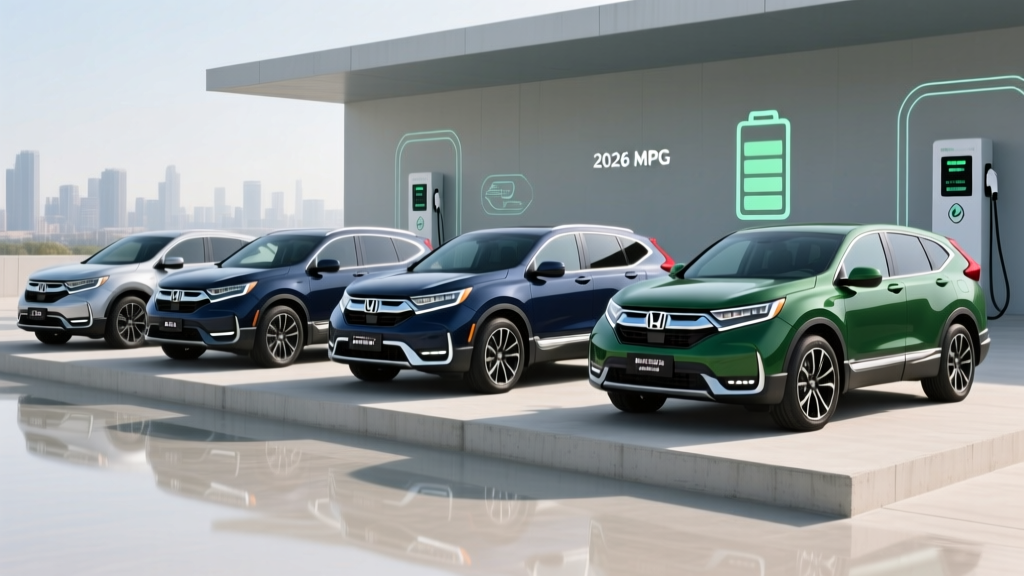
The Honda CR-V Hybrid has become the default choice for compact-SUV buyers who want electrified efficiency without plugging in. For 2026, Honda continues the sixth-generation CR-V Hybrid across three trims—Sport, Sport-L, and Sport Touring—all sharing the same proven two-motor hybrid powertrain. But with price gaps stretching nearly $8,000 from base to top trim, the real question is: which one actually earns your money?
This 2026 Honda CR-V Hybrid trim walk breaks down every trim by specs, features, real-world fuel economy, and value, so you can pick the right one without overpaying for equipment you won't use.
First: The CR-V Hybrid Is a Conventional Hybrid (HEV), Not a PHEV
Key distinction: The 2026 CR-V Hybrid is a conventional hybrid electric vehicle (HEV). It charges its own small battery through regenerative braking and the gasoline engine—you never plug it in. Honda does not currently offer a plug-in hybrid (PHEV) version of the CR-V in the US market.
If you're looking for electric-only driving and the ability to charge at home, you'd need to look at competitors like the Toyota RAV4 Prime (PHEV, 42 miles electric-only) or consider a fully electric SUV. The CR-V Hybrid's job is simpler: deliver significantly better fuel economy than a gas-only SUV with zero change to your refueling habits.
2026 Honda CR-V Hybrid Powertrain Specs
Every 2026 CR-V Hybrid trim shares the same powertrain hardware. There are no performance upgrades available at higher trims—what changes is comfort, technology, and convenience features.
| Specification | 2026 CR-V Hybrid (All Trims) |
|---|---|
| Powertrain | 2.0L Atkinson-cycle 4-cylinder + 2 electric motors |
| Combined System Output | 204 hp / 247 lb-ft torque |
| Transmission | e-CVT (direct-drive with lock-up clutch) |
| Drivetrain | Standard FWD; available AWD (all trims) |
| Hybrid Battery | Lithium-ion, ~1.06 kWh (self-charging, not plug-in) |
| 0–60 mph | ~7.6 seconds (AWD) |
| Towing Capacity | 1,000 lbs |
| Cargo Volume | 36.3 cu ft (rear seats up) / 76.5 cu ft (rear seats folded) |
The two-motor system operates primarily in EV mode at low speeds, switches to hybrid mode for acceleration and highway cruising, and can run the engine as a generator to charge the battery under load. It's a series-parallel architecture similar to Toyota's Hybrid Synergy Drive, and it's one of the most refined systems in the segment.
EPA Fuel Economy by Trim: FWD vs. AWD
The 2026 CR-V Hybrid's EPA ratings depend on drivetrain choice. Here's the complete breakdown by configuration, sourced from fueleconomy.gov:
| Configuration | City MPG | Highway MPG | Combined MPG |
|---|---|---|---|
| Sport FWD | 43 | 36 | 40 |
| Sport AWD | 40 | 34 | 37 |
| Sport-L FWD | 43 | 36 | 40 |
| Sport-L AWD | 40 | 34 | 37 |
| Sport Touring AWD | 40 | 34 | 37 |
Note: The Sport Touring is only available with AWD, which is why it carries the slightly lower rating. All FWD trims share identical EPA figures, as do all AWD trims—weight differences between trims are too small to affect the sticker rating.
Real-World MPG: What to Actually Expect
Honda's hybrid system, like Toyota's, tends to exceed its EPA city rating in stop-and-go driving because regenerative braking recaptures energy that a gas car wastes as heat. In mixed suburban driving with moderate traffic, owners commonly report 41–45 MPG in FWD trims during warm months.
Highway efficiency is a different story. At sustained 70–80 mph speeds, the gasoline engine carries most of the load, and real-world highway MPG typically lands between 32–35 MPG for AWD models. Cold weather (below 40°F) reduces efficiency by roughly 5–10% as the engine runs more frequently for cabin heat and battery thermal management.
For a driver covering 15,000 miles per year in mixed conditions at 38 MPG average, annual fuel cost sits around $1,450 at $3.50/gallon—roughly $500–$700 less than the gas-only CR-V AWD rated at 29 MPG combined.
Trim-by-Trim Breakdown: Sport, Sport-L, and Sport Touring
Sport (Base Hybrid Trim) — Starting ~$36,395 (FWD) / $37,995 (AWD)
The Sport trim serves as the entry point to the CR-V Hybrid lineup. Standard equipment includes:
- 7-inch touchscreen with wireless Apple CarPlay and Android Auto
- Honda Sensing suite (adaptive cruise control, lane-keeping assist, forward collision warning, automatic emergency braking)
- LED headlights and taillights
- 18-inch alloy wheels
- Push-button start with smart entry
- Dual-zone automatic climate control
- Blind-spot information with rear cross-traffic alert
Who it's for: Buyers who want hybrid MPG and Honda's safety suite without paying for leather or premium audio. The Sport trim is the strongest value proposition in the lineup if you're spec-focused rather than luxury-focused.
Sport-L (Mid Hybrid Trim) — Starting ~$39,095 (FWD) / $40,695 (AWD)
The Sport-L adds the most-demanded comfort upgrades over the base Sport:
- Leather-trimmed seats (heated front seats)
- Power-adjustable front seats (8-way driver, 4-way passenger)
- Leather-wrapped steering wheel and shift knob
- Wireless phone charger
- Power liftgate with walk-away auto-close
- Heated side mirrors
- One-touch turn signals
Who it's for: The majority of CR-V Hybrid buyers. The $2,700 premium over the Sport trim buys leather, heated seats, and a power liftgate—features that hold strong resale value and make daily driving noticeably more comfortable, especially in cold climates.
Sport Touring (Top Hybrid Trim) — Starting ~$42,895 (AWD only)
The Sport Touring is the fully loaded CR-V Hybrid, and it's AWD-exclusive:
- 9-inch touchscreen with built-in navigation
- Bose premium 12-speaker audio system
- Wireless Apple CarPlay and Android Auto (upgraded from wired)
- Heated rear seats and heated steering wheel
- Ventilated front seats
- Hands-free power liftgate
- Low-speed braking control and front/rear parking sensors
- Rain-sensing wipers
- Auto-dimming rearview mirror with HomeLink
Who it's for: Buyers who want near-luxury amenities in a mainstream compact SUV. The Sport Touring's $42,895 MSRP starts to overlap with entry-level luxury crossovers, but it offers more cargo space, better fuel economy, and lower maintenance costs than competitors like the Audi Q3 or BMW X1.
Pricing Summary and Tax Credit Eligibility
| Trim | FWD MSRP | AWD MSRP | Federal Tax Credit |
|---|---|---|---|
| Sport | ~$36,395 | ~$37,995 | Not eligible (§30D is for PHEVs/BEVs only) |
| Sport-L | ~$39,095 | ~$40,695 | Not eligible |
| Sport Touring | N/A | ~$42,895 | Not eligible |
Federal tax credit note: The IRS §30D Clean Vehicle Credit applies only to battery electric vehicles (BEVs) and plug-in hybrids (PHEVs) with a minimum battery capacity of 7 kWh. Because the CR-V Hybrid is a conventional HEV with a ~1 kWh battery, it does not qualify for the federal EV tax credit. Some states or local utilities may offer small rebates for hybrid purchases—check your state's energy office or utility provider for current programs.
Battery Warranty, Reliability, and Replacement Costs
Hybrid battery longevity remains the top concern for first-time hybrid buyers. Here's what Honda covers:
| Warranty Component | Coverage |
|---|---|
| Hybrid Battery (IMA system) | 8 years / 100,000 miles (10 years / 150,000 miles in CARB states) |
| Powertrain (engine, transmission, motors) | 5 years / 60,000 miles |
| New Vehicle Limited | 3 years / 36,000 miles |
Honda's two-motor hybrid system has proven exceptionally reliable since its introduction. Unlike early-generation hybrid systems from other manufacturers, Honda's current architecture uses a relatively small lithium-ion battery that cycles shallowly—it never fully depletes or fully charges, which dramatically extends cell life.
Real-world battery replacement cost: If the hybrid battery does fail outside of warranty, replacement runs approximately $2,000–$4,000 including labor at a Honda dealer. However, failures before 150,000 miles are rare based on long-term ownership data. Many CR-V and Accord Hybrids have exceeded 200,000 miles on the original hybrid battery.
For context, the CR-V Hybrid earned top marks from the IIHS and carries a strong reliability track record in Consumer Reports and J.D. Power surveys for the hybrid powertrain specifically.
CR-V Hybrid vs. Alternatives: Which Powertrain Fits You?
Choose the CR-V Hybrid (HEV) If:
- You want 37–40 MPG with zero changes to your refueling routine
- You lack access to home or workplace charging (no plug needed)
- You drive 12,000–18,000 miles/year and want to reduce fuel spend by $500–$700 annually
- You want a compact SUV with best-in-class cargo space (36.3 cu ft)
- You plan to keep the vehicle 8+ years (hybrid system longevity is proven)
Look at a PHEV or BEV Instead If:
- You want electric-only driving for short commutes (consider the RAV4 Prime or Tucson PHEV)
- You have home Level 2 charging and want to minimize gasoline use entirely
- You want access to HOV lane stickers (available for PHEVs/BEVs in many states, not HEVs)
- You qualify for the $7,500 federal tax credit on a new BEV or PHEV—this can offset a higher purchase price
- Your daily commute is under 30 miles and you want zero tailpipe emissions on most trips
Which 2026 CR-V Hybrid Trim Is the Best Value?
Sport (FWD, ~$36,395): Best for budget-conscious buyers in mild climates who don't need AWD. You get the full hybrid powertrain, Honda Sensing, and 40 MPG combined. The 7-inch screen is the main compromise.
Sport-L (AWD, ~$40,695): The sweet spot. Leather, heated seats, power liftgate, and AWD for under $41K. This is the trim most buyers will be happiest with, and it holds the strongest resale value relative to its MSRP.
Sport Touring (AWD, ~$42,895): Justified if you want Bose audio, ventilated seats, and the larger navigation screen. The $2,200 premium over the Sport-L AWD is reasonable for the feature content, but at this price point, cross-shop the Toyota RAV4 Hybrid Limited and Hyundai Tucson Hybrid Limited as well.
Frequently Asked Questions
How many MPG does the 2026 Honda CR-V Hybrid get?
The EPA rates the CR-V Hybrid at 43 city / 36 highway / 40 combined for FWD trims, and 40 city / 34 highway / 37 combined for AWD trims. Real-world mixed driving typically yields 36–42 MPG depending on driving style, terrain, and temperature.
Does the CR-V Hybrid need to be plugged in?
No. The CR-V Hybrid is a conventional hybrid (HEV), not a plug-in hybrid. It charges its battery through regenerative braking and the gasoline engine. You fuel it exactly like a regular gas car.
How far can the CR-V Hybrid drive on electric only?
The CR-V Hybrid can operate in EV mode for roughly 1–2 miles at very low speeds (under 25 mph) when the battery is sufficiently charged. It is not designed for meaningful electric-only range—that's the role of a PHEV like the Toyota RAV4 Prime, which offers 42 miles on electricity alone.
Is the CR-V Hybrid reliable, and what does battery replacement cost?
Honda's two-motor hybrid system has an excellent reliability record. The hybrid battery is warranted for 8 years/100,000 miles (10 years/150,000 miles in CARB states). Out-of-warranty replacement costs approximately $2,000–$4,000, but failures before 150,000 miles are uncommon.
Does the 2026 CR-V Hybrid qualify for any tax credit?
The CR-V Hybrid does not qualify for the federal §30D Clean Vehicle Credit, which requires a plug-in vehicle with at least 7 kWh of battery capacity. Some state or utility rebates may apply—check your local programs. If tax credits are a priority, consider a PHEV or BEV instead.
Which CR-V Hybrid trim should I buy?
The Sport-L AWD at ~$40,695 offers the best balance of features and value for most buyers. Choose the Sport FWD if budget is the priority, or the Sport Touring if you want premium audio, ventilated seats, and built-in navigation.