The 2026 Honda CR-V Hybrid Lineup at a Glance
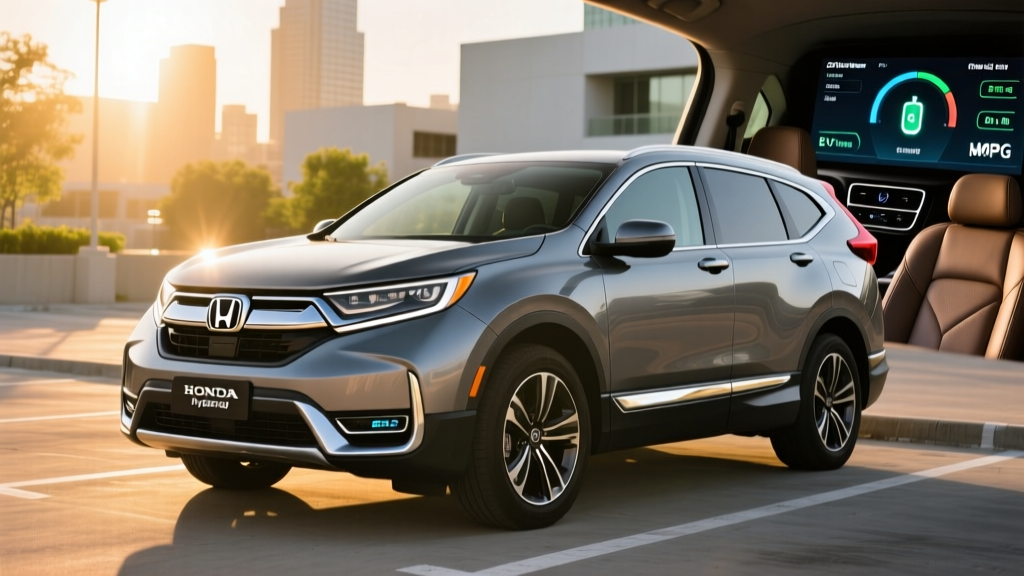
Honda sells the CR-V Hybrid across four trims for 2026 — Sport, Sport Touring, and in some markets a Sport-L — all built around the same fourth-generation two-motor hybrid system. There is no plug-in hybrid (PHEV) CR-V in the U.S. for 2026; Honda discontinued the Clarity PHEV years ago and has not reintroduced a plug-in variant of the CR-V stateside. If you see "2026 Honda CR-V Hybrid offers" at a dealer, you are looking at a conventional self-charging hybrid (HEV) that never needs to be plugged in.
That distinction matters because buyers cross-shopping the Toyota RAV4 Prime (a PHEV with ~42 miles of electric-only range) or the Hyundai Tucson PHEV will find a different value equation here. The CR-V Hybrid trades plug-in electric range for lower starting price, simpler ownership, and strong real-world city MPG.
HEV vs PHEV: Where the CR-V Hybrid Sits
| Feature | 2026 CR-V Hybrid (HEV) | PHEV Competitors (e.g., RAV4 Prime) | Full BEV (e.g., Ioniq 5) |
|---|---|---|---|
| Plug-in required? | No — self-charging | Yes, for EV range | Yes, always |
| Electric-only range | ~1–2 mi at low speed | 35–42 mi | 250–320 mi |
| EPA combined MPG / MPGe | 37–40 MPG | 94 MPGe (EV) / 38 MPG (gas) | 110–132 MPGe |
| Starting MSRP | ~$36,000 | ~$44,000+ | ~$42,000+ |
| Federal tax credit (§30D) | Not eligible | Up to $7,500 if sourcing rules met | Up to $7,500 if sourcing rules met |
2026 Honda CR-V Hybrid MPG: EPA Numbers and Real-World Results
The 2026 CR-V Hybrid with front-wheel drive carries an EPA rating of 43 city / 36 highway / 40 combined MPG. Adding AWD drops the sticker slightly to 40 city / 34 highway / 37 combined MPG, per fueleconomy.gov. These figures are competitive with the RAV4 Hybrid (41 combined AWD) and edge out the Hyundai Tucson Hybrid Blue (38 combined AWD).
| Drivetrain | City MPG | Highway MPG | Combined MPG |
|---|---|---|---|
| FWD (Sport trim) | 43 | 36 | 40 |
| AWD (Sport / Sport Touring) | 40 | 34 | 37 |
Real-World MPG: What Owners Actually See
Honda's two-motor hybrid system excels in stop-and-go driving, where the electric motor handles low-speed propulsion and the 2.0-liter Atkinson-cycle engine acts primarily as a generator. In real-world city and suburban driving, many owners report 41–45 MPG in warm weather, exceeding the EPA city estimate — a common pattern for series-dominant hybrids.
Highway fuel economy is where the CR-V Hybrid loses ground. At sustained 75–80 mph speeds, expect 32–35 MPG AWD, slightly below the EPA highway sticker. Cold-weather driving (below 35°F) can reduce combined MPG by 8–12% due to increased engine idling for cabin heat and reduced battery efficiency. On a 600-mile winter road trip in AWD form, plan for roughly 330–350 miles per tank rather than the theoretical 390+.
Powertrain Specs: Horsepower, Motors, and How It Drives
Every 2026 CR-V Hybrid uses Honda's fourth-generation two-motor hybrid system pairing a 2.0-liter DOHC Atkinson-cycle inline-4 with dual electric motors. Combined system output is 204 horsepower and 247 lb-ft of torque from the drive motor. That torque figure is available from near-zero RPM, which gives the CR-V Hybrid strong off-the-line acceleration despite a 0–60 mph time in the 7.6-second range — adequate for merging, not sporty.
| Specification | 2026 CR-V Hybrid |
|---|---|
| Engine | 2.0L Atkinson-cycle I-4 |
| Combined horsepower | 204 hp |
| Drive motor torque | 247 lb-ft |
| Transmission | e-CVT (direct drive) |
| 0–60 mph | ~7.6 seconds |
| Drivetrain | FWD or AWD (torque-vectoring rear) |
| Towing capacity | 1,000 lbs |
| Fuel tank | 14.0 gallons |
| Cargo volume (rear seats up) | 36.3 cu ft |
The AWD system uses a dedicated rear electric motor that can send up to 50% of torque to the rear axle, with torque vectoring across the rear wheels. It is not an off-roader, but it handles snow and wet pavement with more confidence than a typical FWD-biased hybrid crossover.
Pricing: What Each 2026 CR-V Hybrid Trim Offers
Honda prices the CR-V Hybrid as a premium over the gas-only CR-V trims, but the gap has narrowed for 2026 as Honda pushes hybrid adoption. Approximate MSRPs (destination included) are:
- Sport Hybrid FWD: ~$36,300
- Sport Hybrid AWD: ~$37,800
- Sport-L Hybrid AWD: ~$40,000
- Sport Touring Hybrid AWD: ~$42,300
The Sport trim includes a 7-inch touchscreen with wireless Apple CarPlay and Android Auto, Honda Sensing (adaptive cruise, lane-keeping, automatic emergency braking), heated front seats, and dual-zone climate control. The Sport Touring adds a 9-inch touchscreen with wireless CarPlay, a 12-speaker Bose audio system, heated rear seats, a heated steering wheel, a panoramic moonroof, and a hands-free power tailgate.
Tax Credit Eligibility: No Federal Credit for HEVs
The 2026 CR-V Hybrid is a conventional HEV and does not qualify for the federal §30D Clean Vehicle Credit. That credit — up to $7,500 — applies only to plug-in vehicles (PHEVs and BEVs) meeting battery-sourcing, MSRP, and buyer-income caps. Some states and utilities offer rebates for HEVs, but these vary by jurisdiction; check your state energy office or local utility for current programs.
If the tax credit is a dealbreaker, the RAV4 Prime PHEV or a BEV like the Hyundai Ioniq 5 or Tesla Model Y may be worth cross-shopping — but only if you can charge at home and meet IRS §30D income and sourcing requirements.
Battery Warranty, Reliability, and Replacement Cost
Honda Hybrid Battery Warranty
Honda covers the CR-V Hybrid battery with a 8-year / 100,000-mile warranty in most states and 10-year / 150,000-mile in California Air Resources Board (CARB) states (CA, CO, CT, ME, MD, MA, NJ, NY, OR, RI, VT, WA). The warranty covers capacity loss below a defined threshold and defects.
The CR-V Hybrid uses a relatively small lithium-ion battery pack (approximately 1.1 kWh usable) because it is a conventional hybrid — the battery buffers energy from regenerative braking and the engine, then deploys it for electric assist and low-speed driving. This small pack cycles frequently but within a narrow state-of-charge window (roughly 40–60% SoC), which is gentle on cell longevity.
Is the CR-V Hybrid Reliable?
Honda's two-motor hybrid system has been in production since the 2014 Accord Hybrid, and the fourth-generation unit in the current CR-V is well-proven. IIHS has historically rated the CR-V highly for crash safety. The main reliability concerns owners report are minor — infotainment glitches and occasional brake-feel inconsistency as the system blends regenerative and friction braking — not powertrain failures.
Should the hybrid battery need replacement outside warranty, expect a dealer-installed pack to cost in the $2,000–$3,500 range, significantly less than a PHEV or BEV battery replacement. Independent hybrid shops often offer refurbished packs for $1,200–$2,000. Given the narrow SoC operating window and Honda's track record, most CR-V Hybrid batteries outlast the vehicle itself.
CR-V Hybrid vs Rival Hybrids: Where It Wins and Falls Short
Pros
- Best-in-class city MPG for FWD (43 EPA)
- Spacious cargo area (36.3 cu ft) beats RAV4 Hybrid
- Smooth, quiet hybrid system with strong low-end torque
- Standard Honda Sensing ADAS across all trims
- AWD system with torque vectoring handles snow well
Cons
- Highway MPG drops noticeably at 75+ mph
- No PHEV option if you want electric-only commuting
- 1,000-lb towing limit — lowest in the compact SUV segment
- No DC fast charging (not applicable to HEV, but limits versatility vs PHEV)
- Cabin noise under hard acceleration (engine drones at high RPM)
Compared to the Toyota RAV4 Hybrid (41 combined AWD, ~$33,000 start), the CR-V Hybrid costs more but delivers a quieter, more refined cabin and better cargo space. The RAV4 Prime PHEV (~$44,500, 42 mi EV range, 94 MPGe) is the pick if you have home charging and a short commute — the $7,500 federal credit can erase the price gap. The Hyundai Tucson Hybrid (38 combined AWD) undercuts on price but trails on fuel economy.
Who Should Buy the CR-V Hybrid — and Who Shouldn't
Choose the CR-V Hybrid if:
- You drive 12,000–18,000 miles/year with a mix of city and highway
- You cannot install a home charger (apartment, no garage)
- You want hybrid fuel savings without plug-in complexity
- You prioritize cargo space and cabin refinement over maximum MPG
- You live in a region with cold winters where BEV range drops 20–30%
Choose a PHEV (RAV4 Prime, Tucson PHEV) if:
- You can charge at home (Level 2, even 120V overnight)
- Your daily commute is under 40 miles round-trip
- You want to drive mostly on electricity and qualify for the §30D credit
Choose a full BEV (Ioniq 5, Model Y, EV6) if:
- You have reliable home or workplace Level 2 charging
- You want zero tailpipe emissions and the lowest per-mile fuel cost
- You drive under 250 miles/day and can plan around DC fast charging on road trips
Frequently Asked Questions
How many MPG does the 2026 Honda CR-V Hybrid get?
The FWD CR-V Hybrid is EPA-rated at 43 city / 36 highway / 40 combined MPG. AWD drops to 40 city / 34 highway / 37 combined. Real-world city driving often yields 41–45 MPG in warm weather; highway driving at 75+ mph may return 32–35 MPG.
Does the CR-V Hybrid need to be plugged in?
No. The CR-V Hybrid is a conventional HEV. It charges its small battery through regenerative braking and the gasoline engine. You simply fill it with gas like any other car.
Is there a plug-in hybrid (PHEV) version of the 2026 CR-V?
Not in the United States. Honda sells a CR-V e:PHEV in China and Europe, but it is not offered stateside for 2026. If you need a compact SUV PHEV, look at the Toyota RAV4 Prime, Hyundai Tucson PHEV, or Kia Sportage PHEV.
Is the CR-V Hybrid battery reliable, and what does replacement cost?
Honda's hybrid battery is covered for 8 years/100,000 miles (10 years/150,000 miles in CARB states). Replacement cost outside warranty is approximately $2,000–$3,500 at a dealer. Most hybrid batteries last the life of the vehicle due to the narrow state-of-charge operating window.
Does the 2026 CR-V Hybrid qualify for any tax credit?
No. The federal §30D Clean Vehicle Credit applies only to plug-in electric vehicles (PHEVs and BEVs). The CR-V Hybrid, as a conventional HEV, does not qualify. Some state or utility rebates may apply — check your local programs.
How does the CR-V Hybrid perform in snow and rain?
The available AWD system can route up to 50% of torque to the rear wheels with torque vectoring. Combined with Honda's traction control and standard winter-driving modes, the CR-V Hybrid AWD is competent in moderate snow and wet conditions. For deep snow or ice, dedicated winter tires make a larger difference than AWD alone.
What is the towing capacity of the CR-V Hybrid?
The 2026 CR-V Hybrid is rated for 1,000 pounds — enough for a small utility trailer or a couple of dirt bikes, but not a boat or camper. If you need to tow 1,500+ lbs, the gas-only CR-V (1,500 lbs) or a body-on-frame SUV is a better fit.