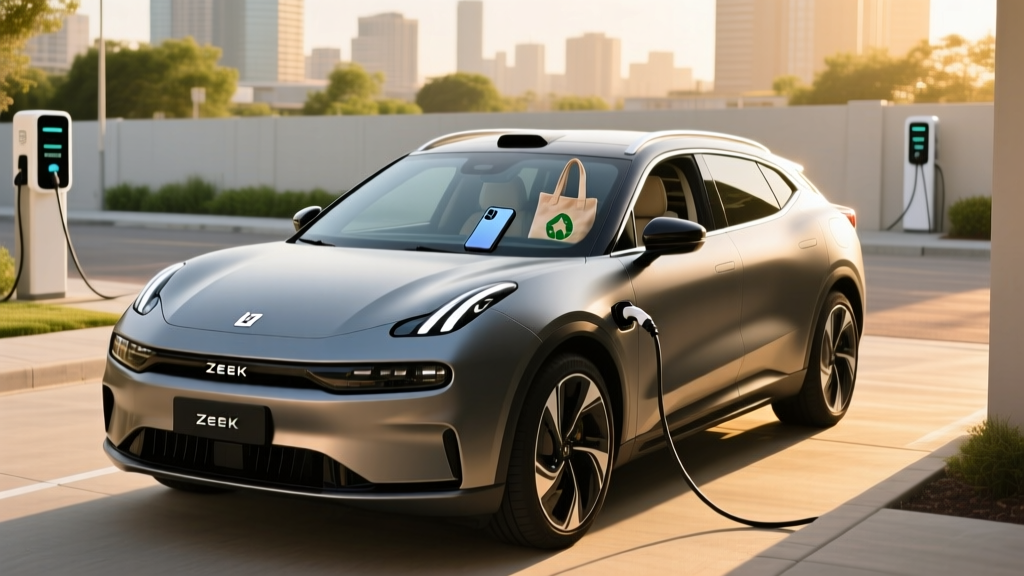
Geely's premium electric brand has finally brought its mid-size luxury crossover to U.S. showrooms, and the 2026 Zeekr SUV — badged globally as the 7X — enters one of the most competitive segments in the EV market. Priced to undercut the Tesla Model Y and BMW iX while offering a 100 kWh battery and 800-volt architecture, it promises a lot on paper. But how does it perform once you leave the dealer lot? After spending time with the 7X in mixed commuting and highway driving, here's what buyers need to know before signing.
Range and Efficiency: What the EPA Says vs. Reality
The 2026 Zeekr 7X Long Range AWD carries an EPA-estimated 310 miles of range from its 100 kWh (usable) battery pack. That places it squarely between the Tesla Model Y Long Range (320 mi) and the BMW iX xDrive50 (307 mi). Efficiency is rated at 99 MPGe combined, translating to roughly 34 kWh per 100 miles — respectable for a 5,000-pound luxury crossover but not class-leading.
EPA sticker: 310 miles. In practice, expect approximately 275–290 miles on highway-heavy trips at 70–75 mph, and closer to 240–260 miles in sustained cold weather (below 30°F) without preconditioning. The 7X's heat pump helps mitigate winter losses compared to EVs without one, but the large frontal area and AWD drivetrain still exact a toll at highway speeds.
City driving with regenerative braking set to high yields the best results — we saw 315+ miles of projected range in stop-and-go commuting at 35–45 mph. The lesson here is familiar to EV owners: the EPA number is achievable in mixed suburban use, not sustained interstate travel.
Battery Chemistry and Longevity
Zeekr equips the U.S.-spec 7X with a 100 kWh NMC (nickel manganese cobalt) lithium-ion pack supplied by CATL, built on Geely's SEA (Sustainable Experience Architecture) platform. NMC chemistry offers higher energy density than LFP (lithium iron phosphate), which is why Zeekr can pack this much capacity into a mid-size footprint — but it also means the pack is more sensitive to sustained 100% state-of-charge storage.
For daily use, Zeekr recommends charging to 80–90% and only hitting 100% before long road trips. Based on CATL's published cycle-life data for this cell generation, owners can expect roughly 10–12% degradation over 100,000 miles under normal use patterns — meaning approximately 275 miles of real-world range retention at that mileage milestone.
| Specification | Value |
|---|---|
| EPA Range | 310 miles (Long Range AWD) |
| Battery Capacity | 100 kWh usable (NMC) |
| Efficiency | 99 MPGe / 34 kWh/100 mi |
| Peak DC Fast Charge | 240 kW |
| 10–80% DC Charge Time | ~21 minutes |
| Level 2 Charge Rate | 11.5 kW (~37 mi/hr) |
| Drivetrain | Dual-motor AWD |
| Horsepower | 536 hp combined |
| 0–60 mph | 4.2 seconds |
| Base MSRP | $52,990 (Long Range AWD) |
| Battery Warranty | 8 years / 100,000 miles |
Charging Speed: 800V Architecture in Practice
The 7X's headline charging feature is its 800-volt electrical architecture, enabling a peak DC fast-charge rate of 240 kW on compatible stations. At a 350 kW Electrify America or Tesla Supercharger (via NACS adapter), the 7X can add 10–80% in approximately 21 minutes — competitive with the Hyundai Ioniq 5 and Porsche Macan Electric.
| Charging Level | Power / Rate | Miles Added per Hour | Notes |
|---|---|---|---|
| Level 1 (120V household) | 1.4 kW | ~4 mi/hr | Emergency/trickle only |
| Level 2 (240V home) | 11.5 kW | ~37 mi/hr | Full charge in ~9 hours |
| DC Fast Charge (peak) | 240 kW | ~500+ mi/hr (10–80%) | Tapers significantly above 80% |
Home charging on a Level 2 wall connector at 11.5 kW is straightforward: a full overnight charge from 10% to 100% takes roughly 9 hours. The onboard charger accepts the full 11.5 kW, so there's no wasted capacity on a 48-amp circuit — a detail some competitors (like older Model Y builds) fumbled with lower onboard acceptance rates.
The charge curve is the real story. The 7X holds near-peak 240 kW from roughly 10% to 55% state-of-charge, then tapers to ~150 kW through 70%, and drops to ~80 kW from 80–90%. If you're road-tripping, the smart play is charging to 80% and moving on — the last 20% adds nearly as much time as the first 70%.
For U.S. buyers, Zeekr ships the 7X with a CCS1 charge port and includes a NACS (Tesla) adapter in the box, giving access to both Electrify America's network and Tesla's Supercharger network — a significant practical advantage over CCS-only rivals in 2026.
Performance and Driving Dynamics
The dual-motor AWD powertrain produces 536 horsepower and an estimated 516 lb-ft of torque, launching the 7X from 0–60 mph in 4.2 seconds. That's brisk — quicker than a BMW iX xDrive50 (4.4 sec) but a half-step behind the Tesla Model Y Performance (3.5 sec).
Where the 7X differentiates itself is ride quality. Zeekr has clearly tuned this SUV for comfort over sportiness: the standard adaptive air suspension soaks up expansion joints and potholes with a composure that the stiffly-sprung Model Y can't match. Steering is light and accurate but not communicative — this is a luxury cruiser, not a canyon carver.
Regenerative braking offers three levels plus a one-pedal-driving mode. The strongest regen setting provides approximately 0.2g of deceleration — enough to handle most city driving without touching the brake pedal, though not as aggressive as Nissan's e-Pedal or Tesla's Hold mode.
Interior, Cargo, and Technology
The 7X cabin is where Zeekr makes its strongest value argument. Standard equipment includes a 16-inch AMOLED center display, a 14-speaker Yamaha audio system, ventilated Nappa leather seats, and a panoramic glass roof with an electrochromic dimming panel (no shade needed).
Passenger space is generous: 41.3 inches of front legroom and 39.1 inches in the rear — enough to comfortably seat two adults over six feet tall. The flat floor (a benefit of the SEA platform's dedicated EV architecture) makes the middle rear seat actually usable for short trips.
Cargo volume measures 28.5 cubic feet behind the second row and 65.2 cubic feet with the rear seats folded. There's also a modest 2.1 cu-ft front trunk (frunk) — enough for charging cables and a small bag but not the deep well you'll find in a Rivian R2 or Ford Mustang Mach-E.
Driver assistance comes via Zeek's in-house ADAS suite, which includes adaptive cruise control, lane-centering assist, automatic emergency braking, and a highway lane-change assist feature. This is a SAE Level 2 system — it requires continuous driver supervision and does not enable hands-free driving. It performs competently but doesn't match the smoothness of GM's Super Cruise or Ford's BlueCruise on divided highways.
The Zeekr ADAS system is a Level 2 driver-assist feature. The driver must keep hands on the wheel and eyes on the road at all times. It is not autonomous or "self-driving." The system may disengage unexpectedly in construction zones, faded lane markings, or heavy rain.
Pricing, Trims, and Federal Tax Credit Eligibility
The 2026 Zeekr 7X launches in a single U.S. trim:
| Item | Amount |
|---|---|
| Base MSRP (Long Range AWD) | $52,990 |
| Destination Charge | $1,295 |
| Technology Package (HUD, parking assist) | $2,500 |
| As-Tested Price | $56,785 |
| Federal Tax Credit (§30D) — Potential | Up to $7,500* |
| Estimated Price After Credit | From ~$45,490 |
*Federal tax credit eligibility is not guaranteed. Under current IRS §30D rules, buyers must meet income caps ($150,000 single / $300,000 joint MAGI), the vehicle MSRP must not exceed $80,000 for SUVs, and the battery must meet critical-mineral and battery-component sourcing requirements that tighten annually. Zeekr has indicated the 7X qualifies for the full $7,500 at launch, but buyers should verify current eligibility on the IRS clean vehicle credit list before purchasing. The credit can be transferred to the dealer at point of sale for an immediate price reduction.
Even without the full credit, the 7X undercuts a comparably-equipped BMW iX (starting ~$87,000) by a wide margin and sits just above the Tesla Model Y Long Range (~$48,990 before credit). The value proposition hinges on whether Zeekr's service network and resale value hold up over the ownership period — a legitimate question for a brand-new entrant.
Pros, Cons, and Who Should Buy
- 310-mile EPA range with a 100 kWh battery — among the largest in this segment
- 240 kW peak DC charging with a flat charge curve through 55% SoC
- Air suspension and ride quality rival SUVs costing $30,000 more
- NACS adapter included — Supercharger access from day one
- Generous rear legroom and premium materials at this price point
- Brand-new to the U.S. — service center density is limited in 2026
- ADAS is competent but unremarkable vs. Super Cruise or BlueCruise
- Small frunk (2.1 cu-ft) compared to segment rivals
- No single-motor/RWD option for buyers who don't need AWD
- Resale value and long-term depreciation are unknowns
Who the Zeekr 7X suits best: Commuters and families who want a premium electric crossover with strong range and ride comfort but don't want to pay BMW or Mercedes pricing. It's ideal for buyers with home Level 2 charging who take occasional road trips and value cabin refinement over sporty handling. If you live in an area with a nearby Zeekr service center and prioritize value-per-dollar, the 7X deserves a serious test drive.
Who should look elsewhere: Buyers in rural areas far from Zeekr's initial service footprint, those who want best-in-class ADAS for long highway commutes, and anyone who prioritizes a proven resale track record. The Tesla Model Y, Hyundai Ioniq 5, and Ford Mustang Mach-E all offer deeper service networks and more predictable depreciation.
Frequently Asked Questions
What is the real-world range of the 2026 Zeekr 7X?
The EPA rates it at 310 miles. In real-world highway driving at 70–75 mph, expect 275–290 miles. In cold weather (below 30°F), range can drop to 240–260 miles without preconditioning. City driving with strong regenerative braking can exceed the EPA estimate.
How fast does the Zeekr 7X charge?
On a DC fast charger, it peaks at 240 kW and charges from 10–80% in about 21 minutes. At home on a Level 2 (240V) charger, it accepts 11.5 kW and adds roughly 37 miles of range per hour, fully charging overnight in about 9 hours.
Does the Zeekr 7X qualify for the $7,500 federal EV tax credit?
Zeekr indicates the 7X qualifies under current IRS §30D rules, but eligibility depends on your income (capped at $150K single / $300K joint), the vehicle's MSRP (under $80K for SUVs — the 7X passes), and battery-sourcing requirements that change annually. Always verify on the IRS qualified vehicle list before purchasing. The credit can be applied at point of sale.
Is the Zeekr 7X worth buying vs. a Tesla Model Y or BMW iX?
Against the Model Y, the 7X offers a quieter, more comfortable ride and a larger battery but a less mature service network and less advanced driver assist. Against the BMW iX, the 7X delivers 80% of the refinement at roughly 60% of the price. If value and comfort are your priorities and you have service-center access, it's a strong choice.
What is the battery warranty?
Zeekr covers the 7X battery and powertrain for 8 years or 100,000 miles, whichever comes first, with a capacity retention threshold of 70%. The bumper-to-bumper warranty is 4 years / 50,000 miles — typical for the segment.
Does the Zeekr 7X have a frunk?
Yes, but it's small — just 2.1 cubic feet. It's useful for storing charging cables and small items but can't match the deeper frunks in the Mustang Mach-E or Rivian R2.
Can the Zeekr 7X use Tesla Superchargers?
Yes. The U.S.-spec 7X ships with a CCS1 port and includes a NACS adapter, giving access to Tesla's Supercharger network as well as Electrify America and other CCS networks.