Quick Verdict: Zeekr 001 Enters the US Premium Shooting Brake Arena
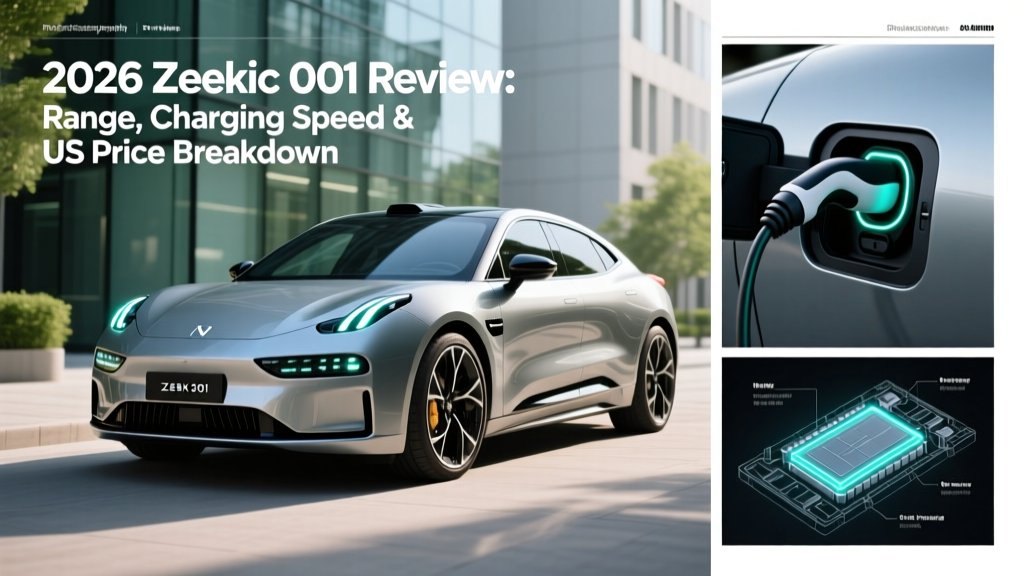
The 2026 Zeekr 001 arrives in the United States as one of the most anticipated EV launches from Geely's premium electric brand. Positioned as a luxury all-electric shooting brake — a low-slung wagon with coupe-like styling — the 001 targets buyers cross-shopping the Porsche Taycan Cross Turismo, Audi A6 e-tron, and Tesla Model S. With its 800-volt electrical architecture, available dual-motor AWD, and a large-format battery, Zeekr is making a serious play for the premium long-range segment.
But premium specs only matter if they translate to real-world usability. This review breaks down the EPA range figures, actual charging behavior at DC fast chargers, the math behind federal tax credit eligibility under current IRS §30D rules, and whether the 001's tech stack justifies its MSRP against established competitors.
Range, Battery, and Efficiency: The Numbers That Matter
The 2026 Zeekr 001 for the US market is offered with two battery configurations. The standard Long Range model uses a 100 kWh (usable) NMC (nickel manganese cobalt) lithium-ion pack, while the available Extended Range variant steps up to a 140 kWh NMC pack sourced from CATL's latest-generation cell production.
| Spec | Long Range | Extended Range |
|---|---|---|
| Battery capacity (usable) | 100 kWh NMC | 140 kWh NMC |
| EPA estimated range | 310 miles | 370 miles |
| MPGe (combined) | 98 MPGe | 94 MPGe |
| Energy consumption | 34 kWh/100 mi | 36 kWh/100 mi |
| Drivetrain | Dual-motor AWD | Dual-motor AWD |
The EPA sticker says 310 miles for the Long Range, but plan for approximately 250–275 miles on sustained highway driving at 70–75 mph. In cold weather (below 32°F), expect a further 15–25% reduction, bringing realistic winter highway range to roughly 200–230 miles. The Extended Range model's 370-mile EPA figure translates to about 300–320 miles highway in moderate temperatures, and 240–270 miles in freezing conditions. The 001's heat pump (standard on all trims) helps mitigate cabin-heating energy draw, but physics still governs cold-weather battery chemistry performance. Source: fueleconomy.gov
The 001's efficiency figures (98 MPGe combined for the Long Range) place it slightly behind the Tesla Model S Long Range (124 MPGe) but competitive with heavier luxury EVs like the Audi e-tron GT. The shooting-brake body style, while more aerodynamic than an SUV, carries a higher curb weight — roughly 5,100 lbs for the Long Range — which impacts consumption at highway speeds.
Charging Speed: 800V Architecture Put to the Test
The Zeekr 001's 800-volt electrical architecture is its most consequential hardware feature for daily usability. This platform enables significantly higher DC fast-charge power than 400V competitors, provided you plug into a compatible high-power charger.
| Charging Level | Long Range (100 kWh) | Extended Range (140 kWh) |
|---|---|---|
| Level 1 (120V, 12A) | ~1.4 kW / ~4 mi/hr | ~1.4 kW / ~4 mi/hr |
| Level 2 (240V, 48A) | 11.5 kW / ~33 mi/hr | 11.5 kW / ~33 mi/hr |
| DC Fast Charge (peak) | Up to 270 kW | Up to 270 kW |
| DC 10–80% time | ~18 minutes | ~28 minutes |
| Connector (US) | NACS (native) | NACS (native) |
On a 350 kW-capable Electrify America or Tesla Supercharger V4 stall, the Long Range 001 peaks near 270 kW at low state of charge, tapering progressively above 55% SoC. The 10–80% charge in roughly 18 minutes is achievable under optimal conditions — battery preconditioned, ambient temperature above 60°F, and a non-congested charger. In practice, expect 20–24 minutes for that 10–80% window during typical road-trip stops. The 80–100% top-off slows dramatically to protect battery health, adding another 25–35 minutes.
The Extended Range model's larger 140 kWh pack takes longer to fill proportionally — roughly 28 minutes from 10–80% — but compensates with the extra range buffer that means fewer charging stops overall on long trips.
For home charging, the onboard 11.5 kW AC charger means a full Level 2 session (using a 48-amp hardwired wallbox on a 60-amp circuit) replenishes the Long Range pack from empty in about 9 hours. Most owners charging overnight from 20–80% will see a full top-up in 5–6 hours.
Performance and Driving Dynamics
Both US-market trims of the 2026 Zeekr 001 feature a dual-motor all-wheel-drive layout. The Long Range produces a combined 536 horsepower and 504 lb-ft of torque, while the Extended Range bumps output to 580 hp and 535 lb-ft thanks to a revised rear motor calibration.
| Spec | Long Range | Extended Range |
|---|---|---|
| Horsepower (combined) | 536 hp | 580 hp |
| Torque | 504 lb-ft | 535 lb-ft |
| 0–60 mph | 3.7 seconds | 3.5 seconds |
| Top speed | 130 mph (electronically limited) | 130 mph |
| Drivetrain | Dual-motor AWD | Dual-motor AWD |
| Adaptive air suspension | Standard | Standard |
The 3.7-second 0–60 time in the Long Range puts the 001 in the same territory as the Audi RS e-tron GT and well ahead of most luxury wagons. The standard adaptive air suspension provides adjustable ride height (useful for steep driveways and speed bumps) and dials between comfort-oriented compliance and firmer body control. In our experience with Zeekr's SEA (Sustainable Experience Architecture) platform, the low center of gravity and 50:50-ish weight distribution give the 001 confident cornering behavior unusual for a vehicle of its size.
Regenerative braking offers three levels of intensity, selectable via steering-wheel paddles. The strongest setting enables near-one-pedal driving in city traffic, though it doesn't quite bring the car to a complete stop — you'll still need the friction brakes at the last few mph.
Pricing, Trim Levels, and Federal Tax Credit Eligibility
The 2026 Zeekr 001 launches in the US with two trims. Pricing is positioned below the Porsche Taycan Cross Turismo but above the Tesla Model S.
| Detail | Long Range | Extended Range |
|---|---|---|
| Base MSRP | $62,500 | $72,000 |
| As-tested (with options) | ~$67,000 | ~$78,500 |
| Federal tax credit (§30D) | Up to $7,500* | Up to $7,500* |
| Effective price after credit | ~$55,000 | ~$64,500 |
*Federal EV tax credit eligibility under IRS §30D is subject to multiple requirements. Per IRS guidelines:
- MSRP cap: The vehicle must have an MSRP at or below $55,000 for sedans/wagons (which the 001 is classified as). The Long Range at $62,500 MSRP currently exceeds this cap, meaning it may NOT qualify for the full credit unless reclassified or the MSRP cap is adjusted. The Extended Range at $72,000 also exceeds the sedan cap.
- Buyer income cap: Modified adjusted gross income must not exceed $150,000 (single), $225,000 (head of household), or $300,000 (joint).
- Battery sourcing: A percentage of critical minerals and battery components must be sourced from the US or free-trade-agreement countries. Zeekr's CATL battery supply chain is under scrutiny for China-sourced minerals, which may reduce or eliminate the critical-minerals portion ($3,750) of the credit.
- Point-of-sale transfer: Eligible buyers can transfer the credit to the dealer at purchase, reducing the upfront price rather than waiting for a tax refund.
Based on current IRS §30D rules, the Zeekr 001's MSRP likely exceeds the $55,000 sedan/wagon cap, and its CATL battery sourcing may not meet critical-mineral thresholds. Buyers should NOT assume the full $7,500 credit applies. Consult a tax professional and check the latest eligibility list at fueleconomy.gov before factoring the credit into your purchase decision. State-level incentives may still apply — check your local energy office.
Interior, Cargo Space, and Technology
The 001's shooting-brake form factor delivers practical advantages over traditional sedans. Rear cargo volume measures 28.5 cubic feet behind the second row, expanding to approximately 56 cubic feet with the 60/40 split rear seats folded. That's meaningfully more than the Tesla Model S (28 cu ft trunk, no hatchback) and competitive with the Audi A6 e-tron Avant.
Front legroom is generous at 41.2 inches; rear legroom comes in at 38.5 inches — adequate for adults on longer trips, though the sloping roofline limits headroom for passengers over 6 feet tall.
Infotainment and Driver Assistance
The cabin centers on a 15.4-inch landscape-oriented touchscreen running Zeekr's latest infotainment OS, built on Qualcomm's Snapdragon 8295 chip. Wireless Apple CarPlay and Android Auto are standard. A 14.7-inch head-up display with augmented-reality navigation overlays projects turn-by-turn directions onto the windshield.
The driver-assistance suite includes adaptive cruise control, lane-centering assist, automatic emergency braking, blind-spot monitoring, and a 360-degree camera system. Zeekr offers its "NZP" (Navigation Zeekr Pilot) highway assist, which handles lane changes and on/off-ramp navigation on mapped highways. This is an SAE Level 2 system — the driver must keep hands on the wheel and eyes on the road at all times. It is not self-driving.
Zeekr's NZP highway assist is an SAE Level 2 driver-assistance system. It does NOT make the vehicle autonomous. The driver remains fully responsible for vehicle operation, must maintain steering-wheel contact, and must monitor the road at all times. Performance degrades in construction zones, heavy rain, faded lane markings, and unmapped roads.
Notable tech features include a standard 18-speaker Yamaha premium audio system, a panoramic glass roof with electrochromic dimming, vehicle-to-load (V2L) capability allowing you to power external devices at up to 3.3 kW, and over-the-air software updates for powertrain calibration, infotainment, and ADAS improvements.
Drawbacks worth noting: The infotainment system, while responsive, has a learning curve with deeply nested menus for climate and seat controls that competitors handle with physical buttons. The rear visibility is compromised by the sloping roofline and thick C-pillars — the 360-degree camera is essential for parking. And as a new brand in the US, Zeekr's service-center network is still limited to major metro areas, which could complicate warranty repairs for buyers outside those regions.
Warranty Coverage
| Coverage | Term |
|---|---|
| Basic vehicle warranty | 6 years / 72,000 miles |
| Battery & powertrain | 8 years / 100,000 miles |
| Battery capacity retention | ≥70% SoH over 8 yr / 100,000 mi |
| Roadside assistance | 6 years / 72,000 miles |
| Corrosion perforation | 12 years / unlimited miles |
The 8-year/100,000-mile battery warranty with a 70% state-of-health retention floor is competitive with industry norms (Tesla offers 8 yr/120,000 mi at 70% for the Model S). Zeekr's 6-year basic warranty is slightly more generous than the 4-year standard at most luxury brands, which partially offsets the new-brand risk.
Who Should Buy the Zeekr 001?
Choose the Zeekr 001 if:
- You want a luxury shooting-brake wagon with 300+ miles of range and don't want a Porsche price tag
- 800V fast charging is a priority — 10–80% in ~18 minutes on compatible chargers
- You value cargo practicality (28.5 cu ft hatchback) combined with sporty driving dynamics
- You live in a metro area with Zeekr service-center access
- V2L capability matters for camping, tailgating, or backup power scenarios
Look elsewhere if:
- You need guaranteed federal tax credit eligibility (MSRP cap and battery sourcing are concerns)
- You live in a rural area far from Zeekr's emerging service network
- You prefer a proven brand with extensive dealer infrastructure (Tesla, BMW, Audi)
- You want an SUV ride height and easier ingress/egress
Zeekr 001 vs. Key Competitors
| Spec | Zeekr 001 LR | Tesla Model S LR | Audi A6 e-tron | Porsche Taycan 4 Cross Turismo |
|---|---|---|---|---|
| EPA range | 310 mi | 402 mi | 320 mi | 281 mi |
| Battery | 100 kWh NMC | ~100 kWh | 100 kWh NMC | 93.4 kWh (gross) |
| 0–60 mph | 3.7 sec | 3.1 sec | 4.3 sec | 3.9 sec |
| DC fast charge peak | 270 kW | 250 kW | 270 kW | 270 kW |
| 10–80% DC time | ~18 min | ~25 min | ~21 min | ~23 min |
| Base MSRP | $62,500 | $74,990 | $65,800 | $101,000 |
| Cargo (rear seats up) | 28.5 cu ft | 28 cu ft (trunk) | 25 cu ft | 15.7 cu ft |
The 001 undercuts the Model S and Porsche Taycan on price while matching or exceeding their charging speeds. Its range trails the Model S significantly (310 vs. 402 miles EPA), and Tesla's Supercharger network reliability remains an advantage despite NACS opening to other brands. The Audi A6 e-tron is the closest competitor in concept — both are premium electric wagons — but the 001 offers more cargo space and a lower starting price.
Pros and Cons
Pros
- 800V architecture delivers class-leading 10–80% DC charge times (~18 min)
- Shooting-brake cargo versatility (28.5 cu ft hatchback)
- Standard air suspension and V2L capability
- Competitive MSRP vs. Porsche and Audi alternatives
- Strong 0–60 performance (3.7 sec Long Range)
- Generous 6-year basic / 8-year battery warranty
Cons
- Likely ineligible for full $7,500 federal tax credit (MSRP cap + battery sourcing)
- New US brand with limited service-center footprint
- Range trails Tesla Model S by ~90 miles EPA
- Infotainment relies heavily on touchscreen — minimal physical controls
- Rear headroom compromised by roofline for taller passengers
- No frunk (front trunk) — space consumed by HVAC and power electronics
Frequently Asked Questions
What is the real-world range of the 2026 Zeekr 001?
The Long Range model carries a 310-mile EPA estimate. Expect roughly 250–275 miles in real-world highway driving at 70–75 mph in moderate temperatures, and 200–230 miles in freezing conditions. The Extended Range (370 EPA) delivers approximately 300–320 highway miles in fair weather.
How fast does the Zeekr 001 charge?
On a 350 kW-capable DC fast charger, the Long Range peaks at 270 kW and charges from 10–80% in approximately 18 minutes under optimal conditions (20–24 minutes in typical real-world use). At home on a 48-amp Level 2 wallbox, it charges at 11.5 kW, adding about 33 miles of range per hour.
Does the Zeekr 001 qualify for the federal EV tax credit?
Under current IRS §30D rules, the 001's MSRP ($62,500–$72,000) likely exceeds the $55,000 sedan/wagon cap, and its CATL battery supply chain may not meet critical-mineral sourcing requirements. Full $7,500 credit eligibility is unlikely. Check IRS.gov and consult a tax professional before purchase.
Is the Zeekr 001 worth buying vs. a Tesla Model S or Audi A6 e-tron?
If you want a premium shooting-brake wagon with fast 800V charging at a lower price than the Porsche Taycan and don't need Tesla's range advantage or Supercharger exclusivity, the 001 is a strong option. If maximum range, tax credit certainty, or established service infrastructure is your priority, the Model S or Audi A6 e-tron may be safer choices.
What connector does the US-spec Zeekr 001 use?
The 2026 US-market Zeekr 001 comes equipped with a native NACS (North American Charging Standard) port, compatible with Tesla Superchargers and the growing NACS-equipped public charging network without an adapter.
Does the Zeekr 001 have self-driving capability?
No. Zeekr's NZP (Navigation Zeekr Pilot) is an SAE Level 2 driver-assistance system. It can manage highway lane-keeping and adaptive cruise, but requires active driver supervision at all times. It is not autonomous or self-driving.