Zeekr, Geely's premium electric brand, has turned heads with the 001 shooting brake — a vehicle that pairs sports-wagon proportions with a cabin that punches well above its price class. For buyers researching the Zeekr 001 interieur (the European-market term for interior), the story is one of genuine luxury materials, expansive digital real estate, and packaging that leverages a dedicated EV platform. But the cabin is only half the equation. This profile covers the full ownership picture: range, charging, performance, pricing, and the critical question of whether and when US buyers can actually get one.
Zeekr 001 Interior: Materials, Layout, and Technology
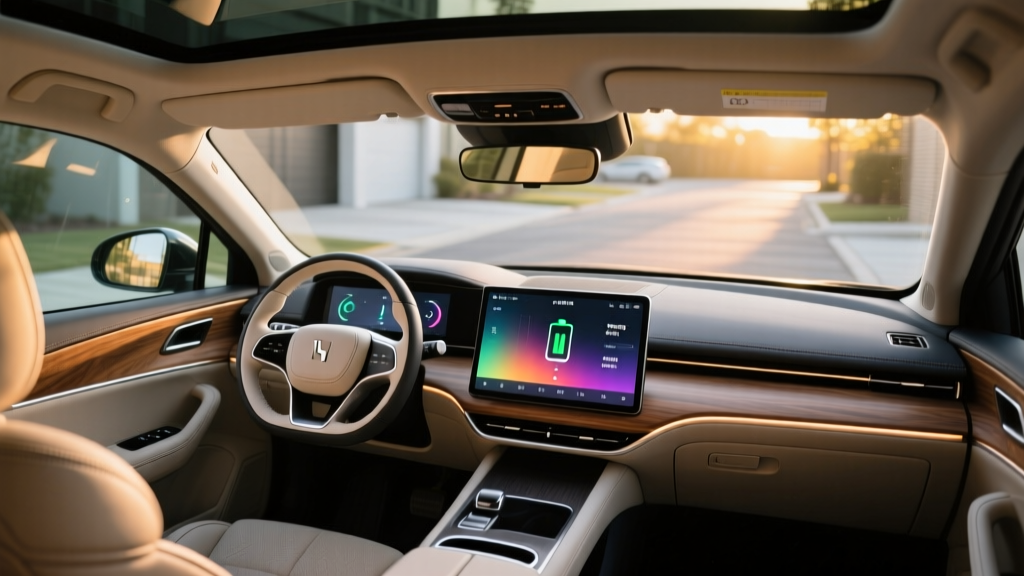
The 001's cabin is anchored by a minimalist, horizontally oriented dashboard dominated by a 15.4-inch central touchscreen running Zeekr's ZEEKR OS (powered by a Qualcomm Snapdragon 8155 chip in the latest generation). The driver faces a slim 8.8-inch digital instrument cluster and an available 35.5-inch AR head-up display that projects navigation, speed, and ADAS cues onto the windshield.
Material quality is where the 001 separates itself from rivals in its price band. Upper trims feature Nappa leather upholstery with quilted stitching, genuine aluminum trim accents, and microfiber suede on the headliner and A-pillars. Lower trims use a synthetic leather that is convincing to the touch, with soft-touch surfaces on the door uppers and dash top. Fit and finish on pre-production and European-spec units has been tight, with even panel gaps and no obvious cost-cutting in high-touch areas.
The center console houses a wireless phone charger (up to 50W with active cooling), two cupholders with a sliding cover, and a split-level storage bin. Physical buttons are sparse — climate and volume are handled via the touchscreen or steering-wheel controls, though a slim row of shortcut toggles sits below the main display for frequently used functions (defrost, hazard, drive-mode selector).
Seating, Space, and Cargo Practicality
The 001 rides on Geely's Sustainable Experience Architecture (SEA), which pushes the wheels to the corners and yields generous interior volume for a vehicle in the 195.7-inch overall-length class.
| Dimension | Measurement |
|---|---|
| Wheelbase | 118.1 in (3,005 mm) |
| Front headroom | ~39.4 in (1,000 mm) |
| Rear headroom | ~38.2 in (970 mm) |
| Rear legroom | ~38.6 in (980 mm) |
| Cargo (rear seats up) | ~27.4 cu ft (775 L) |
| Cargo (rear seats folded) | ~74.1 cu ft (2,100 L) |
| Front trunk (frunk) | Not available (motor/inverter packaging) |
The shooting-brake roofline pays dividends at the rear: the wide, squared-off tailgate opens to a deep load floor, and the 60/40 split-folding rear seats create a near-flat surface suitable for long cargo. Rear-seat passengers get dedicated climate vents, USB-C ports (one per side), and an available rear-seat entertainment tablet mounted on the center armrest in top trims.
Battery, Range, and Real-World Efficiency
The global-spec Zeekr 001 is offered with two primary battery options. The long-range model that most buyers consider uses a 100 kWh NMC (nickel manganese cobalt) lithium-ion pack supplied by CATL, while a standard-range variant uses an 86 kWh NMC pack. In certain markets, Zeekr has also introduced a 140 kWh pack (using CATL's Qilin cell-to-pack technology) for a limited-edition WE Edition, pushing CLTC range above 620 miles — though this variant is not expected for European or potential US sale.
Real-World Expectation: 270–300 miles on mixed highway driving at 70 mph; 230–260 miles in cold weather (below 32°F) with cabin heating. The 001's heat pump (standard on most trims) mitigates winter losses by ~15–20% compared to resistive heating, but the shooting-brake aero profile and ~5,070-lb curb weight keep efficiency moderate at roughly 33–35 kWh/100 mi (equivalent to ~97–101 MPGe combined).
Because the 001 has not received official EPA certification as of this writing (it is not yet sold in the US), the figures above are projected from WLTP data (which rates the 100 kWh AWD at approximately 374 miles WLTP) using a typical WLTP-to-EPA reduction factor of ~12–15%. WLTP figures tend to overstate real-world range compared to EPA methodology, so treat 330 miles as an optimistic upper bound and plan trips around ~280 miles of usable range for safety margin.
Charging Speed: DC Fast, Level 2, and Architecture
The Zeekr 001 uses an 800-volt electrical architecture, which is a significant differentiator in its class and enables fast DC charging without excessive current (and therefore thinner, lighter cables). Here is the charging breakdown:
| Charging Level | Power / Rate | Time or Miles Added |
|---|---|---|
| DC Fast Charge (peak) | Up to 200 kW (800V) | 10–80% in ~28 minutes |
| DC Sustained (to 80%) | Avg ~140–160 kW | Charge curve tapers above 80% |
| Level 2 (home, 240V/48A) | 11 kW onboard charger | ~25–28 miles of range per hour; 0–100% in ~9.5 hours |
| Level 1 (120V household) | ~1.4 kW | ~3–4 miles of range per hour |
The 200 kW peak rate is competitive but not class-leading — the Hyundai Ioniq 5 and Porsche Taycan can sustain higher peaks thanks to similar 800V architectures but more aggressive thermal management. In practice, expect the 001 to hold above 150 kW from roughly 10–50% state of charge, then step down to ~100 kW through 70%, and taper further to ~50 kW by 85%. Preconditioning the battery (via the navigation-routed preconditioning feature) is essential to hitting peak rates; arriving at a fast charger without preconditioning can cut peak power by 30–40%.
The 001 uses a CCS2 connector in European markets and is expected to adopt NACS (the Tesla-standard connector now used by most major automakers in North America) if and when it enters the US market. This would grant access to the Tesla Supercharger network, a meaningful advantage for road-trip charging.
Performance: 0–60, Horsepower, and Drivetrain
The Zeekr 001 is offered in single-motor rear-wheel-drive and dual-motor all-wheel-drive configurations:
- Single-Motor RWD (100 kWh): 272 hp (200 kW), 254 lb-ft torque, 0–60 mph in ~6.9 seconds
- Dual-Motor AWD (100 kWh): 536 hp (400 kW), 504 lb-ft torque, 0–60 mph in ~3.8 seconds
- 001 FR (performance variant, China market): 1,265 hp (quad motor), 0–60 mph in ~2.07 seconds — a track-oriented halo not expected for export
The dual-motor AWD model is the volume seller globally and delivers genuinely quick acceleration with confident all-weather traction. Air suspension is available on upper trims (standard on the YOU trim), offering adjustable ride height and adaptive damping that smooths rough pavement while keeping body roll controlled in corners. The steering is light and numb by enthusiast standards but precise enough for daily driving, and the regenerative braking system offers three levels of intensity (including a one-pedal-driving mode) adjustable via the touchscreen.
Pricing, Trim Levels, and US Tax Credit Eligibility
As of early 2026, the Zeekr 001 is sold in China and select European markets. It is not currently available for purchase in the United States, and Zeekr has not announced a firm US launch date. European pricing starts at approximately €59,990 (~$65,000 USD at current exchange rates) for the single-motor WE Edition and climbs to roughly €69,990 (~$76,000) for the dual-motor YOU Edition with air suspension and the full Nappa leather interior.
| Trim | Approx. EU Price | Est. US MSRP (if launched) | Federal Tax Credit (§30D) |
|---|---|---|---|
| WE Edition RWD (100 kWh) | €59,990 | ~$55,000–$60,000 | Uncertain — depends on battery sourcing and MSRP cap compliance |
| WE Edition AWD (100 kWh) | €64,990 | ~$60,000–$65,000 | Uncertain — MSRP cap for sedars/wagons is $55,000 |
| YOU Edition AWD (100 kWh, air susp.) | €69,990 | ~$68,000–$75,000 | Likely ineligible — exceeds $55,000 MSRP cap for non-SUVs |
The IRS §30D clean vehicle credit imposes several hurdles for the 001. The MSRP cap is $55,000 for sedans, wagons, and hatchbacks (the 001's shooting-brake body style would likely fall here rather than the $80,000 SUV/truck cap). Buyer income caps apply ($150,000 single / $300,000 joint AGI). Additionally, the battery must meet critical-mineral and battery-component sourcing requirements that phase in through 2029 — and Chinese-manufactured battery cells (the 001 uses CATL packs) face increasing restrictions under current rules. If Zeekr enters the US market, credit eligibility will depend on whether they can restructure supply chains or whether the 001 is reclassified as an SUV for MSRP-cap purposes. Always verify current-year rules on irs.gov or consult a tax professional before relying on credit eligibility.
Driver Assistance and Safety Technology
The 001 comes equipped with Zeekr's Advanced Driver Assistance System (ADAS), which includes adaptive cruise control with stop-and-go, lane-centering assist, automatic emergency braking (front and rear), blind-spot monitoring, rear cross-traffic alert, and a 360-degree surround-view camera. Upper trims add a highway-driving assist feature that combines lane-centering and adaptive cruise for hands-on, eyes-on highway use.
All Zeekr 001 driver-assist features are SAE Level 2 — meaning the driver must remain fully engaged, with hands on the wheel and eyes on the road, at all times. This is not autonomous or "self-driving" capability. The system assists with steering, acceleration, and braking but does not replace driver judgment or attention.
Zeekr has demonstrated more advanced Level 3+ capabilities in Chinese-market testing (using lidar-equipped prototypes), but these features are not available in production vehicles for consumer use. European-spec models have earned strong marks in preliminary safety assessments, though Euro NCAP and US NHTSA/IIHS ratings have not been published as of this writing.
Warranty and Ownership Costs
In European markets, Zeekr provides the following warranty coverage:
- Vehicle limited warranty: 6 years / 150,000 km (~93,000 miles)
- Battery warranty: 8 years / 200,000 km (~124,000 miles), with a capacity-retention threshold of 70% state of health
- Connected services: Included for the first 3 years, then subscription-based
The battery warranty is competitive with European rivals (BMW i4, Audi e-tron GT) and slightly better than Tesla's 8-year/120,000-mile coverage on Model S/X. The 70% SoH threshold is industry-standard — if the battery degrades below 70% of original capacity within the warranty period, Zeekr will repair or replace it. Based on NMC chemistry degradation curves observed in similar CATL-supplied packs (e.g., in the Polestar 2 and Volvo XC40 Recharge), expect roughly 8–12% capacity loss over the first 100,000 miles under normal use, with the curve flattening significantly thereafter.
Pros and Cons: The Honest Take
- Premium interior materials (Nappa leather, aluminum, suede) rival vehicles costing $20K+ more
- 800V architecture enables competitive DC fast-charging speeds
- Generous cargo volume (74.1 cu ft folded) thanks to shooting-brake design
- Dual-motor AWD delivers 536 hp and 3.8-sec 0–60 for the price
- Air suspension on YOU trim provides excellent ride quality
- Heat pump standard — reduces cold-weather range loss
- Not available in the US — no announced launch date
- No frunk — front trunk space sacrificed to motor/inverter packaging
- Touchscreen-dependent climate controls can be distracting while driving
- Steering feel is numb; not a sports sedan despite the performance numbers
- Charging taper above 80% is aggressive — plan to charge to 80% and go
- US tax credit eligibility highly uncertain due to battery-sourcing rules and MSRP cap
- Service/parts network nonexistent in North America
Who Should Consider the Zeekr 001?
- You live in a European or Asian market where it is sold and serviced
- You want shooting-brake practicality with a luxury interior at a sub-$70K price
- You value 800V fast-charging and don't need 350 kW peak rates
- You want a dual-motor AWD EV with air suspension without paying Porsche or Audi pricing
- You are a US-based buyer — the 001 is not purchasable and credit eligibility is doubtful
- You need a frunk for charging-cable storage or front cargo
- You prefer physical buttons for climate and audio controls
- You want proven Level 2+ driver assist with hands-free highway capability (consider BMW or GM Super Cruise)
Frequently Asked Questions
What is the real-world range of the Zeekr 001?
Based on projected EPA-equivalent figures, expect approximately 270–300 miles in mixed highway driving and 230–260 miles in cold weather (below freezing). The WLTP rating of ~374 miles (100 kWh AWD) overstates real-world range by roughly 15–20% in typical American driving conditions.
How fast does the Zeekr 001 charge at home and on the road?
On a DC fast charger, the 001 peaks at 200 kW and charges from 10–80% in approximately 28 minutes, with the charge curve tapering significantly above 80%. At home on a Level 2 (240V/48A) charger, the 11 kW onboard charger adds roughly 25–28 miles of range per hour, fully replenishing the 100 kWh battery in about 9.5 hours.
Does the Zeekr 001 qualify for the US federal EV tax credit?
Currently, no — the 001 is not sold in the US. If it launches stateside, eligibility under IRS §30D is uncertain. The MSRP cap for non-SUVs is $55,000, and most 001 trims would likely exceed this. Additionally, Chinese-manufactured CATL battery cells face increasing restrictions under critical-mineral and battery-component sourcing rules. Consult IRS guidance and a tax professional for current-year rules.
Is the Zeekr 001 worth buying vs. key competitors?
In European markets, the 001 competes against the BMW i4, Audi e-tron GT, Polestar 2, and Tesla Model S. Its interior quality and cargo space are standout advantages at its price point. However, the Tesla Model S offers longer range and Supercharger access, the BMW i4 offers a more engaging driving experience, and the Polestar 2 offers a more established service network. In the US, buyers should cross-shop the Hyundai Ioniq 5 N, Audi A6 e-tron, and Porsche Taycan depending on budget.
What is the Zeekr 001's battery chemistry and how long will it last?
The 001 uses NMC (nickel manganese cobalt) lithium-ion cells supplied by CATL, in either 86 kWh or 100 kWh configurations. NMC offers higher energy density than LFP chemistry, enabling the 001's range in a relatively compact pack. Expect 8–12% degradation over the first 100,000 miles, with the battery covered for 8 years / ~124,000 miles at a 70% state-of-health threshold.
When will the Zeekr 001 be available in the United States?
Zeekr has not announced a US launch date for the 001 as of early 2026. The brand has focused on China, Europe, and select Asian/Middle Eastern markets. Geely's corporate strategy suggests eventual North American expansion, but tariff structures, battery-sourcing regulations, and service-network buildout remain significant barriers. Monitor Zeekr's official channels for announcements.