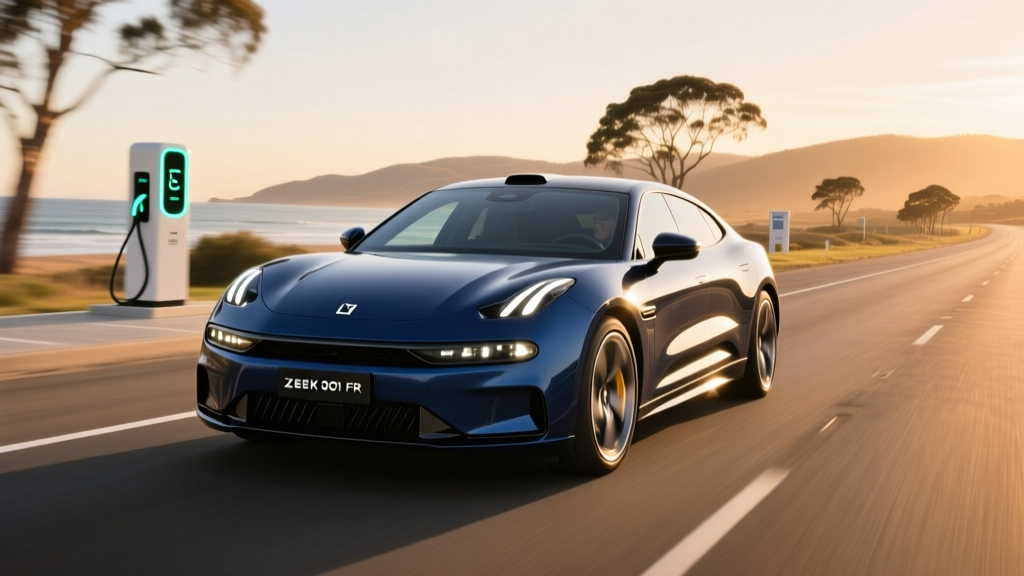
Quick Verdict: A 1,265-HP Hypercar in Shooting-Brake Clothing
The Zeekr 001 FR is Geely's answer to the Tesla Model S Plaid and Porsche Taycan Turbo GT — a quad-motor, 1,265-horsepower electric shooting brake that produces supercar numbers at a fraction of the price. But there's a catch for US buyers: as of 2026, Zeekr does not sell vehicles in the United States, and a 100% tariff on Chinese-manufactured EVs effectively blocks any grey-market import path. This review examines the 001 FR's specifications, real-world performance data from European and Chinese markets, and what its existence signals for the global EV performance segment.
Zeekr 001 FR Specifications at a Glance
| Spec | Value |
|---|---|
| Drivetrain | Quad-motor AWD (2 front, 2 rear) |
| Horsepower | 1,265 hp (944 kW) peak |
| Torque | 9,400 Nm (6,933 lb-ft) wheel torque |
| 0-60 mph | 2.02 seconds (claimed) |
| Top Speed | 174 mph (280 km/h) |
| Battery Capacity | 100 kWh (usable), NMC chemistry |
| Battery Voltage | 800V architecture |
| CLTC Range | 342 miles (550 km) |
| WLTP Range (est.) | ~280 miles |
| EPA Range (est.) | ~250-265 miles (unofficial) |
| Max DC Charge Rate | 260 kW peak |
| 10-80% DC Charge | ~18 minutes (claimed, optimal conditions) |
| Level 2 AC Charge | 22 kW onboard charger |
| Length / Width / Height | 195.5" / 79.1" / 56.3" |
| Wheelbase | 118.1" |
| Curb Weight | ~5,400 lbs (2,450 kg) |
| Cargo Volume | ~21 cu ft (rear seats up), hatchback style |
| Price (China) | ¥769,000 (~$106,000 USD) |
| Warranty (China) | 6 yr / 150,000 km (powertrain) |
Range and Efficiency: Real-World Expectations
CLTC (China): 342 miles — this cycle is notoriously optimistic and not comparable to US figures.
WLTP (Europe): ~280 miles — a more realistic mixed-driving benchmark.
EPA Equivalent (estimated): ~250-265 miles — based on typical CLTC-to-EPA conversion ratios of 25-30% reduction for high-performance EVs.
Highway driving (75 mph sustained): Expect 200-220 miles. The quad-motor setup and aggressive tire compound prioritize grip over low rolling resistance.
Cold weather (below 32°F): Expect 170-195 miles. The 001 FR uses a heat pump for cabin heating, but the 100 kWh NMC pack still loses 20-30% capacity in freezing temperatures, consistent with industry norms.
The Zeekr 001 FR's 100 kWh battery uses NMC (nickel manganese cobalt) chemistry rather than LFP. This choice makes sense for a performance vehicle: NMC offers higher energy density, keeping weight lower for a given capacity, and supports the extreme discharge rates needed for 1,265-hp launches. The trade-off is a slightly faster degradation curve over time compared to LFP, though Zeekr's thermal management system — with active liquid cooling across all four motor inverters and the battery pack — should mitigate this.
Efficiency figures for the 001 FR have not been published in EPA MPGe format since the vehicle isn't US-certified. Based on WLTP consumption data from European testers, expect roughly 2.2-2.5 kWh per mile in mixed driving, or about 40-45 MPGe equivalent. That's thirsty by EV standards — comparable to a Tesla Model S Plaid (~2.0 kWh/mile) but worse than a Lucid Air Sapphire (~1.9 kWh/mile), both of which benefit from more aerodynamic sedan profiles versus the 001 FR's shooting-brake roofline.
Charging Speed: 800V Architecture Done Right
| Charge Level | Power | Speed / Notes |
|---|---|---|
| Level 1 (120V) | 1.4 kW | ~3 mi/hr — impractical for a 100 kWh pack |
| Level 2 (240V, 48A) | 11.5 kW | ~25 mi/hr, full charge in ~9 hours |
| Level 2 (240V, max onboard) | 22 kW | ~48 mi/hr, full charge in ~5 hours (requires 90A circuit) |
| DC Fast Charge (peak) | 260 kW | 10-80% in ~18 min (optimal conditions, preconditioned pack) |
| DC Sustained (20-60%) | ~220-240 kW | Strong mid-range curve; tapers above 80% SoC |
The 001 FR's 800-volt architecture is its charging ace. At 260 kW peak on a compatible DC fast charger, the vehicle can add roughly 150 miles of range in 10 minutes — competitive with the Hyundai Ioniq 5 N and Porsche Taycan Turbo GT. The 800V system means lower current for a given power level, reducing heat buildup in cables and connectors during sustained fast charging.
The 22 kW onboard AC charger is a standout feature rarely seen outside European luxury EVs. Most US-market EVs cap Level 2 charging at 11.5 kW (48 amps). The 001 FR's 22 kW capability means a full overnight charge in about 5 hours if your home electrical panel can support a 90-amp dedicated circuit — a significant electrical upgrade that most residential panels cannot accommodate without a service upgrade costing $2,000-$5,000.
Charging connector compatibility varies by market: Chinese-market 001 FRs use the GB/T standard, while European examples use CCS2. If one were to import this vehicle to the US (again, currently impractical), a CCS-to-NACS adapter would be required for Tesla Supercharger access, and GB/T vehicles would need a full connector conversion.
Performance: Quad-Motor Engineering Unleashed
The Zeekr 001 FR's powertrain is a masterclass in electric excess. Four independent motors — two on the front axle, two on the rear — produce a combined 1,265 horsepower. Each rear motor is a permanent-magnet synchronous unit rated at 421 hp, while the front pair delivers a combined 423 hp. The result is precise torque vectoring at each wheel, enabling the car to rotate through corners with a neutrality that belies its 5,400-pound curb weight.
The claimed 0-60 mph time of 2.02 seconds places the 001 FR in rarefied air — 0.08 seconds quicker than a Tesla Model S Plaid (2.1 sec) and on par with the Rimac Nevera. Independent testing by Chinese automotive media has validated sub-2.1-second runs on prepared surfaces, though the number is highly dependent on tire temperature, surface grip, and launch-control preconditioning.
Beyond straight-line speed, the 001 FR features:
- Carbon-ceramic brakes (standard) — 10-piston front calipers with 420mm rotors, necessary to repeatedly arrest 5,400 lbs from triple-digit speeds
- Active rear-wheel steering — up to 3 degrees of rear-axle articulation for tighter low-speed turns and enhanced high-speed stability
- Adjustable air suspension — with track-mode ride-height drop of 20mm and adaptive damping
- Tank-turn capability — the independent quad-motor layout allows the car to perform 360-degree tank turns (like the Mercedes G580 EQ), though this is a demonstration feature, not a practical driving mode
Interior, Tech, and Driver Assistance
The 001 FR's cabin blends luxury and motorsport intent. Carbon fiber bucket seats with integrated headrests are standard, upholstered in a mix of Alcantara and Nappa leather. The rear seat is a two-place bench (not three-across), reflecting the car's performance-first philosophy. Cargo space is approximately 21 cubic feet with the rear seats upright, expanding to roughly 50 cubic feet with the 60/40 split folded — generous for a performance vehicle, thanks to the hatchback/shooting-brake form factor.
Technology highlights include:
- 15.4-inch central touchscreen running Zeekr's ZEEKR OS (Android Automotive-based), with Qualcomm Snapdragon 8295 processor
- 8.8-inch digital instrument cluster plus a 35.5-inch AR-HUD (augmented reality head-up display)
- Yamaha surround sound — 28-speaker system with headrest-mounted drivers
- Zeekr AD (Advanced Driving) — a Level 2 driver-assistance suite with highway lane-centering, adaptive cruise, and automatic lane changes. Uses a combination of cameras, millimeter-wave radar, and (in some markets) a roof-mounted LiDAR unit. This is not autonomous driving — the driver must remain engaged at all times.
Pricing, Tax Credits, and the US Import Barrier
In China, the Zeekr 001 FR is priced at ¥769,000, which converts to approximately $106,000 USD at current exchange rates. European pricing, where the car is available in limited markets, is expected to be significantly higher — likely €120,000-€140,000 (~$130,000-$150,000) once VAT, registration, and market adjustments are factored in.
The Zeekr 001 FR does not qualify for the US federal EV tax credit for multiple reasons:
1. Not US-certified: The vehicle has no EPA certification or NHTSA homologation.
2. MSRP cap exceeded: Even if it were available, the §30D credit caps eligible sedars/wagons at $55,000 MSRP (SUVs/trucks at $80,000). At $106,000+, the 001 FR is far above either threshold.
3. Battery sourcing: The §30D credit requires critical minerals and battery components to meet escalating US/FTA-country sourcing thresholds. Chinese-manufactured battery cells from CATL (Zeekr's supplier) would fail this requirement.
4. 100% tariff: The US imposes a 100% tariff on Chinese-manufactured EVs as of 2024, effectively doubling the import price to ~$212,000 before any dealer markup.
Source: IRS §30D Clean Vehicle Credit guidelines
How the 001 FR Compares to Key Rivals
| Spec | Zeekr 001 FR | Tesla Model S Plaid | Porsche Taycan Turbo GT |
|---|---|---|---|
| Motors | 4 (quad) | 3 (tri) | 2 (dual) |
| HP | 1,265 | 1,020 | 1,092 (Launch Control) |
| 0-60 mph | 2.02 sec | 1.99 sec | 2.1 sec |
| Battery | 100 kWh NMC | ~95 kWh | 105 kWh (gross) |
| EPA Range | ~250-265 (est.) | 396 mi | 269 mi |
| DC Peak Charge | 260 kW | 250 kW | 320 kW |
| US Price | N/A (not sold) | $89,990 | $230,700 |
| US Tax Credit | No | No (MSRP cap) | No (MSRP cap) |
The comparison reveals the 001 FR's value proposition in markets where it's available: it delivers Plaid-rivaling performance at roughly half the Porsche's price. For US buyers, the Model S Plaid remains the accessible hypercar-EV benchmark, while the Taycan Turbo GT appeals to those prioritizing chassis dynamics and brand cachet over raw numbers.
Pros, Cons, and Who Should Care
✅ Pros
- 1,265 hp from a quad-motor layout with genuine torque vectoring
- Sub-2.1-second 0-60 mph — hypercar territory
- 800V architecture with 260 kW DC fast charging
- 22 kW onboard AC charger (rare in this segment)
- Carbon-ceramic brakes and air suspension standard
- Hatchback practicality with ~21 cu ft cargo
- Undercuts Porsche and even Tesla on price in China
❌ Cons
- Not available in the US — no sales, no service network
- 100% US tariff makes importation economically absurd
- CLTC range of 342 mi translates to ~250-265 EPA — mediocre for the price
- 5,400-lb curb weight is felt in sustained cornering
- No NHTSA crash testing or IIHS evaluation
- Long-term battery degradation data not yet available
- Chinese-market infotainment may lack US app ecosystem
Who this EV suits best (in markets where it's sold): The 001 FR targets the performance-obsessed buyer who wants hypercar acceleration without the hypercar service experience. It's a weekend toy and daily driver rolled into one — the hatchback body adds genuine usability for two people and their gear. It is not a family hauler (the rear seat is tight), not a road-trip champion (range is modest and charging infrastructure in China's interior is still developing), and not a status play in markets where the Zeekr badge carries no heritage.
For US buyers: The 001 FR is a fascinating benchmark to study, not a car to buy. Its existence pressures Tesla, Porsche, and BMW to justify their performance-EV pricing. If Zeekr ever enters the US market — perhaps with a US-built or EU-built model to sidestep tariffs — the brand's value proposition could disrupt the luxury EV segment. Until then, the Model S Plaid ($89,990), Lucid Air Sapphire ($249,000), and upcoming next-gen Porsche Taycan remain your options for four-door electric hyper-performance.
Frequently Asked Questions
What is the real-world range of the Zeekr 001 FR?
The CLTC-rated range is 342 miles, but this Chinese test cycle is significantly more generous than the US EPA cycle. Based on WLTP data and conversion ratios observed in similar high-performance EVs, expect approximately 250-265 miles under EPA-equivalent testing. In real-world highway driving at 75 mph, plan for 200-220 miles. In freezing temperatures, that drops to 170-195 miles.
How fast does the Zeekr 001 FR charge?
On a DC fast charger capable of delivering its peak rate, the 001 FR charges at up to 260 kW, achieving a 10-80% charge in approximately 18 minutes under optimal conditions (preconditioned battery, warm ambient temperature). At home on a standard 48-amp Level 2 charger (11.5 kW), expect about 25 miles of range per hour, or a full charge in roughly 9 hours. The 22 kW onboard charger can halve that time but requires a 90-amp circuit most homes don't have.
Does the Zeekr 001 FR qualify for the federal EV tax credit?
No. The 001 FR fails every prong of the IRS §30D Clean Vehicle Credit requirements: it is not US-certified, its MSRP far exceeds the $55,000 sedan cap, its battery cells are manufactured in China (failing the critical-minerals and battery-component sourcing requirements), and a 100% tariff on Chinese EVs makes importation economically unviable regardless of credit eligibility.
Is the Zeekr 001 FR worth buying vs. the Tesla Model S Plaid?
In China, the 001 FR is a compelling alternative to the Plaid — more horsepower, a more practical hatchback body, and a lower price. In the US, the question is moot: you cannot buy one. The Model S Plaid at $89,990 remains the default choice for American buyers seeking sub-2-second 0-60 times, and it benefits from Tesla's Supercharger network, EPA-certified 396-mile range, and established service infrastructure.
Will Zeekr ever sell cars in the United States?
As of 2026, Zeekr has not announced US market entry. The 100% tariff on Chinese EVs, combined with escalating US-China trade tensions and battery-sourcing requirements under the Inflation Reduction Act, make near-term entry extremely unlikely. Zeekr's parent company, Geely, does have a European presence (Volvo, Polestar, Lotus), and a future EU-built Zeekr model could theoretically be exported to the US, but no such plan has been confirmed.
What battery chemistry does the Zeekr 001 FR use?
The 001 FR uses NMC (nickel manganese cobalt) lithium-ion cells supplied by CATL, China's largest battery manufacturer. NMC chemistry was chosen for its high energy density and ability to sustain the extreme discharge rates required for 1,265-hp acceleration. The pack operates on an 800V architecture, which reduces current and thermal losses during both charging and high-power discharge.