The XPeng P7 has generated considerable buzz as a sleek, tech-forward electric sedan from China's fast-growing EV sector. But for US-based buyers researching their next electrified purchase, the critical question isn't what the P7 can do in Shanghai or Oslo — it's whether this sedan is actually available stateside, what the real numbers look like, and how it stacks up against the Tesla Model 3, Hyundai IONIQ 6, and BMW i4. This review breaks down every spec that matters.
US Availability and Market Status
As of early 2026, the XPeng P7 is not officially sold in the United States. XPeng has focused its international expansion on European markets (Norway, Netherlands, Germany, Sweden, Denmark) and select Asian territories. The company has signaled long-term interest in the US market, but no confirmed launch date, dealer network, or homologation timeline has been announced.
This matters because without US-market EPA certification, the figures below are drawn from WLTP testing cycles and XPeng's published specifications. WLTP range figures tend to run 10-15% higher than EPA estimates for the same vehicle — a critical distinction for any buyer cross-shopping this against a Tesla or Hyundai with official EPA numbers.
Range, Battery, and Efficiency
The P7 is offered with multiple battery configurations depending on market and trim. The most widely available variant, the P7 Long Range, features an 82.7 kWh usable battery pack using NMC (nickel manganese cobalt) cell chemistry — the higher-energy-density choice that favors range over the cycle-life advantages of LFP.
| Specification | Standard Range | Long Range | Wing Edition (AWD) |
|---|---|---|---|
| Battery Capacity (usable) | 60.2 kWh | 82.7 kWh | 82.7 kWh |
| Cell Chemistry | NMC | NMC | NMC |
| WLTP Range | ~304 mi (490 km) | ~423 mi (682 km) | ~380 mi (612 km) |
| Estimated EPA Range* | ~260 mi | ~360 mi | ~325 mi |
| Efficiency (WLTP) | ~3.4 mi/kWh | ~3.5 mi/kWh | ~3.1 mi/kWh |
*Estimated EPA figures are approximations based on typical WLTP-to-EPA conversion ratios. Official EPA numbers would require US-market certification.
Charging Performance
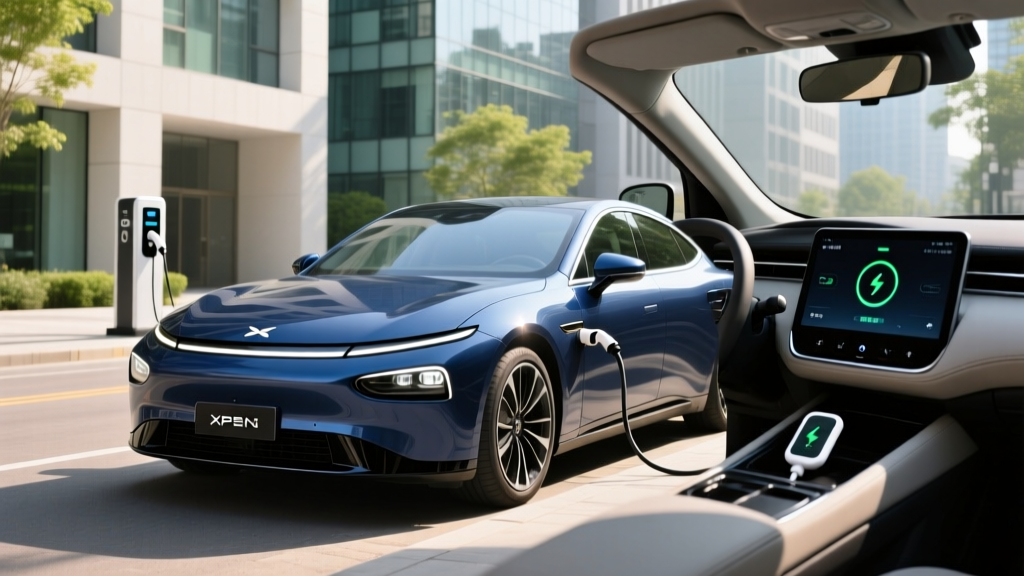
The P7 supports DC fast charging at up to 170 kW peak on compatible CCS2 chargers (the European standard; a US model would use NACS or CCS1). XPeng quotes a 10-80% charge time of approximately 31 minutes for the Long Range variant.
| Charging Level | Power/Rate | Time / Miles Added |
|---|---|---|
| Level 1 (120V household) | ~1.4 kW | ~4-5 miles per hour |
| Level 2 (240V home/public AC) | 11 kW (3-phase) / ~7.7 kW (US split-phase est.) | ~25-35 miles per hour |
| DC Fast Charge (CCS) | Up to 170 kW peak | 10-80% in ~31 min |
A few important caveats on the charging curve: the 170 kW peak is achieved only at lower states of charge (typically 10-40% SoC) with a preconditioned battery. Expect sustained rates closer to 100-120 kW through the middle of the curve, tapering significantly above 80%. This is standard behavior for NMC chemistry — the battery management system protects cell longevity by reducing current as the pack fills. On a road trip, plan your stops around the 10-80% window for the fastest turnaround.
For home charging, a full 0-100% charge on a Level 2 wallbox takes roughly 8-10 hours for the Long Range model — easily achievable with overnight charging.
Performance and Drivetrain
The P7 lineup spans from efficiency-focused single-motor variants to a performance-oriented dual-motor AWD model. Here's how the powertrain numbers break down:
| Variant | Drivetrain | Horsepower | Torque (lb-ft) | 0-60 mph |
|---|---|---|---|---|
| Standard Range RWD | Rear-Wheel Drive | 267 hp | 295 | ~6.7 sec |
| Long Range RWD | Rear-Wheel Drive | 267 hp | 295 | ~6.7 sec |
| Wing Edition AWD | Dual-Motor AWD | 462 hp | 487 | ~4.3 sec |
The RWD variants prioritize range and efficiency over acceleration, which aligns with the P7's grand-tourer positioning. The AWD Wing Edition's 4.3-second 0-60 time is respectable, though it trails the Tesla Model 3 Performance (3.1 seconds) and BMW i4 M50 (3.7 seconds). Where the P7 distinguishes itself is ride comfort — European reviewers consistently note its well-tuned suspension and cabin quietness at highway speeds.
Interior, Tech, and Cargo
The P7's cabin centers on a 14.96-inch touchscreen running XPeng's Xmart OS, paired with a 10.25-inch digital instrument cluster. The infotainment system supports voice control, navigation, and over-the-air updates. A standout feature is the available scissor-style "wing" doors on the Wing Edition — a design flourish more commonly seen on supercars than executive sedans.
XPeng's XPILOT advanced driver-assistance system includes adaptive cruise control, lane-keeping assist, automated parking, and highway navigation assist. This is a Level 2 SAE system, meaning the driver must remain fully engaged and hands-on (or eyes-on, depending on market configuration). It is not autonomous driving.
| Dimension | Measurement |
|---|---|
| Length | 190.6 in (4,845 mm) |
| Wheelbase | 117.2 in (2,998 mm) |
| Rear Legroom | ~37.8 in (960 mm) est. |
| Trunk Volume | ~15.9 cu ft (450 L) |
| Frunk | Not available |
The trunk is a conventional sedan design (not a liftback like the Tesla Model S or Polestar 2), which limits cargo versatility for larger items. The absence of a frunk also means less total storage than some competitors offer. Rear seat space is generous for two adults, though the sloping roofline cuts into headroom for taller passengers.
Pricing and Tax Credit Eligibility
Because the XPeng P7 is not currently sold in the US, there is no official US MSRP. European pricing provides a reference point: the Long Range variant starts at approximately €52,000-€58,000 (roughly $56,000-$63,000 at current exchange rates), with the Wing Edition commanding a significant premium.
How It Compares: P7 vs. the Competition
For US buyers drawn to the P7's profile, here's how it stacks up against sedans you can actually purchase today:
| Spec | XPeng P7 LR (est.) | Tesla Model 3 LR | Hyundai IONIQ 6 LR | BMW i4 eDrive40 |
|---|---|---|---|---|
| EPA Range | ~360 mi* | 363 mi | 361 mi | 301 mi |
| Battery (usable kWh) | 82.7 | 75.0 | 77.4 | 81.5 |
| DC Fast Charge (peak kW) | 170 | 250 | 240 | 205 |
| 10-80% DCFC Time | ~31 min | ~25 min | ~18 min | ~31 min |
| 0-60 mph | ~6.7 sec | 4.2 sec | 5.1 sec | 5.5 sec |
| Starting MSRP (US) | N/A | $47,740 | $42,600 | $57,900 |
| US Tax Credit | Not eligible | Up to $7,500† | Up to $7,500† | Up to $7,500† |
*Estimated. †Subject to IRS §30D eligibility rules including income caps, MSRP limits, and battery sourcing requirements. Verify at irs.gov.
The P7's estimated range is competitive, but its charging speed lags behind the IONIQ 6's class-leading 800V architecture and the Model 3's Supercharger network advantage. For US buyers, the practical gap in service infrastructure, warranty support, and parts availability makes the established alternatives far easier to own.
Warranty and Long-Term Ownership
XPeng offers an 8-year/100,000-mile (160,000 km) battery and powertrain warranty in European markets, with a capacity retention threshold typical of the industry (70% over the warranty period). Without a US presence, there is no American warranty framework, dealer network, or certified service center — a critical gap for any vehicle purchase.
The NMC battery chemistry in the P7 is well-proven across the industry. Based on degradation data from comparable packs, owners can expect approximately 85-90% capacity retention after 100,000 miles under normal use patterns — meaning an original 360-mile estimated range would decrease to roughly 306-324 miles over that period.
Who Should Consider the XPeng P7?
Not ideal for: US-based buyers. Without domestic availability, EPA certification, a dealer network, or tax-credit eligibility, the P7 is a vehicle to watch rather than buy. If you're drawn to the concept, the Tesla Model 3, Hyundai IONIQ 6, and BMW i4 deliver comparable (or superior) specs with full US support.
Pros and Cons
- Competitive estimated range (~360 mi Long Range)
- Striking design, especially Wing Edition scissor doors
- Spacious cabin with long wheelbase
- Comprehensive ADAS suite (XPILOT)
- Over-the-air update capability
- Strong build quality based on European reviews
- Not available in the United States
- No EPA certification or official US specs
- DC fast charging (170 kW) trails competitors
- No frunk; trunk is conventional sedan, not liftback
- US tax credit eligibility unlikely due to sourcing rules
- No US dealer or service network
- XPILOT is Level 2 only — not self-driving
Frequently Asked Questions
What is the real-world range of the XPeng P7?
The Long Range P7 carries a WLTP rating of approximately 423 miles (682 km). Translated to EPA-equivalent testing, that's roughly 360 miles. In real-world mixed highway driving, expect 310-330 miles. In cold weather (below freezing), plan for 250-270 miles. These are estimates — official EPA figures don't exist without US certification.
How fast does the XPeng P7 charge?
On a DC fast charger, the P7 peaks at 170 kW, achieving a 10-80% charge in approximately 31 minutes. On a home Level 2 charger (240V), expect roughly 25-35 miles of range added per hour, with a full charge taking 8-10 hours for the Long Range model.
Does the XPeng P7 qualify for the US federal EV tax credit?
The P7 is not sold in the US, making it ineligible. Even if it were, the IRS §30D credit's battery-sourcing and critical-minerals requirements would likely disqualify it due to its Chinese-manufactured supply chain. The $55,000 MSRP cap for sedans and buyer income limits add further constraints. Check irs.gov for current rules.
Is the XPeng P7 worth buying over a Tesla Model 3 or Hyundai IONIQ 6?
For US buyers, no — because you cannot currently purchase one. For European buyers, the P7 competes on range and design but trails the IONIQ 6 on charging speed and the Model 3 on charging-network access and performance. The established alternatives offer stronger infrastructure and resale confidence.
What battery chemistry does the XPeng P7 use?
The P7 uses NMC (nickel manganese cobalt) lithium-ion cells across all variants. NMC offers higher energy density than LFP, contributing to the P7's strong range figures, though LFP packs typically offer longer cycle life and can tolerate regular 100% charging without degradation concerns.
Will XPeng come to the United States?
XPeng has expressed interest in the US market but has announced no firm timeline, dealer partnerships, or model lineup for American sales. Tariff structures, homologation costs, and the need to restructure battery sourcing for tax-credit eligibility all present significant barriers. Monitor XPeng's official channels for updates.