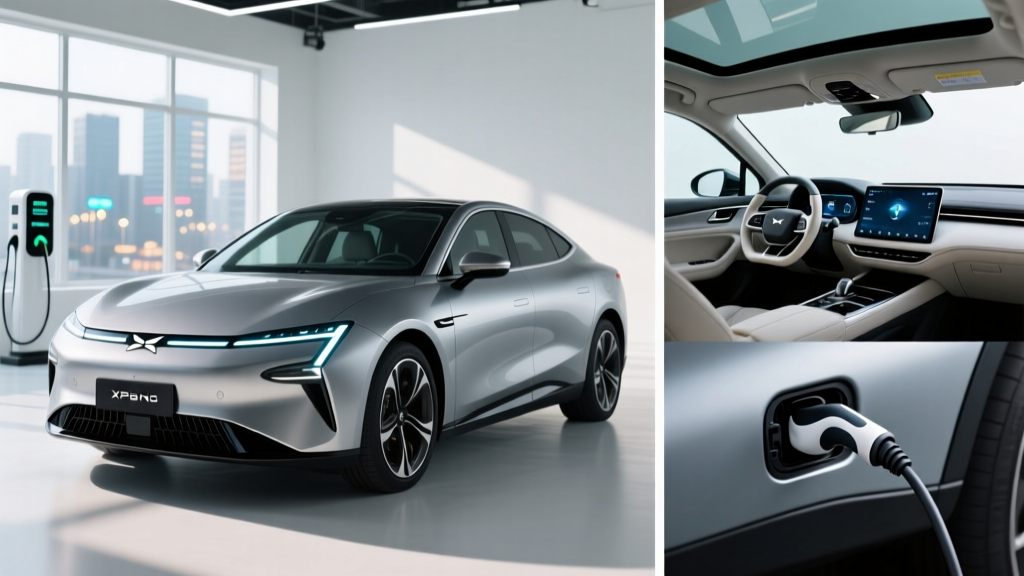
If you have been browsing Chinese EV news, the XPeng Mona M03 has likely caught your eye. Launched in late 2024 as XPeng's entry-level sedan under its new Mona sub-brand, the M03 targets the ultra-competitive compact EV segment in China with aggressive pricing and a feature list that punches well above its weight class. But for U.S.-based EV shoppers, the critical questions are different: Does it have a realistic path to American roads? What do its specs look like when translated to EPA testing standards? And how does it stack up against the Chevrolet Bolt, Tesla Model 3, and Hyundai Ioniq 6?
This profile breaks down every confirmed specification for the XPeng Mona M03, reconciles its Chinese-market CLTC range figures with realistic EPA-equivalent estimates, and gives you a clear-eyed assessment of whether this EV should be on your radar — or whether it remains a China-only proposition for the foreseeable future.
What Is the XPeng Mona M03?
The Mona M03 is a compact four-door battery-electric sedan developed by XPeng's Mona division — a sub-brand created through a partnership originally involving Didi Chuxing's EV assets, which XPeng acquired in 2023. The M03 is the first production vehicle from this collaboration, positioned as an affordable, tech-forward EV aimed at younger buyers and ride-hail drivers in China.
Dimensionally, the M03 slots between a Honda Civic and a Tesla Model 3 in size. It rides on a dedicated EV platform with a skateboard-style battery pack, rear-wheel drive, and a focus on aerodynamic efficiency — XPeng claims a drag coefficient (Cd) of just 0.194, which, if independently verified, would make it one of the most aerodynamic production sedans in the world.
Range, Battery, and Efficiency
The Mona M03 is offered with two lithium iron phosphate (LFP) battery options supplied by BYD's FinDreams division. LFP chemistry is notable for its long cycle life, thermal stability, and lower cost compared to nickel-manganese-cobalt (NMC) packs — though it trades off some energy density and cold-weather performance.
| Specification | Standard Range (515) | Long Range (620) |
|---|---|---|
| Battery Chemistry | LFP (BYD Blade) | LFP (BYD Blade) |
| Battery Capacity (usable) | 51.8 kWh | 62.2 kWh |
| CLTC Range | 515 km (320 mi) | 620 km (385 mi) |
| Estimated EPA Range | ~240–260 mi | ~295–315 mi |
| Est. Efficiency (kWh/100 mi) | ~27–29 kWh/100mi | ~27–29 kWh/100mi |
For context, the EPA-rated Tesla Model 3 Long Range RWD achieves 363 miles on a ~79 kWh NMC pack, while the Hyundai Ioniq 6 SE Long Range RWD reaches 361 miles on 77.4 kWh. The M03's smaller LFP pack means it cannot match those figures under EPA testing, but its claimed aerodynamic efficiency helps close the gap per kWh of battery.
Charging Speed: DC Fast Charge and Home Level 2
Charging infrastructure compatibility is where the M03's China-market origins create the most friction for any hypothetical U.S. launch. Here is what we know from XPeng's published specifications:
| Charging Level | Rate / Power | Estimated Time / Speed |
|---|---|---|
| Level 1 (120V AC) | ~1.4 kW | ~3–4 mi/hr (not practical for daily use) |
| Level 2 (240V AC, home/public) | ~7–11 kW (est.) | ~25–35 mi/hr; full charge in 6–9 hours |
| DC Fast Charge (peak) | ~92 kW (515) / ~115 kW (620) | 10–80% in ~26–30 minutes (claimed) |
XPeng has not published a detailed DC charging curve for the M03, which is critical for understanding sustained charge rates. Peak kW is never maintained across the full 10–80% window. With a ~92–115 kW peak on an LFP pack, expect the charge rate to taper noticeably above 60% state of charge (SoC). The 10–80% claim of approximately 26–30 minutes is plausible but should be verified with independent testing.
In China, the M03 uses the GB/T charging standard. Any U.S.-spec model would need to adopt either the NACS (Tesla) connector or CCS1. Given the industry's rapid shift toward NACS in 2025–2026, a U.S. launch would almost certainly require NACS compatibility to access the Tesla Supercharger network — now the dominant fast-charging ecosystem in North America.
Performance and Drivetrain
The Mona M03 is a single-motor, rear-wheel-drive sedan. It is not positioned as a performance vehicle, but its output is adequate for daily commuting and highway merging.
| Specification | Value |
|---|---|
| Drivetrain | Rear-Wheel Drive (RWD), single motor |
| Motor Output | 140 kW (~188 hp) / 160 kW (~215 hp) depending on trim |
| Torque | ~225 lb-ft (est.) |
| 0–60 mph (estimated) | ~7.0–7.8 seconds |
| Top Speed | ~106 mph (electronically limited) |
For comparison, the base Tesla Model 3 RWD hits 60 mph in 5.8 seconds with 271 hp, while the Hyundai Ioniq 6 SE RWD does it in 6.5 seconds with 168 hp. The M03 sits in the adequate-but-not-thrilling category — perfectly suited for urban and suburban driving, but it will not win any stoplight drag races.
Pricing, Trims, and U.S. Tax Credit Eligibility
In China, the Mona M03 launched with remarkably aggressive pricing:
- 515 Standard Range: Starting at ¥119,800 (~$16,500 USD at current exchange rates)
- 620 Long Range: Starting at ¥129,800 (~$17,900 USD)
- 580 Max (ADAS-equipped): Starting at ¥155,800 (~$21,500 USD)
These prices are extraordinary for the feature content. However, they reflect the Chinese domestic market with local incentives, supply-chain proximity, and no tariff burden.
Regarding the IRS §30D federal EV tax credit: eligibility requires the vehicle to meet MSRP caps ($55,000 for sedans), buyer income limits ($150,000 single / $300,000 joint AGI), and stringent battery-component and critical-mineral sourcing requirements. A vehicle with a BYD-sourced battery would face additional scrutiny under the Foreign Entity of Concern (FEOC) rules that took effect in 2024–2025. Do not assume any Chinese-market EV automatically qualifies for the $7,500 credit. Consult a tax professional and check the latest IRS guidance at irs.gov.
Interior, Cargo, and Technology
The M03's cabin follows XPeng's minimalist design language with a prominent central touchscreen dominating the dashboard. Key interior and technology highlights:
- Infotainment: 15.6-inch central display running XPeng's Xmart OS, with wireless Apple CarPlay and Android Auto (expected for export models)
- Instrument Cluster: Minimalist — XPeng relies on the central screen and an available head-up display rather than a traditional gauge cluster
- Audio: Available 18-speaker premium audio system (a standout feature at this price point in China)
- Seating: Five-passenger capacity, synthetic leather upholstery, heated front seats on higher trims
- Cargo Volume: Approximately 23.2 cubic feet (trunk) — competitive with the Tesla Model 3's ~23 cu ft, though the M03 is a traditional sedan trunk rather than a liftback
- Frunk: Not confirmed; many compact EVs in this segment omit front trunk space
ADAS and Autonomous Driving Features
The top-trim Mona M03 (580 Max) features XPeng's XNGP driver-assistance suite, which includes:
- Adaptive cruise control with stop-and-go
- Lane-keeping assist and automatic lane change
- Traffic light and stop sign recognition
- Automated parking assist
- Available city-level navigation-guided pilot (China-specific, mapped roads)
For a U.S. launch, XPeng would need to retrain and recalibrate XNGP for American road infrastructure, signage, and driving norms — a significant engineering undertaking that adds to the timeline uncertainty.
Warranty and Ownership Considerations
In China, XPeng offers the following warranty coverage for the Mona M03:
- Vehicle Limited Warranty: 5 years / 120,000 km (~75,000 mi)
- Battery & Powertrain Warranty: 8 years / 160,000 km (~100,000 mi), with a capacity retention threshold of 70%
These terms are broadly in line with industry standards. For U.S. homologation, XPeng would need to meet or exceed the typical 8-year/100,000-mile battery warranty that American buyers expect (and that federal law effectively mandates for emissions-related components on PHEVs, setting consumer expectations for BEVs as well).
Long-Term Battery Outlook
The BYD Blade LFP cells in the M03 are among the most durable in the industry. LFP chemistry typically supports 3,000+ full charge cycles before reaching 80% state of health — far more than most owners will accumulate in the vehicle's lifetime. At an average of 12,000 miles per year and 315 miles per full charge, a 620-variant owner would need roughly 38 full cycles per year. Even after 15 years, that is only ~570 cycles — well within the LFP comfort zone.
Pros, Cons, and Who Should Consider the Mona M03
Pros
- Extremely competitive pricing in China (under $22K for top trim)
- LFP battery offers excellent longevity and thermal safety
- Class-leading aerodynamics (Cd 0.194 claimed)
- Comprehensive ADAS suite on Max trim
- Strong infotainment with large screen and premium audio option
- Adequate range for daily commuting and moderate road trips
Cons
- Not available in the U.S. — no announced timeline
- DC fast-charge rate (~92–115 kW) is modest vs. 200+ kW competitors
- LFP cold-weather range loss is significant (20–30%)
- Sedan trunk limits cargo versatility vs. hatchback/liftback rivals
- U.S. tariffs on Chinese EVs make a competitive launch price unlikely
- Unproven service/parts network outside China
Who This EV Suits Best
If you are in China: The M03 is an outstanding value for urban commuters, ride-hail drivers, and first-time EV buyers who want modern tech without the premium price. The Long Range variant's ~385 km CLTC range handles most daily needs with room to spare.
If you are in the U.S.: The Mona M03 is not a purchase option today, and there is no confirmed timeline for availability. U.S. buyers seeking similar value and efficiency should evaluate the Chevrolet Equinox EV (~$33,000 base, 319 mi EPA), Hyundai Ioniq 6 (~$37,500 base, up to 361 mi EPA), or the upcoming next-generation Tesla Model 3 refresh. If budget is the primary constraint, watch for the used EV market where vehicles like the Bolt EV and Model 3 offer strong value under the §25E used-EV credit (up to $4,000).
Frequently Asked Questions
What is the real-world range of the XPeng Mona M03?
Under the Chinese CLTC test cycle, the Long Range M03 is rated for 620 km (385 mi) and the Standard Range for 515 km (320 mi). Translated to EPA-equivalent estimates, expect approximately 295–315 miles (Long Range) and 240–260 miles (Standard Range). In real-world highway driving, subtract 10–15%. In freezing weather, LFP range loss of 20–30% is common, bringing usable winter highway range to roughly 210–240 miles for the Long Range model.
How fast does the Mona M03 charge?
DC fast charging peaks at approximately 92 kW (515) or 115 kW (620), with a claimed 10–80% time of 26–30 minutes. Home Level 2 charging at 240V adds roughly 25–35 miles of range per hour, meaning a full overnight charge is easily achievable. These DC speeds are adequate but trail competitors like the Hyundai Ioniq 6 (up to 240 kW) and Tesla Model 3 (up to 250 kW on V3 Superchargers).
Does the XPeng Mona M03 qualify for the U.S. federal EV tax credit?
The M03 is not currently sold in the United States, so the question is moot for now. Even if it were, the §30D credit requires compliance with battery-component and critical-mineral sourcing rules (FEOC restrictions), MSRP caps ($55,000 for sedans), and buyer income limits. A BYD-sourced LFP battery would face significant hurdles under current FEOC rules. Always verify eligibility at irs.gov and consult a tax professional.
Is the XPeng Mona M03 worth buying vs. key competitors?
In China, the M03 offers exceptional value against rivals like the BYD Seal, Tesla Model 3 (China-built), and Nio ET5. For U.S. buyers, it is not an option. The closest American-market alternatives in price and segment are the Chevrolet Equinox EV, Hyundai Ioniq 6, and Tesla Model 3 RWD — all of which offer established service networks, EPA-certified range figures, and (depending on sourcing and trim) potential tax credit eligibility.
Will XPeng bring the Mona M03 to the United States?
XPeng has expressed interest in expanding beyond China, with Europe as the likely first export market. A U.S. launch faces major obstacles: punitive tariffs on Chinese-manufactured vehicles (currently 100%+ under Section 301), the need for NHTSA crash-test homologation, connector standard differences (GB/T vs. NACS/CCS), and building a dealer and service network from scratch. There is no announced U.S. launch date for the M03 or any XPeng vehicle as of early 2026.