XPeng AeroHT's "Land Aircraft Carrier" is not a conventional EV review subject — it's a modular, six-seat electric SUV designed to carry, launch, and dock a foldable eVTOL (electric vertical takeoff and landing) aircraft. First previewed in late 2024 and entering limited production in China through 2025, the system represents one of the most ambitious attempts to merge ground transportation with personal aviation. Here's what US-based EV shoppers and tech enthusiasts need to know about the platform's electric specs, real-world feasibility, and what it signals for the future of multimodal electric transport.
What Is the XPeng Land Aircraft Carrier?
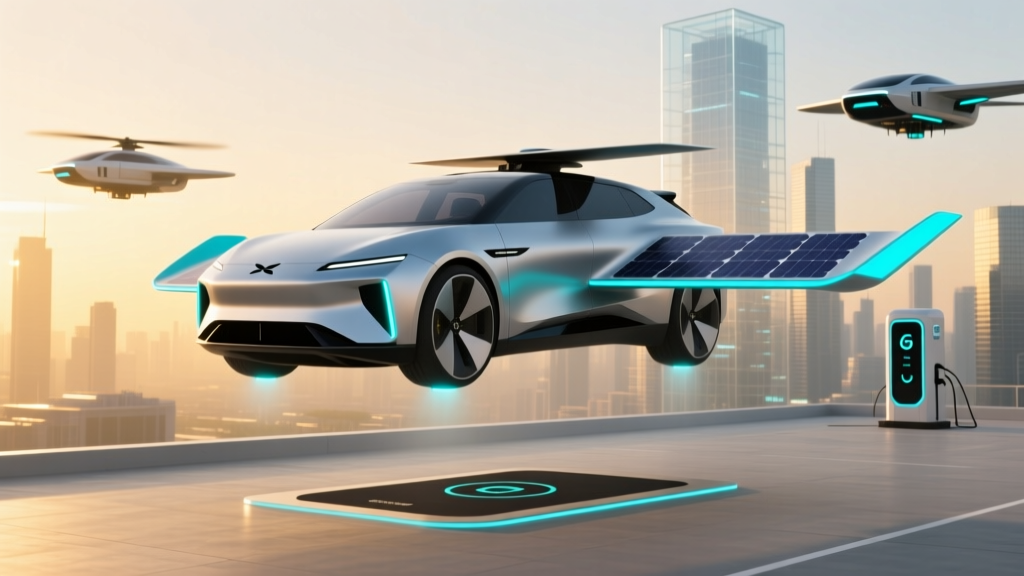
The Land Aircraft Carrier is a two-part system: a large electric SUV (the "mothership") and a detachable, foldable eVTOL aircraft stored in the vehicle's rear cargo module. The SUV serves as both a daily driver and a mobile launch platform — the eVTOL deploys from the rear, flies autonomously or with a pilot, then folds back into the vehicle's integrated hangar bay.
XPeng AeroHT (the aero-mobility subsidiary of XPeng Motors) positions this as a solution to urban congestion, targeting a future where commuters drive to a launch point and fly the final miles. The system debuted publicly at the 2024 China International Import Expo and has since been confirmed for limited Chinese-market production, with pre-orders reportedly exceeding 1,000 units.
EV SUV Specifications: Range, Battery, and Efficiency
Detailed EPA-equivalent testing data for the Land Aircraft Carrier's ground vehicle remains limited, as the platform is primarily engineered for the Chinese market under CLTC standards. Based on XPeng AeroHT's published specifications and comparable XPeng SUV platforms, here is what we know:
| Spec | Value |
|---|---|
| Battery Capacity | ~100–120 kWh (estimated, NMC chemistry) |
| CLTC Range | ~620 mi / 1,000 km (with eVTOL stored) |
| EPA-Equivalent Range (est.) | ~380–420 mi |
| Drivetrain | Dual-motor AWD |
| Horsepower | ~540 hp (estimated) |
| 0–60 mph | ~5.0 sec (estimated) |
| Efficiency | ~2.0–2.3 kWh/mi (est., heavy vehicle) |
| Vehicle Weight | ~6,600+ lbs (with eVTOL docked) |
Charging Speed: DC Fast Charge and Home Level 2
The Land Aircraft Carrier uses XPeng's latest 800V silicon carbide (SiC) architecture, shared with the G9 and X9 platforms, enabling rapid DC charging. However, the massive battery pack means even high-power charging takes meaningful time.
| Charge Level | Power / Rate | Speed |
|---|---|---|
| DC Fast Charge (peak) | ~480 kW (800V architecture) | 10–80% in ~20–25 min (est.) |
| DC Fast Charge (sustained) | ~200–250 kW avg | Charge curve tapers above 60% SoC |
| Level 2 (Home/Public AC) | ~11–22 kW | ~25–50 mi/hr of range |
| Level 1 (120V outlet) | ~1.4 kW | ~3–4 mi/hr (emergency only) |
Charging curve reality: The 480 kW peak is only achievable on compatible ultra-fast chargers (such as XPeng's own S4 Supercharger stations in China, or equivalent 500 kW+ CCS/NACS stations). On typical 150–350 kW Electrify America or Tesla Supercharger stalls, expect 10–80% times closer to 30–40 minutes. The large battery means even at peak rate, you're adding roughly 12–15 miles of range per minute of charging at the fastest portion of the curve.
The eVTOL Aircraft: Specs and Integration
The aircraft module is a coaxial-rotor eVTOL that folds into a compact form factor for storage inside the SUV's rear hangar. Key published specifications from XPeng AeroHT include:
- Flight range: ~18–25 miles (30–40 km) per charge
- Max altitude: ~3,300 ft (1,000 m)
- Top speed: ~80 mph (130 km/h)
- Passenger capacity: 2 (pilot + 1 passenger, or autonomous mode)
- Charging: Recharges from the SUV's battery pack while docked
- Autonomous flight: Pre-programmed waypoint navigation with obstacle avoidance
The aircraft is designed for short urban hops — think airport transfers or bypassing a congested corridor — not long-distance travel. The SUV's battery pack essentially serves as a mobile power station, replenishing the eVTOL between flights.
Pricing, Availability, and US Tax Credit Eligibility
The Land Aircraft Carrier is currently available for pre-order in China, with pricing announced at approximately ¥2,000,000 RMB (~$275,000 USD) for the complete system (SUV + eVTOL). Deliveries in China began in limited numbers through 2025.
| Item | Price |
|---|---|
| Base MSRP (China) | ~¥2,000,000 / ~$275,000 USD |
| US Availability | Not announced — no confirmed US launch date |
| Federal §30D Tax Credit | Ineligible (MSRP exceeds $80,000 SUV cap; China-manufactured battery sourcing does not meet critical mineral requirements) |
Tax credit reality check: Even if the Land Aircraft Carrier were sold in the US, it would not qualify for the IRS §30D federal EV tax credit. The vehicle's MSRP far exceeds the $80,000 cap for SUVs, and its Chinese-manufactured battery and components do not meet the critical mineral and battery-component sourcing requirements mandated under current law. Additionally, XPeng has not announced any plans to homologate the vehicle for US sale, which would require meeting NHTSA safety standards and EPA certification.
Interior, Cargo, and Technology
The SUV portion of the Land Aircraft Carrier is a large, three-row vehicle with seating for six. The rear cargo area is reconfigured to serve as the eVTOL hangar, which significantly impacts traditional cargo utility:
- Passenger capacity: 6 (2+2+2 layout)
- Cargo volume (with eVTOL docked): Minimal traditional cargo space — the aircraft module occupies the majority of the rear cargo area
- Cargo volume (eVTOL deployed): Estimated ~40–50 cu ft of usable space once aircraft is in flight
- Infotainment: Expected XPeng Xmart OS with large central touchscreen, heads-up display, and aircraft-status monitoring dashboard
- Driver assists: XPeng XNGP (Level 2 ADAS) — adaptive cruise, lane-keeping, automated parking, city/highway navigation assist
Pros, Cons, and Who Should Consider It
Pros
- Genuinely novel concept — no other production vehicle integrates a flyable eVTOL
- 800V architecture enables best-in-class DC charging speeds
- Large battery provides mobile power-station capability
- XPeng's proven ADAS and infotainment technology
- Statement vehicle with unmatched conversation value
Cons
- Not available in the US — no announced plans for US sale
- Extreme price (~$275,000) puts it in supercar territory
- eVTOL range is very short (~18–25 mi) — useful only for specific corridors
- Massive weight crushes efficiency vs. conventional electric SUVs
- Cargo space severely limited when eVTOL is docked
- Regulatory uncertainty around personal eVTOL operation in most markets
- No federal or state EV incentives apply
Who this suits: The Land Aircraft Carrier is not a practical daily EV for US buyers. It targets ultra-high-net-worth individuals in China with access to approved eVTOL flight corridors and the infrastructure to support aircraft operations. For US-based EV shoppers, it's best understood as a technology demonstrator and a signal of where multimodal electric transport may head — not a purchase candidate.
Competitive Context: What Else Exists?
There is no direct competitor that combines an EV SUV with a dockable flying vehicle. However, for buyers interested in the concept's individual components:
- Large electric SUVs (US-available): Rivian R1S, Tesla Model X, Kia EV9 all offer three-row seating, 300+ miles of EPA range, and prices between $55,000–$110,000.
- eVTOL companies: Joby Aviation, Archer Aviation, and Lilium are developing air-taxi eVTOLs, but these are ride-service platforms, not personal aircraft you store in your garage.
- Future outlook: Several companies (including Alef Aeronautics and Samson Sky) are developing roadable flying cars, but none have reached production or FAA certification.
Frequently Asked Questions
What is the real-world range of the XPeng Land Aircraft Carrier?
Based on the estimated ~100–120 kWh battery and the vehicle's heavy weight, real-world EPA-equivalent range is approximately 380–420 miles under mixed driving. Highway driving at sustained speeds will reduce this to roughly 320–360 miles, and cold-weather conditions could drop it further to 270–310 miles. The CLTC-rated ~620-mile figure uses a more generous testing cycle than the US EPA.
How fast does the Land Aircraft Carrier charge?
On an 800V-compatible ultra-fast DC charger (480 kW+ peak), the vehicle can charge from 10–80% in approximately 20–25 minutes. On more common 150–350 kW DC fast chargers, expect 30–40 minutes. Home Level 2 charging at 11–22 kW adds roughly 25–50 miles of range per hour, meaning a full overnight charge is feasible for most daily needs.
Can I buy the XPeng Land Aircraft Carrier in the United States?
No. As of 2026, XPeng AeroHT has not announced any plans to sell the Land Aircraft Carrier in the US. The vehicle is available only in China, and bringing it to the US market would require NHTSA crash-test certification, EPA compliance, FAA approval for the eVTOL component, and significant modifications to meet American safety and emissions standards.
Does it qualify for the federal EV tax credit?
No. Even if sold in the US, the Land Aircraft Carrier would fail multiple IRS §30D eligibility criteria: its MSRP (~$275,000) far exceeds the $80,000 SUV cap, its battery components and critical minerals are sourced from China (failing the foreign-entity-of-concern and sourcing requirements), and buyer income limits would further restrict eligibility for most purchasers.
Is the eVTOL actually safe to fly?
XPeng AeroHT has conducted test flights and received preliminary approvals from Chinese aviation authorities (CAAC), but the eVTOL operates under experimental/limited certification. Personal eVTOL operation requires specific flight corridors, pilot licensing (or approved autonomous routes), and favorable weather conditions. This is not a "fly anywhere" solution — it's designed for pre-approved urban air mobility routes.
What is the battery warranty?
XPeng typically offers an 8-year / 160,000 km (~100,000 mile) battery warranty on its Chinese-market vehicles, covering degradation below 70% state of health. Specific warranty terms for the Land Aircraft Carrier have not been independently confirmed but are expected to follow this structure.
Bottom Line
The XPeng Land Aircraft Carrier is one of the most technically ambitious electrified vehicles ever conceived — a functioning EV SUV that genuinely carries and launches a flyable aircraft. For EV enthusiasts tracking where the industry might head, it's a fascinating proof of concept. For actual US-based EV buyers, it's irrelevant to any near-term purchase decision. The practical takeaway is that 800V charging architecture, large NMC battery packs, and integrated power-station functionality are all technologies already available in US-market EVs at a fraction of the price. The flying part? That's still a long way from your driveway.