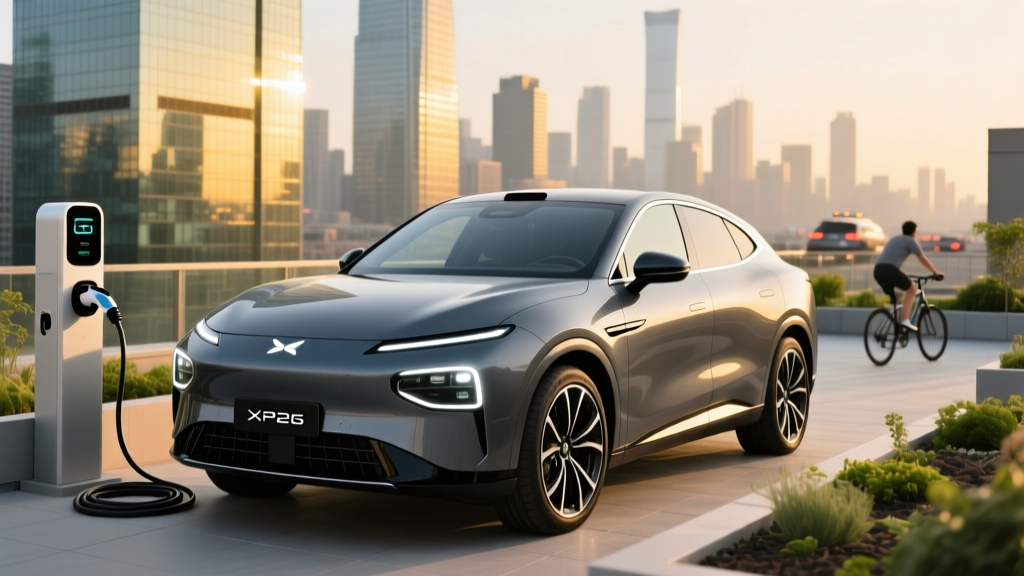
The XPeng G7 is a midsize electric SUV from the Chinese automaker that has been building momentum in international markets. As of early 2026, the G7 is not yet sold in the United States, but XPeng has signaled North American ambitions, and the G7 is widely expected to be a key model if and when the brand launches stateside. This review synthesizes confirmed global-market specifications, announced US plans, and real-world data from European and Asian reviewers to give US shoppers the most complete picture available.
XPeng G7 SUV at a Glance: Projected US Specifications
| Spec | Standard Range (RWD) | Long Range (AWD) |
|---|---|---|
| EPA Range (est.) | ~250–270 mi | ~300–320 mi |
| Battery Capacity | ~66 kWh usable (LFP) | ~87.5 kWh usable (NMC) |
| Battery Chemistry | LFP (CATL) | NMC (CATL) |
| Drivetrain | Rear-Wheel Drive | Dual-Motor AWD |
| Horsepower | ~258 hp | ~480 hp |
| 0–60 mph (est.) | ~6.5 sec | ~3.9 sec |
| Max DC Fast Charge | ~170 kW (peak) | ~280 kW (peak, 800V) |
| 10–80% DC Charge | ~26 min | ~20 min |
| Level 2 Home Charge | 11 kW (~30 mi/hr) | 11 kW (~35 mi/hr) |
| MPGe (est. combined) | ~105 MPGe | ~98 MPGe |
| Efficiency | ~30 kWh/100 mi | ~33 kWh/100 mi |
| Estimated Base MSRP | ~$38,000 | ~$48,000 |
| Battery Warranty (est.) | 8 years / 100,000 mi (projected) | |
These figures are drawn from XPeng's European WLTP data and Chinese-market specifications, converted to EPA-equivalent estimates. WLTP ranges tend to run 10–15% higher than EPA, so we have adjusted downward accordingly. Final US specs may differ once EPA certification is complete.
Range and Efficiency: What to Expect in the Real World
EPA Estimate (Long Range AWD): ~300–320 miles
Real-World Highway (70 mph, moderate temps): ~260–285 miles
Real-World Cold Weather (below 32°F, mixed driving): ~210–240 miles
City/Commuter Driving (mild weather, regen-heavy): ~300+ miles achievable
The LFP Standard Range variant will see more pronounced cold-weather losses — expect 30–40% range reduction in deep winter due to LFP chemistry's lower cold tolerance compared to NMC.
The Long Range AWD variant uses an 87.5 kWh NMC pack supplied by CATL. In European WLTP testing, this variant achieves roughly 570 km (~354 miles), which translates to approximately 300–320 miles under the more conservative EPA cycle. The Standard Range RWD model carries a ~66 kWh LFP battery rated for roughly 480 km WLTP (~250–270 miles EPA-estimated).
Efficiency lands in the mid-pack for the midsize electric SUV segment. At roughly 30–33 kWh per 100 miles, the G7 trails the Tesla Model Y (~28 kWh/100 mi) but runs close to the Ford Mustang Mach-E and Hyundai Ioniq 5. The 800-volt electrical architecture in the Long Range model contributes to better thermal efficiency during fast charging, though it doesn't dramatically change driving consumption.
Charging Speed: 800V Architecture Makes a Difference
| Charging Level | Standard Range (RWD) | Long Range (AWD, 800V) |
|---|---|---|
| Level 1 (120V, 12A) | ~1.4 kW / ~4 mi/hr | ~1.4 kW / ~4 mi/hr |
| Level 2 (240V, 48A) | ~11 kW / ~30 mi/hr | ~11 kW / ~35 mi/hr |
| DC Fast Charge (peak) | ~170 kW | ~280 kW |
| DC 10–80% Time | ~26 minutes | ~20 minutes |
| DC 10–80% Miles Added | ~170 miles | ~225 miles |
| Connector (US expected) | NACS (projected for US market) | |
The Long Range G7's 800-volt architecture is its charging headline. On a 350 kW-capable DC fast charger (such as Electrify America or Ionity stations), the Long Range model peaks near 280 kW and sustains above 200 kW through roughly 60% state of charge before tapering. The 10–80% sprint in approximately 20 minutes is competitive with the Hyundai Ioniq 5 and Porsche Macan Electric, and meaningfully faster than the Tesla Model Y's ~25-minute 10–80% session.
The Standard Range RWD model, constrained by its 400V architecture and smaller pack, peaks around 170 kW. That's adequate for road trips but noticeably slower — plan for 25–28 minute stops on DC fast chargers.
Important charging-curve note: Like all EVs, the G7's charge rate tapers significantly above 80% SoC. Charging from 80–100% on DC can add another 15–20 minutes. For daily driving, set your charge limit to 80% (or 100% for the LFP variant, as LFP chemistry tolerates full charges better than NMC). For road trips, plan your stops to arrive at chargers around 10–15% SoC and depart at 80% to minimize total trip time.
Performance and Driving Dynamics
The dual-motor AWD Long Range variant produces approximately 480 horsepower and hits 0–60 mph in roughly 3.9 seconds — quick enough to match a BMW iX xDrive50 and outrun most midsize SUVs at any price point. The single-motor RWD Standard Range model makes ~258 hp with a 0–60 time around 6.5 seconds, which is adequate for commuting and highway merging but not thrilling.
XPeng has tuned the G7's suspension for comfort over sportiness. European reviewers note well-controlled body motion, a compliant ride over rough pavement, and surprisingly low cabin noise at highway speeds. The steering is light and direct but not particularly communicative — this is a cruiser, not a canyon carver. Regenerative braking offers multiple levels including a one-pedal driving mode that brings the vehicle to a complete stop.
Ground clearance is approximately 7.1 inches, and the G7 is not rated for towing in most markets. If towing capacity matters, the Tesla Model Y (3,500 lbs) or Ford Mach-E (up to 2,200 lbs with the trailer package) remain better choices.
Interior, Cargo Space, and Technology
The G7's cabin follows XPeng's minimalist design language: a 14.96-inch central touchscreen dominates the dashboard, with a 10.2-inch digital instrument cluster behind the wheel. There are minimal physical buttons. The infotainment system runs XPeng's Xmart OS, which supports voice control, over-the-air updates, and a built-in app ecosystem. European-market units support wireless Apple CarPlay and Android Auto; US-market support is expected but unconfirmed.
Passenger and cargo dimensions (global spec):
- Front headroom: ~40.2 inches
- Rear headroom: ~38.8 inches
- Rear legroom: ~38.5 inches — generous for the segment
- Cargo behind rear seats: ~24.7 cu ft
- Cargo with rear seats folded: ~57.3 cu ft
- Frunk (front trunk): ~2.5 cu ft (small, fits a charging cable bag)
Rear-seat space is a genuine strength — the G7 offers more rear legroom than the Tesla Model Y and rivals the Hyundai Ioniq 5. The cargo area is well-shaped but slightly smaller than the Model Y's ~30 cu ft behind the second row. The frunk is disappointingly small; competitors like the Ford Mach-E and Rivian R2 offer more usable front storage.
Driver Assistance: XNGP
XPeng's XNGP (XPeng Navigation Guided Pilot) is a Level 2 driver-assistance system. The driver must remain attentive, keep hands on or near the wheel, and be prepared to take over at any moment. This is not self-driving. XNGP offers adaptive cruise control, lane-centering, automatic lane changes on highways, and navigation-guided on/off-ramp assistance in supported regions. US feature availability and mapping coverage will depend on XPeng's US launch plans and NHTSA compliance.
Pricing, Trims, and Federal Tax Credit Eligibility
| Trim | Est. MSRP | Est. After §30D Credit | Credit Eligibility |
|---|---|---|---|
| Standard Range RWD | ~$38,000 | ~$30,500 (if eligible) | Uncertain — see below |
| Long Range AWD | ~$48,000 | ~$40,500 (if eligible) | Uncertain — see below |
| Long Range AWD Performance | ~$53,000 | ~$45,500 (if eligible) | Uncertain — see below |
Pricing is projected based on European pricing converted to USD with typical market adjustments. The Standard Range RWD model undercuts the Tesla Model Y Long Range by a significant margin, while the Long Range AWD sits in the thick of the midsize EV SUV segment.
Will the XPeng G7 Qualify for the §30D Federal Tax Credit?
This is the biggest unknown for US buyers. Under current IRS §30D rules, eligibility depends on several criteria:
- MSRP cap: SUVs must be priced at or below $80,000 — the G7 clears this easily.
- Buyer income cap: Modified AGI must not exceed $150,000 (single), $225,000 (head of household), or $300,000 (joint).
- Battery component manufacturing: A percentage of battery components must be manufactured or assembled in North America (threshold increases annually).
- Critical minerals sourcing: A percentage of critical minerals must be sourced from the US or FTA partners (threshold increases annually).
- Final assembly: Must occur in North America.
- Foreign Entity of Concern (FEOC): Vehicles with battery components or critical minerals from a FEOC (including many Chinese suppliers) are disqualified.
XPeng is a Chinese automaker using CATL batteries (also Chinese). Unless XPeng establishes North American assembly and secures non-FEOC battery supply chains, the G7 will almost certainly not qualify for the full $7,500 federal tax credit under current rules. This is a significant competitive disadvantage against the Tesla Model Y, Ford Mach-E, and Hyundai Ioniq 5 (all of which qualify for at least partial credits when built in US plants). Consult a tax professional and check the latest IRS clean vehicle credit guidance before making a purchase decision.
XPeng G7 vs. Key Competitors
| Spec | XPeng G7 LR AWD | Tesla Model Y LR | Hyundai Ioniq 5 LR AWD | Ford Mach-E ER AWD |
|---|---|---|---|---|
| EPA Range | ~300–320 mi | 320 mi | 290 mi | 290 mi |
| Battery | 87.5 kWh NMC | 78.1 kWh NMC | 84 kWh NMC | 91 kWh NMC |
| DC Peak kW | ~280 kW | 250 kW | 240 kW | 150 kW |
| 10–80% DC | ~20 min | ~25 min | ~18 min | ~38 min |
| 0–60 mph | ~3.9 sec | 4.8 sec | 5.1 sec | 5.1 sec |
| Cargo (rear up) | ~24.7 cu ft | 30.2 cu ft | 27.2 cu ft | 29.7 cu ft |
| Base MSRP | ~$48,000 | $46,630 | $50,250 | $48,995 |
| §30D Credit | Unlikely | Up to $7,500 | Up to $7,500 | Up to $7,500 |
The G7's 800V charging speed and 0–60 performance are genuine differentiators. However, its smaller cargo area, uncertain US availability, and likely tax-credit ineligibility are substantial headwinds. The Tesla Model Y remains the default recommendation for most buyers in this segment due to Supercharger network access, proven reliability, and full credit eligibility.
- 800V DC fast charging (Long Range) among fastest in segment
- Strong 0–60 performance in AWD variant
- Spacious rear-seat legroom
- Competitive pricing (pre-credit)
- LFP option for Standard Range (better longevity, 100% charge tolerance)
- Modern, minimalist interior with large display
- US availability unconfirmed as of early 2026
- Almost certainly ineligible for §30D federal tax credit
- Smaller cargo area than Model Y and Mach-E
- Tiny frunk
- No established US service/dealer network
- Charging network access uncertain (no Supercharger access guaranteed)
- No US safety ratings yet (NHTSA/IIHS)
Who Should Consider the XPeng G7 SUV?
- XPeng confirms US sales and establishes a service network in your area
- You prioritize fast DC charging speed for frequent road trips
- You want a premium-performing AWD electric SUV under $50,000 (pre-credit)
- Rear-seat passenger comfort matters more than maximum cargo volume
- You're willing to forgo the federal tax credit for a potentially lower base price
- You need guaranteed Supercharger or established public charging network access
- Federal tax credit eligibility is essential to your budget
- You want a proven US service and parts network
- Maximum cargo space or towing capacity is a priority
- You need NHTSA/IIHS safety ratings before purchasing
Warranty Coverage
XPeng has not published US-specific warranty terms, but based on European and Chinese coverage, the projected US warranty package is:
- Basic vehicle: 5 years / 75,000 miles (estimated)
- Battery and powertrain: 8 years / 100,000 miles (estimated, with minimum 70% capacity retention threshold)
- Roadside assistance: 5 years (estimated)
The 8-year/100,000-mile battery warranty matches the industry standard set by most competitors, including Tesla, Hyundai, and Ford. The LFP battery in the Standard Range variant is expected to show less degradation over time than the NMC pack — CATL's LFP cells typically retain 90%+ capacity after 1,000 charge cycles, which translates to well over 200,000 miles of normal use before hitting the 70% warranty threshold.
Frequently Asked Questions
What is the real-world range of the XPeng G7 SUV?
The Long Range AWD variant is estimated at 300–320 miles EPA. In real-world highway driving at 70 mph, expect 260–285 miles. In cold weather below freezing, range may drop to 210–240 miles. The Standard Range RWD is estimated at 250–270 miles EPA, with LFP chemistry suffering greater cold-weather losses.
How fast does the XPeng G7 charge?
The Long Range AWD with 800V architecture peaks at ~280 kW on DC fast chargers, reaching 10–80% in approximately 20 minutes. The Standard Range RWD peaks at ~170 kW with a 10–80% time of about 26 minutes. On a home Level 2 charger (240V, 48A), both variants charge at 11 kW, adding roughly 30–35 miles of range per hour — a full overnight charge from 10% takes about 8–9 hours.
How much does the XPeng G7 cost after tax credits?
Estimated MSRP ranges from ~$38,000 (Standard Range) to ~$53,000 (Performance). However, the G7 is unlikely to qualify for the $7,500 federal §30D tax credit due to Chinese battery sourcing and assembly. Without the credit, effective pricing is the sticker price minus any state or local incentives you may qualify for.
Does the XPeng G7 qualify for the federal EV tax credit?
Almost certainly not under current IRS rules. The §30D credit requires North American final assembly, non-FEOC battery sourcing, and compliance with critical-mineral thresholds. As a Chinese-manufactured vehicle with CATL batteries, the G7 fails multiple requirements. Rules can change — monitor IRS guidance for updates.
Is the XPeng G7 worth buying vs. the Tesla Model Y or Hyundai Ioniq 5?
If and when it launches in the US, the G7's charging speed and performance will be competitive. But without tax credit eligibility, a US service network, or guaranteed Supercharger access, it's a harder recommendation for most American buyers. The Model Y and Ioniq 5 offer proven infrastructure, full credit eligibility, and established resale values. The G7 would need aggressive pricing or a compelling warranty to overcome these gaps.
Will the XPeng G7 have access to Tesla Superchargers?
Unconfirmed. If XPeng adopts the NACS connector for the US market and negotiates access with Tesla, Supercharger compatibility is possible. However, Tesla has not announced partnerships with XPeng. Initially, G7 owners would likely rely on Electrify America, EVgo, ChargePoint, and other public networks.
What battery chemistry does the XPeng G7 use?
The Standard Range RWD uses a CATL-supplied LFP (lithium iron phosphate) battery — known for longer cycle life, better thermal stability, and tolerance for regular 100% charging. The Long Range AWD uses a CATL NMC (nickel manganese cobalt) pack — higher energy density for more range, but best kept between 20–80% for daily use to maximize longevity.