The Wolf Electric Truck at a Glance
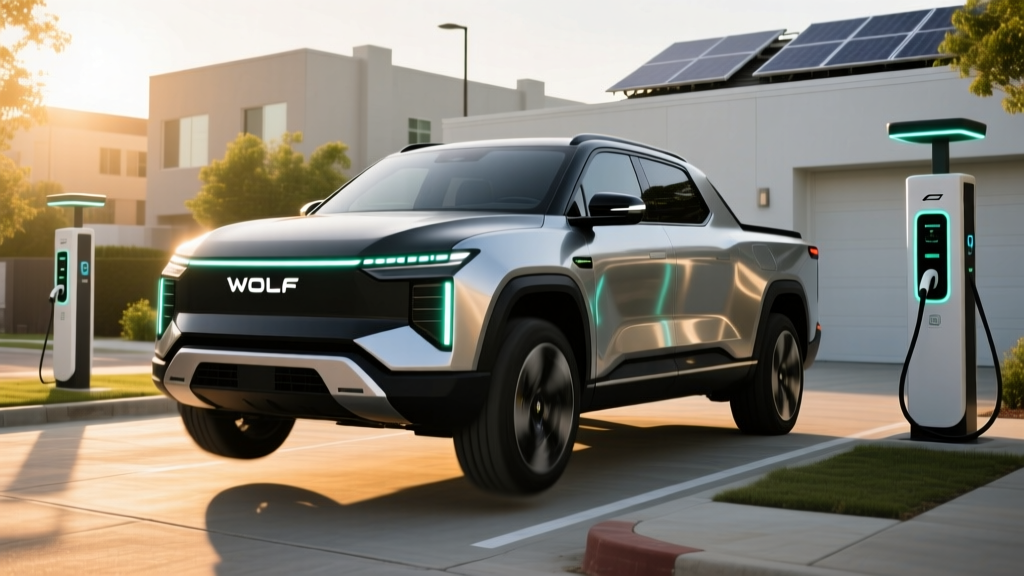
The Wolf is a compact electric pickup from startup Wolf Motor Company, announced with a target base price near $39,000 before incentives. It aims to deliver an EPA-estimated range of approximately 250 miles from a ~85 kWh battery pack, with peak DC fast charging around 150 kW. As of early 2026, the Wolf remains in pre-production/reservation status — it is not yet available for retail delivery. Specs below are based on manufacturer-published preliminary figures and are subject to change before production begins. Buyers should treat all numbers as estimates until EPA certification and independent testing are complete.
What the Wolf Electric Truck Actually Is
The Wolf is a unibody compact electric pickup positioned squarely between the Ford Maverick Hybrid and the Rivian R1T in both size and ambition. Wolf Motor Company — a California-based EV startup — has designed the truck around a skateboard-style platform with a single rear-motor (RWD) or dual-motor (AWD) configuration. The bed is roughly 5 feet, and the overall footprint is closer to a midsize SUV than a traditional body-on-frame pickup.
The value proposition is straightforward: a sub-$40,000 electric truck with usable range, basic towing capability, and a footprint small enough for urban parking. Whether Wolf Motor Company can actually deliver at that price point — given the supply-chain realities and capital requirements that have felled competitors like Lordstown Motors and Fisker Inc. — is the central question for prospective reservation holders.
| Spec | Wolf RWD (Base) | Wolf AWD |
|---|---|---|
| Est. Base MSRP | $39,000 | $46,000 |
| Battery Capacity (usable) | ~85 kWh (NMC est.) | ~85 kWh (NMC est.) |
| EPA Range (est./preliminary) | ~250 mi | ~230 mi |
| Peak DC Fast Charge | ~150 kW | ~150 kW |
| 10–80% Charge Time (est.) | ~35–40 min | ~35–40 min |
| Level 2 Charge Rate | ~11.5 kW | ~11.5 kW |
| Motor Output | ~210 hp / 295 lb-ft | ~350 hp / 440 lb-ft (combined) |
| 0–60 mph (est.) | ~7.5 sec | ~5.5 sec |
| Towing Capacity (est.) | ~3,500 lbs | ~5,000 lbs |
| Payload (est.) | ~1,200 lbs | ~1,100 lbs |
| Battery/Powertrain Warranty | 8 yr / 100,000 mi (target) | 8 yr / 100,000 mi (target) |
Note: All figures above are manufacturer-preliminary and have not been independently verified or EPA-certified as of publication. Source: Wolf Motor Company press materials.
Real-World Range: What to Actually Expect
The preliminary 250-mile EPA estimate for the RWD model is a useful benchmark, but real-world results will vary — often significantly — based on driving conditions:
EPA vs. Real-World Range Expectations
- Mild weather, mixed driving (city/highway): ~220–250 mi
- Sustained highway (70–75 mph): ~185–210 mi (aerodynamic drag is the enemy of truck-shaped vehicles)
- Cold weather (below 32°F, no preconditioning): ~155–185 mi (expect 25–35% loss without a heat pump or garage preconditioning)
- Towing (near max capacity): ~110–140 mi (towing roughly halves range in most EVs)
The boxy truck silhouette creates more aerodynamic drag than a sedan or crossover, which is why highway and cold-weather range loss is more pronounced. If your commute is 80+ miles round-trip with highway driving, the Wolf's real-world range may feel tight in winter without access to reliable mid-route charging.
Preconditioning the battery while plugged in — warming it to optimal temperature before departure — can recover a significant portion of cold-weather range. Whether Wolf's software will support scheduled preconditioning at launch is unconfirmed.
Charging Speeds and Infrastructure Reality
A 150 kW peak DC fast-charge rate puts the Wolf behind the class leaders. The Hyundai Santa Fe Pickup concept and Rivian R1T both support higher peak rates (R1T at up to 200+ kW on newer packs). At 150 kW peak, expect the charge curve to taper meaningfully above 80% SoC — the last 20% could take as long as the first 50%.
| Charging Level | Power (kW) | Miles of Range Added per Hour | Typical Use Case |
|---|---|---|---|
| Level 1 (120V household) | ~1.4 kW | ~4–5 mi/hr | Emergency / trickle only |
| Level 2 (240V home/public) | ~11.5 kW | ~35–40 mi/hr | Daily home charging (~7 hr for full charge) |
| DC Fast Charge (peak) | ~150 kW | ~450+ mi/hr (at peak) | Road trips; 10–80% in ~35–40 min |
Home Charging Setup Costs
If you plan to charge at home — which is how the vast majority of EV charging happens — budget for a Level 2 installation. The Wolf's ~11.5 kW onboard charger means you'll want a 48-amp hardwired wall connector on a 60-amp circuit to get full speed.
| Component | Low Estimate | High Estimate |
|---|---|---|
| Level 2 EVSE (48A hardwired) | $400 | $750 |
| Electrician labor (2–6 hrs) | $600 | $2,400 |
| Permit & inspection | $50 | $300 |
| Electrical panel upgrade (if needed, 200A) | $1,500 | $4,000 |
| Total (no panel upgrade) | $1,050 | $3,450 |
| Total (with panel upgrade) | $2,550 | $7,450 |
Always hire a licensed electrician for a site assessment before purchasing equipment. Your home's existing panel capacity, the distance from panel to garage, and local permit requirements will determine your actual cost.
Wolf vs. Gas and Hybrid Trucks: Cost Comparison
The Wolf's most direct competitors aren't other electric trucks — it's the compact gas and hybrid pickups that dominate this segment. Here's how the numbers stack up against the Ford Maverick Hybrid and the Hyundai Santa Cruz (gas):
| Category | Wolf RWD (est.) | Ford Maverick Hybrid | Hyundai Santa Cruz (AWD) |
|---|---|---|---|
| Base MSRP | $39,000 | $28,995 | $30,550 |
| Fed. Tax Credit (§30D, est.) | Up to $7,500* | $0 | $0 |
| Effective Purchase Price | ~$31,500* | $28,995 | $30,550 |
| 5-Yr Fuel/Energy Cost | ~$3,800 (home charging) | ~$6,500 (42 MPG combined) | ~$9,200 (23 MPG combined) |
| 5-Yr Maintenance (est.) | ~$1,200 | ~$2,800 | ~$3,200 |
| 5-Yr Insurance (est.) | ~$9,500 | ~$7,200 | ~$7,500 |
| 5-Yr Total (purchase + fuel + maint. + ins.) | ~$46,000 | ~$45,495 | ~$50,450 |
*Tax credit eligibility depends on MSRP caps, buyer income limits, battery sourcing requirements, and point-of-sale transfer rules under IRS §30D. As a startup, Wolf's battery supply chain may not yet meet critical-mineral or component sourcing thresholds. Do not assume full credit eligibility — verify with a tax professional.
The Wolf's energy-cost advantage is real if you charge primarily at home on residential electricity rates (~$0.13–$0.18/kWh national average). At 3.5–4.0 miles per kWh, a full charge costs roughly $22–$31 at home. That same distance in the Santa Cruz at $3.40/gallon costs about $37–$42. The gap widens further with solar-charged electricity or time-of-use rates.
However, EV insurance premiums run 15–25% higher than equivalent gas vehicles due to repair complexity and battery replacement costs. The Wolf's startup status adds uncertainty — insurers may price in higher risk until claims data accumulates.
Federal Tax Credit Eligibility: What You Must Know
The IRS §30D Clean Vehicle Credit offers up to $7,500 for qualifying new EVs, but eligibility in 2026 is governed by strict, multi-layered rules:
- MSRP cap: Pickup trucks must be ≤$80,000 — the Wolf clears this easily.
- Buyer income cap: Modified AGI must not exceed $150,000 (single), $225,000 (head of household), or $300,000 (joint).
- Battery component sourcing: A percentage of battery components must be manufactured or assembled in North America (threshold increases annually).
- Critical minerals: A percentage of critical minerals must be sourced from the U.S. or free-trade-agreement partners.
- Point-of-sale transfer: The credit can be applied at purchase to reduce the transaction price, but the dealer must be IRS-registered.
- Final assembly: Must occur in North America.
For a startup like Wolf Motor Company, the battery sourcing and critical-mineral requirements are the biggest unknowns. Until Wolf publishes its supply-chain compliance documentation and appears on the IRS/Fueleconomy.gov qualifying list, treat the $7,500 credit as aspirational, not guaranteed.
Common Misconceptions About the Wolf
| Myth | Fact |
|---|---|
| "The Wolf is available to buy now." | As of early 2026, the Wolf is in pre-production with reservations open. No retail deliveries have occurred. |
| "It qualifies for the full $7,500 tax credit." | Unconfirmed. Battery sourcing compliance has not been verified by the IRS. Check fueleconomy.gov before purchasing. |
| "250 miles of range is enough for a truck." | For daily commuting and light errands, yes. For towing, road trips through charging deserts, or cold-weather driving, expect 150–185 real-world miles. |
| "I can charge from any standard outlet overnight." | Level 1 (120V) adds only ~4–5 miles per hour. An 85 kWh battery would take 60+ hours from empty. Level 2 (240V) is effectively mandatory for daily use. |
| "EVs need no maintenance." | EVs eliminate oil changes and have fewer moving parts, but tires, brakes, cabin filters, suspension, and cooling systems still require service. Budget ~$200–$300/year. |
| "The battery will need replacement in 5 years." | Modern NMC batteries typically retain 85–90% capacity after 100,000 miles. Wolf targets an 8-year/100,000-mile battery warranty with a ≥70% capacity retention threshold. |
First-Time EV Buyer Checklist: Is the Wolf Right for You?
Decision Framework
Reserve the Wolf if:
- You have home Level 2 charging access (garage or driveway with 240V circuit)
- Your daily round-trip commute is under 120 miles
- You want a compact truck for urban/suburban use, not heavy towing
- You're comfortable with startup risk (delayed production, limited service network, uncertain resale value)
- You don't need a truck immediately — production timelines for startups frequently slip 12–24 months
Look at the Ford Maverick Hybrid or Hyundai Santa Cruz instead if:
- You need a truck this year with a proven dealer/service network
- You lack reliable home charging and your area has limited public DC fast chargers
- You regularly tow more than 2,000 lbs or drive in extreme cold
- You need predictable ownership costs and strong resale value
- The $10,000+ price premium over a Maverick Hybrid isn't offset by your fuel savings timeline
Consider the Rivian R1T or Chevrolet Silverado EV if:
- You need proven production, higher towing capacity, and an established service network
- Your budget extends to $70,000+
- You want faster DC charging (200+ kW) and more verified range
Startup Risk: The Elephant in the Room
Wolf Motor Company joins a long line of EV startups attempting to bring affordable vehicles to market. The track record for this segment is mixed: Lordstown Motors ceased operations after failing to deliver the Endurance at scale; Fisker Inc. filed for bankruptcy in 2024; Bollinger Motors pivoted away from its original B1/B2 truck. Rivian is the notable success story, but it launched with significantly more capital and a premium price point.
Key risks for Wolf reservation holders:
- Production delays: 12–36 month delays are common for undercapitalized startups.
- Spec changes: Final production specs (range, power, features) often differ from pre-production announcements.
- Service network: No established dealer or service-center footprint at launch. Mobile service or third-party partnerships are likely but unproven.
- Resale value: Startup EVs carry significant depreciation risk until brand longevity is established.
- Reservation deposit: Confirm whether your deposit is fully refundable and under what terms.
Frequently Asked Questions
When will the Wolf Electric Truck actually be available?
Wolf Motor Company has not confirmed a firm retail delivery date as of early 2026. The company has targeted production commencement, but startup timelines frequently shift. Reservation holders should expect updates directly from the company and should not plan vehicle replacement around an unconfirmed date.
How much does it cost to charge the Wolf at home per month?
Assuming 1,000 miles/month of driving at ~3.8 miles per kWh, you'd consume roughly 263 kWh monthly. At the national average residential rate of ~$0.15/kWh, that's approximately $39/month — compared to ~$90/month for the Maverick Hybrid (at 42 MPG and $3.40/gal) or ~$148/month for the Santa Cruz AWD (at 23 MPG). Your actual cost depends on local electricity rates and whether you have access to time-of-use or solar pricing.
Can the Wolf tow a trailer or boat?
Preliminary estimates suggest 3,500 lbs for the RWD and 5,000 lbs for the AWD — adequate for a small boat, light utility trailer, or pop-up camper. However, towing significantly reduces range. Expect real-world range to drop to 110–140 miles when towing near maximum capacity. If towing is a primary use case, the Rivian R1T (up to 11,000 lbs) or a hybrid/gas truck is a more practical choice.
Will the Wolf work in cold climates?
All EVs lose range in cold weather — typically 25–35% below freezing without preconditioning. A heat pump (if equipped) and battery preconditioning can mitigate some of this loss. If you live in a region with sustained sub-freezing winters and lack garage parking, plan for 155–185 real-world miles from the Wolf in winter and ensure you have reliable charging access at home and along your routes.
Is the Wolf eligible for the $7,500 federal EV tax credit?
Not confirmed. The Wolf's MSRP clears the $80,000 truck cap, and assuming North American final assembly, the price and assembly requirements are met. However, the battery component sourcing and critical-mineral requirements under §30D are stringent and increase annually. Wolf Motor Company has not published supply-chain compliance documentation. Check the DOE/EPA qualifying vehicle list and consult a tax professional before counting on the credit.
What happens if Wolf Motor Company goes out of business?
This is a real risk with any startup. If the company ceases operations, parts availability, software updates, warranty service, and resale value would all be severely impacted. Some protections exist through third-party component suppliers and independent EV repair shops, but body panels, proprietary electronics, and battery modules could become difficult or impossible to source. Weigh this risk seriously when placing a deposit.