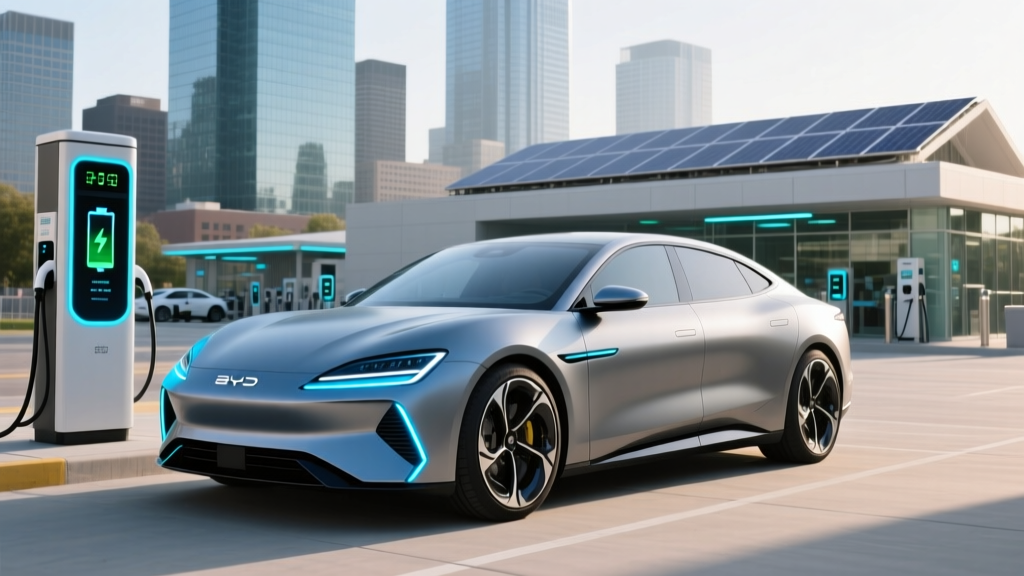
BYD sells more plug-in vehicles than any other automaker on Earth. In 2025, the Chinese giant moved over 4 million new-energy vehicles globally, outselling Tesla in pure BEV volume for multiple consecutive quarters. Yet for American EV shoppers, the question remains frustratingly open: will BYD ever come to us?
The short answer entering 2026 is no — not as a direct consumer brand, and not without a dramatic shift in US trade policy. But BYD's vehicles are real, compelling, and already reshaping EV markets in Europe, Southeast Asia, Australia, and Latin America. Understanding what BYD builds, what it costs, and why it's locked out of the US market is essential context for any American EV buyer weighing their options today.
This profile examines BYD's most globally relevant models — the Seal sedan, Atto 3 (Yuan Plus) crossover, and Dolphin hatchback — with the exact specs, pricing, and ownership data US buyers would care about, alongside a clear-eyed analysis of the tariff and regulatory barriers that keep them off American roads.
BYD's Global Lineup: What American Buyers Are Missing
BYD's current export portfolio centers on three models built on its e-Platform 3.0 architecture, all using the company's proprietary Blade Battery — a lithium iron phosphate (LFP) cell design that prioritizes safety, longevity, and cost over the energy density of nickel-manganese-cobalt (NMC) packs used by many competitors.
| Spec | BYD Seal (AWD Excellence) | BYD Atto 3 (Extended Range) | BYD Dolphin (Extended Range) |
|---|---|---|---|
| Body Style | Mid-size sedan | Compact SUV | Subcompact hatchback |
| Battery (usable) | 82.5 kWh LFP Blade | 60.5 kWh LFP Blade | 60.4 kWh LFP Blade |
| Drivetrain | Dual-motor AWD | Single-motor FWD | Single-motor FWD |
| Horsepower | 523 hp combined | 201 hp | 201 hp |
| 0–60 mph | 3.8 sec | 7.3 sec | 7.0 sec |
| WLTP Range | ~323 mi (520 km) | ~261 mi (420 km) | ~264 mi (425 km) |
| Est. EPA Range* | ~275–290 mi | ~220–235 mi | ~225–240 mi |
| Max DC Fast Charge | 150 kW | 88 kW | 88 kW |
| 10–80% DCFC Time | ~26 min | ~29 min | ~29 min |
| Level 2 AC Charge | 11 kW (~37 mi/hr) | 7 kW (~24 mi/hr) | 7 kW (~24 mi/hr) |
| Length / Wheelbase | 189.0 in / 111.8 in | 176.2 in / 105.5 in | 163.0 in / 104.3 in |
| Cargo Volume | 14.1 cu ft (trunk) + frunk | 15.6 cu ft (rear seats up) | 12.2 cu ft (rear seats up) |
| Global Price (approx.) | €48,000 (~$52,000) | €38,000 (~$41,000) | €36,000 (~$39,000) |
*Estimated EPA range based on typical WLTP-to-EPA conversion factor of ~85–90%. BYD does not publish EPA figures as these vehicles are not sold in the US. Source: BYD Global specifications.
Range, Efficiency, and Real-World Expectations
Because BYD vehicles are not EPA-certified for US sale, there are no official fueleconomy.gov listings for these models. The ranges above are estimates derived from WLTP test cycles, which run slower and shorter than EPA procedures and typically overstate range by 10–15% relative to American testing.
WLTP sticker: ~323 mi | Estimated EPA equivalent: ~275–290 mi
Expect in practice: ~240–260 mi on sustained highway driving at 70+ mph; ~200–220 mi in freezing temperatures with cabin heat. The LFP Blade Battery's flat voltage curve means range depletion is more linear than NMC packs, but cold-weather losses of 20–30% are typical for all LFP chemistries without aggressive battery preconditioning.
The BYD Seal's efficiency in European testing lands around 16.6 kWh/100 km (roughly 105 MPGe combined) — competitive with a Tesla Model 3 Long Range but slightly behind the Hyundai Ioniq 6's class-leading 140 MPGe. The Atto 3 and Dolphin, as taller, less aerodynamic vehicles, achieve roughly 95–100 MPGe combined.
Charging Speed: The Blade Battery Trade-Off
BYD's LFP Blade Battery is engineered for safety (it passes nail-penetration tests without thermal runaway) and cycle life (BYD claims 5,000+ charge cycles before significant degradation). The trade-off is DC fast-charging speed. LFP cells accept charge more slowly than NMC, and BYD's current e-Platform 3.0 vehicles peak at 150 kW for the Seal and just 88 kW for the Atto 3 and Dolphin.
| Charging Level | BYD Seal | Atto 3 / Dolphin | Miles Added per Hour |
|---|---|---|---|
| Level 1 (120V / 12A) | ~1.4 kW | ~1.4 kW | ~4–5 mi/hr |
| Level 2 (240V / 32A) | 7–11 kW | 7 kW | ~24–37 mi/hr |
| DC Fast Charge (peak) | 150 kW | 88 kW | N/A (session-based) |
| 10–80% DCFC Time | ~26 min | ~29 min | — |
For context, a Hyundai Ioniq 5 with its 800V architecture peaks at 240 kW and hits 10–80% in roughly 18 minutes. A Tesla Model 3 on a V3 Supercharger peaks at 250 kW. BYD's charging speeds are adequate for overnight home charging and occasional road trips, but they fall behind the current class leaders for DC fast charging — a meaningful disadvantage on long American highway drives where 350 kW chargers are increasingly common.
The charge curve on BYD's LFP packs is relatively flat through 60% SoC, then tapers significantly above 80%. Plan for 25–30 minutes for a 10–80% session on a sufficiently powerful DC charger, but expect a full 10–100% charge to take 45+ minutes due to the steep taper in the final 20%.
Why BYD Isn't Sold in the US: Tariffs, Politics, and Sourcing Rules
The barriers keeping BYD out of the American market are not technical — they are political and economic.
1. The 100%+ Tariff Wall. In May 2024, the Biden administration raised tariffs on Chinese-made EVs from 25% to 100% under Section 301 trade provisions. This tariff was designed explicitly to prevent Chinese EVs from undercutting domestic manufacturers. A $35,000 BYD Dolphin would cost over $70,000 after tariffs land — eliminating the price advantage that makes BYD disruptive in other markets. As of early 2026, this tariff remains in effect under the Trump administration, with no indication of reversal.
2. Federal Tax Credit Exclusion. Under IRS §30D rules, the $7,500 federal EV tax credit requires battery components and critical minerals to be sourced from the US or free-trade-agreement partners. Chinese-manufactured batteries and minerals are explicitly disqualified. Even if BYD sold in the US, its vehicles would not qualify for the credit, further eroding any price competitiveness.
3. National Security Scrutiny. Chinese-made vehicles face growing scrutiny over connected-car data collection, software security, and potential ties to the Chinese government. In 2024, the Commerce Department proposed rules to ban Chinese-connected vehicle software and hardware from US roads entirely — a regulation that would affect BYD even if tariff barriers were removed.
4. No US Dealer or Service Network. BYD has made no public announcements about establishing a US dealer network, parts distribution, or certified service infrastructure. Building this from scratch takes years and billions of dollars — an investment that makes no sense under the current tariff regime.
How BYD Stacks Up Against US-Available Competitors
If BYD's models were available in the US without tariffs, here is how they would compare against the vehicles American buyers can actually purchase today:
| Spec | BYD Seal AWD | Tesla Model 3 LR AWD | Hyundai Ioniq 6 Limited AWD | BMW i4 xDrive40 |
|---|---|---|---|---|
| Est. EPA Range | ~275–290 mi | 341 mi | 270 mi | 282 mi |
| Battery | 82.5 kWh LFP | 75 kWh NMC | 77.4 kWh NMC | 81.5 kWh NMC |
| 0–60 mph | 3.8 sec | 4.2 sec | 5.1 sec | 4.6 sec |
| Peak DCFC | 150 kW | 250 kW | 240 kW | 205 kW |
| 10–80% DCFC | ~26 min | ~25 min | ~18 min | ~31 min |
| Global MSRP | ~$52,000 | $42,380 | $49,250 | $57,900 |
| US Tax Credit | None | $7,500 (partial) | $7,500 | $7,500 |
The BYD Seal is competitive on performance and price globally, but the Tesla Model 3 offers more EPA-verified range, faster charging, access to the Supercharger network, and potential tax credit eligibility. The Ioniq 6 charges dramatically faster. In a tariff-free world, the Seal would be a solid mid-tier option — but not a segment disruptor in the US.
The Atto 3 and Dolphin face a different calculus. At their global prices (~$39,000–$41,000), they compete with the Chevrolet Equinox EV, Nissan Leaf successor, and base Hyundai Kona Electric. But US-market competitors in this segment offer better EPA range, faster charging, dealer support, and tax credit access. BYD's price advantage only exists because Chinese domestic manufacturing costs are artificially low relative to US production.
Ownership, Warranty, and Long-Term Battery Durability
In markets where BYD is sold, the company offers a generous battery warranty: 8 years / 160,000 km (~100,000 miles) with a capacity retention threshold of 70%. Some European markets receive an 8-year/125,000-mile warranty. The vehicle bumper-to-bumper warranty is typically 6 years / 150,000 km.
The Blade Battery's LFP chemistry is a genuine long-term advantage. LFP cells degrade more slowly than NMC — real-world data from Chinese BYD taxis and fleet vehicles shows less than 10% capacity loss after 200,000+ miles. This is consistent with LFP's known cycle-life advantage: 3,000–5,000 full charge cycles versus 1,000–2,000 for typical NMC cells.
However, BYD has no US service infrastructure, no parts warehouses, and no certified technician network. Even if you could import a BYD, maintaining it would be a significant challenge. This is a non-starter for most buyers who need reliable warranty service and collision repair.
Who Would a BYD Suit — and Who Should Look Elsewhere?
- Urban commuters in markets with affordable electricity and limited highway driving — the Dolphin and Atto 3 excel here with low running costs and adequate range.
- Fleet and rideshare operators who prioritize low acquisition cost, LFP longevity, and high utilization over fast-charging speed.
- Families in Europe and Asia who want a well-equipped EV at a price point below Tesla and legacy European brands.
- No purchase path — BYD is not available, and importing one is impractical and legally complex.
- Slower DC charging than US-market competitors — a real disadvantage for road trips across American distances.
- No service network — even grey-market imports would lack parts and warranty support.
- No tax credit — Chinese-sourced batteries disqualify BYD from §30D under current IRS rules.
- US competitors are strong — the Equinox EV, Model 3, Ioniq 5, and ID.4 offer verified EPA range, NACS/CCS charging compatibility, and established dealer networks.
Could BYD Enter Through a Back Door?
Industry analysts have floated several hypothetical entry strategies:
Mexican manufacturing. BYD has reportedly explored building a factory in Mexico, which could theoretically allow vehicles to enter the US under USMCA trade rules. However, US lawmakers have preemptively pushed for rules that would block this pathway, and USMCA rules of origin require significant North American content. This is unlikely before 2029.
Commercial vehicles first. BYD already sells electric buses and heavy trucks globally. A commercial-vehicle-first strategy could build brand awareness and service infrastructure without triggering the same political backlash as consumer cars. BYD electric buses already operate in limited US transit fleets.
Technology licensing. BYD's Blade Battery and e-Platform technology could be licensed to established automakers — similar to how Toyota has partnered on battery tech. This would generate revenue without requiring a direct US consumer presence.
None of these pathways guarantee that American consumers will be able to buy a BYD-badged car in the foreseeable future. The tariff wall, data-security regulations, and political climate all point to continued exclusion.
Frequently Asked Questions
Will BYD ever sell cars in the United States?
Not under current trade policy. The 100% tariff on Chinese-made EVs, combined with federal tax credit sourcing exclusions and connected-vehicle security regulations, makes US market entry economically and legally impractical. BYD has not announced any US launch timeline.
Can I import a BYD vehicle to the US myself?
Technically, you can petition NHTSA for a vehicle import, but the process requires the vehicle to meet all Federal Motor Vehicle Safety Standards (FMVSS), which BYD's export models are not certified for. The cost and complexity make this unrealistic for individual buyers. Vehicles over 25 years old are exempt, but BYD's EV lineup is far newer than that.
How does BYD's Blade Battery compare to Tesla's LFP packs?
Both use lithium iron phosphate chemistry. BYD's Blade Battery uses a unique cell-to-pack design with long, thin blade-shaped cells that serve as structural members, improving pack-level safety and space utilization. Tesla sources LFP cells primarily from CATL for its standard-range models. Both chemistries offer excellent cycle life and thermal stability, but BYD's structural integration is a packaging innovation Tesla doesn't use in the same way.
Why is BYD so cheap in other countries?
BYD vertically integrates its entire supply chain — it mines lithium, manufactures cells, builds semiconductors, and assembles vehicles. This vertical integration, combined with lower Chinese labor costs and government subsidies for the EV supply chain, allows BYD to price 20–40% below European and American competitors in global markets. That cost advantage disappears under a 100% US tariff.
What's the best US-available alternative to a BYD vehicle?
For a BYD Seal alternative: the Tesla Model 3 Long Range or Hyundai Ioniq 6 offer similar size, better charging, and EPA-verified range. For a BYD Atto 3 alternative: the Hyundai Kona Electric or Chevrolet Equinox EV provide comparable crossover utility with US dealer support. For a BYD Dolphin alternative: the Nissan Leaf (next-gen) or Chevrolet Bolt EV/EUV successor fills the affordable hatchback segment.
Does BYD qualify for the $7,500 federal EV tax credit?
No. Even if BYD sold vehicles in the US, the IRS §30D tax credit requires battery components to be manufactured in North America and critical minerals to be sourced from the US or FTA partners. BYD's Chinese-manufactured supply chain fails both requirements. Additionally, the credit has MSRP caps ($55,000 for sedans, $80,000 for SUVs/trucks) and buyer income limits ($150,000 single / $300,000 joint) that would further complicate eligibility.