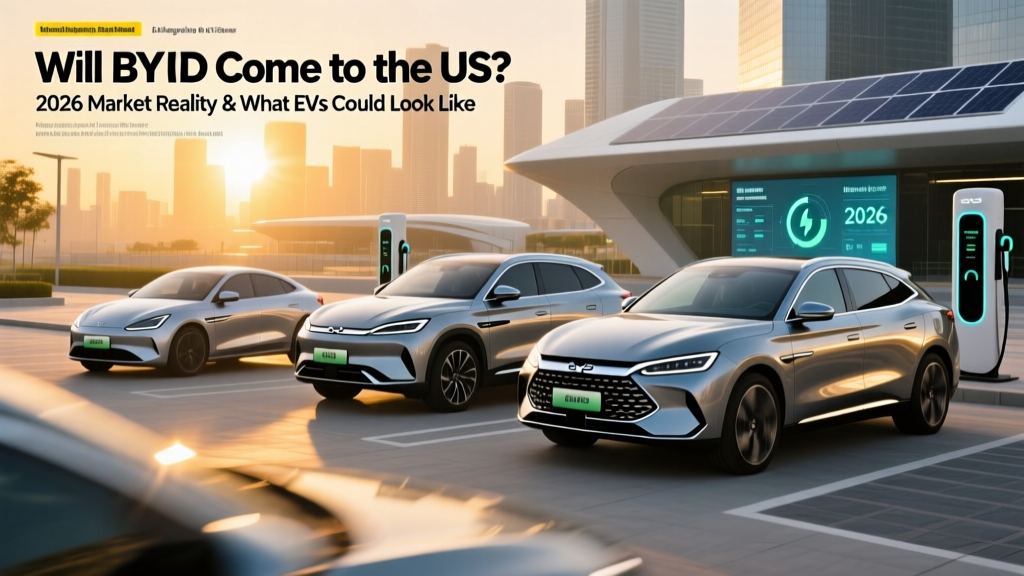
If you've followed the global EV market, you already know BYD (Build Your Dreams) is the world's largest plug-in electric vehicle manufacturer, trading market-share punches with Tesla across China, Europe, Southeast Asia, and Latin America. Yet in the United States, BYD passenger vehicles remain conspicuously absent. The question — will BYD come to us? — has circulated in EV forums for years. In 2026, the answer is finally coming into focus, and it's more nuanced than a simple yes or no.
This guide breaks down the tariff landscape, the federal tax-credit math under IRS §30D, the BYD models most likely to cross the Pacific, and the real specs American buyers would see. We'll also compare BYD's lineup against the domestic and Korean competitors already fighting for the same buyers.
The Short Answer: BYD's US Status in 2026
As of early 2026, BYD does not sell passenger cars or SUVs in the United States. The company maintains a US presence through its Lancaster, California electric bus manufacturing facility and a growing commercial-vehicle footprint, but its consumer EV lineup — the Seal, Atto 3, Dolphin, Han, Tang, and the ultra-affordable Seagull — remains officially unavailable to American retail buyers.
That doesn't mean BYD has abandoned the idea. The company has publicly stated it is evaluating a US entry, but three formidable barriers stand in the way:
- Section 301 tariffs: Chinese-manufactured EVs face a 100% import tariff as of 2024, effectively doubling the sticker price of any BYD shipped from Shenzhen or Xi'an.
- IRS §30D tax-credit exclusion: Under the Inflation Reduction Act, any vehicle containing battery components from a "foreign entity of concern" (FEOC) — which includes Chinese manufacturers — is disqualified from the up-to-$7,500 federal credit. This applies regardless of where the car is assembled.
- Dealer and service infrastructure: BYD would need to build a US retail and parts network from scratch, a multi-year, multi-billion-dollar undertaking.
The BYD Models Americans Want Most
Based on global sales data and US-market search interest, four BYD models generate the most "when can I buy it?" demand. Here's what we know about their specs from international markets, translated to what a hypothetical US-spec version might offer.
| Model | Battery (kWh) | WLTP Range | Est. EPA Range | Max DC Charge | 0-60 mph | Global Price (USD equiv.) |
|---|---|---|---|---|---|---|
| BYD Seagull (Dolphin Mini) | 38.9 / 44.9 LFP | 252 mi | ~210 mi | 40 kW | ~11.0 sec | $10,000–$13,000 |
| BYD Dolphin | 60.4 LFP | 265 mi | ~225 mi | 88 kW | 7.0 sec | $28,000–$34,000 |
| BYD Atto 3 | 58.56 / 69.98 LFP | 260 mi | ~220 mi | 88 kW | 7.3 sec | $33,000–$40,000 |
| BYD Seal (AWD Performance) | 82.5 LFP | 323 mi | ~275 mi | 150 kW | 3.8 sec | $45,000–$52,000 |
| BYD Tang (AWD) | 108.8 LFP | 310 mi | ~260 mi | ~120 kW | 4.4 sec | $55,000–$65,000 |
Note: WLTP range figures are from BYD's international press materials. Estimated EPA ranges apply a ~15% reduction, consistent with observed WLTP-to-EPA conversion ratios. Actual EPA certification would require US-market testing.
What BYD's Blade Battery Brings to the Table
BYD's defining technology is its Blade Battery — a proprietary cell-to-pack lithium iron phosphate (LFP) design that uses elongated, blade-shaped cells arranged directly in the pack without intermediate modules. This architecture delivers two major advantages:
- Safety: LFP chemistry is inherently more thermally stable than nickel-manganese-cobalt (NMC). BYD's Blade Battery has passed nail-penetration tests without thermal runaway — a claim few NMC packs can make.
- Longevity: LFP cells typically endure 3,000+ full charge cycles before degrading to 80% capacity, compared to 1,000–2,000 cycles for many NMC chemistries. For an owner driving 12,000 miles per year, that translates to well over 200,000 miles before significant range loss.
The trade-off is energy density: LFP packs are heavier per kWh than NMC, which is why the BYD Seal carries a 82.5 kWh pack but achieves less range than a Tesla Model 3 Long Range with a smaller NMC pack. For most buyers, the durability and safety benefits outweigh the weight penalty.
Charging Speed: BYD's Weak Point vs. Competitors
Here's where BYD's lineup reveals a real limitation for the US market. American buyers expect fast DC charging — the Hyundai Ioniq 5 peaks at 240 kW, the Tesla Model Y at 250 kW, and the Porsche Taycan at 320 kW. BYD's current fleet tops out at 150 kW on the Seal, with most models limited to 88 kW or less.
| Vehicle | Max DC kW | 10–80% Time | Level 2 (kW) | Connector |
|---|---|---|---|---|
| BYD Atto 3 | 88 kW | ~40 min | 7 kW | CCS2 (intl) |
| BYD Seal AWD | 150 kW | ~26 min | 11 kW | CCS2 (intl) |
| Hyundai Ioniq 5 (US) | 240 kW | ~18 min | 10.9 kW | NACS/CCS |
| Tesla Model Y LR (US) | 250 kW | ~20 min | 11.5 kW | NACS |
| Chevrolet Equinox EV (US) | 150 kW | ~30 min | 11.5 kW | NACS |
On a US road trip using Electrify America or Tesla Superchargers, a BYD Atto 3 owner would spend roughly 40 minutes charging from 10% to 80% — nearly double the time an Ioniq 5 driver needs. The charge curve also tapers significantly above 80% state of charge (SoC), meaning topping off for the last leg of a trip adds disproportionate time. For daily commuting with overnight Level 2 home charging, this isn't an issue. For cross-country travel, it's a real friction point.
Additionally, BYD's international vehicles use the CCS2 connector standard (European). A US-spec BYD would need to adopt either CCS1 or, more likely in 2026, the NACS (Tesla) connector to access the broadest charging network. BYD has not confirmed which connector a US model would use.
The Tariff and Tax-Credit Problem
This is the section that matters most for anyone asking whether BYD will come to the US. Even if BYD solved the logistics of shipping cars stateside, the economics break down at two levels.
100% Section 301 Tariff on Chinese EVs
Effective 2024, the Biden administration raised the Section 301 tariff on Chinese-manufactured electric vehicles from 25% to 100%. A BYD Dolphin that retails for roughly $30,000 in China would face a $30,000 import duty, pushing the landed cost above $60,000 before dealer markup, shipping, and compliance modifications. This tariff applies to vehicles assembled in China regardless of brand.
IRS §30D Federal Tax Credit Disqualification
Under the Inflation Reduction Act's clean vehicle credit rules, any EV with battery components manufactured or assembled by a foreign entity of concern (FEOC) is ineligible for the $7,500 credit. Since BYD manufactures its own Blade Battery cells in China — and China is designated as an FEOC jurisdiction — every BYD vehicle would fail this requirement regardless of where final assembly occurs.
- ✅ Final assembly in North America — BYD has no US/Mexico/Canada plant for passenger vehicles
- ❌ Battery components NOT from FEOC — BYD Blade Battery is made in China (FEOC)
- ❌ Critical minerals from approved sources — BYD sources minerals primarily from Chinese supply chains
- ✅ MSRP under cap ($55,000 sedans / $80,000 SUVs/trucks) — Would depend on model
- ✅ Buyer income under cap ($150K single / $300K joint) — Buyer-dependent
Result: Even with North American assembly, the battery-sourcing FEOC rule alone would disqualify BYD from the credit. Source: IRS.gov §30D guidance.
Could BYD Build Cars in the US or Mexico?
The logical workaround to the tariff problem is local manufacturing. BYD has explored this path:
- Mexico: BYD announced plans to build a factory in Mexico, which could theoretically serve the US market under USMCA trade rules. However, Mexico has faced US political pressure to restrict Chinese EV manufacturing, and any Mexican-assembled BYD would still face the FEOC battery-sourcing disqualification for the tax credit.
- United States: BYD's Lancaster, CA facility builds electric buses but is not configured for passenger vehicles. Converting or building a new plant would require a multi-billion-dollar investment and years of lead time — a bet BYD has not committed to as of 2026.
- Brazil and Thailand: BYD has active passenger-vehicle plants in both countries. While these avoid the China-specific tariff, vehicles from these plants would still face standard US auto import duties (2.5% for cars) and the FEOC battery-component rules for tax-credit eligibility.
Bottom line: there is no near-term manufacturing pathway that gives BYD both tariff-free access AND tax-credit eligibility in the US market.
BYD vs. US Competitors: A Reality Check
If BYD somehow overcame the regulatory hurdles, which US-market vehicles would it compete against? Here's how the BYD Seal stacks up against the Tesla Model 3 and Hyundai Ioniq 6 — its most direct rivals in the midsize electric sedan segment.
| Spec | BYD Seal AWD | Tesla Model 3 LR AWD | Hyundai Ioniq 6 AWD |
|---|---|---|---|
| Battery | 82.5 kWh LFP | ~75 kWh NMC | 77.4 kWh NMC |
| EPA Range (est./actual) | ~275 mi (est.) | 341 mi | 270 mi |
| Max DC Charge | 150 kW | 250 kW | 240 kW (350 kW capable) |
| 10–80% Charge Time | ~26 min | ~20 min | ~18 min |
| 0–60 mph | 3.8 sec | 4.2 sec | 5.1 sec |
| Horsepower | 523 hp | 346 hp | 320 hp |
| Base MSRP (US) | Not available | $47,740 | $46,700 |
| Federal Tax Credit | Ineligible (FEOC) | Up to $7,500* | Up to $7,500* |
*Tax credit eligibility depends on buyer income, MSRP caps, and battery-sourcing compliance. Verify at IRS.gov and fueleconomy.gov.
The BYD Seal wins on raw horsepower and acceleration, but loses meaningfully on range and charging speed — two metrics US buyers prioritize for daily usability. The Tesla Model 3 offers 66 more miles of EPA-rated range and charges nearly 100 kW faster at peak. On a road trip from Denver to Moab, that's the difference between a comfortable stop and a cramped one.
BYD Strengths (If It Came to the US)
- Blade LFP battery — exceptional cycle life and thermal safety
- Competitive pricing in global markets (before tariffs)
- Strong acceleration in AWD trims (Seal: 3.8 sec 0-60)
- Rotating center infotainment screen, premium interior materials
- Broad model range from subcompact (Seagull) to 3-row SUV (Tang)
BYD Weaknesses for US Buyers
- Slow DC charging vs. 800V competitors (88–150 kW vs. 240–350 kW)
- No US sales, service, or parts network
- 100% tariff makes pricing non-competitive
- Ineligible for $7,500 federal tax credit (FEOC battery rule)
- Lower EPA-estimated range than US rivals in same segment
- No confirmed NACS connector adoption for Supercharger access
What Would Need to Change for BYD to Enter the US
For BYD to realistically sell passenger EVs in America, several conditions would need to align — and none of them are within BYD's sole control:
- Tariff reduction or exemption: A trade agreement between the US and China lowering the 100% EV tariff. No such negotiations are active in 2026.
- Non-Chinese battery sourcing: BYD would need to source battery cells from a non-FEOC supplier (e.g., CATL's non-China plants, LG Energy Solution, or Panasonic) to qualify for the tax credit. This would undermine BYD's vertical-integration cost advantage.
- North American assembly plant: A dedicated passenger-vehicle factory in the US, Mexico, or Canada — a $2–5 billion investment with a 3–5 year timeline.
- Dealer and service network: Either a traditional franchise-dealer rollout or a direct-to-consumer model (which faces legal challenges in many US states).
- NACS connector adoption: With Tesla opening the Supercharger network to NACS-equipped vehicles, BYD would need to adopt the connector to remain competitive on charging convenience.
Who Would Buy a BYD in the US — If It Were Available?
Even with the regulatory headwinds, certain buyer profiles would find BYD compelling if the pricing worked:
- Budget-conscious commuters: The BYD Dolphin and Seagull, if priced competitively, would fill the sub-$30,000 EV gap that the Chevrolet Bolt EV left behind. City commuters who charge at home and rarely road-trip would tolerate the slower DC charging.
- LFP-curious buyers: Owners who prioritize battery longevity over peak range — planning to keep their EV 10+ years — would value the Blade Battery's cycle-life advantage.
- Performance-sedan shoppers: The Seal AWD's 523 hp and 3.8-second 0-60 at a potentially lower price point than a Model 3 Performance would attract enthusiasts, if the charging speed weren't a dealbreaker.
Frequently Asked Questions
Will BYD sell cars in the US in 2026 or 2027?
No. BYD has not announced a US passenger-vehicle launch date, and the 100% tariff on Chinese EVs combined with tax-credit ineligibility makes a near-term entry economically unviable. BYD's US operations remain limited to commercial electric buses and trucks.
Why is BYD not sold in the United States?
Three factors: (1) a 100% Section 301 tariff on Chinese-manufactured EVs that doubles the import cost, (2) IRS §30D rules that disqualify any vehicle with FEOC-sourced battery components from the $7,500 federal tax credit, and (3) the absence of a US retail, service, and parts network.
Is BYD's Blade Battery better than Tesla's battery?
It depends on the metric. BYD's Blade Battery (LFP) offers superior thermal safety and longer cycle life (3,000+ cycles to 80% capacity) compared to most NMC chemistries. However, Tesla's NMC and LFP packs (sourced from CATL and Panasonic) achieve higher energy density, translating to more range per kWh. For longevity and safety, Blade wins. For range efficiency, Tesla's packs currently lead.
Can I import a BYD from China or Europe myself?
Practically, no. Individual vehicle imports must meet EPA emissions standards, NHTSA safety regulations (FMVSS), and DOT bumper standards. BYD's international models are not FMVSS-certified, and the importation process for non-conforming vehicles is prohibitively expensive and complex for consumer vehicles. The 100% tariff would also apply.
Does BYD make any vehicles available in the US today?
BYD manufactures electric buses at its Lancaster, California facility, and sells commercial electric trucks and forklifts in the US market. These are fleet/commercial products, not consumer vehicles. You cannot buy a BYD passenger car or SUV in the United States as of 2026.
What's the cheapest BYD electric car, and what would it cost in the US?
The BYD Seagull (also called Dolphin Mini in some markets) starts at approximately $10,000 in China. With the 100% tariff, shipping, compliance modifications, and dealer markup, a US-spec Seagull would likely cost $35,000–$45,000 — eliminating the price advantage that makes it a global bestseller. Without tariff reform, BYD's most affordable model cannot compete in the US on price.
Sources: BYD international press materials, IRS §30D Clean Vehicle Credit guidance, fueleconomy.gov, US Trade Representative Section 301 tariff schedules. All specs based on international-market data; US-spec figures are estimates pending EPA certification. Tax-credit rules current as of 2026 and subject to change.