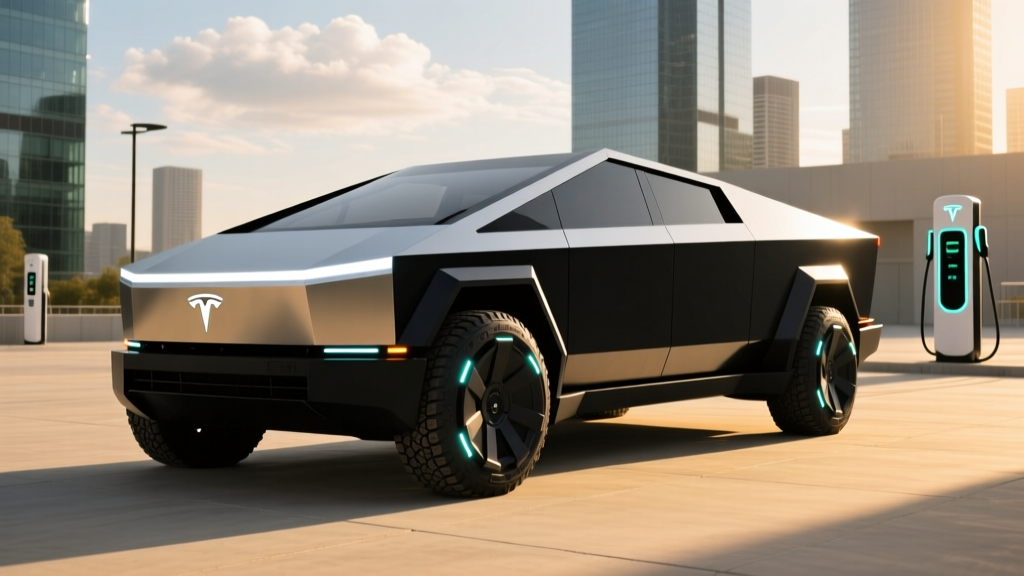
If you have spent any time in EV forums or Tesla fan communities over the past year, you have almost certainly encountered renders, rumors, and heated debates about a widebody Cybertruck — a hypothetical variant of Tesla's angular electric pickup with flared fenders, wider track width, and room for larger tires. The concept taps into a genuine tension in the Cybertruck lineup: the production truck's narrow bed and relatively tight wheel wells limit its utility for off-road enthusiasts, overlanders, and anyone who wants a more aggressive stance. But as of early 2026, Tesla has not announced, teased, or confirmed a widebody Cybertruck variant.
This article separates what is verified about the current Cybertruck platform from what is speculative about a potential widebody version. We will cover real specs you can buy today, the engineering case for a wider variant, aftermarket options that already exist, and what a factory widebody might cost if Tesla ever greenlights it.
Current Cybertruck Lineup: The Baseline for Any Widebody Variant
Before evaluating a hypothetical widebody model, you need the hard numbers on the Cybertrucks Tesla actually sells. The 2026 lineup carries over from the late-2025 refresh with three main configurations.
| Spec | Long Range AWD | Dual Motor AWD | Cyberbeast (Tri-Motor) |
|---|---|---|---|
| EPA Range | ~340 mi | ~340 mi | ~320 mi |
| Battery (usable, est.) | ~123 kWh, NMC | ~123 kWh, NMC | ~123 kWh, NMC |
| Horsepower | 600 hp | 600 hp | 845 hp |
| 0–60 mph | 4.1 sec | 3.9 sec | 2.6 sec |
| Max DC Fast Charge | 250 kW | 250 kW | 250 kW |
| 10–80% DCFC Time | ~27 min | ~27 min | ~27 min |
| Level 2 Charge Rate | 11.5 kW (~37 mi/hr) | 11.5 kW (~37 mi/hr) | 11.5 kW (~37 mi/hr) |
| Towing Capacity | 11,000 lb | 11,000 lb | 11,000 lb |
| Bed Length | 72 in (6 ft) | ||
| Base MSRP (est. 2026) | $79,990 | $84,990 | $99,990 |
| Battery/Drive Warranty | 8 yr / 120,000 mi | ||
The Widebody Cybertruck Rumor: Origins and What It Would Actually Mean
The widebody Cybertruck concept originated in independent renderings by automotive designers on Instagram and YouTube channels in late 2024, gaining traction after a handful of patent filings by Tesla were discovered that referenced wider fender structures — though those patents related to general manufacturing processes, not a specific widebody model. By mid-2025, aftermarket companies like Unplugged Performance and Delta4x4 began offering bolt-on fender flare kits and suspension widening components, which further fueled speculation that Tesla might offer a factory version.
A true factory widebody Cybertruck would likely involve:
- Wider fender flares adding 2–4 inches per side to accommodate 35-inch or larger all-terrain tires
- Revised suspension geometry with wider control arms or spacer lifts for increased track width
- Reinforced bed structure to handle the additional unsprung mass and off-road loads
- Potentially larger battery pack to offset the weight and aerodynamic drag penalty of wider tires and increased frontal area
From an engineering standpoint, widening the truck would add an estimated 200–400 pounds of curb weight and increase the drag coefficient. Both factors reduce range. A realistic estimate for a widebody variant based on the current Dual Motor AWD platform would put EPA range somewhere in the 290–310 mile window — a meaningful drop from the standard 340 miles.
Aftermarket Widebody Kits: What Exists Right Now
Since Tesla has not released a factory widebody Cybertruck, owners seeking a wider stance are turning to the aftermarket. As of early 2026, several companies offer solutions:
| Provider | Type | Approx. Width Added | Price Range | Notes |
|---|---|---|---|---|
| Unplugged Performance | Bolt-on fender flares | ~2 in per side | $2,500–$4,000 | Carbon fiber or ABS plastic; may require wheel spacer kit |
| Delta4x4 | Full widebody conversion | ~3–4 in per side | $8,000–$14,000 | Includes suspension lift, wheel spacers, flares |
| CMC Off-Road | Fender flare + rock slider kit | ~2 in per side | $3,000–$5,500 | Designed for 35-in tire fitment |
| Custom fabricators | Full custom widebody | Varies | $15,000–$30,000+ | One-off builds; warranty implications significant |
A critical caveat: modifying the Cybertruck's body and suspension will almost certainly void portions of Tesla's New Vehicle Limited Warranty, particularly for suspension, drivetrain, and battery-related claims if Tesla determines the modification contributed to a failure. Always get written clarification from your service center before proceeding.
Charging and Efficiency: What a Widebody Would Change
Charging hardware on the current Cybertruck is well-documented, and a widebody variant would almost certainly carry over the same architecture.
| Level | Power / Voltage | Rate | Use Case |
|---|---|---|---|
| Level 1 (120V) | ~1.4 kW | ~4–5 mi/hr | Emergency trickle; not practical for daily use |
| Level 2 (240V, 48A) | 11.5 kW | ~37 mi/hr | Home charging; full charge overnight in ~10 hours |
| DC Fast Charge | Up to 250 kW | 10–80% in ~27 min | Road trips; charge curve tapers significantly above 80% |
The charge curve matters here. The Cybertruck peaks near 250 kW between roughly 10% and 35% state of charge, then progressively tapers. By 60% SoC, you are typically seeing 150–170 kW; above 80%, speeds drop below 75 kW. This means a 10–80% session takes about 27 minutes, but pushing to 90% or 100% can add another 20–25 minutes. For road-trip planning, plan your stops around the 10–80% window for maximum efficiency.
A widebody Cybertruck with larger, more aggressive tires would also see its efficiency drop. The current Dual Motor AWD achieves roughly 2.0–2.2 kWh per mile (approximately 50–45 MPGe equivalent in combined driving, per fueleconomy.gov). Wider all-terrain tires could push consumption to 2.3–2.5 kWh per mile — a 10–15% penalty that directly reduces real-world range and increases charging costs.
Pricing, Tax Credits, and What a Widebody Might Cost
The current Cybertruck lineup is priced at a premium, and a factory widebody variant would sit at or above the top of the range.
| Trim | Base MSRP | §30D Federal Credit | Effective Price | Credit Eligibility Notes |
|---|---|---|---|---|
| Long Range AWD | $79,990 | Up to $7,500 | ~$72,490 | Eligible if buyer income ≤ $150K single / $300K joint; truck MSRP under $80K cap for trucks; battery sourcing must meet 2026 critical-minerals and component requirements per IRS §30D |
| Dual Motor AWD | $84,990 | $0 | $84,990 | Exceeds $80,000 MSRP cap for trucks under §30D — NOT eligible for federal credit |
| Cyberbeast | $99,990 | $0 | $99,990 | Exceeds MSRP cap — NOT eligible |
| Widebody (hypothetical) | $89,990–$109,990 (est.) | $0 (likely) | Full MSRP | Almost certainly exceeds $80K truck MSRP cap |
This is a critical point for buyers: the §30D credit for trucks, vans, and SUVs has an $80,000 MSRP cap. Only the base Long Range AWD Cybertruck at $79,990 qualifies, and only if your adjusted gross income falls under the thresholds ($150,000 single filer, $225,000 head of household, $300,000 joint). Battery component and critical-mineral sourcing requirements also apply and change annually. Consult a tax professional and verify current-year rules on IRS.gov before counting on the credit.
A factory widebody Cybertruck, if it ever arrives, would almost certainly be priced above the $80,000 threshold, meaning buyers would pay full MSRP. Factor in likely pricing in the $90,000–$110,000 range for a properly equipped widebody model, and this becomes a niche, premium product.
Performance, Tech, and the Ownership Experience
Everything that defines the current Cybertruck ownership experience would carry over to a widebody variant — for better and worse.
Performance: Even the base Long Range AWD delivers 600 horsepower and a 4.1-second 0–60 time. The Cyberbeast's 845 hp and 2.6-second sprint remain among the quickest accelerations of any production vehicle. A widebody's added weight might add 0.1–0.3 seconds to these times — negligible in practice.
Driver Assistance: All Cybertrucks ship with Tesla's Enhanced Autopilot, which is an SAE Level 2 driver-assistance system. This means the driver must remain fully engaged — hands on the wheel (or torque-sensing confirmation), eyes on the road — at all times. Full Self-Driving (Supervised) is available as a $8,000 add-on or $99/month subscription, but it remains Level 2 despite its name. It does not make the vehicle autonomous.
Interior and Cargo: The Cybertruck seats five with 34.7 inches of rear legroom — adequate for adults on shorter trips but tight compared to a Ford F-150 Lightning or Rivian R1T. The 6-foot bed offers roughly 74 cubic feet of volume with the tonneau cover closed, and the lockable "frunk" adds 7.1 cubic feet of secure front storage. A widebody variant would not change interior dimensions but could offer slightly wider bed access between the wheel wells if the fender flares are external-only.
Notable Drawbacks: The stainless-steel exoskeleton is prone to fingerprint smudges and shows minor dents differently than painted steel. The steer-by-wire system, while precise, has a learning curve and eliminates traditional road feedback. The yoke-style steering wheel is polarizing and not universally preferred for low-speed maneuvering. Visibility out the rear is limited by the sloped bed cover, making the camera system essential for parking and towing.
Cybertruck vs. the Competition: Where It Stands
| Attribute | Cybertruck Dual Motor AWD | Ford F-150 Lightning Extended Range | Rivian R1T Dual-Motor Max | Chevrolet Silverado EV 4WT |
|---|---|---|---|---|
| EPA Range | 340 mi | 320 mi | 380 mi | 440 mi |
| Starting MSRP | $84,990 | $76,995 | $89,900 | $78,900 |
| Towing | 11,000 lb | 10,000 lb | 11,000 lb | 12,500 lb |
| Max DC Charge | 250 kW | 150 kW | 220 kW | 350 kW |
| Bed Length | 72 in | 67 in (5.5 ft) | 54 in (4.5 ft) | 72 in (5 ft 11 in) |
| Widebody Option? | Aftermarket only | No | No | No |
The Cybertruck's advantage remains its combination of range, performance, and distinctive design. The Rivian R1T Max offers more range and a more refined interior, while the F-150 Lightning provides a more traditional truck experience with broader dealer support. The Silverado EV leads on range and charging speed but is limited in availability.
Who Should Wait for a Widebody Cybertruck — and Who Shouldn't
- You already own or plan to buy a Cybertruck and want off-road capability with 35-inch tires
- You accept potential warranty limitations and higher insurance premiums for modified vehicles
- You primarily use the truck for overlanding, trail driving, or aesthetic customization
- You need a truck in the next 12 months — there is no announced timeline from Tesla
- You require maximum range — wider tires and added weight will reduce it
- You want §30D tax credit eligibility — a factory widebody will almost certainly exceed the $80K MSRP cap
- You prioritize resale predictability — unannounced variants carry speculative risk
Frequently Asked Questions
Has Tesla officially announced a widebody Cybertruck?
No. As of early 2026, Tesla has made no official announcement, press release, or product page listing for a widebody Cybertruck variant. All available information about a potential widebody model is speculative, based on aftermarket trends, patent filings, and community renders. Tesla has not provided a timeline or pricing for such a model.
What is the real-world range of the current Cybertruck?
The EPA rates the Long Range AWD and Dual Motor AWD at approximately 340 miles, and the Cyberbeast at roughly 320 miles. In real-world highway driving at 70–75 mph, expect 270–295 miles. In cold weather (below 30°F), plan for 240–270 miles. A widebody variant with larger tires would likely see a further 10–15% reduction.
How fast does the Cybertruck charge?
At a DC fast charger, the Cybertruck peaks at 250 kW and charges from 10–80% in approximately 27 minutes. At home on a Level 2 (240V, 48A) charger, it adds roughly 37 miles of range per hour, meaning a full overnight charge is achievable. The charge curve tapers significantly above 80% state of charge.
Does the Cybertruck qualify for the federal EV tax credit?
Only the base Long Range AWD at $79,990 MSRP potentially qualifies for the §30D credit of up to $7,500, and only if the buyer's income falls under IRS thresholds ($150K single, $300K joint) and the vehicle meets 2026 battery sourcing requirements. The Dual Motor AWD ($84,990) and Cyberbeast ($99,990) exceed the $80,000 MSRP cap for trucks and are not eligible. Always verify current rules at IRS.gov and consult a tax professional.
Is a widebody Cybertruck worth waiting for vs. buying now?
If you need a truck now, buy what is available. A factory widebody Cybertruck has no confirmed timeline, no official specs, and no pricing. If you want a wider stance today, aftermarket fender flare kits from companies like Unplugged Performance or Delta4x4 are available for $2,500–$14,000, though they carry warranty and insurance implications.
What are the biggest pros and cons of the Cybertruck?
Pros: Strong range (340 mi EPA on Long Range), exceptional acceleration (2.6 sec Cyberbeast), 11,000-lb towing, stainless-steel durability, Supercharger network access, distinctive design, large front trunk.
Cons: High price with no tax credit on most trims, polarizing yoke steering, limited rear-seat legroom, rear visibility challenges, steer-by-wire learning curve, no factory off-road/widebody variant, stainless-steel fingerprint magnet.