Tesla remains one of the most scrutinized companies in the automotive and energy sectors, and one question surfaces constantly among both investors and prospective EV buyers: why doesn't Tesla pay dividends? Unlike legacy automakers such as Ford or General Motors, which distribute a portion of earnings back to shareholders, Tesla has never issued a dividend — and as of 2026, shows no indication of starting. Understanding this decision matters not only for those holding TSLA stock but also for EV shoppers evaluating Tesla's long-term viability, product pipeline, and pricing trajectory.
This analysis examines Tesla's capital reinvestment strategy, how it directly shapes the vehicles you can buy today, and what the dividend policy signals about the company's priorities heading into 2027.
Tesla's No-Dividend Policy: The Core Reasoning
Tesla's board has consistently maintained that retained earnings generate higher long-term shareholder value when reinvested into manufacturing capacity, battery R&D, software development, and the Supercharger network than they would as quarterly cash payouts. CEO Elon Musk has stated publicly on multiple earnings calls that Tesla is in a "hyper-growth" phase requiring sustained capital expenditure — a characterization that, in 2026, remains difficult to dispute given the company's expanding global footprint.
The financial logic follows a well-established pattern among growth-stage technology companies. Amazon paid no dividend for decades. Alphabet (Google) initiated its first dividend only in 2024. Tesla's annual capital expenditures exceeded $11 billion in 2024 and are projected to remain above $10 billion through 2026, funding:
- New Gigafactory construction and capacity expansion (Shanghai, Berlin, Texas, Mexico)
- Next-generation vehicle platform development (the anticipated sub-$30,000 model)
- 4680 battery cell production scaling
- Full Self-Driving (Supervised) software and neural network training infrastructure
- Energy storage (Megapack) and solar deployment growth
- Supercharger network expansion — now open to NACS-equipped non-Tesla EVs
For context, Ford's dividend yield hovers around 5-6% but the company carries significantly higher debt loads and lower profit margins on its EV division. Tesla's approach prioritizes compounding growth over income distribution.
What Tesla's Capital Strategy Means for the Vehicles You Can Buy
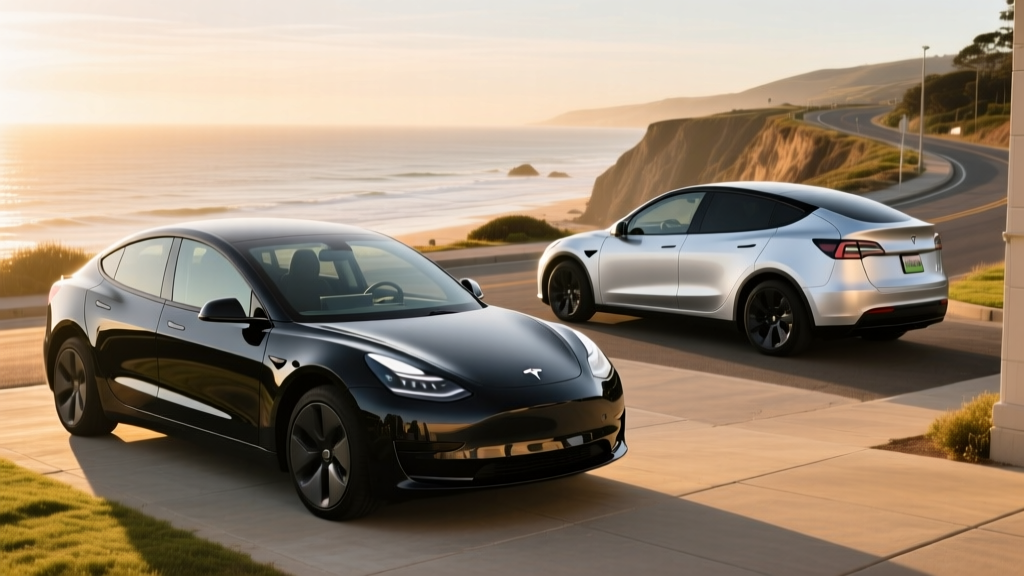
The reinvestment thesis directly shapes Tesla's product lineup. Without diverting billions to shareholder payouts, Tesla funds aggressive price reductions, rapid hardware iteration, and vertical integration that competitors struggle to match. Here is how that translates to the 2026 Tesla lineup most relevant to US buyers.
2026 Tesla Model Y Long Range AWD
| Attribute | Specification |
|---|---|
| EPA Range | 320 miles |
| Battery Capacity | ~78 kWh usable (NMC chemistry, 4680 cells in Austin-built units) |
| Drivetrain | Dual-motor AWD |
| Horsepower | 384 hp combined |
| 0-60 mph | 4.8 seconds |
| Max DC Fast Charge | 250 kW (Supercharger V3/V4) |
| 10-80% DC Charge Time | ~25 minutes |
| Level 2 Home Charge Rate | 11.5 kW / ~37 miles per hour |
| Efficiency | 122 MPGe combined / 27 kWh per 100 miles |
| Cargo Volume | 30.2 cu ft (rear seats up), 72.1 cu ft (rear seats folded) |
| Base MSRP | $44,990 |
| Battery Warranty | 8 years / 120,000 miles (minimum 70% retention) |
Real-World Range Note: The EPA 320-mile figure assumes mixed driving. On sustained highway trips at 75 mph, expect approximately 275-290 miles. In cold weather (below 30°F), range can drop 15-25%, yielding roughly 240-270 miles depending on cabin heating usage and whether you precondition the battery. Tesla's heat pump, standard on all 2026 models, mitigates some cold-weather loss compared to resistive heating systems in older EVs.
2026 Tesla Model 3 Long Range AWD
| Attribute | Specification |
|---|---|
| EPA Range | 341 miles |
| Battery Capacity | ~75 kWh usable (LFP in RWD base; NMC in Long Range) |
| Drivetrain | Dual-motor AWD (Long Range); RWD (base) |
| Horsepower | 346 hp (Long Range AWD) |
| 0-60 mph | 4.2 seconds (Long Range AWD) |
| Max DC Fast Charge | 250 kW |
| 10-80% DC Charge Time | ~22 minutes |
| Level 2 Home Charge Rate | 11.5 kW / ~41 miles per hour |
| Efficiency | 132 MPGe combined / 25 kWh per 100 miles |
| Base MSRP (Long Range) | $42,490 |
| Battery Warranty | 8 years / 120,000 miles |
The Model 3 Long Range remains one of the most efficient EVs on the market, and its pricing reflects Tesla's willingness to compress margins rather than cede market share — a direct consequence of prioritizing growth over dividends.
Charging Infrastructure: Where Reinvested Capital Is Most Visible
Perhaps nowhere is Tesla's reinvestment philosophy more tangible than in the Supercharger network, which as of early 2026 operates over 6,500 stations and 60,000+ individual stalls globally. Tesla has opened the network to non-Tesla vehicles equipped with the NACS (North American Charging Standard) connector, which nearly every major automaker — Ford, GM, Rivian, Hyundai, BMW, and others — has adopted for their 2025+ models.
| Charging Level | Power | Miles Added per Hour | Typical Use Case |
|---|---|---|---|
| Level 1 (120V outlet) | ~1.4 kW | ~3-5 miles | Overnight trickle, emergency |
| Level 2 (240V home/public) | 7.7 - 11.5 kW | 25-44 miles | Daily home charging |
| DC Fast (Supercharger V3) | Up to 250 kW | ~1,000+ mi/hr (peak) | Road trips, 10-80% in ~22-25 min |
| DC Fast (Supercharger V4) | Up to 350 kW (capable) | Higher peak rates | Newer installations, future vehicles |
The charging curve matters: Tesla vehicles peak at 250 kW only at low states of charge (roughly 10-30%). Above 50% SoC, the rate tapers significantly, and above 80%, charging slows dramatically to protect battery longevity. This is why Tesla (and the EPA) quote 10-80% times rather than 0-100% — the final 20% can take as long as the first 70%.
Federal Tax Credit Eligibility: Current 2026 Rules
Tesla's pricing strategy intersects directly with the federal EV tax credit under IRS §30D. For 2026, the credit structure remains complex, and eligibility depends on multiple factors:
- Maximum credit: Up to $7,500 (split: $3,750 for critical minerals + $3,750 for battery component sourcing)
- MSRP caps: Sedans (Model 3) must be ≤ $55,000; SUVs/pickups/vans (Model Y) must be ≤ $80,000
- Buyer income limits: Modified AGI ≤ $150,000 (single), ≤ $225,000 (head of household), ≤ $300,000 (joint)
- Battery sourcing: Increasing percentages of critical minerals and battery components must be sourced from the US or FTA partners — rules that tighten annually through 2029
- Point-of-sale transfer: Buyers can transfer the credit to the dealer for an immediate price reduction at purchase (effective since Jan 1, 2024)
- Foreign entity of concern (FEOC) restrictions: Vehicles with battery components or critical minerals from certain restricted entities may be disqualified
As of 2026, the IRS maintains a list of qualifying vehicles that updates regularly. Tesla Model Y and Model 3 variants have historically qualified for at least a portion of the credit, but battery-sourcing rule tightening means eligibility can shift between model years and even between production batches. Always verify current eligibility on IRS.gov or with a tax professional before relying on the credit in your purchase decision.
| Model | Base MSRP | Est. After $7,500 Credit | Notes |
|---|---|---|---|
| Model 3 RWD | $38,990 | ~$31,490 | Subject to sourcing/income rules |
| Model 3 Long Range AWD | $42,490 | ~$34,990 | Verify current IRS eligibility |
| Model Y Long Range AWD | $44,990 | ~$37,490 | Classified as SUV; $80K MSRP cap |
| Model Y Performance | $49,990 | ~$42,490 | Under $80K cap; sourcing dependent |
How Tesla's Strategy Compares to Legacy Automakers
The dividend question gains clarity when comparing Tesla to competitors who do pay shareholders:
- Ford: Pays a ~5.5% dividend yield but has lost billions on its EV division (Ford Model e), repeatedly restructuring its electrification strategy and delaying models. Capital is split between sustaining ICE profits and funding EVs.
- General Motors: Reinstated dividends after the 2020 pandemic pause, yielding ~1.5-2%. GM has committed heavily to Ultium-based EVs but faces margin pressure and slower-than-expected EV adoption rates.
- Toyota: Modest dividend (~1.5%), but has been notably cautious on full BEVs, favoring hybrids. Toyota's approach preserves shareholder income but risks falling behind in pure EV technology and charging ecosystems.
- Tesla: Zero dividend, but 100% of automotive and energy profits fund vertical integration — from lithium refining to in-house chip design to the Supercharger network. This produces a flywheel effect competitors cannot easily replicate.
For EV buyers, the practical implication is that Tesla's reinvestment funds price competitiveness, software updates, and infrastructure that directly improve ownership experience — even if stockholders do not receive quarterly income.
Who Should Buy a Tesla in 2026?
Choose Tesla if:
- You want access to the most reliable and extensive DC fast-charging network in North America
- You value over-the-air software updates that add features post-purchase
- You prioritize efficiency (kWh per mile) over luxury interior materials
- You are comfortable with a minimalist interior and touchscreen-centric controls
- You want strong resale value supported by brand recognition and Supercharger access
Look at competitors if:
- You prefer a more traditional interior layout with physical buttons and premium materials (consider Hyundai Ioniq 5, BMW i4)
- You need dealer-based service and prefer not to rely on mobile service or limited service centers
- You are uncomfortable with Tesla's Autopilot/FSD naming and want clearly branded Level 2 systems (GM Super Cruise, Ford BlueCruise)
- You want a plug-in hybrid bridge option before committing to full BEV
Pros and Cons of Buying Tesla in 2026
Pros
- Industry-leading Supercharger network now with NACS adoption across the industry
- Best-in-class efficiency — Model 3 achieves up to 132 MPGe combined (per EPA data)
- Aggressive pricing with frequent price cuts and federal tax credit eligibility
- Over-the-air updates continuously improve the vehicle post-purchase
- Strong residual values relative to many EV competitors
- Heat pump standard on all models reduces cold-weather range loss
Cons
- Minimalist interior and lack of physical controls frustrate some drivers
- Service center availability remains limited in rural areas
- Autopilot/FSD (Supervised) is Level 2 driver-assist — NOT self-driving; full attention required at all times
- No Apple CarPlay or Android Auto integration
- Panel gap and build quality inconsistencies, though improving, still draw criticism
- FSD purchase ($8,000 or $99/month) adds significant cost for a system that requires constant supervision
ADAS Level Clarification: Tesla Autopilot and Full Self-Driving (Supervised) are classified as SAE Level 2 driver-assistance systems. The driver must remain fully attentive, hands on or near the wheel, and ready to take over instantly. This is fundamentally different from SAE Level 4 robotaxi services like Waymo, which operate without a human driver in geofenced areas. Tesla's "Full Self-Driving" name is a marketing term, not a technical classification. For details on automation levels, see the NHTSA automated vehicles overview.
Frequently Asked Questions
Why doesn't Tesla pay dividends to shareholders?
Tesla reinvests all earnings into manufacturing expansion, battery R&D, software development, and Supercharger infrastructure. The board and management believe this reinvestment generates higher long-term stock appreciation than quarterly cash payouts would provide. This is consistent with growth-stage technology companies that prioritize compounding capital over income distribution.
Will Tesla ever pay a dividend?
There is no announced plan for a Tesla dividend as of 2026. Dividends typically begin when a company transitions from high-growth to mature-cash-flow status. Given Tesla's ongoing capital expenditure on new factories, next-generation vehicles, and energy storage, a dividend is unlikely in the near term. When Tesla's growth rate normalizes and free cash flow consistently exceeds reinvestment needs, the board may reconsider.
How does Tesla's no-dividend policy affect me as an EV buyer?
Indirectly, it benefits buyers. Reinvested capital funds aggressive pricing, rapid iteration (the refreshed Model 3 "Highland" and Model Y "Juniper" updates), Supercharger expansion, and software improvements. A Tesla paying dividends would likely mean slower product development and higher vehicle prices to maintain margins while distributing cash.
Does the Tesla Model Y qualify for the $7,500 federal tax credit in 2026?
Eligibility depends on current IRS rules regarding battery component sourcing, critical mineral origin, buyer income limits, and MSRP caps. The Model Y, classified as an SUV, falls under the $80,000 MSRP cap. However, battery-sourcing requirements tighten annually, and FEOC (Foreign Entity of Concern) restrictions can disqualify specific production batches. Always check the IRS qualifying vehicle list and consult a tax professional before purchase.
What is the real-world range of the Tesla Model Y in 2026?
The EPA rates the 2026 Model Y Long Range AWD at 320 miles. In real-world highway driving at 70-75 mph, expect approximately 275-290 miles. In cold weather below freezing, range may drop to 240-270 miles even with the heat pump. Preconditioning the battery before driving or charging helps recover some efficiency.
Is Tesla's Supercharger network really better than other charging networks?
By most reliability metrics, yes. Tesla Superchargers consistently report 99%+ uptime, while third-party networks like Electrify America and EVgo have historically struggled with higher failure rates, though they are improving. With NACS adoption, non-Tesla EVs from Ford, GM, Rivian, and others now access Superchargers using adapters (or native NACS ports on 2025+ models), significantly expanding the network's utility.
Should I buy Tesla stock or just buy a Tesla vehicle?
These are separate financial decisions. Tesla stock carries high volatility and is priced for continued growth — the no-dividend policy means returns depend entirely on capital appreciation. As a buyer, the vehicle's value proposition (price, range, charging access, software) should be evaluated independently of stock performance. Many EV buyers choose Tesla products without holding TSLA shares.
The Bottom Line for EV Buyers
Tesla's refusal to pay dividends is not a sign of financial weakness — it is a deliberate capital allocation strategy that directly funds the competitive advantages making Tesla vehicles compelling purchases: aggressive pricing, the Supercharger network, rapid software iteration, and vertical battery manufacturing. For EV shoppers in 2026, the practical takeaway is that Tesla's reinvestment engine continues to produce vehicles with strong range, best-in-class efficiency, and the most robust fast-charging infrastructure available. Whether that strategy eventually transitions to shareholder distributions is a question for investors; for buyers, the products speak for themselves.