The Model S Is Gone From Tesla's New-Car Lineup — Here's Why
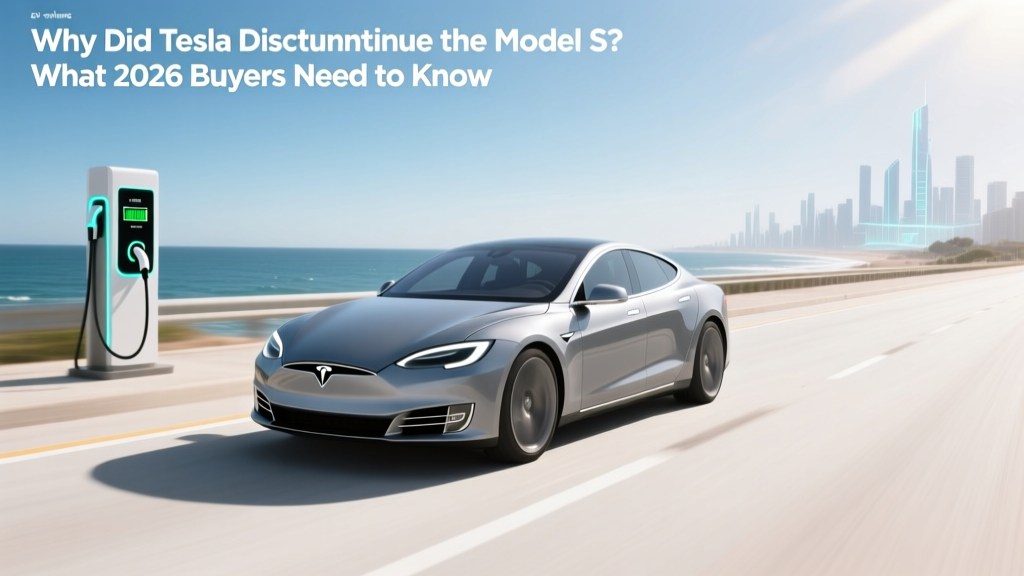
For more than a decade, the Tesla Model S was the benchmark luxury electric sedan. It redefined what an EV could be: 400+ miles of range, sub-2-second 0-60 times in Plaid trim, and over-the-air updates that kept aging hardware feeling fresh. But as of late 2025, Tesla quietly removed the Model S (and its SUV sibling, the Model X) from its new-vehicle configurator in the United States. If you're searching why did Tesla discontinue the Model S, the answer is a convergence of falling demand, platform economics, and a strategic pivot toward higher-volume, lower-cost vehicles.
This article breaks down the specific business and engineering reasons behind the discontinuation, reviews the final 2025 Model S specs for context, and maps out what 2026 buyers should consider instead — whether that's a certified pre-owned Model S, a Tesla Model 3 Performance, or a competitor like the Lucid Air or BMW i5.
The Final Specs: 2025 Tesla Model S at a Glance
Before we get into the "why," let's document what Tesla was selling in the Model S's final model year. These figures reflect the last U.S.-spec Long Range and Plaid trims available through Tesla's configurator before it was pulled.
| Spec | Long Range | Plaid |
|---|---|---|
| EPA Estimated Range | 402 miles | 359 miles |
| Battery (usable, est.) | ~95 kWh, NMC | ~95 kWh, NMC |
| Drivetrain | Dual-Motor AWD | Tri-Motor AWD |
| Horsepower | 670 hp | 1,020 hp |
| 0-60 mph | 3.1 sec | 1.99 sec |
| Top Speed | 155 mph | 200 mph |
| Max DC Fast Charge | 250 kW (peak) | 250 kW (peak) |
| 10-80% DCFC Time | ~27 min | ~27 min |
| Level 2 Charge Rate | 11.5 kW (~44 mi/hr) | 11.5 kW (~44 mi/hr) |
| Efficiency (combined) | 120 MPGe / 28 kWh/100mi | 116 MPGe / 29 kWh/100mi |
| Cargo Volume | 28 cu ft (rear + frunk) | 28 cu ft (rear + frunk) |
| Rear Legroom | 35.4 in | 35.4 in |
| Battery Warranty | 8 yr / 150,000 mi | 8 yr / 150,000 mi |
| Final Base MSRP | $74,990 | $89,990 |
Five Reasons Tesla Killed the Model S
1. Aging Platform Architecture
The Model S debuted in 2012 on an architecture that Tesla refreshed in 2021 with the "Palladium" update (new interior, yoke steering, tri-motor Plaid powertrain, rear entertainment screen). However, the underlying body-in-white, suspension geometry, and electrical architecture remained fundamentally tied to a 2012-vintage design. By contrast, Tesla's newer vehicles (Model Y, Cybertruck, and the refreshed Model 3 "Highland") ride on platforms engineered for modern manufacturing techniques like gigacastings and a 48-volt electrical system. Retooling the Fremont factory's Model S/X line for a ground-up redesign would have required a multi-billion-dollar investment for a low-volume product.
2. Collapsing Sales Volume
At its peak in 2016-2017, Tesla delivered roughly 50,000-55,000 Model S units globally per year. By 2024, combined Model S and Model X deliveries had fallen below 10,000 units annually — a fraction of Tesla's total volume, which exceeded 1.7 million vehicles that year. The luxury sedan segment itself was shrinking as buyers shifted to SUVs and crossovers. Maintaining a dedicated production line, supply chain, and service infrastructure for a vehicle selling fewer than 500 units per month in the U.S. simply stopped making financial sense.
3. Internal Cannibalization From Model 3 and Model Y
The refreshed Model 3 Performance (starting around $52,990 in 2025) delivers 510 hp, a 315-mile EPA range, and a 2.9-second 0-60 time. For most buyers, that performance envelope is indistinguishable from a Model S Long Range in daily driving — at $22,000 less. The Model Y, meanwhile, absorbed the family-hauler use case with more cargo space and a crossover ride height. Tesla effectively made its own flagship sedan redundant.
4. Fierce Competition at the High End
The luxury EV sedan market in 2025-2026 is crowded and capable. The Lucid Air Pure starts under $70,000 with 420 miles of EPA range and a more spacious rear seat. The BMW i5 M60 offers traditional luxury build quality and dealer service. The Mercedes-Benz EQE and Porsche Taycan bring brand cachet the Tesla badge struggles to match in the six-figure segment. Tesla's minimalist interior — praised by enthusiasts but criticized by luxury buyers for panel gaps, material quality, and the absence of physical controls — became a liability against competitors investing heavily in cabin refinement.
5. Strategic Pivot to Mass-Market and Robotaxi
Elon Musk has been explicit since 2024 that Tesla's future growth depends on a next-generation, sub-$30,000 vehicle platform and the company's robotaxi ambitions (the Cybercab concept). Capital expenditure is being directed toward new factories, the Optimus robotics program, and AI compute clusters — not toward a low-volume luxury sedan refresh. The Model S served its purpose: it proved EVs could be desirable, funded Tesla's early growth, and haloed the brand. That mission is complete.
Can You Still Buy a Model S in 2026?
You cannot order a new Model S directly from Tesla as of early 2026. However, the vehicle remains available through three channels:
- Tesla Certified Pre-Owned: Tesla's own used-vehicle inventory frequently lists 2022-2025 Model S examples. CPO vehicles carry a limited warranty extension (typically 2 years / 25,000 miles beyond the original 4-year/50,000-mile bumper-to-bumper) and are inspected by Tesla technicians.
- Independent Used Market: Dealers and private sellers have 2020-2025 Model S inventory. Prices for a 2023 Long Range typically range from $52,000 to $62,000 depending on mileage and condition, per Kelley Blue Book and CarGurus data.
- Remaining New Inventory: A small number of 2025 Model S units may remain at Tesla delivery centers or third-party dealers as unregistered new stock. These are increasingly rare.
Charging the Model S: Speeds and Real-World Expectations
The final Model S uses Tesla's proprietary NACS (North American Charging Standard) connector, which has since been adopted industry-wide. Charging performance is strong but not class-leading in 2026, where competitors like the Hyundai Ioniq 5 and Lucid Air offer 350 kW or 800-volt architectures.
| Charging Level | Power / Voltage | Miles Added per Hour | Notes |
|---|---|---|---|
| Level 1 (120V household) | ~1.4 kW | ~4-5 mi/hr | Emergency/top-up only |
| Level 2 (240V home) | 11.5 kW | ~44 mi/hr | Full charge in ~9 hours |
| DC Fast (Tesla Supercharger V3) | 250 kW peak | ~180 mi in 15 min | 10-80% in ~27 min |
| DC Fast (third-party NACS) | Up to 250 kW | Varies by station | Charge curve tapers above 60% |
Charge curve reality: The 250 kW peak is not sustained across the full session. The Model S typically holds peak rate from roughly 10-30% State of Charge, then steps down to ~150 kW through 60%, and further tapers to ~60-80 kW from 80-100%. A 10-80% session takes approximately 27 minutes at a V3 Supercharger; a 10-95% session can stretch past 45 minutes. Plan road-trip stops accordingly — leaving at 80% saves significant time versus topping off.
Model S vs. 2026 Alternatives: What Should You Buy Instead?
If the Model S is off your new-car shopping list, here's how the leading alternatives stack up for 2026 buyers seeking a luxury electric sedan or performance EV.
| Vehicle | EPA Range | 0-60 mph | Starting MSRP | §30D Credit Eligible? |
|---|---|---|---|---|
| Tesla Model 3 Performance | 315 mi | 2.9 sec | ~$52,990 | Yes (if income/sourcing met) |
| Lucid Air Pure | 420 mi | 5.0 sec | ~$69,900 | No (MSRP > $55K cap) |
| BMW i5 eDrive40 | 295 mi | 5.7 sec | ~$67,795 | No (MSRP > $55K cap) |
| Porsche Taycan (base) | 283 mi | 4.5 sec | ~$92,250 | No (MSRP > $55K cap) |
| Mercedes EQE 350+ | 305 mi | 6.2 sec | ~$74,900 | No (MSRP > $55K cap) |
The uncomfortable truth for luxury EV sedan buyers: none of the direct Model S competitors qualify for the $7,500 federal new-EV credit either, because all exceed the $55,000 sedan MSRP cap. The only Tesla sedan that currently qualifies is the Model 3 (Long Range RWD and certain trims). This is a structural issue with §30D, not a Model S problem — but it matters for your budget.
- Vehicle MSRP must be ≤ $55,000 for sedans, ≤ $80,000 for SUVs/trucks/vans
- Buyer AGI must be ≤ $150,000 (single) or ≤ $300,000 (joint)
- Battery must meet critical-mineral and component-sourcing thresholds (phased annually)
- Credit can be transferred to the dealer at point of sale as a price reduction
- Rules change annually — verify at IRS.gov qualified vehicle list
Who the Model S Was For — And Who Should Look Elsewhere
The Model S was ideal for: Performance-oriented drivers who wanted a luxury sedan with supercar acceleration (Plaid), Tesla Supercharger network access for road trips, and the tech-forward appeal of Autopilot and over-the-air updates. Its 28 cu ft of cargo space (including the frunk) made it practical for small families, and the 402-mile range minimized charging stops on long trips.
Who should look elsewhere in 2026:
- Families needing three-row seating: The Model X (also discontinued) or a Tesla Model Y, Kia EV9, or Rivian R1S is more appropriate.
- Buyers wanting the latest platform tech: The Model S's 2012 bones mean no 800V architecture, no gigacast structural battery pack, and a ride quality that falls short of newer luxury competitors.
- Budget-conscious buyers: A used Model S is attainable, but maintenance on an aging air suspension, out-of-warranty battery replacement ($15,000-$22,000 estimated), and higher insurance premiums add up. The Model 3 or a Hyundai Ioniq 6 offers 90% of the experience at 50% of the cost.
- Buyers prioritizing luxury build quality: Lucid, BMW, Mercedes, and Porsche all surpass Tesla in interior materials, NVH (noise/vibration/harshness), and panel consistency.
The Biggest Pros and Cons of the Final Model S
Pros
- Class-leading 402-mile EPA range (Long Range)
- Absurd 1.99-sec 0-60 (Plaid) — still among the fastest production cars ever made
- Access to Tesla's Supercharger network (now open to other brands, but Tesla vehicles still get the most seamless experience)
- Spacious 28 cu ft cargo capacity with usable frunk
- Over-the-air updates kept the car current for years
- Strong 8-year / 150,000-mile battery warranty
Cons
- Aging platform — 2012 architecture with 2021 refresh only
- Yoke steering controversial and not universally available
- 250 kW peak DC charging lags behind 350 kW competitors
- Interior material quality criticized vs. Lucid, BMW, Mercedes
- No longer in production — parts and service may become slower
- Never qualified for the $7,500 federal new-EV credit
- Rear-seat comfort and headroom trail the Lucid Air and BMW i5
Tech, Driver Assists, and What FSD Actually Does
The final Model S ships with Tesla's current-generation Autopilot hardware (HW4 cameras and processor). Standard features include Traffic-Aware Cruise Control, Autosteer (lane centering), and automatic emergency braking. The optional Full Self-Driving (Supervised) package ($8,000 or $99/month at the time of discontinuation) adds Navigate on Autopilot (highway on/off-ramp automation), Auto Lane Change, Autopark, and Smart Summon.
Despite the "Full Self-Driving" name, Tesla's FSD (Supervised) is an SAE Level 2 driver-assistance system. The driver must remain fully attentive, keep hands on the wheel (or demonstrate engagement via camera monitoring), and be prepared to take over at any moment. It is not autonomous driving. Only Level 4 services like Waymo's robotaxi operate without a human driver — and those are limited to geofenced urban areas. Never treat FSD as a substitute for active driving.
The 17-inch center touchscreen handles infotainment, climate, and vehicle settings. A rear 8-inch screen provides entertainment and climate controls for back-seat passengers. The gaming-capable processor can run titles at a quality approaching a PlayStation 4, a quirky differentiator that owners either love or ignore entirely.
Frequently Asked Questions
Is Tesla bringing back the Model S?
As of early 2026, Tesla has not announced any plans to revive the Model S nameplate on a new platform. Elon Musk has indicated that future Tesla vehicles will focus on the mass market (sub-$30,000 platform) and autonomous robotaxi form factors. If a luxury Tesla sedan returns, it would likely be on the next-generation architecture, years from now.
What is the real-world range of a used 2023-2025 Model S?
For a Long Range in good condition, expect 310-340 miles at highway speeds (70-75 mph) in mild weather, and 280-320 miles in freezing temperatures. Battery degradation on a 2-3 year old Model S is typically 5-8%, so a vehicle originally rated at 402 miles EPA may show ~370-380 miles on a full charge at the dash — though the EPA number itself doesn't change; the car simply won't reach it as readily.
How much does a used Model S cost in 2026?
Prices vary widely by year, mileage, and trim. A 2022 Long Range typically lists between $48,000 and $58,000. A 2023-2024 Plaid ranges from $70,000 to $85,000. Tesla CPO pricing tends to run 5-10% above independent dealers but includes warranty coverage.
Does a used Model S qualify for any tax credit?
Possibly. The federal used-EV credit (up to $4,000 or 30% of sale price, whichever is less) applies if the vehicle is at least two model years old, the sale price is $25,000 or less, you buy from a licensed dealer, and your income is within limits ($75,000 single / $150,000 joint). Given that most used Model S examples sell well above $25,000, qualifying is unlikely for recent model years. Older, higher-mileage 2020-2021 examples may eventually dip into eligibility.
Should I buy a used Model S or a new Model 3 Performance?
If you prioritize warranty coverage, the latest tech, and lower running costs, the new Model 3 Performance is the rational choice. If you need more rear-seat space, cargo room, and the prestige of a full-size luxury sedan — and accept the risk of out-of-warranty repairs — a CPO Model S is compelling. Test-drive both back to back; the Model 3 Highland interior is a significant step up from earlier Tesla cabins and narrows the luxury gap.
Will Tesla still service the Model S?
Yes. Tesla is obligated to support the vehicle with parts and service for years after discontinuation, and the Model S shares many components with the Model X (which used the same platform). However, unique body panels, air suspension components, and Plaid-specific drivetrain parts may face longer lead times as the supply chain winds down. Factor this into ownership planning.
Sources: EPA range and efficiency data via fueleconomy.gov; Tesla Model S historical specifications from Tesla's press archive; IRS §30D tax credit rules at irs.gov.