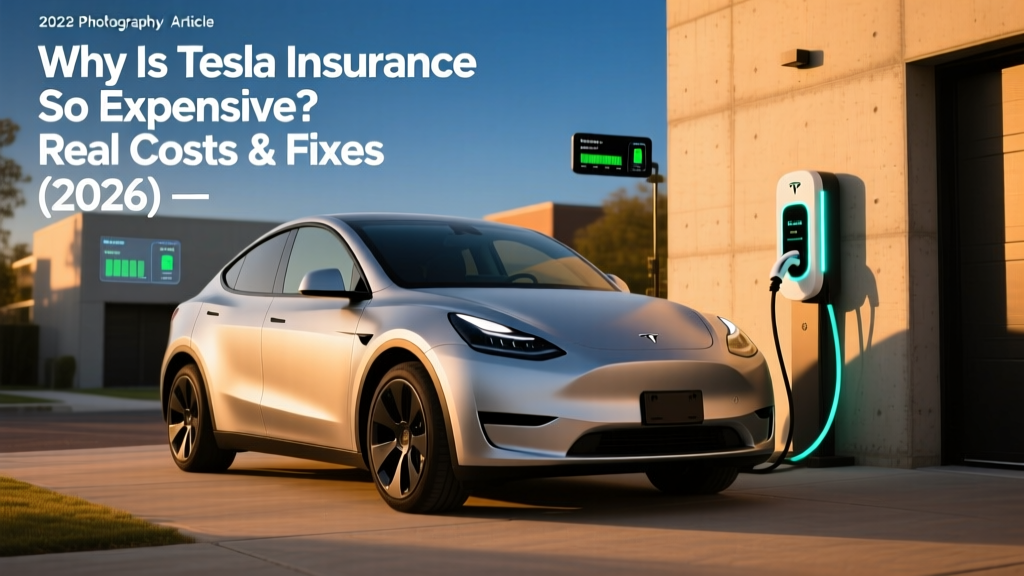
Tesla Insurance Costs: The Short Answer
If you've pulled a quote and wondered why is Tesla insurance so expensive, the headline number is usually 40–80% higher than an equivalent gas sedan or crossover. For a 2026 Model Y Long Range, expect to pay roughly $2,400–$3,600 per year depending on state, age, and driving record; Model S Plaid owners routinely see $4,000–$6,500. The reasons aren't mysterious — they're mechanical, actuarial, and structural.
Teslas are fast, aluminum-intensive, sensor-dense, and repaired through a limited body-shop network. They also generate proprietary telematics data that most third-party insurers can't access, which limits competitive pricing. Below, we'll quantify each factor, show what you'll actually pay by model, and walk through seven concrete ways to cut the premium without dropping coverage you need.
The 7 Reasons Tesla Insurance Costs More
1. Collision Repair Is Structurally Expensive
Tesla's unibody uses a mix of aluminum stampings, ultra-high-strength steel, and — on Model Y and Cybertruck — gigacast rear and front underbody pieces. A single large casting replaces ~70 welded parts, which is great for stiffness and manufacturing cost but terrible for minor collisions: a corner impact that would mean a $1,800 quarter-panel repair on a RAV4 can total a rear subframe casting on a Model Y, pushing the claim past the vehicle's total-loss threshold.
Tesla's own collision centers and a small certified network mean fewer shops competing for the work, and OEM parts dominate because aftermarket structural castings don't yet exist at scale. Average Tesla collision claims run 1.5–2.0× the industry average for the vehicle class, and insurers price that directly into premiums.
2. Performance Skews the Risk Pool
A Model 3 Performance does 0–60 in 2.9 seconds. A Model S Plaid does it in 1.99. Even the "base" Model Y Long Range AWD hits 60 in ~4.8 seconds with 384 hp. Instant torque plus low curb weight (relative to power) produces a loss profile that looks more like a sports coupe than a family EV to underwriters. Frequency of at-fault claims in the 25–39 age bracket is measurably higher on performance trims, and Tesla sells a lot of them.
3. Sensor and Glass Replacement Is Non-Trivial
The current Tesla Vision stack relies on eight cameras, and the windshield houses three forward-facing units with precise calibration. A rock-chip that would be a $140 resin fill on a Corolla often requires a full windshield replacement with camera recalibration on a Model 3/Y — typically $1,200–$1,800. Comprehensive claims on Teslas are therefore more expensive per incident, which raises the base rate even for careful drivers.
4. Limited Independent Body-Shop Network
Unlike Toyota or Ford, Tesla does not license repair procedures broadly. The certified collision network has grown, but in many states you're still one or two shops away from a 200-mile tow. Insurers factor in higher rental-car days and logistics costs, and those costs get amortized into every policy in the zip code.
5. Telematics Data Is Mostly Locked Inside Tesla
Tesla collects granular driving data — hard-braking events, Autopilot engagement, cornering Gs — but shares very little with third-party insurers. That means Progressive, GEICO, and State Farm are pricing with less behavioral data than they'd like, which pushes them toward conservative (higher) base rates. Tesla Insurance, by contrast, uses a real-time Safety Score, which is the main reason it often undercuts competitors by 15–30% for clean drivers.
6. High Theft and Vandalism Recovery Costs
Teslas are among the most-stolen vehicles in several metro areas, not for the whole car but for wheels, charge-port doors, and catalytic-adjacent wiring. Glass break-ins for cabin electronics are also above class average. Comprehensive premiums reflect this.
7. Total-Loss Thresholds Are Lower Than You'd Expect
Because battery packs represent 30–40% of vehicle value and Tesla restricts third-party battery diagnostics, many states' total-loss formulas (repair cost ÷ actual cash value) are triggered by damage that would be repairable on a conventional car. Insurers know this and build it into the rate.
Average Tesla Insurance Premiums by Model (2026)
| Model / Trim | MSRP (base) | Avg. Annual Premium | Primary Cost Drivers |
|---|---|---|---|
| Model 3 RWD | $38,990 | $1,900–$2,700 | Lower power, but aluminum + sensor cost |
| Model 3 Long Range AWD | $45,240 | $2,200–$3,100 | AWD + 346 hp |
| Model 3 Performance | $54,990 | $3,100–$4,400 | 2.9s 0–60, track-capable |
| Model Y Long Range AWD | $46,630 | $2,400–$3,600 | Highest volume, gigacast rear |
| Model Y Performance | $52,130 | $2,900–$4,100 | 3.5s 0–60, 21" wheels |
| Model S Long Range | $74,990 | $3,400–$4,900 | High repair value, 670 hp |
| Model S Plaid | $89,990 | $4,000–$6,500 | 1,020 hp, 1.99s 0–60 |
| Model X Long Range | $79,990 | $3,600–$5,200 | Falcon-wing complexity |
| Cybertruck AWD | $79,990 | $3,800–$5,600 | Stainless exoskeleton, novel parts |
Premiums shown are U.S. averages for a 35-year-old driver with a clean record, 100/300/100 liability, and comprehensive/collision with a $1,000 deductible. Actual quotes vary widely by state, credit tier, and mileage. Source: aggregated 2026 quotes from Tesla Insurance, Progressive, and GEICO via IIHS loss data.
How to Lower Your Tesla Insurance Bill
- Start with Tesla Insurance. The Safety Score program (available in most states) rewards clean driving with real-time discounts. Drivers consistently scoring 90+ report 20–35% savings vs. legacy carriers.
- Bundle home + auto. Even if Tesla Insurance wins on standalone auto, bundling with homeowners or renters at a traditional carrier can flip the math.
- Raise your deductible to $2,000. On a Model Y, this typically saves $400–$700/year. Only do this if you have the cash reserve — glass claims alone can hit $1,800.
- Drop collision on older models. A 2019 Model 3 SR+ with 80k miles and a $17k actual cash value rarely justifies $1,200/year in collision coverage.
- Take a state-approved defensive-driving course. In NY, CA, and TX this yields a mandatory 5–10% discount.
- Garage-park and document it. Comprehensive claims drop meaningfully when the car is stored indoors overnight; tell your insurer.
- Limit annual mileage. Sub-7,500-mile/year drivers qualify for low-mileage tiers at most carriers — a meaningful lever for WFH owners.
The Tesla-Specific Coverage Gaps Most Owners Miss
Two items routinely surprise new Tesla owners at claim time:
- Wall Connector and home charging gear are generally not covered under auto comprehensive — they fall under homeowners. Confirm your HO policy lists EVSE explicitly.
- Battery damage from road debris is covered under collision/comprehensive, but Tesla may require the battery be replaced as a sealed unit rather than repaired, which can push the claim over the total-loss threshold. If you live where road debris is common, consider a higher-liability umbrella policy to protect against gap exposure.
Does the Federal EV Tax Credit Offset the Insurance Premium?
Partially. Under current IRS §30D rules, a new Model 3 Long Range AWD qualifies for up to $7,500 (assuming the buyer meets the income cap — $150k single / $300k MFJ — and the vehicle's battery satisfies critical-mineral and North-American-assembly sourcing thresholds). That $7,500 offsets roughly 2.5 years of the insurance premium gap vs. a gas Camry. After that, the higher premium is a real ongoing cost of ownership.
| Ownership Year | Insurance Premium Gap vs. Gas Sedan | Cumulative Gap |
|---|---|---|
| Year 0 (purchase) | — | −$7,500 (tax credit) |
| Year 1 | +$900 | −$6,600 |
| Year 2 | +$900 | −$5,700 |
| Year 5 | +$900 | −$3,000 |
| Year 8 | +$900 | −$300 |
| Year 9+ | +$900/yr | Net cost |
The credit is also available as a point-of-sale transfer to the dealer, so you don't have to wait until tax time — but eligibility rules change, so confirm on the IRS site before signing.
Is Tesla Insurance Worth It vs. the Competition?
For clean-record drivers in states where it's offered, Tesla Insurance is usually the cheapest option by 15–30%, largely because the Safety Score rewards behavior that legacy carriers can't observe. For drivers with a recent claim, a low Safety Score, or in states where Tesla Insurance isn't yet licensed (notably FL, MI, and parts of the Southeast as of early 2026), Progressive and GEICO's usage-based programs (Snapshot, Drive Safe & Save) can be competitive — but expect to pay the full Tesla premium penalty.
Bottom line: if you can keep your Safety Score above 90 and you live in a Tesla Insurance state, the premium gap vs. gas cars narrows to roughly 10–20%. If you can't, budget the full 50–80% uplift into your total cost of ownership before signing the purchase agreement.
Frequently Asked Questions
Why is Tesla insurance so expensive for young drivers?
Drivers under 25 on a Model 3 Performance can see quotes above $6,000/year. The combination of instant torque, high repair costs, and limited driving history places this cohort in the highest-risk underwriting bucket Tesla sells into.
Does Autopilot or FSD (Supervised) lower my premium?
Not directly. FSD (Supervised) is SAE Level 2 driver-assist — you remain the responsible driver — and insurers do not currently discount for it. In fact, a $12,000 FSD purchase raises the vehicle's insured value, which can slightly increase comprehensive/collision premiums.
Will Tesla insurance get cheaper as the fleet ages?
Modestly, yes. As Model 3s age out of the high-performance cohort and the certified repair network expands, claims costs should decline. Expect 3–5% annual improvement, not a structural reset.
Is a Model 3 cheaper to insure than a Model Y?
Generally yes — by $300–$700/year on equivalent trims. The Y's higher MSRP, larger glass, and gigacast rear structure push its claims cost slightly above the 3's.
Do I need special coverage for the battery?
No separate policy is required — the 8-year/100,000–120,000-mile battery warranty covers defects, and collision/comprehensive covers impact damage. But confirm your policy's actual-cash-value calculation includes the battery's remaining state of health, not just vehicle age.