The Quick Answer
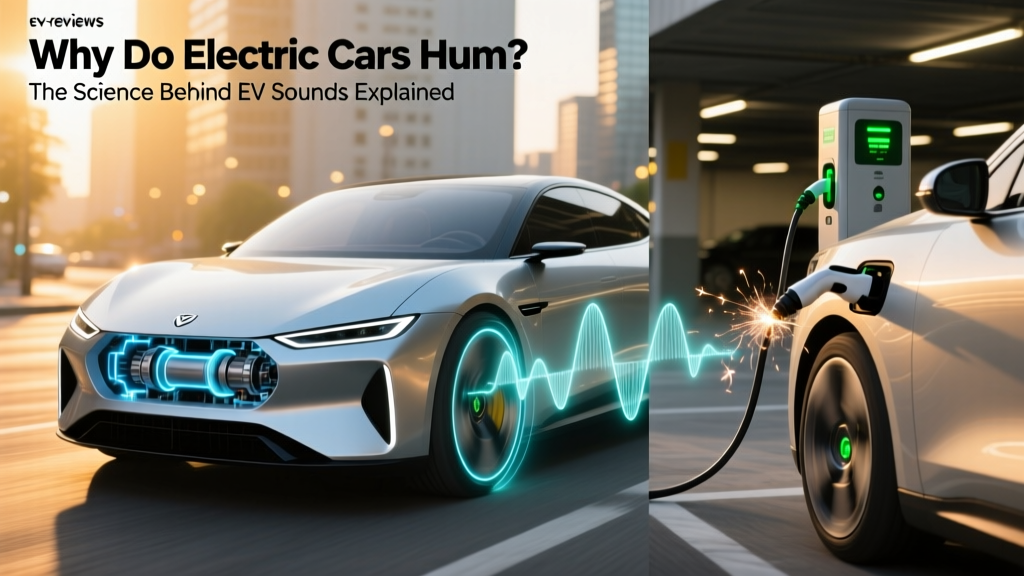
Electric cars hum because their electric motors produce electromagnetic noise as current flows through copper windings, creating vibrations at specific frequencies. Unlike gas engines that rumble from combustion, EVs generate a high-pitched whine that rises with speed. Below 18.6 mph, federal law requires EVs to emit an artificial hum through external speakers to alert pedestrians. Above that speed, tire and wind noise naturally mask the motor sound. This hum is fundamentally different from engine noise — it's the sound of rotating magnetic fields, not controlled explosions.
The Physics: Why Electric Motors Whine Instead of Roar
A gasoline engine produces sound through thousands of controlled explosions per minute — each combustion event creates a pressure wave you hear as rumble and vibration. An electric motor operates on entirely different physics.
When alternating current flows through the motor's stator windings, it creates a rotating magnetic field that pulls the rotor around. This electromagnetic interaction produces vibrations at frequencies directly tied to motor RPM. A typical EV motor spinning at 10,000 RPM generates noise in the 1,000–5,000 Hz range — a high-pitched whine rather than a low-frequency rumble.
The specific frequency depends on the motor's pole count and switching frequency. Most modern EVs use permanent-magnet synchronous motors (PMSMs) with 8 to 12 poles. At highway speeds, the inverter switches current thousands of times per second (typically 4–16 kHz), and imperfections in this switching create audible harmonics.
There's also mechanical noise from the single-speed reduction gear — a set of helical gears that reduce the motor's 15,000+ RPM to a practical wheel speed. These gears whine under load, contributing to the overall EV sound signature.
The Pedestrian Warning Hum: Federal Requirements
The hum you hear at low speeds isn't always the motor — it's often an artificial sound broadcast through external speakers. The NHTSA's Federal Motor Vehicle Safety Standard 141 requires all electric and hybrid vehicles to emit a warning sound when traveling below 18.6 mph (30 km/h).
This regulation exists because EVs are dangerously quiet at parking-lot speeds, where tire and wind noise are minimal. Studies showed that quiet vehicles were 35% more likely to be involved in pedestrian crashes than conventional vehicles. The rule phased in starting with 2018 models and was fully mandatory by September 2020.
Each manufacturer designs its own signature sound:
- Tesla: A futuristic, sci-fi-inspired tone that varies with speed
- Hyundai/Kia: A soft, turbine-like whir reminiscent of a spaceship
- Ford: A low, mechanical hum meant to sound like a traditional vehicle
- Chevrolet: A subtle electronic chirp that rises in pitch with speed
These sounds must meet specific frequency, volume, and pitch-change requirements to ensure pedestrians can identify both the vehicle's presence and whether it's accelerating or decelerating.
EV Noise vs. Gas Car Noise: A Sound Comparison
| Noise Source | Electric Vehicle | Gasoline Vehicle |
|---|---|---|
| Idle / Stationary | Silent (or HVAC fan noise only) | 60–80 dB engine rumble |
| Low Speed (<20 mph) | Artificial pedestrian hum: 43–64 dB | Engine + exhaust: 65–75 dB |
| City Driving (30–40 mph) | Motor whine + tire noise: ~68 dB | Engine + tire noise: ~72 dB |
| Highway (70 mph) | Wind + tire noise dominant: ~73 dB | Wind + tire + engine: ~75 dB |
| Hard Acceleration | Rising motor whine, no gear shifts | Engine roar, exhaust note, shift points |
| Regenerative Braking | Subtle motor-generator whine | Engine braking or brake pad friction |
At highway speeds, the cabin noise difference between EVs and gas cars narrows considerably. Wind resistance and tire contact with the road become the dominant noise sources for both vehicle types. A 2025 Tesla Model 3 measures approximately 73 dB at 70 mph — only 2–3 dB quieter than a comparable Toyota Camry. That 2 dB difference is perceptible but modest.
What EV Buyers Should Know About Cabin Quietness
The absence of engine noise in an EV creates a paradox: the cabin is quieter overall, but every other sound becomes more noticeable. Here's what first-time EV buyers consistently report:
What you'll hear more of:
- Tire noise: Without engine masking, tire roar on coarse asphalt becomes the dominant cabin sound. EV-specific tires (like Michelin Pilot Sport EV or Hankook iON) use foam-lined inner layers to reduce this by 3–9 dB.
- Wind noise: Around A-pillars and mirrors at highway speeds — identical to gas cars but more noticeable without engine masking.
- Motor whine under load: During hard acceleration, the inverter switching frequency and gear whine become audible, especially in performance-oriented models.
- Suspension and road imperfections: Potholes, expansion joints, and gravel transmit more clearly through the chassis.
What you won't hear:
- Engine idle vibration and drone at stoplights
- Exhaust resonance or muffler rumble
- Transmission shift clunks
- Cold-start noise on winter mornings
Manufacturers have responded with active noise cancellation (ANC) systems in premium EVs. The 2026 Hyundai Ioniq 5 N uses ANC through the cabin speakers to counter motor and road frequencies. Tesla introduced "Acoustic Glass" on refreshed Model S/X with laminated side windows that reduce cabin noise by approximately 4 dB at highway speeds.
Myths About EV Sound — Fact-Checked
| Myth | Fact |
|---|---|
| "EVs are completely silent" | Only at idle. At speed, tire and wind noise make EVs comparable to gas cars (~73 dB at 70 mph). |
| "The pedestrian hum is the motor sound" | It's an artificial sound from external speakers, mandated by NHTSA below 18.6 mph. |
| "You can turn off the warning sound" | Federal law prohibits disabling it. Tesla removed the "boombox" feature after an NHTSA investigation in 2022. |
| "EVs need fake engine noise for safety" | Only at low speeds. Above 20 mph, tire noise provides adequate pedestrian awareness. |
| "Electric motors don't make any noise" | Electromagnetic forces and gear meshing produce measurable whine, especially under heavy load. |
Real-World Ownership: Does Noise Affect Your EV Decision?
Cabin quietness is consistently rated among the top three EV satisfaction factors in owner surveys, alongside low operating costs and instant torque. But it comes with trade-offs worth considering:
Home charging access: The quietest EV experience is paired with home Level 2 charging — you'll never hear a gas station pump or an engine cold-start in your garage. A 48-amp Level 2 charger (like the ChargePoint Home Flex, ~$600 + $500–$2,000 installation) adds roughly 30–35 miles of range per hour of charging.
Cold-weather reality: In sub-freezing temperatures, EVs use cabin heat pumps or resistive heaters, which produce a low fan hum. This is quieter than a gas engine's cold-start roar but means you'll hear the HVAC system more prominently in winter.
Driving patterns: If your commute is mostly highway, the quietness advantage of an EV over a modern gas car is modest (2–4 dB). The dramatic silence benefit is most felt in stop-and-go city driving and at idle.
Is EV Quietness Right for You?
Choose an EV if:
- You value a serene, low-vibration cabin for daily commuting
- You have home charging and want silent garage starts
- You frequently drive in stop-and-go traffic where engine noise is fatiguing
- You prioritize a smooth, single-gear driving experience
A gas car or hybrid may suit you better if:
- You rely on engine sound for driving engagement and feedback
- You drive primarily on coarse-pavement highways where tire noise dominates anyway
- You frequently tow heavy loads (where engine noise is expected and reassuring)
- You live in an area without reliable charging access and range/cost concerns outweigh cabin quietness
Frequently Asked Questions
Can I make my EV louder or add exhaust sound?
Aftermarket "exhaust simulators" exist (like the Milltek Sport E-Sound system, ~$2,500), which play amplified motor or synthetic V8 sounds through cabin and external speakers. However, these don't change the vehicle's actual sound profile and may conflict with pedestrian warning regulations. Most EV owners who test these systems revert to stock within weeks.
Why does my EV hum louder when I accelerate hard?
Under hard acceleration, the motor draws more current through the inverter, which increases electromagnetic vibration in the stator. The single-speed reduction gear also transmits more meshing noise under high torque. This is normal and doesn't indicate a mechanical problem.
Do all EVs sound the same?
No. Motor type, gear design, cabin insulation, and tire selection all affect the sound signature. A 2026 Tesla Model 3 (rear-mounted induction motor) sounds noticeably different from a 2026 Hyundai Ioniq 5 (front and rear permanent-magnet motors). Luxury EVs like the Mercedes EQS use significantly more sound deadening, making them quieter than economy EVs.
Is the EV pedestrian hum annoying to neighbors?
The external warning sound is designed to be noticeable but not intrusive — typically 43–64 dB at 6 feet, comparable to a normal conversation. Most owners report that neighbors barely notice it, especially compared to a gas car's exhaust note at startup.
Will future EVs be even quieter?
Yes, incrementally. Manufacturers are investing in better motor lamination, foam-lined tires, and acoustic glass. However, the fundamental physics of tire-road interaction and aerodynamic wind noise create a noise floor around 70 dB at highway speeds that's difficult to reduce further without adding impractical weight.