The Short Answer: Tariffs, Geopolitics, and Battery Sourcing
If you've been following the global EV market, one question keeps surfacing: why is BYD not in the US? The Chinese automaker — which surpassed Tesla in global BEV sales volume in late 2023 and has traded the top spot ever since — offers some of the most cost-competitive electric vehicles on the planet. Yet American buyers cannot walk into a dealership and purchase a BYD Seal, Dolphin, or Atto 3.
The answer is not a single barrier but a layered wall of trade policy, national security concerns, and battery-sourcing regulations that collectively make selling BYD vehicles in the United States economically unviable for the company. Here is the full breakdown of what keeps BYD out, what American buyers are missing, and whether that could ever change.
| Model | Battery (kWh) | Chemistry | WLTP Range | 0-60 mph | Global Price (approx.) |
|---|---|---|---|---|---|
| Seal (RWD) | 82.5 | LFP (Blade) | 354 mi | 5.9s | ~$42,000 |
| Seal (AWD Perf.) | 82.5 | LFP (Blade) | 323 mi | 3.8s | ~$48,000 |
| Dolphin | 60.4 | LFP (Blade) | 265 mi | 7.0s | ~$30,000 |
| Atto 3 (Standard) | 58.56 | LFP (Blade) | 260 mi | 7.3s | ~$35,000 |
| Han EV | 85.4 | LFP (Blade) | 325 mi | 3.9s (AWD) | ~$55,000 |
| Seal U (PHEV) | 18.3 | LFP | 43 mi EV + 560 total | 8.0s | ~$38,000 |
Note: WLTP range figures are typically 10-15% higher than EPA estimates. All prices are approximate global MSRPs converted to USD and do not reflect US availability.
The 100% Tariff Wall: How US Trade Policy Blocks BYD
In May 2024, the Biden administration announced that tariffs on Chinese-made electric vehicles imported into the United States would quadruple from 25% to 100%, effective August 2024. This policy, enacted under Section 301 of the Trade Act, was explicitly designed to protect the domestic auto industry from what officials described as unfair trade practices and massive state subsidies funneled into China's EV sector.
That 100% tariff remains firmly in place as of 2026. The practical effect is devastating for BYD's US economics: a BYD Seal that might cost $42,000 to import would face an additional $42,000 in duties before it even reached a port lot — pushing its effective price well above $84,000 and rendering it uncompetitive against a Tesla Model 3 Long Range (starting around $42,490) or a Hyundai Ioniq 6.
But the tariff is only the first layer. Chinese-made EVs also face:
- A 2.5% standard import duty on automobiles (stacked on top of the Section 301 tariff)
- Ineligibility for the §30D federal EV tax credit (up to $7,500) because the credit's battery-component and critical-mineral sourcing requirements explicitly exclude vehicles containing battery components manufactured by a "foreign entity of concern" (FEOC) — a designation that covers Chinese companies including BYD and CATL
- Proposed legislation at both federal and state levels that would further restrict Chinese-connected vehicles from US roads on national-security grounds, including concerns about data collection from vehicle sensors and software
Even if BYD built a US factory to sidestep the import tariff, the battery-sourcing rules embedded in the IRS §30D credit requirements would likely disqualify any vehicle using BYD's own Blade Battery cells, since BYD itself is a Chinese-headquartered entity classified as an FEOC.
What American Buyers Are Missing: BYD's Standout Models
Understanding why BYD matters globally requires looking at what the company actually sells in Europe, Southeast Asia, Australia, and Latin America. These vehicles compete directly with models Americans can buy — often at lower prices and with competitive specs.
BYD Seal: The Tesla Model 3 Competitor
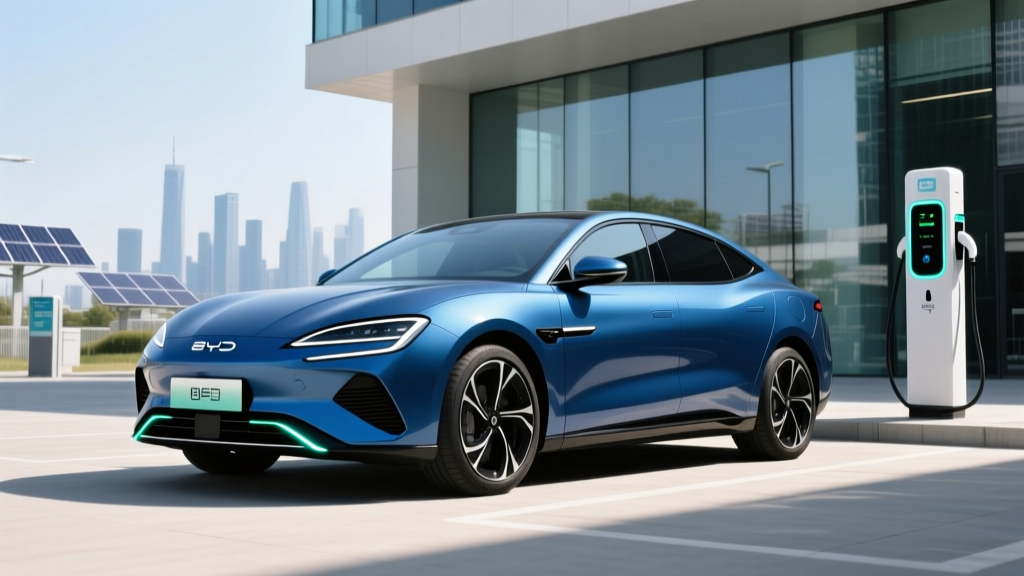
The BYD Seal is a midsize electric sedan positioned squarely against the Tesla Model 3 and BMW i4. In its dual-motor AWD Performance trim, it delivers 523 horsepower and a 3.8-second 0-60 time. Its 82.5 kWh Blade Battery (LFP chemistry) provides a WLTP range of 354 miles in RWD form — which would likely translate to an EPA estimate around 300-310 miles if the car were sold in the US.
WLTP: 354 mi | Estimated EPA: ~305 mi | Real-world highway (70 mph): ~255-275 mi | Cold weather (20°F): ~220-240 mi. LFP chemistry typically shows less range degradation over time than NMC but suffers greater cold-weather range loss — expect 25-30% reduction in freezing temperatures without preconditioning.
The Seal supports DC fast charging at a peak of 150 kW, which yields a 10-80% charge in approximately 26 minutes. On a home Level 2 charger at 11 kW, the battery refills in roughly 7.5 hours. These numbers are competitive but not class-leading — the Hyundai Ioniq 6 peaks at 240 kW and charges 10-80% in about 18 minutes thanks to its 800V architecture.
BYD Dolphin: The Budget EV That Could Have Disrupted Everything
The Dolphin is the model that most frustrates US EV advocates. Globally priced around $30,000 (and significantly less in China), it offers a 60.4 kWh Blade Battery, a WLTP range of 265 miles, and practical hatchback packaging. An EPA estimate would likely land near 225-235 miles. For context, the cheapest new EV available in the US — the Nissan Leaf S — starts around $28,140 but offers only 149 miles of EPA range. A Dolphin at a comparable price with 230+ miles would have been transformative for budget EV adoption.
BYD Atto 3 (Yuan Plus): The Compact SUV
The Atto 3 competes with the Kia Niro EV and Chevrolet Equinox EV. Its 58.56 kWh Blade Battery yields roughly 260 miles WLTP (~220 EPA), with 201 horsepower and a 7.3-second 0-60. Cargo space is rated at approximately 15.8 cu ft behind the rear seats and 44.3 cu ft with seats folded — adequate but behind the Equinox EV's 26.4 cu ft / 57.2 cu ft.
Charging and Battery Technology: BYD's Blade Battery Explained
BYD's biggest technological differentiator is its Blade Battery, a lithium iron phosphate (LFP) cell design that arranges long, thin prismatic cells directly into the battery pack structure. This cell-to-pack architecture increases volumetric energy density compared to traditional module-based LFP packs.
| Charging Level | Power / Rate | Time / Speed | Connector |
|---|---|---|---|
| Level 1 (120V) | ~1.4 kW | ~3-4 mi/hr | Standard outlet |
| Level 2 (240V) | 11 kW | ~30 mi/hr; full in ~7.5 hr | Type 2 (CCS2 in global markets) |
| DC Fast Charge | Peak 150 kW | 10-80% in ~26 min | CCS2 / GB/T |
Charge curve note: BYD's LFP packs maintain relatively flat charging power through 50-60% SoC before tapering. The 150 kW peak is only sustained briefly; average 10-80% rate is closer to 90-100 kW. This is a key reason the 10-80% time is longer than 800V rivals like the Ioniq 5 or Porsche Taycan.
LFP vs NMC: The Chemistry Trade-Off
BYD's exclusive use of LFP chemistry (at least for its volume models) represents a deliberate choice:
- Advantages: Lower cost, longer cycle life (3,000+ full cycles vs ~1,500-2,000 for NMC), superior thermal stability (much lower fire risk), no cobalt or nickel supply-chain exposure
- Disadvantages: Lower energy density (heavier packs for same range), worse cold-weather performance, less precise state-of-charge estimation at partial charge
Tesla has adopted LFP for its Standard Range Model 3 and Model Y, validating the chemistry for mass-market use. But BYD was doing this years earlier and at far greater scale.
The Geopolitical Dimension: National Security and Data Concerns
Beyond economics, there is a growing bipartisan consensus in Washington that Chinese-made vehicles pose potential data security risks. Modern EVs are essentially computers on wheels — equipped with cameras, LiDAR, GPS, microphones, and constant cellular connectivity. The concern is that a Chinese automaker could be compelled under China's 2017 National Intelligence Law to share data collected from US roads and drivers with the Chinese government.
In 2024, the US Department of Commerce proposed rules to ban the sale of vehicles with Chinese-connected hardware and software in the United States, with hardware restrictions taking effect for model year 2027 and software restrictions for model year 2028. These rules, if finalized as proposed, would create a second independent barrier to BYD's entry — even if the company attempted to manufacture vehicles domestically or import them from a non-China factory.
BYD has acknowledged these headwinds. In a 2024 interview, BYD executives stated the company has "no plans" to enter the US market, instead focusing expansion on Europe, Southeast Asia, Latin America, and the Middle East. The company has announced or opened factories in Thailand, Brazil, Hungary, Indonesia, and Turkey — a deliberate strategy to build market share in regions without prohibitive trade barriers.
US Competitors BYD Would Face: Head-to-Head
If BYD could somehow overcome the tariff and regulatory wall, here is how its key models would stack up against vehicles Americans can actually buy:
BYD Seal AWD: 523 HP, 3.8s 0-60, ~305 EPA mi (est.), 150 kW peak DC, ~$42,000 global MSRP
Tesla Model 3 LR AWD: 346 HP, 4.2s 0-60, 346 EPA mi, 250 kW peak DC, $42,490 MSRP
Verdict: The Seal is quicker and cheaper globally, but the Model 3 has better range, faster charging, and access to the Supercharger network. With the 100% tariff, the Seal would cost $84,000+ — no contest.
BYD Dolphin: 201 HP, 7.0s 0-60, ~230 EPA mi (est.), 88 kW peak DC, ~$30,000 global
Chevy Equinox EV LT: 213 HP, 8.3s 0-60, 319 EPA mi, 150 kW peak DC, $33,600 MSRP
Verdict: The Dolphin is cheaper, but the Equinox EV offers substantially more range and faster charging — and qualifies for the $7,500 federal credit, bringing its effective price near $26,100.
Does BYD Qualify for the Federal EV Tax Credit?
No. Under current IRS §30D rules, BYD vehicles fail multiple eligibility tests:
- ❌ Battery component sourcing: Battery components must be manufactured or assembled in North America (phased thresholds increase annually). BYD's Blade Battery is manufactured in China.
- ❌ Critical minerals: A percentage of critical minerals must be sourced from the US or FTA partners. BYD's supply chain is predominantly China-domestic.
- ❌ FEOC exclusion: Vehicles containing battery components from a Foreign Entity of Concern (which includes Chinese-headquartered companies) are categorically ineligible starting 2024 for components and 2025 for critical minerals.
- ✅ MSRP caps: $55,000 for sedans, $80,000 for SUVs/trucks — most BYD models would clear this threshold if they were sold here.
- ✅ Buyer income caps: $150K single / $300K joint — irrelevant since the vehicle fails sourcing requirements.
Even through the point-of-sale transfer option (where the dealer applies the credit as a price reduction), no BYD vehicle would qualify. This means a US buyer would pay full MSRP plus the 100% import tariff — a combination that eliminates any price advantage BYD's global pricing suggests.
Could BYD Ever Enter the US Market?
Three scenarios could theoretically open the door, though none appear imminent:
- US factory with non-Chinese battery supply chain: BYD could build a North American assembly plant and source battery cells from a non-FEOC partner (e.g., a joint venture with a Korean or Japanese cell maker). This would address the tariff and potentially the credit, but the FEOC rules around BYD's corporate ownership structure could still be disqualifying.
- Trade policy shift: A future administration could reduce the Section 301 tariff, though bipartisan support for protecting domestic EV manufacturing makes this unlikely through at least 2028.
- Licensing/partnership model: BYD could license its Blade Battery technology to a non-Chinese automaker — similar to how Toyota has explored partnerships for solid-state cells. This would let BYD monetize its tech without branding vehicles for US sale.
For now, BYD's US strategy is straightforward: there isn't one. The company is investing aggressively in markets where it faces lower barriers, and its global sales growth has not slowed as a result. In 2025, BYD sold over 4 million electrified vehicles (BEV + PHEV combined), making it the world's largest producer of plug-in vehicles by volume.
Frequently Asked Questions
Why is BYD not in the US in 2026?
A 100% import tariff on Chinese-made EVs (enacted August 2024), FEOC battery-sourcing rules that disqualify BYD from the $7,500 federal tax credit, proposed bans on Chinese-connected vehicle software, and national security concerns collectively make US market entry economically unviable. BYD has confirmed it has no current plans to sell vehicles in the US.
Can I import a BYD vehicle to the US myself?
Practically, no. Even as a personal import, the vehicle would be subject to the 100% Section 301 tariff, would need to pass NHTSA safety certification (which BYD's global models have not undergone for US FMVSS standards), and would still be ineligible for any federal incentives. The cost and regulatory burden make this unrealistic.
Is BYD's Blade Battery technology competitive?
Yes. BYD's Blade Battery (LFP chemistry in a cell-to-pack configuration) offers excellent thermal stability, long cycle life, and competitive energy density for LFP. It has passed nail-penetration tests without thermal runaway. Tesla uses LFP chemistry from CATL in Standard Range models, validating the approach. BYD's pack-level integration is considered among the best in the industry for cost efficiency.
Does BYD sell any products in the US?
BYD has a limited US presence in commercial vehicles — it has delivered electric buses to some transit agencies (though this has faced political pushback). BYD also sells forklifts and has explored energy storage products. But passenger vehicles are not part of its US operations.
What is the cheapest EV I can buy in the US with similar specs to a BYD Dolphin?
The closest US-available equivalent is the Chevrolet Equinox EV LT (319 mi EPA, $33,600 before a potential $7,500 credit, bringing it to ~$26,100). For a smaller, cheaper option, the Hyundai Kona Electric SE ($32,975, 261 mi EPA) is competitive but does not qualify for the full federal credit in all configurations. Neither matches the Dolphin's global sub-$30K price, but both offer substantially more EPA-rated range than the Dolphin's estimated ~230 miles.
Will BYD's global growth hurt Tesla and other automakers?
It already is — outside the US. In Europe, Southeast Asia, and Latin America, BYD's pricing pressure has forced Tesla to cut prices and legacy automakers to accelerate cost reduction. The US market is insulated by tariffs, but American automakers competing globally (Ford, GM) face BYD pressure in export markets. This competitive dynamic is one reason the tariff has bipartisan support: it buys time for domestic manufacturers to achieve cost parity.
Sources: IRS §30D Clean Vehicle Credit, NHTSA, BYD global press materials, US Trade Representative Section 301 tariff schedule.