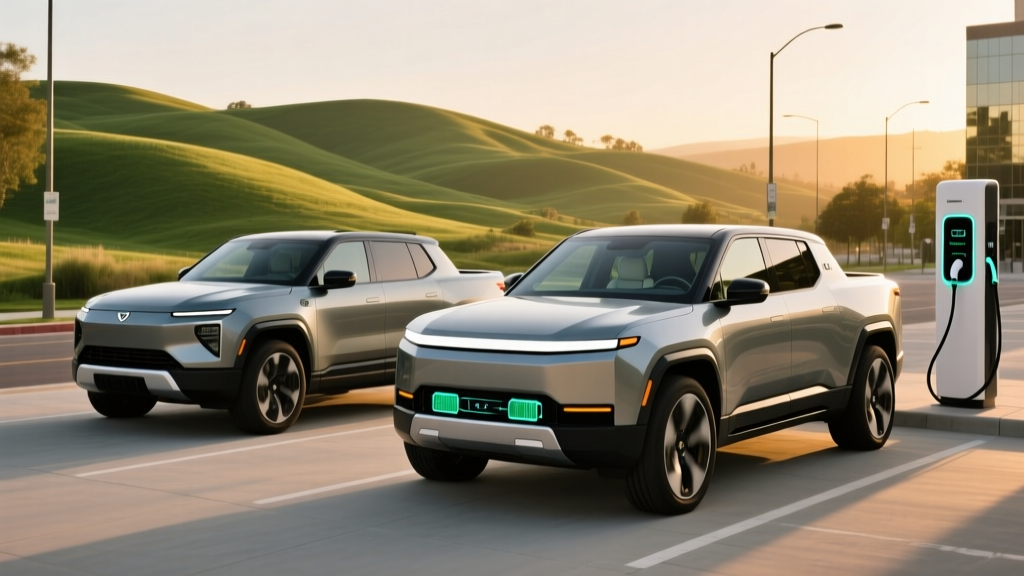
The Company Behind the Rivian R1S and R1T
If you've been researching the Rivian R1S SUV or R1T pickup and found yourself asking who owns Rivian auto, the answer requires a look at both its leadership and its major financial backers. Rivian Automotive, Inc. is a publicly traded company (NASDAQ: RIVN) founded in 2009 by RJ Scaringe, who serves as CEO. Headquartered in Irvine, California, with manufacturing in Normal, Illinois, Rivian is not a subsidiary of a legacy automaker — it is an independent, publicly traded EV manufacturer.
However, Rivian has significant institutional ownership that shapes its direction:
- Volkswagen Group — In November 2024, VW announced a joint venture with Rivian to share software and electrical architecture, backed by up to $5.8 billion in investment. VW holds a substantial equity stake.
- Amazon — An early investor, Amazon holds a major stake and has an exclusive order for Rivian's commercial delivery vans (EDVs), though the R1S/R1T consumer vehicles are entirely separate products.
- Public shareholders and institutional funds — As a publicly traded company since its November 2021 IPO, Rivian's remaining shares are held by retail investors and large asset managers.
For buyers, this matters: Rivian is financially backed by two of the largest transportation companies on Earth, which reduces the startup-failure risk that has plagued other EV newcomers. Let's look at what Rivian's current consumer lineup actually delivers for the money.
2026 Rivian R1S and R1T: Core Specifications at a Glance
For the 2026 model year, Rivian offers the R1S (three-row SUV) and R1T (crew-cab pickup) on the updated Gen 2 platform, featuring redesigned drive units, a new zonal electrical architecture, and NACS (Tesla-style) charge ports native from the factory. Below are the key specs for the most popular configurations.
| Spec | Dual-Motor (Standard Battery) | Dual-Motor (Large Battery) | Tri-Motor (Max Battery) |
|---|---|---|---|
| EPA Range (R1S) | ~270 mi | ~352 mi | ~410 mi |
| EPA Range (R1T) | ~280 mi | ~352 mi | ~420 mi |
| Battery Capacity (usable) | ~92 kWh (LFP) | ~109 kWh (NMC) | ~141 kWh (NMC) |
| Horsepower | 533 hp | 533 hp | 850 hp |
| 0–60 mph | 4.5 sec | 4.5 sec | ~3.0 sec |
| Drivetrain | AWD (dual-motor) | AWD (dual-motor) | AWD (tri-motor) |
| Max DC Fast Charge | ~200 kW | ~220 kW | ~220 kW |
| 10–80% DC Charge Time | ~28 min | ~30 min | ~38 min |
| Level 2 Home Charge Rate | 11.5 kW (~25 mi/hr) | 11.5 kW (~25 mi/hr) | 11.5 kW (~25 mi/hr) |
| Max Tow Capacity | 7,700 lb | 7,700 lb | 7,700 lb |
| Base MSRP (R1S) | $79,900 | $86,400 | $105,900 |
| Base MSRP (R1T) | $71,700 | $78,200 | $99,900 |
Note: The Tri-Motor (Performance) with Max Battery is currently limited to the R1T and specific R1S trims. Specifications are subject to change — always verify on Rivian's official spec page.
Real-World Range: What the EPA Number Doesn't Tell You
The Large Battery Dual-Motor R1S carries a 352-mile EPA estimate. In real-world driving, expect ~290–310 miles on highway road trips (70–80 mph), and ~220–260 miles in cold weather (below 32°F) with cabin heating active. The LFP Standard Battery pack, while more affordable, is rated lower at ~270 miles EPA — plan for ~220 miles highway in mild conditions.
Rivian's range figures are competitive within the large electric SUV and truck segment, but physics is unforgiving: these are heavy vehicles (6,800–7,100+ lb curb weight) with the aerodynamics of a brick. Efficiency for the Dual-Motor Large Battery R1S sits around 73 MPGe combined, or roughly 46 kWh/100 mi. That's thirstier than a Tesla Model X or Hyundai Ioniq 5, but expected for a body-on-frame vehicle with genuine off-road and towing capability.
For daily commuting under 60 miles round-trip, even the Standard Battery is more than adequate, and you'll charge mostly at home where electricity costs $0.10–$0.20/kWh. Road-trippers should plan charging stops every 200–240 miles to stay in the fast-charging sweet spot (10–80% SoC) and avoid range stress in remote areas.
Charging Speed and Infrastructure: NACS Native, Ready for Superchargers
The Gen 2 Rivian platform ships with a native NACS charge port, meaning direct access to Tesla's Supercharger network without an adapter — a significant advantage over CCS-equipped competitors that require dongles. Here's what charging looks like in practice:
| Charging Level | Power | Speed (Miles Added) | Use Case |
|---|---|---|---|
| Level 1 (120V household) | ~1.4 kW | ~3 mi/hr | Emergency / trickle |
| Level 2 (240V home wall connector) | 11.5 kW | ~25 mi/hr | Daily overnight charging |
| DC Fast Charge (NACS Supercharger) | Peak 220 kW | ~140+ mi in 15 min | Road trips |
Charging curve reality: The Large Battery NMC pack peaks near 220 kW at low states of charge (10–20% SoC) but tapers significantly above 60%. A 10–80% session takes roughly 30 minutes at a V3/V4 Supercharger or equivalent 250+ kW station. The final 80–100% stretch can add another 25–35 minutes — plan accordingly and avoid charging past 80% on road trips unless necessary.
For home charging, a full overnight charge (10–80%) on a Level 2 wall connector takes approximately 8.5 hours for the Large Battery and 7 hours for the Standard (LFP) Battery. Most owners will set a charge limit to 80% daily for NMC battery longevity; LFP packs can be charged to 100% regularly without degradation concerns.
Pricing, Trims, and Federal Tax Credit Eligibility
Rivian positions the R1S and R1T in the premium-to-luxury price bracket. Here's the current pricing landscape and how the federal tax credit factors in:
| Configuration | R1T MSRP | R1S MSRP | §30D Credit Eligible? |
|---|---|---|---|
| Dual-Motor Standard Battery | $71,700 | $79,900 | Potentially (see below) |
| Dual-Motor Large Battery | $78,200 | $86,400 | R1T: No (over MSRP cap); R1S: No |
| Tri-Motor Max Battery | $99,900 | $105,900 | No (over MSRP cap) |
Critical §30D tax credit details for Rivian buyers:
- The IRS §30D credit provides up to $7,500 for qualifying new EVs, with the option for a point-of-sale transfer to the dealer (effective as an instant discount).
- SUV MSRP cap: $80,000 — The R1S qualifies as an SUV, so configurations at or below $80,000 MSRP may be eligible. The Dual-Motor Standard Battery R1S at $79,900 squeaks under this cap.
- Pickup/truck MSRP cap: $80,000 — The R1T Dual-Motor Standard at $71,700 is under the cap.
- Buyer income limits apply: Modified AGI cannot exceed $150,000 (single), $225,000 (head of household), or $300,000 (joint).
- Battery sourcing and critical minerals requirements must be met — Rivian has been working to localize its supply chain, but eligibility can shift. Always verify the current status on fueleconomy.gov and consult the IRS §30D guidance before purchasing.
Realistically, only the base Dual-Motor Standard Battery R1T ($71,700) and possibly the base R1S ($79,900) have a path to the full $7,500 credit, and only if battery-sourcing rules are satisfied at the time of purchase and your income qualifies. Most Rivian buyers in higher trims will pay full MSRP.
Interior Space, Tech, and Driver Assistance
R1S Cargo & Passenger Space:
- Behind 3rd row: ~10.6 cu ft
- Behind 2nd row (3rd folded): ~46.7 cu ft
- Max (all rear seats folded): ~104.7 cu ft
- Front trunk (frunk): ~11.1 cu ft — large enough for a full grocery run or charging cables
- 3rd-row legroom: ~30.4 inches (tight for adults; best for children)
R1T Bed & Storage:
- Bed length: 54.6 inches (with midgate closed); extends to ~82 inches with midgate open
- Gear Tunnel: ~11.7 cu ft of enclosed, lockable, weatherproof cross-vehicle storage — a Rivian-exclusive feature
- Frunk: ~11.1 cu ft
Technology highlights:
- 15.6-inch center touchscreen running Rivian's proprietary OS (Gen 2 hardware is faster and more responsive)
- 9.6-inch digital instrument cluster
- 6.8-inch rear-seat touchscreen for climate/media
- Over-the-air (OTA) software updates adding features regularly
- Rivian Electric Driver Assist+ (Enhanced Highway Assist): SAE Level 2 — provides adaptive cruise, lane centering, and lane-change assist on divided highways, but requires hands on wheel and driver supervision at all times
- Native NACS port with Plug & Charge on Tesla Superchargers
Rivian's Enhanced Highway Assist is a Level 2 system per SAE classification. It is not autonomous driving. The driver must remain attentive, keep hands on the steering wheel, and be prepared to take over instantly. Hands-free systems like GM's Super Cruise or Ford's BlueCruise (on approved highways) offer more relaxed monitoring, though they remain Level 2 as well.
Pros, Cons, and the Competition
- Genuine off-road capability (8.9–14.9 in. ground clearance with air suspension)
- Native NACS port — full Supercharger network access
- Gear Tunnel (R1T) is a unique, practical storage innovation
- Excellent build quality for a startup; Gen 2 refinements are substantial
- OTA updates continuously improve the vehicle
- Strong tow rating (7,700 lb) for an EV
- VW partnership adds long-term financial stability
- Expensive — base models start near $72K–$80K, well before options
- Most trims exceed §30D MSRP cap, disqualifying from the tax credit
- Efficiency is modest (~73 MPGe) — heavier and thirstier than car-based EVs
- 3rd-row space in R1S is tight for adults
- Driver-assist (Level 2) lags behind Tesla FSD Supervised and GM Super Cruise in capability
- Service center network still expanding — wait times can be long in some regions
- Cold-weather range loss is significant (~25–30%) due to large cabin volume
Key competitors to cross-shop:
- Tesla Model X — More efficient, faster charging, broader Supercharger experience, but less off-road capability and no truck variant
- Ford F-150 Lightning — Lower starting price (~$55K), tax-credit eligible, but less range and less premium interior
- Chevrolet Silverado EV — Competitive tow rating and range, but larger and less refined in ride quality
- Kia EV9 — Three-row SUV starting around $55K, eligible for tax credit, but less off-road ability and lower tow rating
Who Should Buy a Rivian (And Who Shouldn't)
Buy a Rivian R1S if: You need a three-row electric SUV with genuine off-road chops, want native Supercharger access, value the frunk + cargo flexibility, and your budget accommodates a $80K–$110K vehicle without needing the federal tax credit.
Buy a Rivian R1T if: You want an electric pickup that's equally at home on a trail, at a campsite, or on a commute — and the Gear Tunnel alone sold you. It's the most livable daily-driver truck in the EV market.
Look elsewhere if: Your priority is maximum efficiency, lowest cost per mile, tax-credit eligibility, or hands-free highway driving. A Tesla Model Y, Hyundai Ioniq 5, or Ford F-150 Lightning may better serve those needs.
Frequently Asked Questions
Who owns Rivian auto — is it a subsidiary of another car company?
No. Rivian Automotive, Inc. is an independent, publicly traded company (NASDAQ: RIVN). It was founded by RJ Scaringe, who remains CEO. Volkswagen Group and Amazon are major equity investors and strategic partners, but neither owns a controlling stake.
What is the real-world range of the Rivian R1S and R1T?
The EPA rates the Large Battery Dual-Motor R1S at 352 miles and the R1T at 352 miles. Real-world highway driving at 70–80 mph typically yields 290–310 miles. In sub-freezing temperatures, expect 220–260 miles due to battery and cabin heating demands.
How fast does a Rivian charge at home and on the road?
On a Level 2 home charger (11.5 kW), you'll add about 25 miles of range per hour — a full overnight session covers daily needs easily. On a DC fast charger, the Gen 2 Rivian peaks at ~220 kW and charges from 10–80% in approximately 28–38 minutes depending on battery size.
Does the Rivian R1T or R1S qualify for the $7,500 federal EV tax credit?
Potentially, but only certain configurations. The base R1T Dual-Motor Standard Battery ($71,700) and possibly the base R1S ($79,900) fall under the §30D MSRP cap. However, buyer income limits, battery critical-mineral sourcing rules, and annual rule changes all affect eligibility. Always check fueleconomy.gov and consult a tax professional before relying on the credit.
Is Rivian worth buying over a Tesla Model X or Ford F-150 Lightning?
If you value off-road capability, unique features like the Gear Tunnel, adventure-oriented design, and native NACS charging, Rivian is compelling. If your priorities are lowest price, maximum efficiency, or the most advanced driver-assist, a Model X or Lightning may be a better fit. Cross-shop all three and test-drive before deciding.
What is Rivian's battery and powertrain warranty?
Rivian provides an 8-year / 175,000-mile battery and drive unit warranty for the R1S and R1T, covering defects and capacity degradation below a specified threshold. The vehicle limited warranty is 5 years / 60,000 miles. These terms are competitive within the premium EV segment.