If you've been researching electric trucks and SUVs, you've likely asked: who manufactures Rivian? Unlike legacy automakers that outsource production or badge-engineer platforms, Rivian designs, engineers, and builds its vehicles entirely in-house at a massive facility in Normal, Illinois. This vertical integration shapes everything from the R1T's battery chemistry to its over-the-air update cadence.
In this deep dive, we'll walk through Rivian's manufacturing footprint, then break down the 2026 R1T (truck) and R1S (SUV) with the exact numbers EV buyers need — EPA range, battery kWh, DC fast-charge curves, real-world efficiency, and federal tax credit eligibility under IRS §30D rules.
Rivian's Manufacturing Home: Normal, Illinois
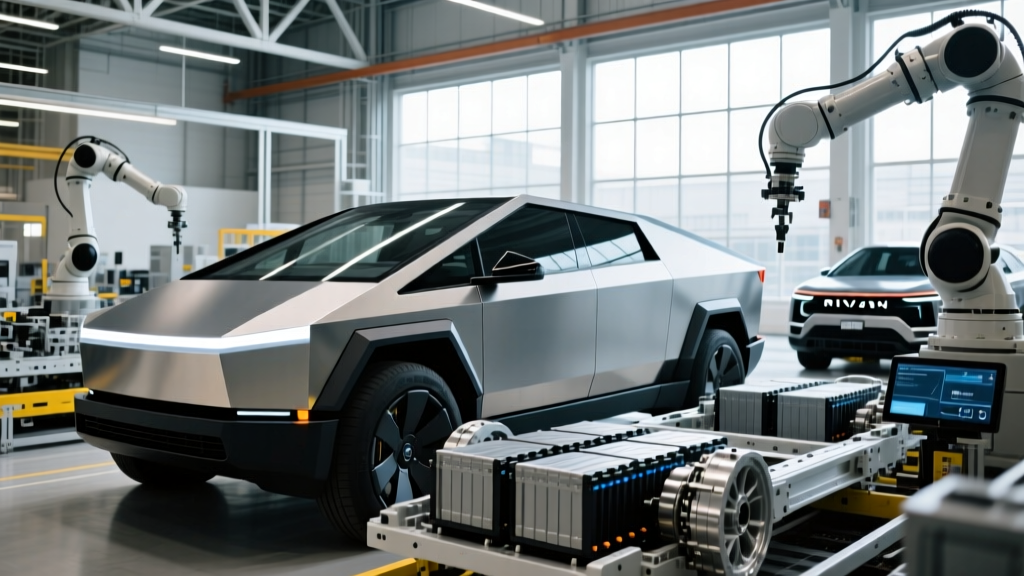
Rivian Automotive, Inc. is an American electric vehicle manufacturer founded in 2009 by RJ Scaringe. The company's sole production facility is a former Mitsubishi plant in Normal, Illinois, which Rivian purchased in 2017 and retooled for EV production. The factory spans approximately 3.3 million square feet and employs over 9,000 workers as of 2025.
Every Rivian vehicle — the R1T pickup, R1S SUV, and the Commercial Van (EDV) built for Amazon — rolls off the same Illinois assembly line. Rivian controls its own battery pack assembly, motor production, and software development, giving it tighter quality control than companies that rely on third-party suppliers for core powertrain components.
In 2024, Rivian opened a second manufacturing line within the Normal facility to increase capacity, and the company has announced plans for a second factory in Stanton, Georgia (expected production start in 2028 for the R2 platform). For now, every R1T and R1S you can buy is built in Normal.
2026 Rivian R1T & R1S: Core Specifications
Rivian offers the R1T (crew-cab pickup) and R1S (three-row SUV) on the same skateboard platform with shared powertrain options. For 2026, Rivian continues with its dual-motor, performance dual-motor, and tri-motor configurations, paired with two battery pack sizes.
| Spec | Standard Battery (Dual-Motor) | Max Battery (Tri-Motor) |
|---|---|---|
| Battery Capacity (usable) | ~106 kWh (NMC) | ~141 kWh (NMC) |
| EPA Range (R1T) | 270 mi | 420 mi |
| EPA Range (R1S) | 261 mi | 410 mi |
| Horsepower | 533 hp | 850 hp |
| 0-60 mph | 4.5 sec | 2.9 sec |
| Drivetrain | AWD (dual-motor) | AWD (tri-motor) |
| Max DC Fast Charge | 200 kW | 220 kW |
| 10-80% DC Time | ~28 min | ~42 min |
| Level 2 Home Charge | 11.5 kW (~25 mi/hr) | 11.5 kW (~25 mi/hr) |
| Towing Capacity | 11,000 lbs | 11,000 lbs |
| Efficiency (R1T) | 70 MPGe / 48 kWh/100mi | 69 MPGe / 49 kWh/100mi |
Real-World Range: What the EPA Sticker Doesn't Tell You
Rivian's large battery packs give it a buffer advantage — even with cold-weather degradation and highway-speed consumption, the Max pack keeps you above 250 miles in most realistic scenarios. However, the R1T's boxy aerodynamics and 6,000+ lb curb weight mean efficiency suffers at speed compared to sleeker sedans. Plan charging stops accordingly on road trips.
EPA fueleconomy.gov data confirms the combined city/highway efficiency at approximately 70 MPGe for dual-motor configurations, which translates to roughly 48 kWh consumed per 100 miles driven. For context, that's about 2.1 miles per kWh — respectable for a truck this size, but far from the 3-4 mi/kWh you'd see in a lighter EV like the Hyundai Ioniq 6.
Charging Speed: DC Fast and Home Level 2
Rivian uses the NACS (Tesla) connector on all 2025+ models, giving native access to Tesla's Supercharger network — a significant practical advantage for road-trip charging reliability. Older models with CCS connectors can use a NACS adapter.
| Charging Level | Power | Miles Added Per Hour | Notes |
|---|---|---|---|
| Level 1 (120V) | ~1.4 kW | ~3 mi/hr | Emergency/trickle only |
| Level 2 (240V home) | 11.5 kW | ~25 mi/hr | Full charge in ~10-13 hrs |
| DC Fast Charge | 200-220 kW peak | ~500+ mi/hr (peak) | 10-80% in 28-42 min |
Charging curve reality: The R1T Max Battery peaks near 220 kW but only sustains that rate between roughly 10-30% state of charge. Above 50%, the curve tapers significantly — from 50-80% you'll see speeds closer to 80-120 kW. This means the advertised "42-minute 10-80%" time assumes optimal battery preconditioning and a capable charger (350 kW-rated station). At a 150 kW Electrify America stall, expect 10-80% to take closer to 50-55 minutes.
For home charging, Rivian's onboard 11.5 kW charger is competitive. On a 48-amp Level 2 circuit (hardwired), you'll add about 25 miles of range per hour — enough to fully replenish the Standard pack overnight. For the Max pack, a full home charge takes roughly 13 hours, so most owners will top up nightly rather than draining fully.
Pricing, Trims & Federal Tax Credit Eligibility
Rivian prices the R1T and R1S across several configurations rather than traditional trim levels. Here's where the 2026 lineup lands before incentives:
| Configuration | R1T MSRP | R1S MSRP |
|---|---|---|
| Dual-Motor Standard Battery | $69,900 | $74,900 |
| Dual-Motor Max Battery | $83,900 | $88,900 |
| Performance Dual-Motor | $89,900 | $94,900 |
| Tri-Motor Max Battery | $99,900 | $104,900 |
With the full $7,500 credit applied at point of sale, a Dual-Motor Standard R1T effectively drops to ~$62,400 — competitive with a loaded Ford F-150 Lightning Lariat. However, most buyers opt for the Max Battery for range confidence, which pushes the price well above the credit threshold.
Cargo, Passenger Space & Practical Utility
The R1T's 54-inch bed is shorter than a traditional full-size truck, but Rivian compensates with the Gear Tunnel — a lockable, pass-through compartment behind the rear seats that holds roughly 11 cubic feet of cargo (ideal for skis, camping gear, or groceries). Combined with the 11-cu-ft front trunk (frunk), total enclosed storage reaches approximately 33 cu ft without using the bed.
The R1S offers three rows with seating for seven. Behind the third row: ~10 cu ft. Fold the third row and you get ~47 cu ft; fold both rear rows for a max of ~105 cu ft. Rear legroom is generous at 38.5 inches in the second row, though the third row is best suited for children on longer trips.
Both models feature Rivian's Camp Kitchen option (a slide-out kitchen system for the Gear Tunnel) and integrated air compressors for tire inflation — practical touches that signal Rivian's outdoor-adventure positioning.
Tech, Driver Assistance & Software
Rivian's 15.6-inch center touchscreen runs a proprietary OS with built-in navigation, charging trip planning, and over-the-air updates. The system is responsive and well-organized, though it lacks Apple CarPlay and Android Auto — a deliberate choice that frustrates some buyers who prefer phone-mirroring.
The Driver+ suite includes adaptive cruise control, lane-centering assist, and automatic lane changes on divided highways. This is a SAE Level 2 system — the driver must remain engaged with hands on the wheel at all times. It's competent for highway cruising but does not approach hands-off systems like GM's Super Cruise in mapped coverage area.
Unique tech highlights include the Rivian app's vehicle-location sharing (useful for group off-road trips), customizable drive modes (All-Purpose, Sport, Snow, Off-Road), and the Gear Guard cable lock system that secures bed cargo and alerts you via the app if tampered with.
Warranty & Battery Longevity
Rivian provides the following coverage on 2026 models:
- Battery & Drive Units: 8 years / 175,000 miles (whichever comes first)
- Limited Vehicle Warranty: 5 years / 60,000 miles
- Corrosion Perforation: 8 years / unlimited miles
The battery warranty guarantees that the pack will retain at least 70% of its original capacity during the coverage period. Rivian uses NMC (nickel manganese cobalt) chemistry in both pack sizes — this offers higher energy density than LFP but requires more careful thermal management. Real-world degradation data from early 2022 owners suggests approximately 5-7% capacity loss over the first 60,000 miles, which is within the normal curve for NMC packs.
Battery replacement cost out of warranty remains a concern for long-term owners. Industry estimates place a full R1T pack replacement at $15,000-$22,000 depending on pack size, though prices are expected to decline as cell costs fall. Rivian has not published official replacement pricing.
Rivian vs. Key Competitors: Is It Worth Buying?
✅ Pros
- Class-leading real-world range (420 mi EPA on Max pack)
- NACS native — full Supercharger access
- Exceptional off-road capability (air suspension, quad-motor torque vectoring)
- Gear Tunnel + frunk add practical storage
- Strong OTA update cadence, continuously improving software
- 11,000-lb towing capacity
❌ Cons
- High starting price; most configs exceed $80K tax-credit cap
- No Apple CarPlay / Android Auto
- Efficiency drops sharply at highway speeds and in cold weather
- Service center network still expanding — wait times in some regions
- DC fast-charge taper above 50% SoC extends road-trip stops
- Third row in R1S is tight for adults
vs. Ford F-150 Lightning: The Lightning undercuts the R1T significantly on price (starting ~$55K) and qualifies for the tax credit on more trims, but tops out at 320 miles EPA range and lacks the R1T's off-road sophistication. Choose Lightning for value and fleet practicality; choose R1T for range, adventure capability, and Supercharger access.
vs. Tesla Cybertruck: The Cybertruck offers comparable range and faster peak charging, but its polarizing design, stainless-steel panel repair complexity, and limited service infrastructure are trade-offs. The R1T's conventional truck proportions and proven build quality give it a practicality edge for most buyers.
vs. Chevrolet Silverado EV: The Silverado EV 4WT and RST offer strong range (up to 440 mi on the Max pack) and GM's Ultium platform, but availability remains limited and the interior materials lag behind Rivian's premium cabin.
Who Should Buy a Rivian?
- Choose the R1T if: You need a daily-drivable truck with legitimate off-road chops, 400+ mile range for road trips, and you can absorb the $70K-$100K price point. Ideal for outdoor enthusiasts, light-duty contractors, and adventure-oriented families.
- Choose the R1S if: You want a three-row electric SUV that can handle backcountry trails and tow a boat — without defaulting to a Tesla Model X or the body-on-frame Cadillac Escalade IQ.
- Look elsewhere if: Budget is your primary concern (F-150 Lightning, Ioniq 5), you need CarPlay, or you live in a region with no Rivian service center within reasonable driving distance.
Frequently Asked Questions
Who manufactures Rivian vehicles?
Rivian manufactures all of its vehicles — the R1T, R1S, and EDV commercial van — at its own factory in Normal, Illinois. The company has owned and operated this facility since 2017. A second factory in Stanton, Georgia is planned for 2028 production of the upcoming R2 platform.
What is the real-world range of the Rivian R1T?
The EPA rates the R1T Max Battery at 420 miles. In real-world highway driving at 70-75 mph, expect 320-350 miles in mild weather and 260-300 miles in cold conditions (below 30°F). The Standard Battery (EPA 270 mi) delivers roughly 210-230 highway miles.
How fast does the Rivian R1T charge?
On a DC fast charger, the R1T Max peaks at 220 kW and charges from 10-80% in approximately 42 minutes under optimal conditions. At home on a Level 2 (240V, 48-amp) charger, it adds about 25 miles of range per hour, or a full charge in ~13 hours.
Does the Rivian R1T qualify for the federal EV tax credit?
The R1T Dual-Motor Standard Battery ($69,900 MSRP) may qualify for up to $7,500 under IRS §30D, provided the buyer meets income limits ($150K single / $300K joint), the vehicle meets battery-sourcing requirements, and the MSRP stays under the $80,000 truck cap. Max Battery and Tri-Motor configurations exceed the cap and are ineligible. Verify at IRS.gov.
Is Rivian made by Ford or Amazon?
No. Rivian is an independent, publicly traded company (NASDAQ: RIVN). Ford invested $500 million in Rivian in 2019 but has since reduced its stake and has no manufacturing role. Amazon invested heavily and is a major customer for Rivian's EDV delivery van, but does not manufacture Rivian consumer vehicles.
Where is the nearest Rivian service center?
As of 2026, Rivian operates over 50 service centers and mobile service fleets across the U.S., concentrated in metro areas. Coverage in the Mountain West, rural South, and parts of the Midwest remains limited. Check Rivian's website for your nearest location before purchasing if you live outside a major metro.