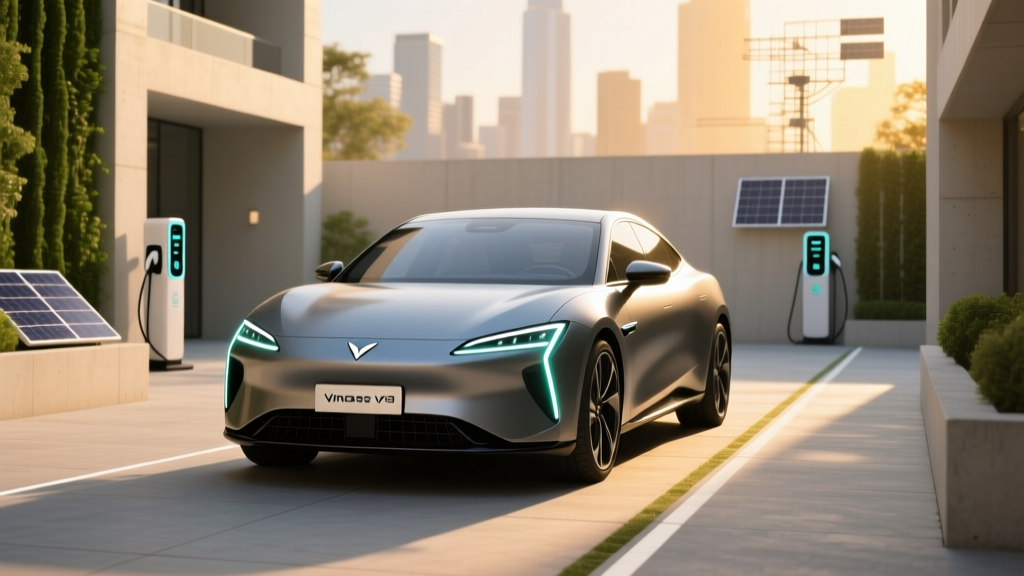
If you've seen the VinFast VF8 on American roads and wondered who is behind this angular electric SUV, the answer traces back to Hanoi, Vietnam. VinFast Auto Ltd. — a subsidiary of Vingroup, one of Vietnam's largest conglomerates — launched the brand in 2017 and pivoted to full electric-vehicle production for global markets by 2022. The VF8 is its flagship midsize crossover aimed squarely at U.S. families who want a dual-motor AWD electric SUV without the Tesla or Hyundai badge.
But origin story aside, the real question for buyers in 2026 is whether the VF8's specs, charging speed, and pricing hold up against established competitors like the Tesla Model Y, Hyundai Ioniq 5, and Ford Mustang Mach-E. Below is a data-driven review covering range, battery chemistry, charging curves, real-world ownership economics, and federal tax credit eligibility.
VinFast VF8 Core Specifications at a Glance
| Spec | VF8 Eco | VF8 Plus |
|---|---|---|
| EPA Range | 292 miles | 264 miles |
| Battery (Usable) | 82.7 kWh (NMC) | 82.7 kWh (NMC) |
| Drivetrain | Dual-Motor AWD | Dual-Motor AWD |
| Horsepower | 349 hp | 402 hp |
| 0–60 mph | 5.5 sec | 4.5 sec |
| Peak DC Fast Charge | 155 kW | 155 kW |
| 10–80% DC Time | ~31 min | ~31 min |
| Level 2 Home Charge | 11 kW (~37 mi/hr) | 11 kW (~37 mi/hr) |
| Combined MPGe | 83 MPGe | 79 MPGe |
| Cargo (rear seats up) | 18.0 cu ft | 18.0 cu ft |
| Cargo (rear folded) | 52.5 cu ft | 52.5 cu ft |
| Base MSRP | $46,000 | $52,000 |
| Battery/Powertrain Warranty | 10 yr / 125,000 mi | 10 yr / 125,000 mi |
Who Makes the VinFast VF8 and Where Is It Built?
VinFast is the automotive arm of Vingroup, a Vietnamese conglomerate with interests in real estate, retail, healthcare, and technology. The company's primary manufacturing hub sits in Hai Phong, Vietnam, a massive 335-hectare complex that produces vehicles for both domestic and export markets. For the U.S. market, VinFast began constructing an assembly plant in Chatham County, North Carolina, intended to localize production and potentially help vehicles qualify for more favorable battery-sourcing rules under the Inflation Reduction Act.
The brand's U.S. entry has been turbulent. Early 2023 deliveries of the VF8 faced significant criticism for software glitches, ride quality, and driver-assist calibration. VinFast responded with over-the-air updates and revised suspension tuning for subsequent model years. By the 2026 model year, the VF8 reflects multiple rounds of hardware and software revisions — but buyers should still approach with awareness of the brand's short track record in North America.
Range, Efficiency, and Real-World Expectations
EPA sticker: 292 miles
Real-world highway (70–75 mph, moderate climate): ~235–255 miles
Cold-weather (below 32°F, highway): ~195–220 miles
City/mixed driving (mild climate): ~265–285 miles
The VF8's 82.7 kWh NMC (nickel manganese cobalt) battery delivers competitive capacity for the segment. However, the SUV's boxy aerodynamic profile and ~5,000 lb curb weight reduce highway efficiency. The VF8 Plus, with its larger 20-inch wheels and higher-output motor, sacrifices roughly 28 miles of EPA range. Plan conservatively for road trips — especially in winter or mountainous terrain where consumption climbs significantly.
Efficiency ratings land at 83 MPGe combined for the Eco and 79 MPGe for the Plus, translating to roughly 40–42 kWh per 100 miles. This is below segment leaders like the Hyundai Ioniq 5 (114 MPGe combined) and Tesla Model Y Long Range (122 MPGe), meaning you'll spend more per mile on electricity — particularly relevant if you rely on paid public DC fast chargers rather than cheap home electricity.
Charging Speed: DC Fast Charging and Home Level 2
| Charging Level | Max Power | Approximate Speed | Notes |
|---|---|---|---|
| Level 1 (120V) | ~1.4 kW | ~4 mi/hr | Emergency/trickle only — 60+ hrs for full charge |
| Level 2 (240V, 48A) | 11 kW | ~37 mi/hr | Full charge in ~9 hrs; ideal overnight home charging |
| DC Fast (CCS) | 155 kW peak | 10–80% in ~31 min | Tapers significantly above 80%; ~18 min to 50% |
The VF8's 155 kW peak DC fast-charge rate is functional but falls behind rivals. The Hyundai Ioniq 5 peaks at 240 kW on 800V architecture (10–80% in ~18 min), and the Tesla Model Y peaks around 250 kW on V3 Superchargers. At 155 kW, the VF8 will spend roughly 13 extra minutes at a rest stop on a road trip compared to the fastest-charging competitors.
An important nuance: peak kW is not sustained kW. The VF8's charge curve holds near 155 kW up to approximately 40% state of charge (SoC), then steps down to ~110 kW through 60%, and further tapers to ~70 kW as it approaches 80%. The published 31-minute 10–80% time reflects this taper. If you typically charge only to 80% on road trips (as you should, to preserve battery health and avoid the slow tail), plan for about a half-hour stop every ~200 miles of highway driving.
For home Level 2 charging, the 11 kW onboard charger is competitive. A full charge from empty takes about 9 hours — easily achievable overnight on a 240V/48A circuit. Installation of a hardwired Level 2 home charger (like a ChargePoint Home Flex or Emporia Vue) typically costs $800–$2,000 depending on your electrical panel capacity and run length to the garage.
Performance, Ride, and Driver-Assist Technology
Both VF8 trims use a dual-motor all-wheel-drive layout. The Eco produces 349 hp and reaches 60 mph in 5.5 seconds — adequate for merging and passing but not thrilling. The Plus bumps output to 402 hp with a 4.5-second sprint, putting it in the same ballpark as a Ford Mustang Mach-E Premium AWD.
Ride quality has improved since the VF8's rocky 2023 launch. VinFast revised damper tuning and bushings for the 2025 model year, and the 2026 version benefits from those refinements. The SUV rides on a multi-link rear suspension and delivers acceptable compliance over broken pavement, though it's noticeably firmer than a Hyundai Ioniq 5 or Kia EV6.
Driver-assistance features include adaptive cruise control, lane-keeping assist, automatic emergency braking, and blind-spot monitoring. VinFast brands its ADAS suite but it operates at SAE Level 2 — meaning the driver must remain fully engaged with hands on the wheel and eyes on the road at all times. This is not a self-driving system; it is a driver-assist feature comparable to Toyota Safety Sense or Honda Sensing. Do not confuse it with Level 4 robotaxi platforms like Waymo.
The infotainment system runs on a 15.6-inch center touchscreen with wireless Apple CarPlay and Android Auto. Early software complaints have been largely addressed through OTA updates, though some owners report that the menu structure remains less intuitive than Tesla's or Hyundai's interfaces. A notable quirk: the VF8 has no traditional instrument cluster behind the steering wheel — all driving information is displayed on a compact HUD (heads-up display) and the central screen.
Pricing, Trim Levels, and Federal Tax Credit Eligibility
| Trim | Base MSRP | As-Tested (w/ common options) | Est. After §30D Credit* |
|---|---|---|---|
| VF8 Eco | $46,000 | $48,500 | ~$38,500–$41,000 |
| VF8 Plus | $52,000 | $56,000 | ~$44,500–$48,500 |
*Tax credit estimates assume full or partial §30D eligibility. Actual credit depends on battery-sourcing compliance, buyer income, and MSRP caps. See checklist below.
- MSRP cap: SUVs must be ≤$80,000 — both VF8 trims qualify ✅
- Buyer income cap: AGI ≤$150K single / $225K head of household / $300K joint filers
- Battery sourcing: Critical minerals and battery components must meet escalating domestic/free-trade-partner thresholds. VinFast's Vietnam-built batteries face scrutiny — check the latest IRS guidance at irs.gov before purchasing.
- Point-of-sale transfer: Eligible buyers can transfer the credit to the dealer at purchase, reducing the out-of-pocket price immediately (effective Jan 2024).
- Final assembly: Must occur in North America. The VF8 is currently assembled in Vietnam — this may disqualify it from the §30D credit until the North Carolina plant becomes operational. Verify current assembly location with the dealer and IRS before counting on the credit.
⚠️ Critical note: As of early 2026, the VinFast VF8's final assembly in Vietnam likely disqualifies it from the federal §30D new-vehicle credit. Consult a tax professional and check fueleconomy.gov for the latest eligibility list before purchase.
Cargo, Interior Space, and Practicality
The VF8 offers 18.0 cubic feet of cargo space behind the second row and 52.5 cubic feet with the rear seats folded. Rear legroom measures approximately 38.5 inches — adequate for adults on shorter trips but tighter than the Hyundai Ioniq 5 (41.7 inches rear legroom) or Tesla Model Y (41.8 inches).
There is no front trunk (frunk), which is a missed opportunity for an EV platform. The cabin materials on the Plus trim include synthetic leather and soft-touch plastics that feel appropriate for the price point, though some hard plastics appear on lower door panels. A panoramic glass roof is standard on both trims, creating an airy cabin but adding solar heat load in summer — an area where a retractable shade would help.
Warranty Coverage and Ownership Considerations
VinFast provides one of the segment's stronger battery warranties: 10 years or 125,000 miles (whichever comes first) with a capacity retention threshold of 70%. If the battery degrades below 70% of original capacity within the warranty period, VinFast commits to repair or replacement. The bumper-to-bumper warranty runs 7 years / 75,000 miles, and roadside assistance is included for the same 10-year / 125,000-mile window.
The generous warranty is clearly designed to offset buyer anxiety about a new brand. However, warranty value depends entirely on the company's long-term presence in the U.S. market. VinFast's financial position and commitment to the American market remain a variable that buyers should weigh carefully. A 10-year warranty from a company that exits the market in year three is worth little — this is the core risk with any startup automaker.
Pros and Cons: The Honest Scorecard
✅ Pros
- Competitive 292-mile EPA range (Eco)
- Strong 10-year/125,000-mi battery warranty
- Standard dual-motor AWD on all trims
- Distinctive exterior styling stands out in a crowded segment
- Panoramic glass roof standard
- Improved ride quality over 2023 launch models
❌ Cons
- DC fast charging peaks at only 155 kW — slow for the segment
- Below-average efficiency (83 MPGe) increases charging costs
- Likely ineligible for §30D federal tax credit (Vietnam assembly)
- No frunk; cargo space trails key rivals
- Brand-new company — long-term U.S. support uncertain
- Infotainment UI still less polished than competitors
- No instrument cluster — HUD-only may not suit all drivers
Is the VinFast VF8 Worth Buying vs. Competitors?
The VF8 competes in the hottest segment of the EV market. Here's how it stacks up on the metrics that matter:
| Metric | VinFast VF8 Eco | Hyundai Ioniq 5 (AWD) | Tesla Model Y LR | Ford Mach-E (ER AWD) |
|---|---|---|---|---|
| EPA Range | 292 mi | 290 mi | 330 mi | 290 mi |
| Battery | 82.7 kWh NMC | 77.4 kWh NMC | ~75 kWh NMC | 91 kWh NMC |
| Peak DC Charge | 155 kW | 240 kW | 250 kW | 150 kW |
| 10–80% Time | ~31 min | ~18 min | ~20 min | ~36 min |
| MPGe (combined) | 83 | 110 | 122 | 98 |
| Base MSRP | $46,000 | $49,750 | $48,590 | $48,995 |
| §30D Eligible | Unlikely ❌ | Partial ✅ | Likely ✅ | Partial ✅ |
Choose the VinFast VF8 if:
- You value distinctive styling and want to stand apart from the ubiquitous Model Y
- You drive primarily in-city where the range penalty of lower efficiency is less impactful
- The 10-year battery warranty gives you confidence to try a newer brand
- You have reliable home Level 2 charging and rarely need public DC fast chargers
Choose a competitor if:
- Road trips are frequent — the Ioniq 5 or Model Y charge significantly faster
- You need the $7,500 federal tax credit to make the math work — the VF8 likely won't qualify
- Maximum cargo and rear-seat space are priorities — the Model Y and Ioniq 5 both offer more room
- Long-term brand support and dealer network density matter to you
Frequently Asked Questions
What is the real-world range of the VinFast VF8?
The EPA rates the VF8 Eco at 292 miles and the Plus at 264 miles. In real-world highway driving at 70–75 mph in moderate temperatures, expect roughly 235–255 miles (Eco). In cold weather below freezing, highway range can drop to 195–220 miles due to battery resistance and cabin heating demands. City driving with regenerative braking recovers more energy, yielding closer to EPA numbers.
How fast does the VF8 charge at home and on the road?
On a Level 2 home charger (240V, 48A), the VF8 charges at up to 11 kW, adding roughly 37 miles of range per hour — a full charge takes about 9 hours. On DC fast chargers, it peaks at 155 kW and reaches 10–80% in approximately 31 minutes. This is slower than the Hyundai Ioniq 5 (18 min) or Tesla Model Y (20 min) due to its lower peak charge rate.
Does the VinFast VF8 qualify for the federal EV tax credit?
As of early 2026, the VF8 is assembled in Vietnam, which likely disqualifies it from the IRS §30D new clean vehicle credit that requires North American final assembly. Even if assembly shifts to VinFast's planned North Carolina plant, the battery must also meet critical-mineral and component-sourcing thresholds. Always verify current eligibility on fueleconomy.gov and with a tax professional before purchase.
Is the VinFast VF8 safe?
The VF8 includes standard automatic emergency braking, lane-keeping assist, blind-spot monitoring, and rear cross-traffic alert. As of early 2026, the VF8 has not been crash-tested by the NHTSA or IIHS in the United States, so there is no official crash safety rating available. The lack of independent safety testing is a consideration for family buyers.
Who should buy the VinFast VF8?
The VF8 suits buyers who want a distinctive, AWD electric SUV with a long battery warranty and who primarily charge at home. It is less ideal for frequent road-trippers (slow DC charging), tax-credit-dependent buyers (likely ineligible), or those who prioritize maximum interior space and established dealer support. If you're cross-shopping, test-drive the Hyundai Ioniq 5, Tesla Model Y, and Ford Mustang Mach-E alongside the VF8 before deciding.