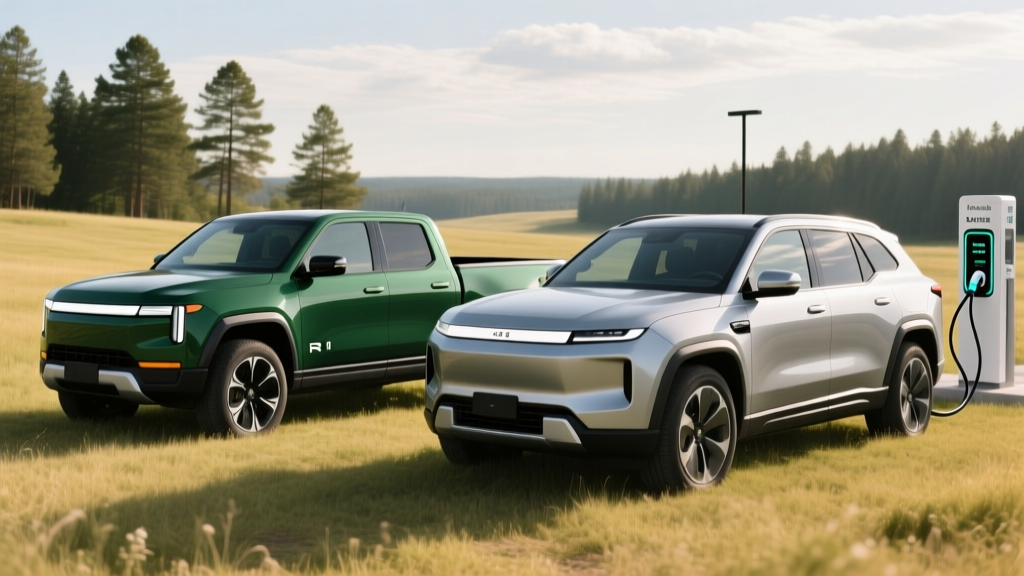
If you've seen a boxy, adventure-ready electric SUV or pickup on the trail and wondered who makes Rivian vehicles, the answer is an American automaker headquartered in Irvine, California. Founded in 2009 by RJ Scaringe, Rivian Automotive designs, engineers, and manufactures its own electric vehicles at a 3.3-million-square-foot factory in Normal, Illinois. Unlike many EV startups that outsource production, Rivian is a fully vertically integrated OEM — handling everything from battery pack assembly to over-the-air software updates in-house.
As of 2026, Rivian's consumer lineup consists of two core vehicles built on a shared skateboard platform: the R1S three-row SUV and the R1T crew-cab pickup truck. Both received a comprehensive Gen 2 refresh for the 2025 model year, bringing new dual-motor and tri-motor powertrains, a redesigned electrical architecture, and the company's proprietary NACS (North American Charging Standard) port, eliminating the need for adapters at Tesla Superchargers. Let's break down the specs, pricing, and ownership reality of the 2026 Rivian lineup.
2026 Rivian Lineup at a Glance: R1S and R1T Specs
| Spec | R1S (SUV) | R1T (Truck) |
|---|---|---|
| EPA Range (Standard Pack) | 270 miles | 270 miles |
| EPA Range (Large Pack) | 352 miles | 352 miles |
| EPA Range (Max Pack) | 410 miles | 420 miles |
| Battery Capacity (Standard) | 95 kWh (usable), LFP | 95 kWh (usable), LFP |
| Battery Capacity (Large) | 128 kWh (usable), NMC | 128 kWh (usable), NMC |
| Battery Capacity (Max) | 149 kWh (usable), NMC | 149 kWh (usable), NMC |
| Drivetrain | Dual-Motor AWD | Dual-Motor AWD |
| Horsepower (Dual-Motor) | 533 hp | 533 hp |
| Horsepower (Tri-Motor) | 850 hp | 850 hp |
| 0–60 mph (Dual-Motor) | 4.5 seconds | 4.5 seconds |
| 0–60 mph (Tri-Motor) | 2.9 seconds | 2.9 seconds |
| Max DC Fast Charge | 220 kW (Large/Max) | 220 kW (Large/Max) |
| 10–80% DC Fast Charge | ~25 minutes | ~25 minutes |
| Level 2 Home Charging | 11.5 kW (~25 mi/hr) | 11.5 kW (~25 mi/hr) |
| Efficiency (Large Pack) | 73 MPGe / 46 kWh/100mi | 73 MPGe / 46 kWh/100mi |
| Towing Capacity | 7,700 lbs | 11,000 lbs |
| Cargo (R1S behind 3rd row) | 11.1 cu ft (104 cu ft max) | N/A (4.5 cu ft frunk + 48 cu ft bed) |
| Base MSRP (Dual-Motor Standard) | $75,900 | $69,900 |
| Warranty (Battery/Powertrain) | 8 years / 175,000 miles | 8 years / 175,000 miles |
Real-World Range: What to Actually Expect
EPA sticker: 352 miles (Large Pack, Dual-Motor). In real-world highway driving at 70–75 mph, expect ~280–310 miles in mild weather. In freezing temperatures (below 32°F), range can drop 20–30%, yielding ~220–260 miles before needing a charge. The Max Pack extends this buffer significantly, but the LFP Standard Pack is best suited for drivers with reliable home charging and commutes under 200 miles round-trip.
Rivian's EPA numbers are achievable in mixed city/suburban driving where regenerative braking recovers energy frequently. However, these vehicles are heavy — the R1S Large Pack tips the scales at nearly 7,000 lbs — and that mass exacts a penalty at sustained highway speeds and in cold weather. The R1S and R1T use a heat pump for cabin and battery thermal management, which helps mitigate cold-weather losses compared to older EVs using resistive heating, but physics still wins: expect roughly a 25% range reduction in deep winter conditions.
For road trippers, the practical calculation isn't total range but distance between fast-charging stops. With a Large Pack, plan for charging stops every 220–250 miles to keep the battery in the optimal 10–80% state of charge (SoC) window, where charging speeds are fastest.
Charging Speed: DC Fast, Level 2, and NACS Access
| Charging Level | Power (kW) | Miles Added per Hour | Notes |
|---|---|---|---|
| Level 1 (120V household) | ~1.4 kW | ~3 mi/hr | Emergency/trickle only |
| Level 2 (240V home, 48A) | 11.5 kW | ~25 mi/hr | Full charge overnight (~12 hrs for Large Pack) |
| DC Fast (peak) | 220 kW | ~140 mi in 20 min | Large/Max packs; Standard Pack peaks ~180 kW |
| DC Fast 10–80% | Varies (curve) | ~25 minutes | Charge tapers significantly above 80% SoC |
A critical detail many spec sheets gloss over: peak kW is not sustained kW. The Rivian R1S/R1T with Large or Max packs can hit 220 kW at a DC fast charger, but only in a narrow SoC window (roughly 10–35%). From 35–60%, speeds settle around 170–180 kW, and above 80%, the charge rate drops sharply to protect battery longevity — often below 50 kW. This is why the 10–80% metric matters more than the peak number.
For 2026, all new Rivians come equipped with the NACS charge port, meaning native access to Tesla's Supercharger network — the largest and most reliable DC fast-charging network in North America — without an adapter. Rivian owners can also use Electrify America, EVgo, and ChargePoint stations, though CCS-to-NACS adapters may be needed at older CCS-only stations. According to Rivian's charging page, the vehicle's navigation system automatically preconditions the battery when routing to a fast charger, warming it to the ideal temperature for maximum charge acceptance.
At home, Rivian's Wall Charger delivers up to 11.5 kW on a 60-amp circuit (48 amps continuous). That translates to roughly 25 miles of range per hour of charging, meaning a depleted Large Pack refills in about 12 hours — practical for overnight charging. Installation typically costs $500–$2,000 depending on your electrical panel's capacity and the run length from panel to garage. Homes with 100-amp service may require a panel upgrade ($1,500–$3,000) before adding a Level 2 charger.
Pricing, Trims, and Federal Tax Credit Eligibility
| Model / Configuration | Base MSRP | Est. Federal Credit (§30D) | Effective Price |
|---|---|---|---|
| R1T Dual-Motor Standard Pack | $69,900 | $3,750–$7,500* | $62,400–$66,150 |
| R1T Dual-Motor Large Pack | $75,900 | $3,750–$7,500* | $68,400–$72,150 |
| R1T Tri-Motor Max Pack | $99,900 | $3,750–$7,500* | $92,400–$96,150 |
| R1S Dual-Motor Standard Pack | $75,900 | $3,750–$7,500* | $68,400–$72,150 |
| R1S Dual-Motor Large Pack | $81,900 | $3,750–$7,500* | $74,400–$78,150 |
| R1S Tri-Motor Max Pack | $105,900 | $3,750–$7,500* | $98,400–$102,150 |
*Federal tax credit eligibility under IRS §30D depends on multiple factors: buyer income caps ($150K single / $300K joint AGI), vehicle MSRP caps ($80K for trucks, $80K for SUVs/vans), battery critical-mineral sourcing, and North American assembly. Rivian manufactures in Illinois, satisfying the assembly requirement. However, battery-sourcing rules have tightened — the Standard Pack's LFP cells use cathode materials that may only partially satisfy critical-mineral requirements, potentially qualifying for $3,750 instead of the full $7,500. The Large and Max packs using NMC chemistry with diversified sourcing are more likely to qualify for the full credit. As of 2026, buyers can transfer the credit to the dealer at point of sale for an immediate price reduction. Always verify current eligibility with your tax professional before purchase.
The MSRP cap is a key concern: the R1S qualifies as an SUV under IRS classification, meaning the $80,000 MSRP cap applies. The base Dual-Motor Standard Pack at $75,900 clears this threshold, but adding packages (the Adventure Package, premium paint, 22-inch wheels) can push the sticker above $80K and eliminate credit eligibility. The R1T, classified as a pickup truck, also has an $80,000 cap. Buyers targeting the tax credit should configure carefully and confirm the final MSRP before ordering.
Performance, Capability, and Drivetrain
Rivian's dual-motor AWD powertrain produces 533 horsepower and 610 lb-ft of torque in its standard tune, propelling either vehicle to 60 mph in approximately 4.5 seconds — remarkable for vehicles weighing over 6,500 pounds. The available tri-motor configuration (one front, two rear) pushes output to 850 hp and drops the 0–60 time to under 3 seconds, placing the R1T in supercar-truck territory alongside the GMC Hummer EV and Tesla Cybertruck Beast.
Where Rivian separates itself from competitors is off-road capability. Every R1S and R1T features an available adaptive air suspension with up to 14.9 inches of ground clearance, a wading depth of over 3 feet, and a quad-motor tank-turn capability on tri-motor models (where individual motors on each wheel allow the vehicle to pivot in place). The R1T's gear tunnel — a lockable, pass-through storage compartment between the cab and bed — is a genuinely innovative feature that no other electric truck offers, providing 11.7 cubic feet of secure, weatherproof storage.
Towing capacity stands at 7,700 lbs for the R1S and 11,000 lbs for the R1T. However, towing at max capacity will reduce range by 40–50% in real-world conditions — a physics reality common to all EVs. Plan for charging stops every 100–130 miles when towing near maximum.
Interior, Tech, and Driver Assistance
Rivian's interior design language is minimalist but warm, with sustainable materials like vegan leather and reclaimed wood accents. The centerpiece is a 15.6-inch center touchscreen running Rivian's custom operating system, which receives regular over-the-air (OTA) updates. The digital instrument cluster is a 12.3-inch display, and a 6.8-inch rear touchscreen allows back-seat passengers to control climate and media. A unique feature: the removable Bluetooth speaker (the "Camp Speaker") that can be taken out of the vehicle for tailgating or campsite use.
On the driver-assistance front, Rivian's Driver+ system is a SAE Level 2 feature — meaning it provides combined lane-centering and adaptive cruise control on highways, but the driver must remain fully engaged with hands on the wheel and eyes on the road. This is not self-driving. It competes with Tesla Autopilot, Ford BlueCruise, and GM Super Cruise in capability. Rivian uses a camera-and-radar sensor suite (11 cameras, 5 radar units, and a LiDAR sensor on certain trims) to perceive the driving environment.
Rivian Driver+ is a Level 2 driver-assistance system, not an autonomous driving feature. You must keep your hands on the steering wheel and monitor traffic at all times. It does not navigate stoplights, construction zones, or unmapped roads independently.
Notable tech drawbacks include the absence of Apple CarPlay and Android Auto — Rivian uses its own native infotainment system exclusively. While the native system is well-designed, many buyers expect phone projection as standard. Additionally, the R1S third row is best suited for children; adults will find legroom tight at 28.7 inches.
Who Should Buy a Rivian — And Who Shouldn't
✅ Best For
- Outdoor enthusiasts who need off-road capability, camping features (camp kitchen accessory, gear tunnel), and all-weather AWD
- Families needing 3 rows (R1S) with genuine cargo space and towing for a boat or camper trailer
- Truck buyers (R1T) who want a daily-drivable electric pickup with a usable 4.5-foot bed and 11,000-lb towing
- Homeowners with Level 2 charging who can charge overnight and use DC fast charging for road trips
- Tech-forward buyers who value OTA updates, NACS Supercharger access, and a distinctive design
❌ Think Twice If
- Apartment dwellers without access to home or workplace Level 2 charging — public-only charging will be costly and inconvenient for a 7,000-lb vehicle
- Budget-conscious buyers — even after tax credits, the cheapest Rivian starts above $62,000 effective
- Apple CarPlay/Android Auto loyalists — Rivian does not support phone mirroring
- Frequent long-distance highway drivers in cold climates — real-world range drops to ~220 miles in winter, requiring more frequent stops
- Buyers needing a full-size truck bed — the R1T's 4.5-foot bed is shorter than a standard F-150 or Silverado
Rivian vs. Key Competitors
The Rivian R1S competes most directly with the Tesla Model X, BMW iX, and the upcoming Volvo EX90 in the three-row electric SUV segment. The R1T's competitive set includes the Ford F-150 Lightning, Chevrolet Silverado EV, and Tesla Cybertruck. Here's how the R1T stacks up against the F-150 Lightning, the best-selling electric truck:
| Attribute | Rivian R1T (Large Pack) | Ford F-150 Lightning (Ext. Range) |
|---|---|---|
| EPA Range | 352 miles | 320 miles |
| Battery | 128 kWh NMC | 131 kWh NMC |
| Horsepower | 533 hp | 580 hp |
| 0–60 mph | 4.5 sec | 3.8 sec |
| Max Towing | 11,000 lbs | 10,000 lbs |
| Bed Length | 4.5 ft | 5.5 ft |
| Base MSRP | $75,900 | $74,995 |
| Charge Port | NACS (native Supercharger) | CCS (adapter for Supercharger) |
| Off-Road Focus | Air suspension, 14.9" clearance | Available (less ground clearance) |
The R1T wins on range, towing, and off-road capability. The F-150 Lightning wins on bed length, rear-seat space, and a slightly lower price. If you need a work truck with a full-size bed, the Lightning is the pragmatic choice. If you want an adventure vehicle that doubles as a daily driver with superior trail capability, the R1T is the stronger pick.
Warranty and Long-Term Battery Outlook
Rivian covers the battery pack and drive units with an 8-year / 175,000-mile warranty, guaranteeing a minimum of 70% capacity retention over that period. The limited vehicle warranty is 5 years / 60,000 miles. For context, this battery warranty is competitive with Tesla (8 yr / 150K mi on Model S/X) and exceeds the federal minimum requirement of 8 yr / 100K miles. According to fueleconomy.gov, the R1S Large Pack achieves 73 MPGe combined, translating to approximately 46 kWh per 100 miles — a useful figure for calculating home charging costs.
The Standard Pack's LFP (lithium iron phosphate) chemistry offers a distinct longevity advantage: LFP cells typically endure more charge cycles with less degradation than NMC, making them ideal for buyers who plan to charge to 100% daily. The trade-off is lower energy density, which is why the Standard Pack delivers fewer miles in the same physical footprint. The Large and Max packs use NMC chemistry for maximum range but benefit from staying in the 20–80% SoC window for daily use.
Frequently Asked Questions
Who makes Rivian vehicles?
Rivian Automotive, Inc., an American electric vehicle manufacturer founded in 2009 and headquartered in Irvine, California. All Rivian vehicles are produced at the company's manufacturing facility in Normal, Illinois. Rivian is a publicly traded company (NASDAQ: RIVN) and also has a commercial division that builds delivery vans for Amazon.
What is the real-world range of a Rivian?
The EPA-rated range for the 2026 R1S/R1T Large Pack is 352 miles. In real-world highway driving at 70+ mph, expect 280–310 miles. In cold weather (below freezing), range may drop to 220–260 miles. The Max Pack extends EPA range to 410–420 miles, providing a larger buffer for road trips and towing.
Does the Rivian R1S or R1T qualify for the federal EV tax credit?
Potentially, yes — but eligibility depends on the buyer's adjusted gross income (capped at $150K single / $300K joint), the vehicle's final MSRP (must be at or below $80,000), and battery component/critical-mineral sourcing requirements under IRS §30D. Rivian's Illinois assembly satisfies the North American manufacturing rule. The Standard Pack (LFP) may qualify for a partial $3,750 credit due to cathode mineral sourcing, while Large/Max packs are more likely to qualify for the full $7,500. Always confirm with a tax professional and check IRS.gov for the latest guidance.
How fast does a Rivian charge at home?
On a Level 2 home charger (240V, 48 amps / 11.5 kW), a Rivian adds approximately 25 miles of range per hour. A full charge of the Large Pack from empty takes roughly 12 hours. Most owners who plug in nightly never need to use public chargers for daily driving.
Can Rivians use Tesla Superchargers?
Yes. All 2025+ Rivian vehicles come equipped with the NACS (North American Charging Standard) charge port, providing native access to Tesla's Supercharger network without an adapter. For older Rivians with CCS ports, Rivian offers an official NACS adapter.
Is Rivian a reliable brand?
Rivian's Gen 2 vehicles (2025+) have addressed many early-production issues reported by 2022–2024 owners, including panel gaps, software glitches, and drive-unit noise. As a newer automaker, long-term reliability data (10+ years) does not yet exist. Rivian's service model includes mobile service vans for many repairs, reducing dealership dependency, but service center density is still growing compared to legacy brands.