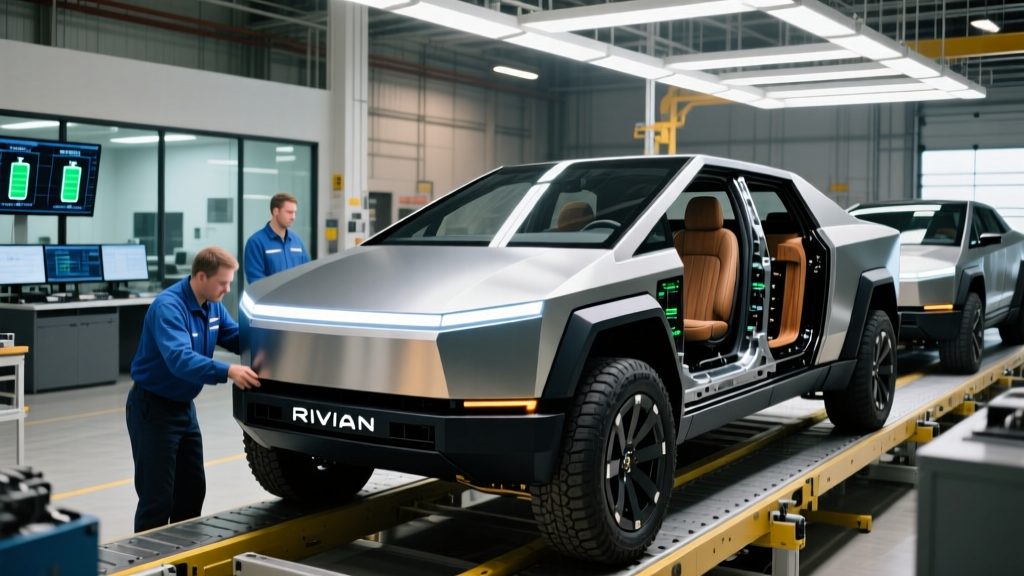
Rivian doesn't sell cars — it builds electric adventure trucks and SUVs, and every one of them rolls off the line at the company's own factory in Normal, Illinois. If you've been asking who makes the car Rivian, the short answer is: Rivian itself, in the USA, using a skateboard platform the company designed from scratch. The longer answer involves a 3.3-million-square-foot former Mitsubishi plant, a vertically integrated supply chain, and a lineup that currently includes the R1T pickup, the R1S three-row SUV, and the EDV commercial delivery van built for Amazon.
Below is a deep-dive buyer's guide on the 2026 Rivian R1T Dual-Motor and R1S Dual-Motor — the volume trims most shoppers cross-shop against the Tesla Cybertruck, Ford F-150 Lightning, and Chevrolet Silverado EV. We'll cover the real-world range you can actually expect, how fast these trucks charge on the road, what you'll pay after federal tax credits, and whether the Rivian platform is worth your money versus the competition.
Rivian's Factory: Where the R1T and R1S Are Built
Rivian's production hub is a 3.3-million-square-foot facility in Normal, Illinois, originally built by Mitsubishi Motors in the 1990s. Rivian purchased the plant in 2017 and retooled it for battery-electric vehicle production. As of 2026, it remains Rivian's sole manufacturing site, though the company has announced a second factory in Stanton, Georgia (expected production start 2028) to support its upcoming R2 midsize platform.
Unlike legacy automakers that rely on joint-venture battery suppliers, Rivian designs its own battery packs in-house. The current R1 platform uses a structural battery enclosure that serves as part of the vehicle's chassis, reducing weight and improving torsional rigidity. Rivian sources cylindrical lithium-ion cells from multiple suppliers, including Samsung SDI, and assembles packs at the Normal facility.
| Spec | Value |
|---|---|
| EPA Range | 270 miles (Standard); 352 miles (Max) |
| Battery Capacity (Usable) | ~95 kWh (Standard); ~128 kWh (Max) |
| Battery Chemistry | NMC (nickel manganese cobalt) — Standard & Max |
| Peak DC Fast Charge | 200 kW (Standard); 220 kW (Max) |
| 10–80% DC Fast Charge | ~28 minutes (Standard); ~34 minutes (Max) |
| Level 2 Home Charging | 11.5 kW onboard (~25 miles/hr) |
| 0–60 mph | 4.5 seconds |
| Horsepower / Torque | 533 hp / 610 lb-ft |
| Drivetrain | Dual-Motor AWD |
| Towing Capacity | 11,000 lbs |
| Ground Clearance | 7.9–14.9 in (adjustable air suspension) |
| MPGe (Combined) | 73 MPGe / 46 kWh/100mi |
| Base MSRP | $69,900 (R1T Dual-Motor Standard) |
| Battery/Powertrain Warranty | 8 years / 175,000 miles (70% capacity retention) |
Real-World Range: What the EPA Sticker Doesn't Tell You
The EPA rates the 2026 R1T Dual-Motor Standard Battery at 270 miles. That number is measured on a controlled dynamometer cycle and represents a mix of city and highway driving at moderate temperatures. In practice, your mileage will vary — sometimes significantly.
- Mixed city/suburban (55–65 mph, mild weather): 250–270 miles
- Highway sustained (75 mph, 70°F): 220–240 miles
- Highway sustained (75 mph, 30°F): 185–210 miles
- Towing a 5,000-lb trailer (65 mph): 140–160 miles
The R1T's boxy, truck-shaped profile creates more aerodynamic drag than a sedan or crossover, which disproportionately hurts highway efficiency. Cold weather compounds the loss: lithium-ion cells are less efficient at low temperatures, and cabin heating draws substantial power. Rivian's heat pump helps, but expect 25–35% range reduction in sustained sub-freezing highway driving.
If range is a priority, the Max Battery pack (128 kWh usable, EPA 352 miles) provides a meaningful buffer, though it adds roughly $6,000 to the price and approximately 300 lbs of weight. For most daily commuters who charge at home overnight, the Standard pack is sufficient — the real question is how often you plan to road-trip or tow.
Charging Speed: DC Fast and Home Level 2
Rivian uses the NACS (North American Charging Standard) connector on all 2026 models, giving R1T and R1S owners native access to the Tesla Supercharger network — currently the most reliable and widespread DC fast-charging network in North America. This is a significant advantage over CCS-only vehicles that still rely on Electrify America or EVgo.
| Charging Level | Power | Miles Added per Hour | Notes |
|---|---|---|---|
| Level 1 (120V household) | ~1.4 kW | ~3 mi/hr | Emergency/trickle only |
| Level 2 (240V, 48A) | 11.5 kW | ~25 mi/hr | Full charge in ~10 hrs (Standard) |
| DC Fast Charge (peak) | 200 kW | ~200 mi in 20 min | 10–80% in ~28 min (Standard) |
| DC Fast Charge (tapered) | ~50 kW avg above 80% | ~50 mi/hr | Charge curve slows significantly past 80% |
A critical detail many spec sheets gloss over: peak kW is not sustained kW. The R1T Standard Battery hits 200 kW only between roughly 10–35% state of charge (SoC), then tapers progressively. The 10–80% time of 28 minutes reflects this curve. If you're planning a road trip, budget for ~30-minute stops at Superchargers every 180–200 miles to stay in the fast-charging sweet spot.
For home charging, Rivian recommends a 240V / 48-amp Level 2 wall connector, which requires a 60-amp dedicated circuit. Installation costs typically run $800–$2,000 depending on your electrical panel's capacity and the distance from the panel to your parking spot. If your home has a 100-amp main panel, you may need a $1,500–$3,000 panel upgrade to 200 amps before installing a Level 2 charger — a cost many buyers overlook.
Performance and Capability: More Than a Straight Line
The Dual-Motor R1T produces 533 horsepower and 610 lb-ft of torque, enough for a 4.5-second 0–60 mph time. That's quick for a 7,000-lb truck, but the real story is how Rivian manages that power off-road and under load.
Every R1T and R1S comes with a standard air suspension system that adjusts ground clearance from 7.9 inches (for highway efficiency) up to 14.9 inches (for rock crawling or deep snow). The quad-corner air springs also enable a self-leveling feature when towing, keeping the truck bed flat regardless of tongue weight.
The available Tri-Motor and Quad-Motor powertrains push output to 850 hp and 1,025 hp respectively, dropping 0–60 times into the 3.0-second and 2.5-second range. These are enthusiast-oriented trims that carry a steep price premium ($15,000–$25,000 over Dual-Motor) and reduce range due to higher energy consumption.
Towing capacity is rated at 11,000 lbs for the R1T — competitive with the F-150 Lightning (10,000 lbs) and ahead of the Cybertruck (11,000 lbs with the caveat that range drops dramatically when towing). Rivian's integrated trailer brake controller and tow-assist software are well-reviewed, but buyers should be realistic: towing any heavy trailer will cut range nearly in half.
Pricing, Trims, and Federal Tax Credit Eligibility
Rivian's pricing has stabilized after several rounds of restructuring. Here's where the 2026 R1T lineup stands:
| Trim | Base MSRP | §30D Credit Eligibility | Est. After-Credit Price |
|---|---|---|---|
| Dual-Motor Standard | $69,900 | Eligible (up to $7,500) | ~$62,400 |
| Dual-Motor Max | $75,900 | Eligible (up to $7,500) | ~$68,400 |
| Tri-Motor Max | $89,900 | Eligible (up to $7,500) | ~$82,400 |
| Quad-Motor Max | $99,900 | Eligible (up to $7,500) | ~$92,400 |
Federal tax credit rules matter here. Under IRS §30D, the R1T qualifies as a light truck, meaning the MSRP cap is $80,000 (higher than the $55,000 cap for sedans). All Dual-Motor and Tri-Motor trims fall under this cap. The Quad-Motor at $99,900 exceeds it and is not eligible for the federal credit.
Additionally, buyers must meet income caps: $150,000 single / $225,000 head of household / $300,000 joint (modified adjusted gross income). Battery sourcing and critical-mineral requirements also apply — Rivian has worked to localize its supply chain, and as of 2026, the Standard and Max packs meet the domestic-content thresholds for the full $7,500 credit. However, these rules are subject to change. Always verify current eligibility on IRS.gov and consult a tax professional before relying on the credit.
As of 2026, the §30D credit can be transferred to the dealer at the point of sale, effectively reducing your purchase price on day one rather than waiting until tax filing. Rivian supports this point-of-sale transfer through its direct-sales model.
Interior, Cargo, and Daily Usability
The R1T is a midsize truck with a 54-inch bed — shorter than a full-size F-150 or Silverado, but cleverly designed. The signature gear tunnel is a lockable, pass-through compartment behind the rear seats that holds long items (skis, fishing rods, camp chairs) and provides roughly 11 cubic feet of secure, weatherproof storage. Combined with the bed and the front trunk (frunk), the R1T offers about 37 cubic feet of total lockable cargo space.
Inside the cabin, Rivian uses a minimalist, tech-forward design with a 15.6-inch center touchscreen and a 12.3-inch digital instrument cluster. The materials are premium but durable — think vegan leather and open-pore wood rather than luxury-car opulence. Rear-seat legroom is 38.4 inches, adequate for adults on long drives. The R1S three-row SUV variant offers seating for up to seven, with a third row best suited for children.
The Rivian Driver+ system provides Level 2 driver assistance, including adaptive cruise control, lane-centering, and automatic lane changes on divided highways. It's competent and well-calibrated, but it is not self-driving — the driver must remain attentive with hands on the wheel at all times. Rivian does not charge a subscription for Driver+ (unlike Tesla's FSD or GM's Super Cruise), which is a meaningful ownership-cost advantage.
- Class-leading off-road capability with adjustable air suspension
- NACS connector = native Tesla Supercharger access
- Gear tunnel and frunk provide unique, practical storage
- No subscription fees for Level 2 driver assist
- Over-the-air updates continuously add features
- 11,000-lb towing capacity with integrated trailer software
- Highway range drops significantly due to boxy aero profile
- Towing range realistically 140–160 miles (Standard pack)
- Service center network still limited outside major metro areas
- No 800V architecture — charging slower than Hyundai Ioniq 5 or Porsche Macan EV
- Third row in R1S is cramped for adults
- Insurance premiums run 15–25% higher than comparable gas trucks
How Does Rivian Stack Up Against Competitors?
The R1T competes in a narrow but growing segment. Here's how it compares to the two most common cross-shops:
| Spec | Rivian R1T Dual-Motor | Ford F-150 Lightning Lariat | Tesla Cybertruck AWD |
|---|---|---|---|
| EPA Range | 270 mi (Std) / 352 mi (Max) | 240 mi (Std) / 320 mi (Ext) | 340 mi |
| 0–60 mph | 4.5 sec | 5.0 sec | 4.1 sec |
| Peak DC Charge | 200 kW | 150 kW | 250 kW |
| Towing | 11,000 lbs | 10,000 lbs | 11,000 lbs |
| Bed Length | 54 in | 67 in | 72 in |
| Base MSRP | $69,900 | $59,995 | $79,990 |
| Connector | NACS | NACS (2025+) | NACS |
The F-150 Lightning wins on price and bed size — it's a full-size truck at a lower entry point. The Cybertruck offers the most range and the fastest charging, but its polarizing design and limited service infrastructure are drawbacks. The R1T occupies the premium-adventure niche: it's the best off-roader of the three, has the most creative storage, and offers the most refined software experience. You pay more for it, but the ownership experience — from the direct-sales model to the included driver assist — is more cohesive than its rivals.
Warranty and Long-Term Ownership
Rivian provides an 8-year / 175,000-mile battery and powertrain warranty with a guaranteed capacity retention threshold of 70%. That's among the most generous in the industry, exceeding the federal minimum of 8 years / 100,000 miles and matching or beating most competitors.
The vehicle limited warranty covers 5 years / 60,000 miles bumper-to-bumper. Rivian's service model combines mobile service vans (for software issues, 12V battery replacements, and minor repairs) with physical service centers in major metros. As of 2026, Rivian operates approximately 60 service centers nationwide — improving, but still thin for rural owners who may face 100+ mile drives for major warranty work.
Battery degradation data from early R1T owners (2022–2024 models) suggests NMC packs lose approximately 5–8% capacity over the first 60,000 miles, which is within expected norms. Rivian's thermal management system actively conditions the pack, which should support long-term longevity.
Who Should Buy a Rivian?
- You want a premium electric truck with genuine off-road capability
- You value creative storage (gear tunnel, frunk) over a full-size bed
- You plan to use Tesla Superchargers for road trips (NACS native)
- You want included driver-assist tech with no monthly subscription
- You can charge at home and your daily driving is under 200 miles
- You need a full-size truck bed for work (consider the F-150 Lightning)
- You tow heavy trailers frequently and need maximum range while towing
- You live far from a Rivian service center and can't tolerate mobile-service limitations
- Budget is a primary concern — the Lightning starts $10,000 lower
The R1S is the right call if you need three rows of seating and prefer an SUV form factor, but be aware that the third row is best for kids and cargo space behind it is limited (about 10.4 cubic feet with all rows up).
Frequently Asked Questions
Who owns Rivian?
Rivian Automotive, Inc. is a publicly traded company (NASDAQ: RIVN) founded in 2009 by RJ Scaringe. Amazon holds a significant minority stake, and the two companies have a commercial partnership for the EDV delivery van. Rivian is headquartered in Irvine, California, with manufacturing in Normal, Illinois.
Is Rivian made in China?
No. All Rivian consumer vehicles (R1T, R1S) are manufactured in Normal, Illinois, USA. Some battery cell components are sourced globally (including Samsung SDI cells from South Korea), but final assembly, pack construction, and vehicle production are entirely domestic.
What is the real-world range of the Rivian R1T?
The EPA rates the 2026 R1T Dual-Motor Standard at 270 miles. In real-world mixed driving, expect 240–260 miles. Sustained highway driving at 75 mph drops this to 220–240 miles, and cold weather (below 32°F) can push it to 185–210 miles. The Max Battery variant (EPA 352 miles) provides a larger buffer for road trips and towing.
How fast does the Rivian R1T charge?
On a DC fast charger, the Standard Battery peaks at 200 kW and charges from 10–80% in approximately 28 minutes. At home on a 240V Level 2 charger (11.5 kW), a full charge takes about 10 hours. The NACS connector gives native access to Tesla Superchargers, which are the most widely available high-speed chargers in the US.
Does the Rivian R1T qualify for the $7,500 federal tax credit?
Yes, most trims qualify under IRS §30D rules. The R1T is classified as a light truck, so the MSRP cap is $80,000 — the Dual-Motor Standard ($69,900), Dual-Motor Max ($75,900), and Tri-Motor Max ($89,900 — but base is under $80K with options caveats) are eligible. The Quad-Motor ($99,900) exceeds the cap. Buyer income caps ($150K single / $300K joint) and battery-sourcing requirements also apply. Verify at IRS.gov and consult a tax professional. The credit can be applied at point of sale.
Is the Rivian R1T worth buying over the Ford F-150 Lightning?
It depends on your priorities. The Lightning is cheaper, has a larger bed, and is better for work-oriented truck use. The R1T is more expensive but offers superior off-road capability, better software, NACS Supercharger access, and creative storage solutions like the gear tunnel. If you want a lifestyle adventure truck, the R1T is the stronger choice. If you need a work truck on a budget, the Lightning wins.
What are the biggest drawbacks of owning a Rivian?
The top complaints from owners include limited service center coverage outside major metros, highway range that falls short of EPA estimates due to the truck's aerodynamics, insurance premiums that run 15–25% higher than gas trucks, and the lack of an 800V architecture, which means slower DC charging compared to vehicles like the Hyundai Ioniq 5 or Porsche Macan EV.
For official efficiency data, see fueleconomy.gov. For safety ratings, check NHTSA.gov.