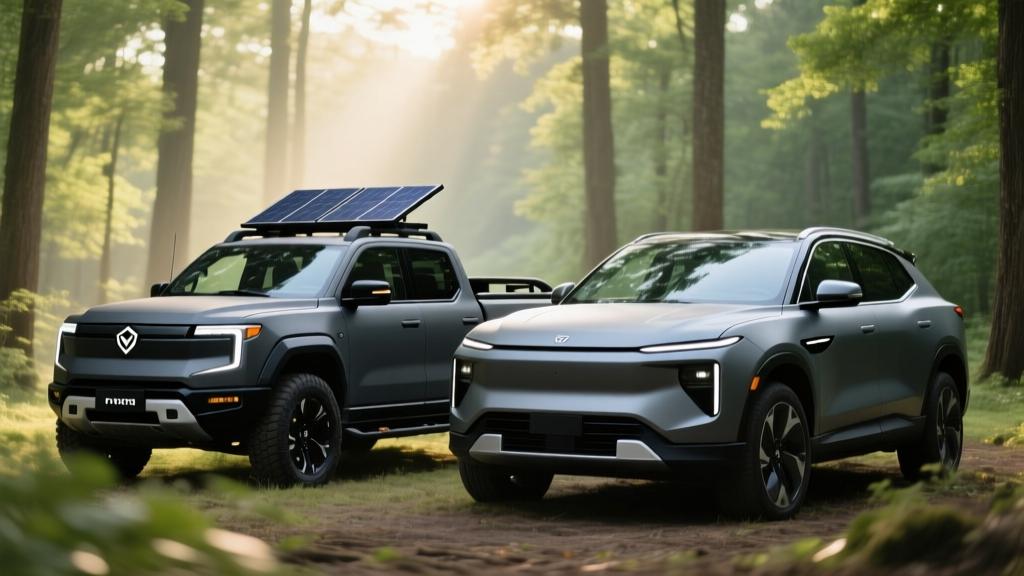
If you've seen a boxy, adventure-ready electric truck or SUV on the trail and wondered, who makes Rivian? — you're not alone. Rivian Automotive is an American EV manufacturer headquartered in Irvine, California, with production at its own purpose-built factory in Normal, Illinois. Founded in 2009 by MIT-trained engineer RJ Scaringe, Rivian began as a stealth startup (originally called Mainstream Motors, later Avera Motors) before emerging as one of the most closely watched EV brands of the decade. After years of development, the company launched its first consumer vehicles — the R1T pickup and R1S three-row SUV — in 2022, followed by its commercial EDV delivery vans built for Amazon.
As of 2026, Rivian has cemented itself as a premium electric-lifestyle brand competing with Tesla, Ford, BMW, and Mercedes-Benz. But unlike legacy automakers retrofitting gas platforms, Rivian designed its vehicles around a proprietary skateboard architecture with a quad-motor or dual-motor layout, making the R1T the first mainstream electric pickup to reach American driveways. Below is a deep-dive profile of the brand and its 2026 lineup, with the exact numbers buyers need: EPA range, battery chemistry, charging curves, pricing, and tax-credit eligibility.
Rivian at a Glance: Who They Are and What They Build
Rivian operates as an independent, publicly traded company (NASDAQ: RIVN) following its November 2021 IPO — one of the largest in U.S. history. Amazon remains a major shareholder and key commercial customer, but Rivian's consumer vehicles are entirely its own design. The brand currently sells two consumer models built on its second-generation platform (for 2025+):
- R1T — A 4-door, 5-passenger electric pickup truck with a unique Gear Tunnel
- R1S — A 3-row, 7-passenger electric SUV sharing the R1T's core architecture
Both vehicles are assembled at Rivian's 3.3-million-square-foot manufacturing complex in Normal, Illinois — a former Mitsubishi plant that Rivian completely retooled for EV production. The company also operates a growing network of service centers and its proprietary Rivian Adventure Network of DC fast chargers along popular outdoor routes.
2026 Rivian Lineup: Specs, Range, and Efficiency
For the 2026 model year, Rivian offers the R1T and R1S with three battery-pack options on its Gen 2 platform. The Standard, Dual-Motor, and Max configurations provide a spread of range and performance to match different buyer priorities. Here are the key figures sourced from fueleconomy.gov and Rivian's official specifications:
| Spec | R1T Dual-Motor (Standard Pack) | R1T Dual-Motor (Large Pack) | R1T Tri-Motor (Max Pack) |
|---|---|---|---|
| EPA Range | 270 miles | 352 miles | 420 miles (est.) |
| Battery Capacity (usable) | ~95 kWh | ~128 kWh | ~149 kWh |
| Battery Chemistry | NMC (nickel manganese cobalt) | NMC | NMC |
| Horsepower | 533 hp | 533 hp | 850 hp |
| 0-60 mph | 4.5 sec | 4.5 sec | ~3.0 sec |
| Drivetrain | AWD (dual-motor) | AWD (dual-motor) | AWD (tri-motor) |
| Efficiency | 73 MPGe / 46 kWh/100mi | 70 MPGe / 48 kWh/100mi | ~65 MPGe / 52 kWh/100mi |
| Max Towing Capacity | 11,000 lbs | 11,000 lbs | 11,000 lbs |
| Starting MSRP (2026) | $69,900 | $75,900 | $99,900 |
Efficiency note: MPGe (miles per gallon equivalent) measures how far the vehicle travels on 33.7 kWh of electricity — the energy equivalent of one gallon of gasoline. The R1T's efficiency is competitive for a heavy, body-on-frame truck but lower than lighter crossover EVs like the Tesla Model Y or Hyundai Ioniq 5.
The EPA sticker says 352 miles for the R1T Dual-Motor Large Pack, but real-world results vary significantly by driving condition:
- City/mixed driving (mild weather): Expect 330–360 miles — regenerative braking recovers energy in stop-and-go traffic.
- Highway cruising at 70–75 mph: Expect 280–310 miles. Aerodynamic drag hits boxy trucks hard at sustained speed.
- Cold weather (below 32°F): Expect 220–260 miles. The large NMC pack loses 15–25% capacity in freezing temps despite the heat pump system.
- Towing (loaded trailer): Range can drop to 140–180 miles depending on trailer weight and terrain.
For road-trip planning, budget for ~280 usable highway miles in moderate weather on the Large Pack and keep a 30-mile buffer for detours.
Charging Speed: DC Fast Charge and Home Level 2
Rivian's Gen 2 platform supports robust charging across all three tiers. Here's what to expect at the plug:
| Charging Method | Peak Power | Speed / Time |
|---|---|---|
| DC Fast Charging (CCS/NACS) | 220 kW peak (Large/Max packs) | 10–80% in ~21 min (Large Pack); ~30 min (Max Pack) |
| Level 2 Home (240V, 48A) | 11.5 kW | ~16–25 miles of range per hour; full charge in 9–13 hours |
| Level 2 Home (240V, 32A portable) | 7.7 kW | ~11–17 miles of range per hour |
| Level 1 (120V household) | 1.4 kW | ~2–3 miles per hour (emergency/trickle only) |
Charging-curve reality: Like most large NMC packs, the R1T sustains peak kW only in the lower state-of-charge window. You'll see 200+ kW between 10–40% SoC, tapering to ~120 kW by 60%, and dropping below 60 kW past 80%. This is normal physics — the battery management system slows the charge to protect cell longevity. For road trips, plan stops around the 10–80% window to minimize time at the charger.
For 2026, Rivian has opened access to the Tesla Supercharger network via NACS adapters (included with new vehicles), dramatically expanding fast-charge coverage across North America. Rivian's own Adventure Network chargers are positioned along overlanding and national-park corridors, offering 200+ kW speeds with guaranteed availability for Rivian owners.
Pricing, Trims, and Federal Tax Credit Eligibility
Rivian's pricing places it firmly in the premium EV segment. Here's the 2026 MSRP breakdown by trim, including destination charges:
| Model / Trim | Base MSRP | Federal §30D Credit | Effective Price (if eligible) |
|---|---|---|---|
| R1T Dual-Motor (Standard Pack) | $69,900 | Up to $7,500 | ~$62,400 |
| R1T Dual-Motor (Large Pack) | $75,900 | Up to $7,500 | ~$68,400 |
| R1T Tri-Motor (Max Pack) | $99,900 | Up to $7,500 | ~$92,400 |
| R1S Dual-Motor (Standard Pack) | $74,900 | Up to $7,500 | ~$67,400 |
| R1S Tri-Motor (Max Pack) | $99,900 | Up to $7,500 | ~$92,400 |
Under current IRS rules, the §30D credit is available as a point-of-sale transfer (applied at purchase, not just at tax filing). However, eligibility depends on multiple requirements:
- MSRP cap: Trucks, vans, and SUVs must have an MSRP of $80,000 or less. The R1T Dual-Motor trims qualify; the Tri-Motor Max at $99,900 exceeds the cap and does NOT qualify.
- Buyer income limits: Adjusted gross income must not exceed $300,000 (joint filers), $225,000 (head of household), or $150,000 (single). Check your prior-year or current-year AGI.
- Battery sourcing: At least a threshold percentage of critical minerals and battery components must be sourced from the U.S. or FTA-trade partners. Rivian's supply chain has been evolving — confirm current-year sourcing compliance at purchase, as the thresholds tighten annually.
- Final assembly: Must occur in North America. All Rivians are assembled in Illinois — this requirement is met.
- One credit per VIN, per buyer per year.
Always consult a tax professional and verify eligibility on the IRS website before purchase. Rules are subject to legislative change.
Interior, Cargo, and Standout Tech
Rivian's interior blends minimalist Scandinavian design with rugged utility. The 15.6-inch center touchscreen runs Rivian's proprietary OS with native navigation, route planning that factors in charging stops, and over-the-air updates. There's no Apple CarPlay or Android Auto — a deliberate choice that frustrates some buyers but keeps the interface tightly integrated.
Cargo and passenger space (R1T):
- Bed length: 54 inches (4.5 feet) — shorter than most gas midsize trucks
- Gear Tunnel: 11 cu ft of lockable, pass-through storage behind the rear seats — a Rivian-exclusive feature perfect for skis, fishing rods, or camping gear
- Front trunk (frunk): 11 cu ft, with a drain plug for use as a cooler
- Rear-seat legroom: 38.4 inches
- Max payload: ~1,760 lbs
Cargo and passenger space (R1S):
- Cargo behind third row: 21 cu ft
- Cargo behind second row (third row folded): 58 cu ft
- Total cargo (all rear seats folded): 105 cu ft
- Third-row legroom: 30.8 inches (tight for adults on long trips)
Standout tech features:
- Rivian Driver+ (Level 2 ADAS): Adaptive cruise control and lane-centering on highways. This is an SAE Level 2 driver-assist system — the driver must remain fully engaged and hands on or near the wheel at all times. It is not autonomous driving.
- Camp Kitchen accessory: A slide-out kitchen unit that fits the Gear Tunnel with a two-burner induction cooktop and sink (optional, ~$5,000)
- Powered tonneau cover: Available on the R1T, electrically retracts to reveal the bed
- Tank turns (Tri-Motor): Independent motor control allows near-360-degree yaw for tight off-road maneuvers
- Over-the-air updates: Continuous feature additions and performance tuning
- Vehicle-to-load (V2L): Power external devices from the truck's battery via bed and frunk outlets
Notable drawbacks: The R1T's 54-inch bed is shorter than competitors like the Ford F-150 Lightning (67 inches). The lack of Apple CarPlay/Android Auto is a dealbreaker for some. Third-row space in the R1S is best suited for children. And at nearly 7,000 lbs, the R1T wears through tires faster than lighter EVs.
Warranty Coverage and Battery Longevity
Rivian provides the following factory warranty coverage:
- Basic vehicle warranty: 5 years / 60,000 miles
- Battery and drive unit (powertrain): 8 years / 175,000 miles
- Battery capacity retention guarantee: At least 70% of original capacity retained during the warranty period
The 8-year/175,000-mile battery warranty is competitive with Tesla (8 yr/120,000–150,000 mi depending on model) and exceeds Ford's 8 yr/100,000 mi coverage on the F-150 Lightning. Rivian's NMC cells use cylindrical 2170-format cells from Samsung SDI (for Gen 1) and newer prismatic formats for Gen 2, with an active liquid thermal management system to mitigate degradation.
Degradation reality: Based on owner-reported data from early 2022–2023 R1T models, typical degradation is approximately 3–5% in the first 30,000 miles, with the curve flattening thereafter. At 100,000 miles, most packs retain 88–92% of original capacity — well above the 70% warranty threshold. To maximize longevity, Rivian recommends daily charging to 80–85% and reserving 100% charges for road trips.
Who Should Buy a Rivian (And Who Shouldn't)
- You need a genuine pickup truck with 11,000-lb towing and real off-road capability (not a unibody crossover masquerading as a truck)
- Outdoor lifestyle matters — skiing, camping, overlanding — and the Gear Tunnel + V2L add real utility
- You want three rows (R1S) with electric drivetrain for family adventures
- You value OTA updates, proprietary tech, and a brand identity distinct from legacy automakers
- You can charge at home (Level 2) and have access to DC fast charging for road trips
- You need a full-size 6.5-foot truck bed for construction or commercial hauling (consider the Ford F-150 Lightning or Chevy Silverado EV)
- Budget is a primary concern — the R1T starts near $70K and climbs fast with options
- You rely on Apple CarPlay or Android Auto for your daily drive
- You want the lowest cost per mile — the R1T's 46–52 kWh/100mi efficiency means higher electricity costs vs. lighter EVs
- You live in an area with limited DC fast-charge infrastructure and need 400+ miles of EPA range without stops
Rivian vs. Key Competitors: Is It Worth Buying?
The Rivian R1T occupies a unique niche — it's the only electric midsize adventure truck on the market. Its closest competitors include:
- Ford F-150 Lightning: Larger bed, lower starting price (~$55K), better for traditional truck buyers. Less off-road capable, lower towing on base trims, and less adventurous brand identity.
- Tesla Cybertruck: Stainless-steel exoskeleton, available tri-motor, comparable range. Cybertruck's polarizing design and build-quality inconsistencies are tradeoffs. The Cyberbeast ($99,990) competes directly with the R1T Tri-Motor.
- Chevrolet Silverado EV: Full-size electric truck with massive range (up to 450 mi on Max Range trims) and a larger bed. Significantly heavier, and more focused on fleet/commercial buyers in lower trims.
- GMC Hummer EV: Extreme performance and off-road tech, but starts above $100K and is far less practical for daily use.
For the R1S SUV, competitors include the Tesla Model X, BMW iX, Mercedes EQS SUV, and the three-row Kia EV9. The R1S stands apart for its off-road chops and towing capacity — features no other electric three-row SUV matches.
- Class-leading off-road capability with 14.9 inches of ground clearance (max)
- Gear Tunnel and frunk add storage no competitor offers
- 11,000-lb towing capacity is best-in-class for electric midsize trucks
- Tri-Motor performance (850 hp, ~3-sec 0-60) rivals supercars
- Strong OTA update cadence adds features post-purchase
- NACS/Supercharger access as of 2024+ expands road-trip range
- 8-yr/175,000-mi battery warranty exceeds most competitors
- Short 54-inch bed limits utility vs. F-150 Lightning and Silverado EV
- No Apple CarPlay or Android Auto
- Efficiency drops significantly when towing (140–180 mi real-world range)
- MSRP exceeds $80K on Tri-Motor trims, disqualifying them from the §30D credit
- Service center network is still expanding — some owners face long wait times for repairs
- Heavy vehicle weight accelerates tire wear
- R1S third row is tight for adults
Frequently Asked Questions
Who makes Rivian vehicles?
Rivian Automotive, Inc. is an independent American EV manufacturer founded in 2009 by CEO RJ Scaringe. The company is publicly traded (NASDAQ: RIVN), headquartered in Irvine, California, and manufactures all vehicles at its own factory in Normal, Illinois. Amazon is a major investor and commercial customer (for Rivian's EDV delivery vans), but Rivian operates independently.
What is the real-world range of the Rivian R1T?
The EPA-estimated range is 270 miles (Standard Pack), 352 miles (Large Pack), and an estimated 420 miles (Max Pack). In real-world highway driving at 70–75 mph, expect roughly 280–310 miles from the Large Pack. In freezing weather, range drops to 220–260 miles. When towing a loaded trailer, plan for 140–180 miles between charges.
How fast does the Rivian R1T charge?
On a DC fast charger, the Large Pack peaks at 220 kW and charges from 10–80% in approximately 21 minutes. The Max Pack takes about 30 minutes for the same 10–80% session due to its larger capacity. At home on a 48-amp Level 2 charger (240V), you'll add 16–25 miles of range per hour, with a full charge taking 9–13 hours depending on pack size.
Does the Rivian R1T qualify for the federal EV tax credit?
The Dual-Motor Standard and Large Pack trims (MSRP under $80,000) are potentially eligible for up to $7,500 under IRS §30D, provided the buyer meets income limits ($150K single / $300K joint) and the vehicle meets battery-sourcing requirements. The Tri-Motor Max at $99,900 exceeds the MSRP cap and does not qualify. Always verify current-year eligibility on irs.gov and consult a tax professional.
Is the Rivian R1T worth buying over the Ford F-150 Lightning?
It depends on your priorities. The R1T offers superior off-road capability, the unique Gear Tunnel, higher ground clearance, and a more adventure-focused design. The F-150 Lightning provides a larger 67-inch bed, lower starting price, and broader dealer/service network. If you tow heavy, need a full-size bed, or want a lower entry price, the Lightning wins. If you prioritize off-road performance, lifestyle features, and a distinctive platform, the R1T is the better choice.
Does Rivian have its own charging network?
Yes. The Rivian Adventure Network consists of DC fast chargers (200+ kW) installed along popular outdoor and overlanding routes, including corridors near national parks. Rivian owners also have full access to the Tesla Supercharger network via NACS adapter, adding over 25,000 fast-charger locations across North America.
What is Rivian's battery warranty?
Rivian covers the battery and drive unit for 8 years or 175,000 miles, whichever comes first, with a guaranteed minimum capacity retention of 70%. This is one of the most generous battery warranties in the EV market, exceeding Tesla's 120,000–150,000-mile coverage and Ford's 100,000-mile coverage.
Sources: fueleconomy.gov (EPA range and efficiency data), irs.gov (IRS §30D clean vehicle credit rules), Rivian Automotive official specifications (rivian.com).