Who Makes Rivian — and Where Do Rivian Vehicles Come From?
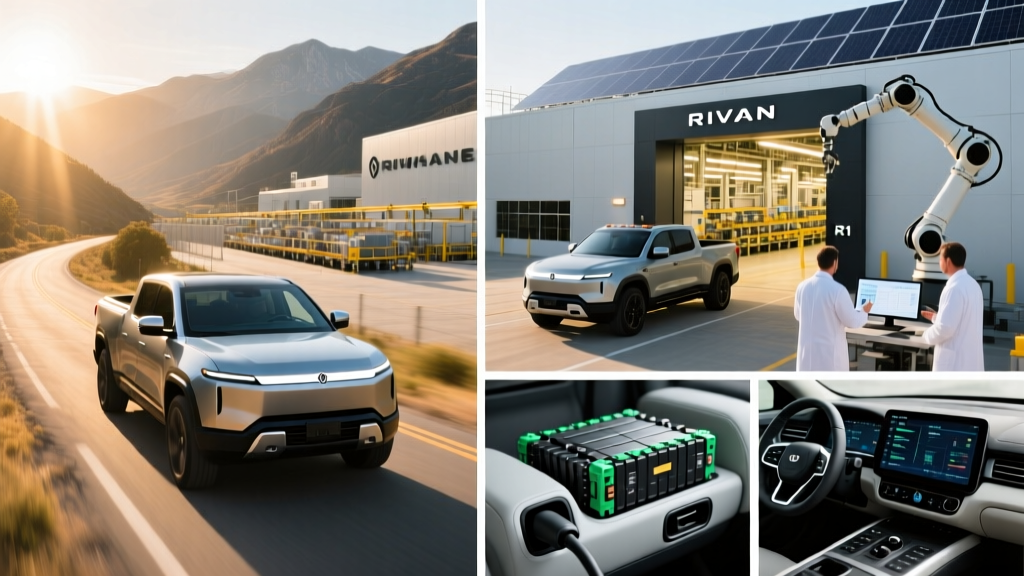
Rivian Automotive, Inc. is an American electric-vehicle manufacturer headquartered in Irvine, California. Founded in 2009 by MIT-educated engineer RJ Scaringe, the company operated under the radar for years before revealing the R1T pickup and R1S SUV at the 2018 Los Angeles Auto Show. Production began in September 2021 at a repurposed Mitsubishi factory in Normal, Illinois — a 3.3-million-square-foot facility that Rivian purchased and extensively retooled.
As of 2026, Rivian remains an independent, publicly traded company (NASDAQ: RIVN). It is not owned by a legacy automaker, though Amazon holds a significant minority stake (roughly 17% as of early 2026) and has been Rivian's anchor fleet customer for its EDV delivery vans. Volkswagen Group invested up to $5.8 billion in Rivian through a joint venture announced in mid-2024, focused on co-developing electrical architecture and software — but VW does not control Rivian or badge its vehicles.
Every Rivian R1T and R1S sold to consumers is built in Normal, Illinois, on what Rivian calls its "skateboard" platform — a structural battery pack integrated into the chassis with independent drive motors at each axle (or each wheel, in quad-motor trims).
| Spec | R1T Dual-Motor AWD (Standard) | R1S Dual-Motor AWD (Standard) | R1T Tri-Motor AWD |
|---|---|---|---|
| EPA Range (Max Pack) | 352 mi | 352 mi | 420 mi |
| Battery (usable, Max Pack) | ~141 kWh, NMC | ~141 kWh, NMC | ~141 kWh, NMC |
| Horsepower | 533 hp | 533 hp | 850 hp |
| 0–60 mph | 4.5 sec | 4.5 sec | 2.9 sec |
| Peak DC Charge | 220 kW | 220 kW | 220 kW |
| 10–80% DC Time | ~30 min | ~30 min | ~30 min |
| Level 2 Home Rate | 11.5 kW (~25 mi/hr) | 11.5 kW (~25 mi/hr) | 11.5 kW (~25 mi/hr) |
| MPGe (combined) | 70 MPGe | 69 MPGe | 65 MPGe |
| Towing Capacity | 11,000 lb | 7,700 lb | 11,000 lb |
| Base MSRP | $69,900 | $74,900 | $99,900 |
2026 R1T and R1S: Real-World Range, Battery, and Efficiency
Rivian offers three battery sizes for 2026: the Standard Pack (~95 kWh usable, NMC lithium-ion), the Large Pack (~112 kWh usable), and the Max Pack (~141 kWh usable). All use nickel-manganese-cobalt (NMC) chemistry supplied primarily by Samsung SDI. Rivian has not adopted LFP (lithium iron phosphate) cells for the R1 platform, likely because LFP's lower energy density would compromise the range and packaging of these heavy, adventure-oriented vehicles.
The R1T Max Pack's 352-mile EPA sticker is achievable in mixed suburban driving at moderate speeds. On a sustained 75-mph highway run, expect 280–310 miles depending on temperature, elevation, and payload. In freezing weather (below 25°F), plan for a 15–25% reduction, bringing real range down to roughly 260–300 miles on the Max Pack. The Standard Pack (EPA 270 mi) realistically delivers 210–240 miles on a highway road trip.
According to EPA data on fueleconomy.gov, the R1T Dual-Motor achieves 70 MPGe combined (48 kWh/100 mi). That's less efficient than a Tesla Model X or Hyundai Ioniq 5, reflecting the R1T's 7,000+ lb curb weight and boxy aerodynamics.
Charging Speed: DC Fast Charging and Home Level 2
Rivian's 2026 R1 vehicles use the NACS (Tesla-style) charge port as standard, a switch the company made beginning with 2025 models. This grants native access to Tesla Superchargers (with V3 stalls delivering up to 150 kW and V4 stalls capable of higher rates) without an adapter — a major practical advantage for road-trippers.
| Charging Level | Connector | Max Power (kW) | Speed / Time |
|---|---|---|---|
| Level 1 (120V) | NACS | 1.4 kW | ~3 mi/hr |
| Level 2 (240V, 48A) | NACS / J1772 (adapter incl.) | 11.5 kW | ~25 mi/hr — full charge in ~12–14 hr |
| DC Fast (NACS Supercharger) | NACS | ~200 kW (sustained peak) | 10–80% in ~30 min (Max Pack) |
| DC Fast (CCS via adapter) | CCS1 (adapter sold separately) | ~220 kW (peak) | 10–80% in ~28 min (Max Pack) |
Charging-curve reality check: Rivian's peak rate of ~220 kW is only sustained between roughly 10% and 35% state of charge on the Max Pack. Above 50%, the curve tapers significantly — by 80% you're pulling under 60 kW. This is normal for a large NMC pack with aggressive thermal management, but it means the advertised 220 kW peak is not representative of an average session. Plan for roughly 30 minutes for a 10–80% fill on a 350-kW Electrify America or Tesla V4 station, and closer to 45 minutes on a 150-kW V3 Supercharger.
For home charging, Rivian's onboard charger maxes at 11.5 kW (48 amps on a 60-amp circuit). A full overnight charge from 20% to 100% on the Max Pack takes about 12–14 hours. Most owners charging daily will only need to replenish 50–100 miles overnight, which takes 2–4 hours — well within a standard workday or sleep cycle.
Performance, Drivetrain, and Capability
The 2026 R1T and R1S are offered in three drivetrain configurations:
- Dual-Motor AWD: One motor per axle, 533 hp, 610 lb-ft torque. 0–60 mph in 4.5 seconds. This is the volume seller and the most efficient variant.
- Performance Dual-Motor: Same hardware, software-unlocked to 665 hp and 829 lb-ft. 0–60 in 3.4 seconds.
- Tri-Motor AWD (R1T only): One front motor, two rear motors, 850 hp, 1,100+ lb-ft. 0–60 in 2.9 seconds — making it one of the quickest production pickups ever built. Includes a dedicated "Sport" drive mode and enhanced torque vectoring.
All R1 vehicles feature an air suspension system with adjustable ride height (up to 14.9 inches of ground clearance in Off-Road mode), a wading mode rated for 3+ feet of water, and Rivian's quad-motor torque-vectoring heritage (now limited to the Tri-Motor's rear axle). The R1T's 11,000-lb towing capacity is best-in-class for electric midsize pickups, though towing at that limit will cut range roughly in half — expect ~170 miles on the Max Pack when pulling a heavy trailer at highway speed.
Pricing, Trims, and Federal Tax Credit Eligibility
Rivian simplified its trim structure for 2026 into three tiers: Adventure (base), Adventure Premium, and Ascend (top luxury). Prices below reflect the base Adventure trim with Standard Pack; upgrading to Large or Max Pack adds $6,000–$10,000 depending on configuration.
| Model / Trim | Base MSRP | As-Tested (Max Pack, Premium) | §30D Credit Eligibility |
|---|---|---|---|
| R1T Dual-Motor Adventure | $69,900 | $89,500 | Up to $7,500 (see caveats) |
| R1S Dual-Motor Adventure | $74,900 | $94,500 | Up to $7,500 (see caveats) |
| R1T Tri-Motor Ascend | $99,900 | $115,000+ | Up to $7,500 (see caveats) |
Does Rivian qualify for the federal EV tax credit? Under current IRS §30D rules, the R1T and R1S are eligible for up to $7,500 in federal tax credits, but several conditions apply:
- MSRP cap: Vans, SUVs, and pickups are capped at $80,000 MSRP. The R1T base Dual-Motor at $69,900 qualifies; the R1S base at $74,900 qualifies. However, many higher-optioned configurations exceed $80,000 and lose eligibility entirely.
- Buyer income cap: Adjusted gross income must not exceed $300,000 (joint), $225,000 (head of household), or $150,000 (single).
- Battery sourcing: A percentage of critical minerals and battery components must be sourced from the U.S. or free-trade-agreement countries. Rivian has worked to localize its supply chain, and most 2026 R1 vehicles are expected to meet the $3,750 critical-minerals requirement, though the $3,750 battery-component requirement is more variable. Verify VIN-specific eligibility on fueleconomy.gov before purchasing.
- Point-of-sale transfer: As of 2024, the credit can be transferred to the dealer at purchase, reducing your out-of-pocket cost immediately rather than waiting for tax filing. Rivian supports this at its direct-to-consumer delivery centers.
Interior, Tech, and Driver Assistance
The R1T and R1S seat five, with 41.5 inches of front legroom and 38.2 inches in the rear. Cargo volume in the R1S is 104.7 cu ft behind the first row (seats folded) and 12.7 cu ft behind the third row. The R1T's 4.5-foot bed offers 54 cu ft of volume, plus the signature 11-cu-ft front trunk ("frunk") and the unique Gear Tunnel — a lockable, pass-through storage compartment behind the rear seats that holds 11.7 cu ft and is available only on the R1T.
The 2026 infotainment system runs on a 15.6-inch center touchscreen with a custom Rivian OS (not Android Automotive). Over-the-air updates are frequent — Rivian has pushed roughly 15 major OTA updates since launch, adding features like improved route planning, enhanced camp mode, and refined regenerative braking profiles. A 7-speaker base audio system is standard; the Ascend trim includes a 20-speaker Meridian system.
Driver assistance is branded Rivian Driver+, which combines adaptive cruise control, lane-centering, and automatic lane changes on divided highways. This is a Level 2 SAE system — the driver must keep hands on the wheel and eyes on the road at all times. It is competent for highway cruising but not a hands-free system like GM's Super Cruise or Ford's BlueCruise. Rivian has not announced a Level 3 or Level 4 autonomy program for consumer vehicles.
Pros
- Class-leading off-road capability with air suspension and 14.9" ground clearance
- Native NACS charge port — full Supercharger network access without adapter
- Gear Tunnel and frunk give R1T unmatched storage versatility
- Tri-Motor variant delivers supercar-rivaling acceleration in a 7,000-lb truck
- Frequent OTA updates continue to add features post-purchase
- Strong build quality and fit-finish improvements since 2023 refresh
Cons
- Efficiency lags competitors — 70 MPGe vs. Tesla Model X's 100+ MPGe
- DC fast-charging curve tapers aggressively above 50% SoC
- Driver+ is adequate but behind Super Cruise and BlueCruise in hands-free capability
- Service center network still limited outside major metros
- No third-row delete option on R1S — forces three-row packaging
- Towing cuts range dramatically (~50% at max load)
Warranty and Long-Term Ownership
Rivian provides a 5-year/60,000-mile limited vehicle warranty and an 8-year/175,000-mile battery and drive-unit warranty. The battery warranty guarantees that the pack will retain at least 70% of its original capacity during the coverage period — a fairly standard threshold in the EV industry, though Rivian's 175,000-mile limit is more generous than some competitors (Tesla uses 120,000–150,000 miles depending on model).
Rivian offers a mobile service fleet for minor repairs and software diagnostics, plus a growing network of dedicated service centers. As of early 2026, there are approximately 50 Rivian Service Centers and 130+ mobile service vans operating across the U.S. — adequate for coastal and major-metro owners but still sparse in rural and Mountain West regions. Rivian also partners with third-party collision repair networks for bodywork.
Long-term battery degradation data from early 2022 delivery owners (now at 50,000–80,000 miles) suggests approximately 5–8% capacity loss, which is within expected NMC parameters. Rivian's thermal management system — which includes a heat pump and liquid cooling/heating loops — appears to be holding up well in both hot-climate (Arizona) and cold-climate (Minnesota) owner reports.
Who Should Buy a Rivian — and Who Shouldn't
- You need a midsize pickup with genuine off-road capability and 11,000-lb towing
- You want native Tesla Supercharger access for road trips without adapter hassle
- Storage versatility (Gear Tunnel, frunk, bed) matters more than maximum efficiency
- You have home Level 2 charging and can absorb ~48 kWh/100 mi energy costs
- You need three-row seating for up to seven (2026 R1S added a small third row)
- You want a family adventure SUV with similar off-road chops to the R1T
- Maximum highway range and efficiency are your top priorities (consider Tesla Model X, Hyundai Ioniq 5, or Chevy Silverado EV for more range-per-kWh)
- You need a hands-free highway driving system (GM Super Cruise or Ford BlueCruise)
- You live far from a Rivian service center and can't tolerate mobile-service-only coverage
- Your budget tops out at $55,000 — Rivian does not currently offer a sub-$60K vehicle
Frequently Asked Questions
Is Rivian made by Ford or Amazon?
No. Rivian is an independent, publicly traded company (NASDAQ: RIVN). Amazon holds a ~17% equity stake and has purchased tens of thousands of Rivian EDV delivery vans for its logistics fleet. Ford invested $500 million in Rivian in 2019 but fully divested by 2023. Rivian designs, engineers, and manufactures its vehicles independently.
What is the real-world range of a Rivian R1T?
The EPA rates the R1T Max Pack at 352 miles. In real-world highway driving at 70–75 mph, expect 280–310 miles. In sub-freezing temperatures, plan for 260–300 miles. The Standard Pack (EPA 270 mi) delivers roughly 210–240 real-world highway miles.
How fast does a Rivian charge at home and on the road?
At home on a 240V Level 2 charger, the R1T/R1S charges at up to 11.5 kW, adding about 25 miles of range per hour. On a DC fast charger, the peak rate is ~220 kW, with a 10–80% session taking approximately 30 minutes on the Max Pack. The charge curve tapers significantly above 50% SoC.
Does the Rivian R1T qualify for the $7,500 federal tax credit?
It can, but eligibility depends on your specific configuration and income. The base R1T Dual-Motor at $69,900 is under the $80,000 MSRP cap for trucks. Your household AGI must be under $300,000 (joint) or $150,000 (single). Battery sourcing requirements also apply — verify your VIN on fueleconomy.gov before finalizing a purchase. The credit can be applied as a point-of-sale discount.
Is Rivian a reliable brand?
Rivian's early 2022 models had notable build-quality issues (panel gaps, software bugs, suspension noises). The company implemented significant production-line improvements in 2023–2024, and owner satisfaction surveys (Consumer Reports, J.D. Power) have trended upward. As with any low-volume startup, service access remains a concern in less-populated areas. The 8-year/175,000-mile battery warranty provides meaningful long-term protection.
How does Rivian compare to Tesla, Ford, and Chevy in the EV truck/SUV space?
The R1T competes with the Ford F-150 Lightning, Chevy Silverado EV, and Tesla Cybertruck. The R1T offers the most off-road capability and storage versatility; the F-150 Lightning is more affordable and has a broader service network; the Silverado EV offers up to 450 miles of range (Max Pack); and the Cybertruck undercuts on price but has polarizing styling and limited availability. The R1S has fewer direct electric three-row SUV rivals — the Kia EV9 is cheaper but less capable off-road, while the Tesla Model X is more efficient but aging.