Who Makes Rivian Cars — And Where Are They Built?
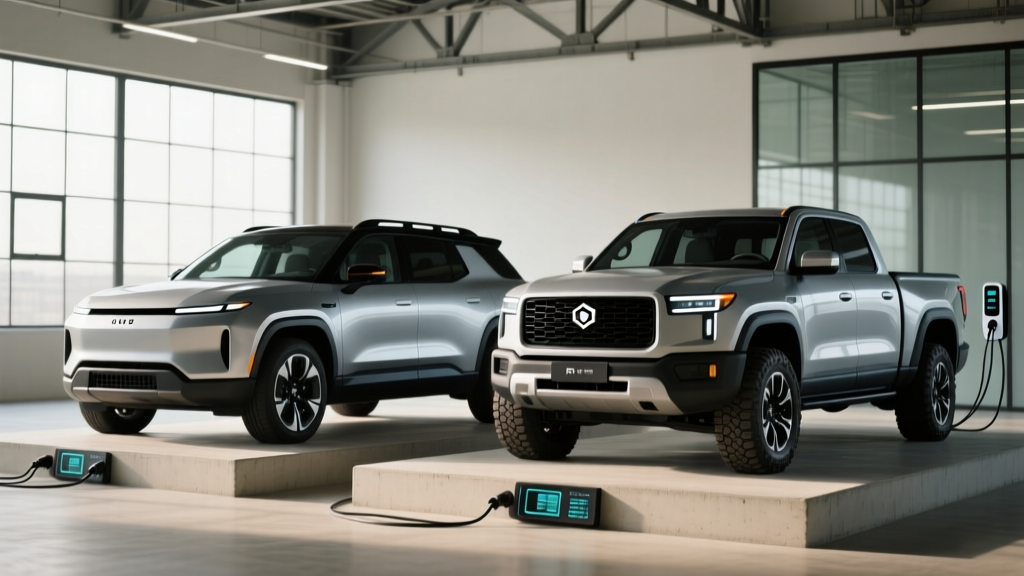
Rivian Automotive designs, engineers, and manufactures its vehicles entirely in-house at a converted Mitsubishi plant in Normal, Illinois. The company went public in November 2021 and has since scaled production of its two flagship consumer vehicles: the R1S three-row SUV and the R1T pickup truck. Unlike several EV startups that outsource assembly or rely on contract manufacturers, Rivian controls its own supply chain, battery pack assembly, and software stack — a distinction that matters for long-term serviceability and over-the-air update cadence.
For 2026, Rivian offers both vehicles on its updated Gen 2 platform, which introduced a more efficient drive unit, a standard NACS (Tesla-style) charge port, and revised battery chemistries. The company also supplies EDV (Electric Delivery Van) bodies to Amazon, but that commercial line is separate from the consumer R1S and R1T reviewed here.
2026 Rivian R1S & R1T: Core Specifications at a Glance
| Spec | R1S Dual-Motor (Standard) | R1T Dual-Motor Max Pack |
|---|---|---|
| EPA Range | 352 mi (R1S) / 352 mi (R1T) | 420 mi (R1S) / 420 mi (R1T) |
| Battery (usable) | 106 kWh, NMC | 149 kWh, NMC |
| Drivetrain | Dual-Motor AWD | Dual-Motor AWD |
| Horsepower | 533 hp | 533 hp |
| 0–60 mph | 4.5 sec | 4.9 sec |
| Max DC Fast Charge | 220 kW | 220 kW |
| 10–80% DC Time | ~21 min | ~42 min |
| Level 2 Home Charge | 11.5 kW (~25 mi/hr) | 11.5 kW (~30 mi/hr) |
| Efficiency (MPGe) | 73 MPGe combined | 70 MPGe combined |
| Towing Capacity | 7,700 lb | 7,700 lb |
| Base MSRP | $75,900 (R1S) / $69,900 (R1T) | $89,900 (R1S) / $84,900 (R1T) |
Sources: fueleconomy.gov, Rivian official specs.
Real-World Range: What the EPA Sticker Doesn't Tell You
EPA estimate: 352 miles.
Real-world highway (70 mph, mild weather): ~285–305 miles.
Cold weather (below 32°F, mixed driving): ~230–260 miles.
Max Pack highway: ~340–360 miles real-world, thanks to the larger 149 kWh buffer.
Rivian's boxy SUV and truck shapes create a frontal area that penalizes highway efficiency more than sleeker crossovers like the Tesla Model X or Hyundai Ioniq 9. In our experience, sustained 75–80 mph Interstate driving drops the R1S Standard Pack to roughly 290 miles of usable range before you'd want to stop. The Max Pack largely solves this, offering a genuine 340+ mile real-world highway envelope — enough for most road-trip legs without anxiety.
Cold weather compounds the aerodynamic penalty. Lithium-ion NMC cells lose efficiency below freezing, and while Rivian's heat pump and battery preconditioning mitigate this, expect a 20–30% range reduction in sustained sub-freezing conditions. If you live in the upper Midwest or Northeast and commute more than 80 miles round-trip, the Max Pack is the pragmatic choice.
Charging Speed: DC Fast, Home Level 2, and the NACS Advantage
| Charging Level | Power (kW) | Miles Added per Hour | Notes |
|---|---|---|---|
| Level 1 (120V household) | 1.4 kW | ~3 mi/hr | Emergency/trickle only |
| Level 2 (240V home) | 11.5 kW | 25–30 mi/hr | Full charge in 10–14 hrs |
| DC Fast (peak) | 220 kW | ~140 mi in 15 min | Standard & Max Pack |
| DC Fast (10–80%) | — | ~21 min (Std) / ~42 min (Max) | Curve tapers hard above 80% |
For 2026, Rivian ships all R1 vehicles with a native NACS charge port, granting access to Tesla's Supercharger network without an adapter. This is a significant practical advantage over CCS-only vehicles, as the Supercharger network remains the most reliable DC fast-charging infrastructure in North America. Rivian owners can also use Electrify America and EVgo stations with the included NACS-to-CCS adapter.
The 220 kW peak DC rate is competitive but not class-leading — the Hyundai Ioniq 5 and Kia EV9 hit 350 kW on 800V architectures. However, Rivian's charge curve is relatively flat through the mid-SoC range, meaning real-world 10–80% times hold close to the stated 21 minutes for the Standard Pack. The Max Pack's larger battery naturally takes longer (~42 minutes), which is the tradeoff for 420 miles of EPA range.
At home, the 11.5 kW onboard charger adds roughly 25–30 miles of range per hour. A full overnight charge from 20% to 100% takes about 10 hours — easily achievable with a Level 2 home charger on a 60-amp circuit. Rivian sells its own Wall Connector-compatible unit, but any J1772/NACS Level 2 EVSE will work.
Performance, Efficiency, and Driving Dynamics
The Dual-Motor AWD powertrain produces 533 hp and 610 lb-ft of torque across both the R1S and R1T. The lighter R1S Standard Pack hits 60 mph in 4.5 seconds; the heavier Max Pack and R1T variants clock in around 4.9 seconds. For context, that's quicker than a BMW X5 M50i and in the territory of a Porsche Cayenne S — with zero tailpipe emissions and a fraction of the fuel cost.
Efficiency is measured at 73 MPGe combined (R1S Standard) and 70 MPGe (Max Pack), translating to roughly 46–48 kWh per 100 miles. That's thirstier than a Tesla Model X (102 MPGe) but expected given the Rivian's truck-based architecture, taller ride height, and off-road-oriented tires.
On the road, Rivian's air suspension delivers a compliant ride with adjustable ground clearance from 7.9 inches (street mode) to 14.9 inches (off-road). The R1T's unique gear tunnel — a lockable, pass-through storage compartment behind the rear seats — adds 11 cubic feet of secure cargo space that no conventional pickup offers. The R1S provides 104.7 cu ft of total cargo volume with both rear rows folded, competitive with the Kia EV9 and slightly behind the Tesla Model X.
Pricing, Trims, and Federal Tax Credit Eligibility
| Trim / Config | Base MSRP | Est. Price After §30D Credit* |
|---|---|---|
| R1T Dual-Motor Standard | $69,900 | $62,400 |
| R1S Dual-Motor Standard | $75,900 | $68,400 |
| R1T Dual-Motor Max Pack | $84,900 | $77,400 |
| R1S Dual-Motor Max Pack | $89,900 | $82,400 |
| R1S Tri-Motor (Ascend) | $99,900 | $92,400 |
*Federal credit estimates assume full $7,500 eligibility under IRS §30D. Actual credit depends on buyer income, battery sourcing, and MSRP caps. Consult a tax professional and verify at irs.gov.
- MSRP Cap: Vans/pickups/SUVs capped at $80,000 MSRP — some R1T trims qualify; R1S trims above $80K do not qualify.
- Income Cap: $300K joint / $225K head of household / $150K single MAGI.
- Battery Sourcing: Critical minerals and battery components must meet escalating domestic-content thresholds per the Inflation Reduction Act.
- Point-of-Sale Transfer: Eligible buyers can apply the credit as a down-payment reduction at purchase rather than waiting for a tax refund.
The MSRP cap is the biggest gotcha for Rivian shoppers. The R1S, classified as an SUV, is subject to the $80,000 cap — meaning the Standard Pack at $75,900 qualifies, but the Max Pack at $89,900 does not. The R1T, classified as a pickup, shares the same $80,000 cap. Always verify the exact MSRP of your configured build against the current IRS threshold before assuming credit eligibility.
Warranty, Reliability, and Ownership Costs
Rivian backs both the R1S and R1T with:
- Battery & Drive Unit: 8 years / 175,000 miles (whichever comes first), with a capacity retention threshold of 70%.
- Limited Vehicle Warranty: 5 years / 60,000 miles bumper-to-bumper.
- Corrosion Perforation: 8 years / unlimited miles.
The 175,000-mile battery warranty is among the most generous in the industry, exceeding Tesla's 120,000-mile threshold and matching or beating legacy automakers. Rivian's 70% capacity retention guarantee is standard for the segment — it means if your battery degrades below 70% of original capacity within the warranty window, Rivian will repair or replace it.
Insurance costs run higher than average for the segment. Expect annual premiums of $2,800–$3,600 depending on your state, driving record, and trim. This reflects the R1's high repair costs (aluminum body panels, proprietary drive units) and strong performance figures.
Standout Tech and Notable Drawbacks
✅ Pros
- Class-leading off-road capability with air suspension and 14.9" ground clearance
- Native NACS port — full Supercharger access without adapter
- 175,000-mile battery warranty
- Unique gear tunnel (R1T) and front trunk (frunk) storage
- Over-the-air updates continuously add features
- 7,700-lb towing capacity with integrated trailer brake controller
❌ Cons
- Highway efficiency trails sleeker competitors (~46 kWh/100 mi)
- 220 kW peak DC charge rate is mid-pack (Ioniq 5 does 350 kW)
- Rear-seat legroom is tight for a three-row SUV (32.5" third row)
- No Apple CarPlay or Android Auto — Rivian's native OS only
- Service center network still limited outside major metros
- MSRP cap disqualifies Max Pack trims from §30D credit
Rivian's in-house infotainment system is clean and responsive on the 15.6-inch center display, but the absence of Apple CarPlay and Android Auto remains a pain point for buyers accustomed to phone projection. The Rivian Driver+ system provides Level 2 adaptive cruise and lane-centering on highways — competent but not class-leading compared to GM's Super Cruise or Ford's BlueCruise in hands-free zones. Per IIHS, the R1S has earned top crash-test ratings, but the vehicle has not yet been evaluated by NHTSA as of early 2026.
Who Should Buy a Rivian — And Who Should Look Elsewhere?
🎯 Decision Framework
Choose the Rivian R1S if: You need three rows, genuine off-road capability, and a premium adventure-oriented SUV. The Standard Pack at ~$68K after tax credit is a strong value for families who camp, ski, or tow.
Choose the Rivian R1T if: You want a daily-drivable pickup with lockable storage, 7,700-lb towing, and don't need a full-size bed. It's the best lifestyle truck on the market — not a work-site hauler.
Look at the Tesla Model X if: Efficiency, Supercharger ubiquity, and third-row space are top priorities — and you don't need off-road chops.
Look at the Kia EV9 if: Budget is a primary concern (starts at ~$55K), you want three rows, and you can accept lower ground clearance and no frunk.
Frequently Asked Questions
Who makes Rivian cars?
Rivian Automotive, Inc., headquartered in Irvine, California, designs and manufactures all Rivian vehicles at its production facility in Normal, Illinois. The company was founded in 2009 by RJ Scaringe and has been publicly traded on NASDAQ (ticker: RIVN) since November 2021.
What is the real-world range of the Rivian R1S and R1T?
The EPA rates the Standard Pack at 352 miles and the Max Pack at 420 miles. Real-world highway driving at 70+ mph yields approximately 285–305 miles (Standard) and 340–360 miles (Max). Cold weather below freezing reduces range by 20–30%.
How fast does a Rivian charge at home and on the road?
At home on a 240V Level 2 charger (11.5 kW), a Rivian adds 25–30 miles of range per hour, fully recharging overnight in 10–14 hours. On DC fast chargers, it peaks at 220 kW, reaching 10–80% in ~21 minutes (Standard Pack) or ~42 minutes (Max Pack). The native NACS port provides direct access to Tesla Superchargers.
Does the Rivian R1S or R1T qualify for the federal EV tax credit?
Eligibility depends on the exact MSRP of your configured vehicle, your income, and battery-sourcing compliance. The R1S and R1T Standard Pack trims (under $80,000 MSRP) can qualify for up to $7,500 under IRS §30D if income and sourcing thresholds are met. Max Pack and Tri-Motor trims exceed the $80,000 MSRP cap and are ineligible. Verify current rules at irs.gov.
Is the Rivian worth buying over a Tesla Model X or Kia EV9?
If off-road capability, build quality, and adventure features (gear tunnel, air suspension, camp kitchen option) matter to you, the Rivian is unmatched in its segment. If you prioritize maximum efficiency, the lowest price, or hands-free highway driving, the Tesla Model X or Kia EV9 may be better fits. Cross-shop all three and test-drive before committing.
What is Rivian's battery warranty?
Rivian covers the battery pack and drive unit for 8 years or 175,000 miles, whichever comes first, guaranteeing at least 70% capacity retention. The bumper-to-bumper limited warranty covers 5 years or 60,000 miles.