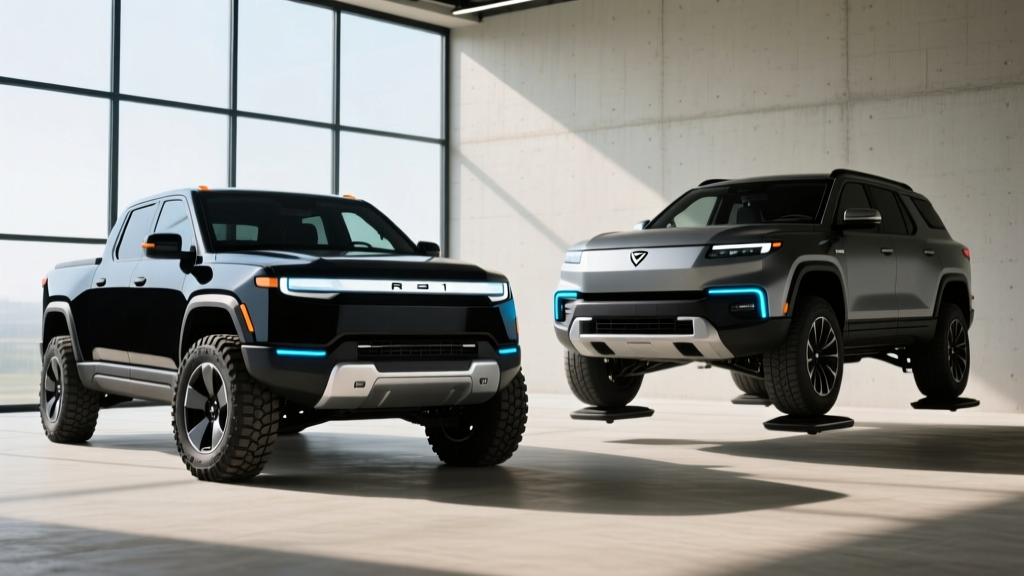
If you've been browsing EV forums or scrolling through adventure-truck content, you've probably asked: who makes a Rivian car, and is the company actually legit? Rivian Automotive, Inc. is an American EV manufacturer founded in 2009 by MIT graduate RJ Scaringe, headquartered in Irvine, California. Unlike legacy automakers retrofitting gas platforms, Rivian built its "skateboard" architecture from scratch, manufacturing its R1T pickup and R1S SUV at a converted Mitsubishi plant in Normal, Illinois — a facility now producing over 100,000 vehicles annually.
But understanding who makes a Rivian is only half the equation. What matters to buyers is whether the 2026 R1T and R1S deliver on their premium price tags. Below, we break down every spec that matters: real-world range, charging curves, battery chemistry, tax credit eligibility, and how Rivian stacks up against the Tesla Cybertruck, Ford F-150 Lightning, and Hyundai Ioniq 5 N.
Rivian at a Glance: Company & Manufacturing Facts
Rivian went public via IPO in November 2021 and has since scaled production significantly. In 2024, the company opened its second generation platform (Gen 2), which introduced a new dual-motor base variant, improved battery chemistry, and the in-house-designed Enduro drive unit. The Normal, Illinois factory remains the sole production site for all Rivian consumer vehicles, though a second plant in Stanton, Georgia (announced for future R2 production) is under construction.
- Founded: 2009 (originally Mainstream Motors, rebranded Rivian in 2011)
- Founder/CEO: RJ Scaringe
- HQ: Irvine, California
- Manufacturing: Normal, Illinois (1 million+ sq ft facility)
- Current consumer models: R1T (pickup), R1S (3-row SUV)
- Commercial fleet: EDV (Electric Delivery Van) for Amazon
- Key investor: Amazon (holds significant equity stake)
2026 Rivian R1T & R1S: Core Specs & Pricing
| Spec | R1T Dual-Motor (Standard Battery) | R1S Dual-Motor (Standard Battery) |
|---|---|---|
| EPA Range | 270 miles | 260 miles |
| Battery Capacity | 93 kWh usable (NMC) | 93 kWh usable (NMC) |
| Drivetrain | AWD (Dual-Motor) | AWD (Dual-Motor) |
| Horsepower | 533 hp | 533 hp |
| 0–60 mph | 4.5 seconds | 4.6 seconds |
| Max DC Fast Charge | 220 kW (peak) | 220 kW (peak) |
| 10–80% DC Charge | ~27 minutes | ~27 minutes |
| Level 2 Home Charge | 11.5 kW (~25 mi/hr) | 11.5 kW (~25 mi/hr) |
| MPGe (Combined) | 73 MPGe | 70 MPGe |
| Cargo Volume | 54 cu ft bed + 11 cu ft frunk | 105 cu ft (max, seats folded) |
| Towing Capacity | 7,700 lbs | 7,700 lbs |
| Base MSRP | $69,900 | $74,900 |
| Battery Warranty | 8 yr / 175,000 mi | 8 yr / 175,000 mi |
Rivian also offers a Max Battery variant (141 kWh usable, NMC) pushing EPA range to 410 miles (R1T) and 390 miles (R1S), as well as a Tri-Motor performance tier producing 850 hp and a 3.0-second 0–60. Those trims start at $89,900 and $99,900 respectively.
Real-World Range: What the EPA Sticker Doesn't Tell You
Rivian's NMC (nickel manganese cobalt) chemistry delivers strong energy density — essential for a heavy, boxy truck — but it is more temperature-sensitive than LFP (lithium iron phosphate). Owners in northern climates should plan for 20–30% range loss in deep winter. The R1T's heat pump (standard on Gen 2 models) helps, but physics wins: a 5,000-lb truck pushing air at 75 mph consumes energy fast. For road trips exceeding 250 miles, the Max Battery or strategic DC fast-charging stops are necessary.
According to fueleconomy.gov, the R1T Dual-Motor achieves 73 MPGe combined (2.0 kWh/mile). That efficiency figure is competitive with the F-150 Lightning Extended Range (70 MPGe) but trails the more aerodynamic Tesla Cybertruck AWD (82 MPGe).
Charging Speed: DC Fast, Level 2, and the Curve Reality
Rivian's Gen 2 platform supports a peak DC fast-charge rate of 220 kW on the Standard Battery and up to 300+ kW on the Max Battery variant via NACS (North American Charging Standard). Starting with 2024 production, Rivian transitioned from CCS1 to the Tesla-compatible NACS port, granting access to over 20,000 Superchargers via an included adapter for older models.
| Charge Level | Power / Rate | Miles Added | Notes |
|---|---|---|---|
| Level 1 (120V) | 1.4 kW | ~3 mi/hr | Emergency/trickle only |
| Level 2 (240V, 48A) | 11.5 kW | ~25 mi/hr | Full charge in ~9 hours (Standard) |
| DC Fast (Peak) | 220 kW (Std) / 300+ kW (Max) | ~140 mi in 15 min (Std) | 10–80% in ~27 min (Std), ~20 min (Max) |
Charging curve reality: The 220 kW peak on the Standard Battery is sustained only between roughly 10% and 35% State of Charge (SoC). Beyond 50%, the rate tapers to ~150 kW, and above 80% it drops sharply to ~50 kW to protect battery longevity. This means a 10–80% session takes ~27 minutes, but 80–100% adds another 30+ minutes. For road trips, the practical strategy is to charge to 80% and drive on — a pattern common to all NMC-based EVs.
At home, a Level 2 Wall Connector or Rivian Wall Charger (48 amps, hardwired, 240V) replenishes the Standard Battery overnight in roughly 9 hours. Installation typically requires a 60-amp dedicated circuit. Expect $800–$1,500 in total installed cost depending on panel proximity, per U.S. Department of Energy estimates. If your home has a 100-amp main panel, a $1,500–$3,000 panel upgrade to 200 amps may be necessary — factor this into your purchase budget.
Performance, Tech & What It's Like to Drive
The dual-motor R1T produces 533 hp and 610 lb-ft of torque, routed through Rivian's in-house Enduro drive units. The result is a 4.5-second 0–60 mph time — remarkable for a 7,000-lb truck. The tri-motor variant (available on Max Battery) pushes 850 hp and a 3.0-second sprint, putting it in supercar territory.
Rivian's air suspension is standard and offers 6.5 inches of adjustable ride height — from a low "Park" mode for easy loading to a 14.9-inch ground clearance in "Off-Road" mode. The quad-motor variant (discontinued after 2024 in favor of tri-motor) previously offered tank turns; the current tri-motor retains a tight turning circle and excellent trail capability.
Infotainment & Software: Rivian runs a proprietary 15.6-inch landscape touchscreen with built-in navigation, streaming, and over-the-air (OTA) updates. There is no Apple CarPlay or Android Auto — a deliberate choice that frustrates some buyers. Instead, Rivian's native system integrates phone-as-key, trip planning with charger routing, and a built-in camp kitchen option (slide-out electric cooktop in the R1T gear tunnel).
Driver Assistance: Rivian's Driver+ system offers highway lane-centering, adaptive cruise, and automatic lane changes on mapped divided highways. This is an SAE Level 2 system — meaning the driver must remain fully engaged with hands on or near the wheel and eyes on the road at all times. It is not autonomous driving. It competes with Ford BlueCruise and GM Super Cruise in capability, though reviewers generally rate Super Cruise as slightly smoother in lane-centering.
Pricing, Trims & Federal Tax Credit Eligibility
| Trim | MSRP | Battery | EPA Range |
|---|---|---|---|
| Dual-Motor Standard | $69,900 | 93 kWh NMC | 270 mi |
| Dual-Motor Max | $84,900 | 141 kWh NMC | 410 mi |
| Tri-Motor Max | $99,900 | 141 kWh NMC | 380 mi |
R1S pricing runs approximately $5,000 higher across equivalent trims due to the enclosed SUV body and third-row seating.
Does the Rivian R1T or R1S Qualify for the Federal EV Tax Credit?
Under current IRS §30D rules, the Rivian R1T Dual-Motor Standard (MSRP $69,900) falls under the $80,000 MSRP cap for pickup trucks and is potentially eligible for up to $7,500 in federal tax credits — but only if the buyer meets all requirements:
- ✔ MSRP cap: Vehicle base MSRP must be ≤ $80,000 for trucks/SUVs (R1T Standard qualifies; R1T Max and all Tri-Motor do NOT)
- ✔ Buyer income cap: Modified AGI ≤ $150,000 (single) / $300,000 (married filing jointly)
- ⚠ Battery sourcing: Critical minerals and battery components must meet escalating domestic/free-trade sourcing thresholds — verify current-year compliance on IRS.gov before purchase
- ✔ Point-of-sale transfer: Buyers may elect to transfer the credit to the dealer at purchase, reducing the out-of-pocket price immediately (available since Jan 2024)
- ✔ Final assembly: Must occur in North America (Rivian's Normal, IL plant qualifies)
If the R1T Dual-Motor Standard qualifies for the full $7,500, the effective price drops to approximately $62,400 — competitive with a well-equipped Ford F-150 Lightning Lariat and significantly undercutting the Tesla Cybertruck AWD ($79,990 before credit).
Rivian vs. Key Competitors: Which Truck Wins?
| Spec | Rivian R1T DM Std | F-150 Lightning Ext. Range | Tesla Cybertruck AWD |
|---|---|---|---|
| EPA Range | 270 mi | 320 mi | 340 mi |
| Starting MSRP | $69,900 | $67,995 | $79,990 |
| 0–60 mph | 4.5 sec | 4.5 sec | 4.1 sec |
| Towing | 7,700 lbs | 7,700 lbs | 7,500 lbs |
| Peak DC Charge | 220 kW | 150 kW | 250 kW |
| Battery Warranty | 8 yr / 175k mi | 8 yr / 100k mi | 8 yr / 120k mi |
| NACS Native | Yes (Gen 2) | Adapter required | Yes |
| Off-Road Focus | High (air susp.) | Moderate | Moderate |
- Best-in-class off-road capability with air suspension
- Unique gear tunnel + camp kitchen option
- 175,000-mile battery warranty (industry-leading)
- Premium interior materials, genuine adventure design
- Strong OTA update cadence
- Lower range than F-150 Lightning or Cybertruck
- No Apple CarPlay / Android Auto
- Service center network still expanding
- Premium pricing; Max Battery trims exceed credit cap
- 2nd-row legroom tighter than F-150 (36.5" vs 43.6")
Who Should Buy a Rivian — And Who Shouldn't?
- You want a genuine off-road-capable electric truck with premium build quality
- You value unique adventure features (gear tunnel, camp kitchen, air suspension)
- You need NACS-native Supercharger access for road trips
- Your daily commute is under 200 miles and you can charge at home
- You want the longest battery warranty in the segment (8 yr / 175,000 mi)
- Maximum range is your top priority (F-150 Lightning Ext. Range: 320 mi at lower cost)
- You need maximum rear-seat space for tall passengers regularly
- You rely on Apple CarPlay for navigation and media
- You live in a region with no Rivian service center within 100 miles
The R1S is the clear pick for families needing three rows of seating and enclosed cargo space, while the R1T is ideal for active-lifestyle buyers who tow boats, haul gear, or hit trails. Neither is the budget option in its segment — Rivian positions itself as the "Patagonia of EVs," and the pricing reflects that premium.
Frequently Asked Questions
Who actually makes Rivian vehicles?
Rivian Automotive, Inc. manufactures all its vehicles at its own factory in Normal, Illinois. The company is publicly traded (NASDAQ: RIVN) and was founded by RJ Scaringe in 2009. Amazon is a major investor and also contracts Rivian to build its commercial delivery vans.
What is the real-world range of the Rivian R1T?
The EPA rates the R1T Dual-Motor Standard at 270 miles. Real-world highway driving at 70+ mph yields approximately 235–250 miles in moderate weather and 190–210 miles in cold conditions (below 30°F). The Max Battery variant extends real-world highway range to roughly 350 miles.
How fast does the Rivian R1T charge at home and on the road?
At home on a Level 2 (240V, 48A) charger, the R1T adds ~25 miles of range per hour, fully charging in about 9 hours. On a DC fast charger, it peaks at 220 kW and charges from 10–80% in approximately 27 minutes. The Max Battery variant peaks higher (~300+ kW) and charges 10–80% in ~20 minutes.
Does the Rivian R1T qualify for the $7,500 federal tax credit?
The R1T Dual-Motor Standard ($69,900 MSRP) is under the $80,000 truck cap and may qualify for up to $7,500, depending on buyer income (≤$150k single / ≤$300k joint), battery sourcing compliance, and North American assembly. The Max Battery and Tri-Motor trims exceed the MSRP cap and do not qualify. Always verify current-year rules at IRS.gov.
Is Rivian reliable compared to Ford or Tesla?
Rivian's Gen 2 vehicles (2024+) have shown improved build quality over early 2022–2023 models, which had panel-gap and software complaints. The 8-year/175,000-mile battery warranty is the strongest in the segment. However, Rivian's service center network is still growing — buyers in rural areas should verify proximity to authorized service before purchasing.
Does Rivian have Apple CarPlay?
No. Rivian uses a proprietary infotainment system with no Apple CarPlay or Android Auto support. The native system includes built-in navigation, streaming apps, and OTA updates, but phone mirroring is not available.